Table of Contents
Overview
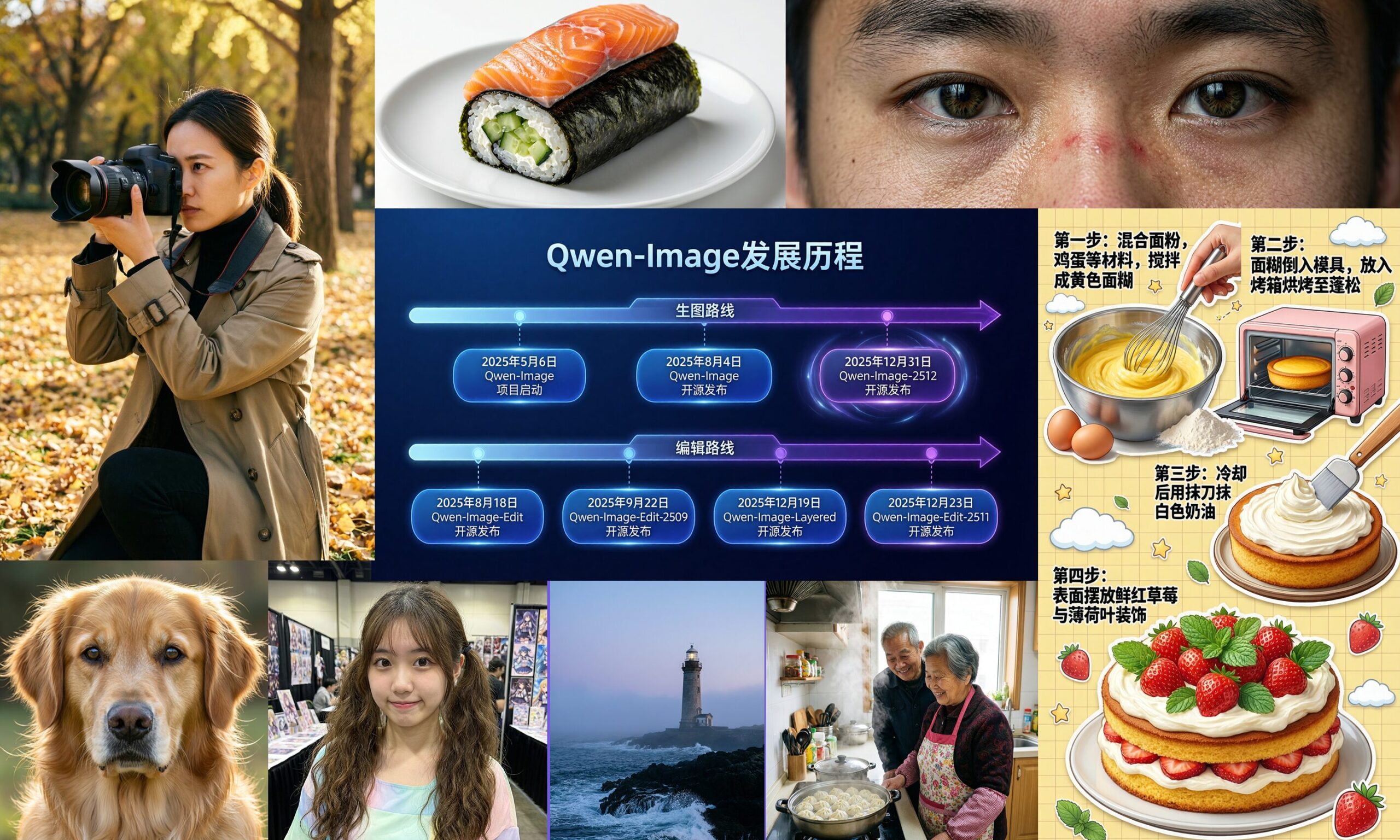
The open-source text-to-image AI landscape reached a new milestone on December 31, 2025, when Alibaba’s Qwen team released Qwen-Image-2512, the December update to their Qwen-Image foundation model. This 20-billion-parameter model built on Multi-Modal Diffusion Transformer (MMDiT) architecture addresses three persistent challenges plaguing AI image generation—rendering legible text within images, creating photorealistic human faces without distinctive artificial appearance, and producing fine natural textures in landscapes and materials. Through over 10,000 blind comparison evaluations on Alibaba’s AI Arena platform, Qwen-Image-2512 achieved fourth place overall and first rank among open-source models, competing effectively against proprietary systems while remaining freely accessible under Apache 2.0 licensing. The model integrates three key components working in tandem: a Multimodal Large Language Model (MLLM) for prompt understanding, a Variational AutoEncoder (VAE) for latent space encoding, and the MMDiT itself for image synthesis, enabling comprehensive prompt interpretation translating detailed descriptions into high-fidelity imagery.
Key Features
- Enhanced Human Realism: Dramatically reduces the distinctive “AI-generated” look in human subjects through improved facial detail rendering, age-appropriate features including wrinkles and expression lines, natural skin textures replacing plastic-smooth artificial appearance, realistic hair direction and density, and subtle micro-expressions capturing emotional nuance. The model accurately renders age cues elderly subjects’ facial features previous versions struggled to capture authentically.
- Finer Natural Detail and Texture Fidelity: Delivers significantly more detailed rendering of landscapes, water surfaces, animal fur, and material textures with fine granularity. Examples include flowing water with depth and motion, moss and vegetation with intricate detail, clear differentiation between soft and coarse surfaces like golden retriever fur versus wild sheep coats, and rugged natural textures that previously appeared washed out or overly stylized in earlier versions.
- Superior Text Rendering Accuracy: Achieves state-of-the-art performance on text rendering benchmarks including LongText-Bench, ChineseWord, and TextCraft, outperforming existing models by significant margins. Generates legible, accurate text within images including multi-line layouts, paragraph-level content, handwritten styles, calligraphy, and standard typography while preserving typographic details, layout coherence, and contextual harmony with surrounding visual elements. Supports complex multilingual text rendering especially strong with both alphabetic languages like English and logographic scripts like Chinese within single images.
- Bilingual and Multilingual Excellence: Unlike many models struggling with non-English text, Qwen-Image-2512 excels at rendering both alphabetic and logographic scripts with high fidelity, seamlessly switching between languages within the same image—critical capability for international marketing and global content creation requiring text in multiple languages.
- Enhanced Prompt Understanding: Interprets complex, detailed prompts with better comprehension of subject relationships, spatial arrangements, and stylistic nuances through bidirectional attention mechanisms processing text and image tokens. Users can describe intricate scenes with multiple elements, specific compositions, and detailed styling requirements which the model faithfully translates into imagery. The model weights prompt information based on position and specificity, prioritizing front-loaded subjects.
- Flexible Output Sizing and Aspect Ratios: Supports custom width and height configurations including standard square (1024×1024 default), landscape ratios (landscape_4_3 at 1232×928, landscape_16_9 at 1664×928), portrait ratios (portrait_4_3 at 1104×1472, portrait_16_9 at 928×1664), and native resolution (1328×1328) for maximum detail though increasing generation time approximately 50% compared to base resolution.
- Style Versatility Across Artistic Ranges: Adapts fluidly across creative styles from photorealistic scenes to impressionist paintings, anime aesthetics to minimalist design, editorial photography to concept art, producing consistent quality across wide artistic range without sacrificing output fidelity.
- Open-Source Apache 2.0 Licensing: Freely available for developers and creators to use, modify, and build upon without restrictive licensing fees. Model weights available on Hugging Face with community-optimized variants including GGUF quantizations, Lightning versions for faster inference, and low-VRAM workflows enabling consumer GPU deployment.
How It Works
Qwen-Image-2512 operates through sophisticated multi-stage architecture integrating language understanding with visual synthesis. The process begins when users provide textual prompts describing desired images through natural language. These prompts feed into the Multimodal Large Language Model (MLLM) component which analyzes linguistic input understanding concepts, relationships, styles, spatial arrangements, and contextual requirements through transformer-based attention mechanisms.
The MLLM processes prompt information bidirectionally, meaning it weighs different prompt elements based on position and specificity rather than simple sequential reading. Front-loaded subjects receive priority attention during generation, making prompt structure critical for controlling output quality. The model understands complex multi-element scenes, interprets style directives, and maintains coherence across detailed specifications.
Processed prompt embeddings then interact with the Multi-Modal Diffusion Transformer (MMDiT) core which handles the actual image synthesis. Unlike traditional single-stream diffusion models, the MMDiT processes text and image tokens through bidirectional attention allowing rich interaction between linguistic concepts and visual elements throughout the generation process. This architectural design enables superior text rendering because textual elements receive dedicated attention channels maintaining legibility and contextual integration.
The Variational AutoEncoder (VAE) component compresses and reconstructs visual information operating in latent space rather than direct pixel manipulation. This latent representation enables efficient high-resolution image generation while maintaining detail fidelity. During synthesis, the VAE decoder translates latent representations into final pixel-space images at specified resolutions.
Text rendering capability stems from training on high-quality datasets emphasizing text-image compositions with correct layouts and typography. The model learned associations between textual descriptions of text appearance and actual rendered results, enabling it to generate specific fonts, sizes, layouts, and multilingual characters based on prompt instructions.
Generation typically requires 25-30 inference steps for production quality, though faster 15-20 step generation suffices for draft iteration, while 35-45 steps achieve maximum quality for complex compositions. Classifier-free guidance parameter controls prompt adherence—higher values (8-10) produce outputs strictly matching prompts ideal for technical work and text rendering, while lower values (2-4) allow creative interpretation suitable for artistic styles.
The architecture supports various acceleration modes trading speed for quality. Full quality generation without shortcuts suits final renders, regular acceleration balances speed and quality for most workflows, while high acceleration enables faster iteration accepting quality trade-offs during experimentation.
Community optimization efforts produced quantized versions reducing model size and VRAM requirements without catastrophic quality loss. Eight-bit quantizations enable deployment on consumer GPUs with 12-16GB VRAM versus original model requiring 24GB+ for full precision, democratizing access beyond professional hardware. Four-step and eight-step Lightning versions achieve real-time generation speeds suitable for interactive applications trading some quality for velocity.
Use Cases
- Marketing and Advertising Collateral: Generate social media graphics, advertisement visuals, website banners, and branded content with legible text integration including product names, taglines, slogans, and promotional copy rendered clearly within photorealistic scenes, eliminating graphic designer time for initial concept visualization.
- Product Design and Mockup Visualization: Create realistic product packaging concepts, label designs, branded merchandise mockups, and marketing materials showing how product names, descriptions, and branding elements appear on physical products before committing to production costs or design finalization.
- Editorial and Publishing: Design book covers incorporating title text, author names, and taglines within compelling visual compositions, magazine layouts combining headlines with imagery, article illustrations with embedded infographics, and digital publishing content where text and visuals work together seamlessly.
- Signage and Branding Materials: Develop storefront signage concepts, logo explorations, branded visual identity elements, and environmental graphics where text accuracy is critical, using the model’s superior text rendering for initial design exploration and client presentations before professional designer refinement.
- Educational and Instructional Content: Produce diagrams, technical charts, infographics, and visual aids with clear labeling, legends, and explanatory text readable and contextually appropriate, supporting educational material development, presentation slides, and training documentation requiring text-image integration.
- Concept Art and Storytelling: Generate character illustrations, environmental scenes, narrative sequences, and storyboard frames for creative projects, game development, film pre-production, or personal artistic expression where photorealistic rendering and environmental detail enhance visual impact.
- Localized International Content: Create marketing materials in multiple languages simultaneously, developing region-specific campaign assets with native-language text for global brands, supporting international expansion without separate design workflows for each market.
- Comic and Sequential Art: Produce multi-panel comics with dialogue bubbles containing legible text, graphic novel illustrations with narration boxes, manga-style artwork with Japanese text integration, leveraging text rendering capability traditional AI image generators cannot match.
Pros \& Cons
Advantages
- Top-Ranked Open-Source Performance: Achieved fourth place overall and first among open-source models in blind evaluations across over 10,000 comparison rounds on AI Arena, demonstrating competitive performance with closed proprietary systems while remaining freely accessible.
- Exceptional Text Rendering Solving Major Pain Point: State-of-the-art text rendering capability addresses the persistent challenge of garbled or illegible text in AI-generated images, enabling practical design applications requiring readable textual elements versus purely artistic generation where text legibility doesn’t matter.
- Multilingual Text Excellence: Superior handling of both alphabetic and logographic scripts particularly Chinese characters enables international content creation and localization impossible with models excelling only at English text, serving global markets and multilingual applications.
- Photorealistic Human Generation: Dramatically reduced artificial “AI look” in faces through improved age-appropriate features, natural skin textures, and subtle expression rendering, crossing threshold from obviously synthetic to potentially passable as photography in certain contexts.
- Fine Natural Texture Detail: Landscapes, water, fur, and materials render with granular detail and realism reducing the washed-out or overly stylized appearance plaguing earlier versions, enabling nature photography-adjacent outputs versus obviously artificial scenery.
- Open-Source Accessibility and Freedom: Apache 2.0 licensing enables unrestricted commercial use, modification, and integration without licensing fees, closed ecosystem restrictions, or ongoing API costs. Model weights downloadable for local deployment ensuring data privacy and operational independence from cloud services.
- Community Optimization Ecosystem: Quantized variants including 8-bit and 4-bit versions, Lightning fast-inference versions, and low-VRAM workflows enable deployment on consumer hardware democratizing access beyond expensive professional GPUs, with active community development producing improvements beyond official releases.
- Flexible Sizing and Aspect Ratios: Multiple preset aspect ratios plus custom dimension support enable outputs optimized for specific use cases from social media posts to presentation slides without post-generation cropping or resizing compromising composition.
Disadvantages
- Significant Computational Requirements: Full-quality generation requires substantial GPU resources with official model demanding 24GB+ VRAM for full precision, though quantized versions reduce requirements to 12-16GB VRAM still exceeding integrated graphics or low-end discrete GPUs, limiting accessibility despite open-source availability.
- Complex Prompt Engineering for Optimal Results: While handling complex prompts well, extracting maximum quality demands understanding prompt structure, position weighting, parameter tuning, and architectural behavior—creating learning curve versus simple “type and generate” user experience of consumer-focused proprietary services.
- Generation Time Versus Closed Systems: Standard 25-30 inference steps for production quality create multi-second generation times even on high-end hardware, slower than optimized proprietary services like Midjourney or DALL-E 3 delivering sub-second results, though Lightning versions address this partially with quality trade-offs.
- Still Behind Absolute SOTA Closed Models: While achieving fourth place overall and leading open-source, Qwen-Image-2512 ranked behind proprietary systems in blind evaluations indicating gap remains between best open-source and absolute cutting-edge closed models, though narrowing substantially from previous generations.
- Limited Editing and Inpainting Capabilities: While Qwen ecosystem includes separate Qwen-Image-Edit and Qwen-Image-Layered models for editing workflows, the base 2512 text-to-image model doesn’t natively support selective inpainting, object removal, or iterative refinement requiring separate tooling or model combinations.
- Potential for Misuse and Deepfakes: Photorealistic human generation and text rendering accuracy create potential misuse for disinformation, fake identity documents, impersonation, or deceptive content, raising ethical considerations requiring responsible deployment and potential watermarking or provenance tracking.
- Inconsistent Results Across Prompts: Like all generative models, output quality varies significantly based on prompt specificity, phrasing, and subject matter, requiring multiple generation attempts with prompt refinement to achieve desired results versus guaranteed consistent quality.
How Does It Compare?
The text-to-image AI landscape in early 2026 features intense competition from both proprietary closed-source systems and open-source alternatives. Here’s how Qwen-Image-2512 positions itself:
FLUX.1 Series (Black Forest Labs)
FLUX.1 represents Black Forest Labs’ flagship text-to-image models with three variants: pro (closed API-only, highest quality), dev (open-weight research license, strong quality), and schnell (Apache 2.0, fast inference). FLUX.1 [dev] competes directly with Qwen-Image-2512 in open-source space, offering excellent prompt adherence, strong photorealism, and artistic versatility. Both models achieve state-of-the-art open-source performance with different strengths. FLUX.1 [dev] provides superior creative artistic outputs and stylistic versatility with exceptional prompt following for imaginative scenes. Qwen-Image-2512 differentiates through superior text rendering capability particularly multilingual and Chinese text where FLUX struggles, better human facial realism in certain scenarios, and stronger natural texture detail in landscapes and fur. FLUX.1 [pro] closed variant potentially exceeds both in overall quality but requires API payment eliminating local deployment advantages. Choose FLUX.1 for artistic creativity and prompt adherence prioritizing imaginative scenes. Choose Qwen-Image-2512 for applications requiring legible text integration, multilingual content, or Chinese character rendering where FLUX.1 typically fails.
Stable Diffusion 3.5 Series (Stability AI)
Stable Diffusion 3.5 family includes Large (8B parameters), Medium (2.5B), and Large Turbo variants representing latest generation of Stability AI’s open-source offering. SD3.5 models use Multimodal Diffusion Transformer architecture similar to Qwen-Image-2512. The family achieved widespread adoption through ComfyUI workflows, extensive community fine-tuning ecosystem, and comprehensive tooling. SD3.5 and Qwen-Image-2512 both employ MMDiT architecture with different training strategies and dataset emphasis. SD3.5 Large provides strong general-purpose image generation with extensive community LoRA ecosystem enabling style customization. Qwen-Image-2512 offers superior text rendering especially for complex or multilingual text, better photorealistic human faces reducing artificial appearance, and competitive parameter efficiency at 20B versus SD3.5’s 8B though requiring more resources. SD3.5’s larger community and fine-tuning ecosystem provides more immediate style options through downloadable LoRAs. Choose SD3.5 for established ecosystem access, diverse community-created styles, and lighter-weight models. Choose Qwen-Image-2512 for text-heavy applications, photorealistic human generation, or when Chinese language text rendering is required.
Midjourney V6 (Closed Proprietary)
Midjourney V6 represents leading closed-source consumer-focused text-to-image service accessed exclusively through Discord interface with subscription pricing at \$10-120 monthly depending on tier. Midjourney emphasizes artistic quality, stylistic consistency, and beautiful aesthetics with simple natural language prompting requiring minimal technical knowledge. The service achieves exceptional prompt interpretation with “default beautiful” aesthetic making most generations visually appealing. Midjourney and Qwen-Image-2512 serve fundamentally different use cases and deployment models. Midjourney provides superior ease of use with no technical setup, beautiful default aesthetics appealing for artistic and creative applications, and established community with prompt sharing and style references. Midjourney requires ongoing subscription, operates only through Discord limiting workflow integration, provides no local deployment controlling data or costs, and offers limited text rendering capability still inferior to Qwen-Image-2512. Choose Midjourney for artistic creativity, ease of use, and beautiful aesthetics without technical complexity. Choose Qwen-Image-2512 for local deployment, text rendering needs, commercial applications requiring licensing clarity, or cost control through self-hosting versus ongoing subscriptions.
DALL-E 3 (OpenAI)
DALL-E 3 delivers OpenAI’s latest text-to-image capability integrated into ChatGPT Plus (\$20 monthly) and available via API with usage-based pricing. The model excels at prompt interpretation understanding complex instructions with ChatGPT automatically enhancing user prompts for better results. DALL-E 3 emphasizes safety with robust content policy preventing certain content generation. DALL-E 3 and Qwen-Image-2512 both target photorealistic generation with strong prompt comprehension. DALL-E 3 provides superior ease through ChatGPT integration with automatic prompt enhancement, strong built-in safety measures, and no technical setup requirements. Qwen-Image-2512 offers superior text rendering particularly for multilingual content, open-source freedom enabling local deployment and modification, no ongoing API costs for self-hosted deployment, and likely better Chinese language text rendering. DALL-E 3’s closed nature prevents understanding training data or biases. Choose DALL-E 3 for ChatGPT integration, automated prompt enhancement, and hands-off generation. Choose Qwen-Image-2512 for text rendering focus, open-source transparency, local deployment, or avoiding ongoing API costs.
Adobe Firefly (Adobe)
Adobe Firefly integrates AI image generation directly into Creative Cloud applications including Photoshop, Illustrator, and Adobe Express with standalone web interface. Firefly emphasizes commercial safety through training exclusively on Adobe Stock imagery, licensed content, and public domain materials ensuring commercial usage rights. The integration with professional creative tools enables seamless AI-assisted workflows. Firefly and Qwen-Image-2512 target different market segments with distinct value propositions. Firefly provides unmatched Creative Cloud integration for existing Adobe users, commercial usage safety through training data sourcing, and professional tooling integration enabling AI-assisted editing within familiar applications. Qwen-Image-2512 offers open-source freedom without subscription lock-in, superior text rendering capability particularly multilingual, local deployment controlling data and costs, and likely broader stylistic range versus Firefly’s commercial-safe aesthetic. Choose Firefly for Adobe Creative Cloud integration and commercial usage safety through training data provenance. Choose Qwen-Image-2512 for text rendering, open-source flexibility, or avoiding Adobe subscription ecosystem.
Imagen 3 (Google)
Imagen 3 represents Google DeepMind’s latest text-to-image model available through Vertex AI, ImageFX web interface, and integrated into Google products. Imagen 3 emphasizes photorealistic generation, lighting accuracy, and compositional quality with strong prompt understanding. Access requires Google Cloud account with API pricing or consumer access through limited interfaces. Imagen 3 and Qwen-Image-2512 both prioritize photorealism with sophisticated prompt interpretation. Imagen 3 likely delivers superior overall photorealistic quality given Google’s resources and likely training data scale, plus superior integration with Google ecosystem services. Qwen-Image-2512 provides open-source transparency and local deployment options unavailable with Google’s closed system, superior multilingual text rendering particularly Chinese characters, no ongoing API costs for self-hosting, and ability to modify and fine-tune for specific use cases. Choose Imagen 3 for Google Cloud integration, maximum photorealistic quality, and hands-off cloud service. Choose Qwen-Image-2512 for text rendering, open-source control, local deployment, or Chinese language applications.
Ideogram 2.0
Ideogram pioneered sophisticated text rendering in AI-generated images, building reputation specifically for legible text capability before other models caught up. Ideogram 2.0 continues emphasizing text accuracy while expanding photorealistic rendering, creative freedom, and Magic Prompt feature automatically enhancing user inputs. Available through web interface with free tier and \$8-48 monthly subscriptions. Ideogram 2.0 and Qwen-Image-2512 both emphasize text rendering as core differentiator. Ideogram established market position specifically on text capability with polished consumer interface and proven track record. Qwen-Image-2512 now achieves comparable or superior text rendering particularly for multilingual and Chinese content while offering open-source advantages enabling local deployment, customization, and no ongoing costs. Ideogram provides easier consumer-friendly interface without technical setup. Choose Ideogram for consumer-friendly text rendering with established service and easy web interface. Choose Qwen-Image-2512 for open-source flexibility, multilingual text emphasis, local deployment, or building integrated applications.
Playground V2.5 and V3
Playground delivers canvas-based creative interface emphasizing artistic control, mixing generated elements, and iterative refinement. V2.5 and V3 models prioritize aesthetic quality, artistic style variety, and creative flexibility with competitive open-source performance. The platform focuses on creative workflows versus single-shot generation. Playground and Qwen-Image-2512 approach image generation from different creative philosophies. Playground emphasizes iterative creative process with canvas-based mixing, layering, and refinement suited for artistic exploration and composite creation. Qwen-Image-2512 focuses on single-shot generation quality particularly photorealism, text rendering, and detailed prompting producing publication-ready outputs from single generation. Playground provides superior creative workflow tooling. Qwen-Image-2512 delivers stronger text rendering and potentially superior photorealistic human generation. Choose Playground for creative exploration, iterative refinement workflows, and artistic composition. Choose Qwen-Image-2512 for text-heavy applications, photorealism focus, or single-shot generation quality.
Final Thoughts
Qwen-Image-2512 represents a significant milestone in open-source text-to-image AI, demonstrating that freely accessible models can achieve competitive performance with proprietary systems in blind evaluations while addressing critical capability gaps like text rendering that have plagued the field. By achieving fourth place overall and first among open-source models in over 10,000 blind comparison rounds, Alibaba’s Qwen team validated that open development can rival closed commercial efforts, particularly when focusing on specific problem domains like multilingual text rendering where commercial incentives may not align with development priorities.
The model’s strongest value proposition centers on text rendering accuracy making it practical for design applications requiring legible textual elements—product packaging mockups, signage concepts, educational infographics, marketing materials, and editorial design where text must be readable and correctly laid out rather than merely decorative. This capability transforms AI image generation from purely artistic exploration into practical design tooling, enabling designers to visualize concepts with actual text before investing in professional implementation.
The multilingual text excellence particularly for Chinese characters addresses underserved market segment. While most models train predominantly on English text achieving reasonable Latin alphabet rendering, complex logographic scripts like Chinese typically degrade to meaningless symbols or garbled characters. Qwen-Image-2512’s strong Chinese text rendering reflects both Alibaba’s regional market focus and training data composition, enabling applications serving Chinese-speaking audiences or international businesses requiring China market materials.
Photorealistic human generation improvements represent meaningful progress toward crossing the “uncanny valley” where AI-generated faces trigger instant recognition as synthetic. While not perfect, the reduction in distinctive artificial appearance through better age-appropriate features, natural skin textures, and subtle expression rendering enables use cases in concept art, character design, and storytelling where previous generations’ obvious artificiality proved distracting. However, this capability simultaneously raises significant ethical concerns regarding deepfakes, identity impersonation, and deceptive content requiring responsible deployment practices.
Open-source Apache 2.0 licensing provides genuine freedom differentiating Qwen-Image-2512 from API-only closed systems. Local deployment ensures data privacy for sensitive applications, eliminates ongoing API costs creating predictable budgets, enables customization through fine-tuning for domain-specific needs, and removes dependency on external service availability and pricing changes. Community optimization producing quantized versions democratizes access beyond expensive professional hardware, while active development ecosystem generates improvements and tooling beyond official releases.
However, significant practical limitations warrant consideration. The computational requirements despite quantization efforts still demand substantial GPU resources beyond casual users’ hardware, creating barrier despite open-source accessibility. Generation time for production-quality outputs requires patience versus instant results from optimized commercial services. The learning curve for optimal prompt engineering and parameter tuning exceeds simple consumer interfaces, requiring technical investment to achieve results matching marketing demonstrations.
The competitive landscape shows Qwen-Image-2512 excels in specific domains—text rendering, multilingual content, Chinese language applications—while other models may surpass it for artistic creativity, stylistic variety, or absolute photorealistic quality in general scenarios. FLUX.1 provides superior creative artistic outputs. Midjourney delivers more consistently beautiful aesthetics. DALL-E 3 offers easier ChatGPT integration. Adobe Firefly provides commercial safety through training data provenance. The “best” model depends entirely on specific use case priorities.
Ideal users for Qwen-Image-2512 include graphic designers creating text-heavy mockups and concept art, marketing teams producing multilingual campaign materials particularly for China markets, product designers visualizing packaging and branding with actual text rather than placeholder lorem ipsum, educational content creators generating labeled diagrams and infographics, and developers building applications requiring embedded image generation with text rendering capability. The open-source nature particularly suits businesses wanting data privacy through local deployment, cost predictability avoiding usage-based API pricing, and customization freedom through fine-tuning.
Conversely, Qwen-Image-2512 may not suit casual users wanting simple consumer interface without technical setup, artists prioritizing creative aesthetic variety over text rendering, those lacking adequate GPU hardware for local deployment, or applications requiring absolute maximum photorealistic quality regardless of cost or convenience where proprietary alternatives potentially exceed open-source capabilities.
As the model matures with community adoption, success factors include continued refinement maintaining competitive advantage in text rendering as closed systems inevitably improve, expansion of community fine-tuning ecosystem producing style LoRAs and domain-specific variants, development of user-friendly interfaces reducing technical barriers, and demonstration of clear use cases where open-source deployment advantages justify setup complexity versus using commercial alternatives.
For the broader AI landscape, Qwen-Image-2512 reinforces the trend of open-source models achieving competitive parity with commercial systems in specific domains, validating open development as viable path to state-of-the-art performance particularly when addressing capability gaps closed systems under-prioritize. The model succeeds at what it attempts—providing freely accessible text-to-image generation with superior text rendering, strong photorealism, and multilingual excellence. Whether those capabilities meet specific user needs versus alternative approaches depends entirely on individual requirements, technical capacity, and deployment priorities.