Table of Contents
Overview
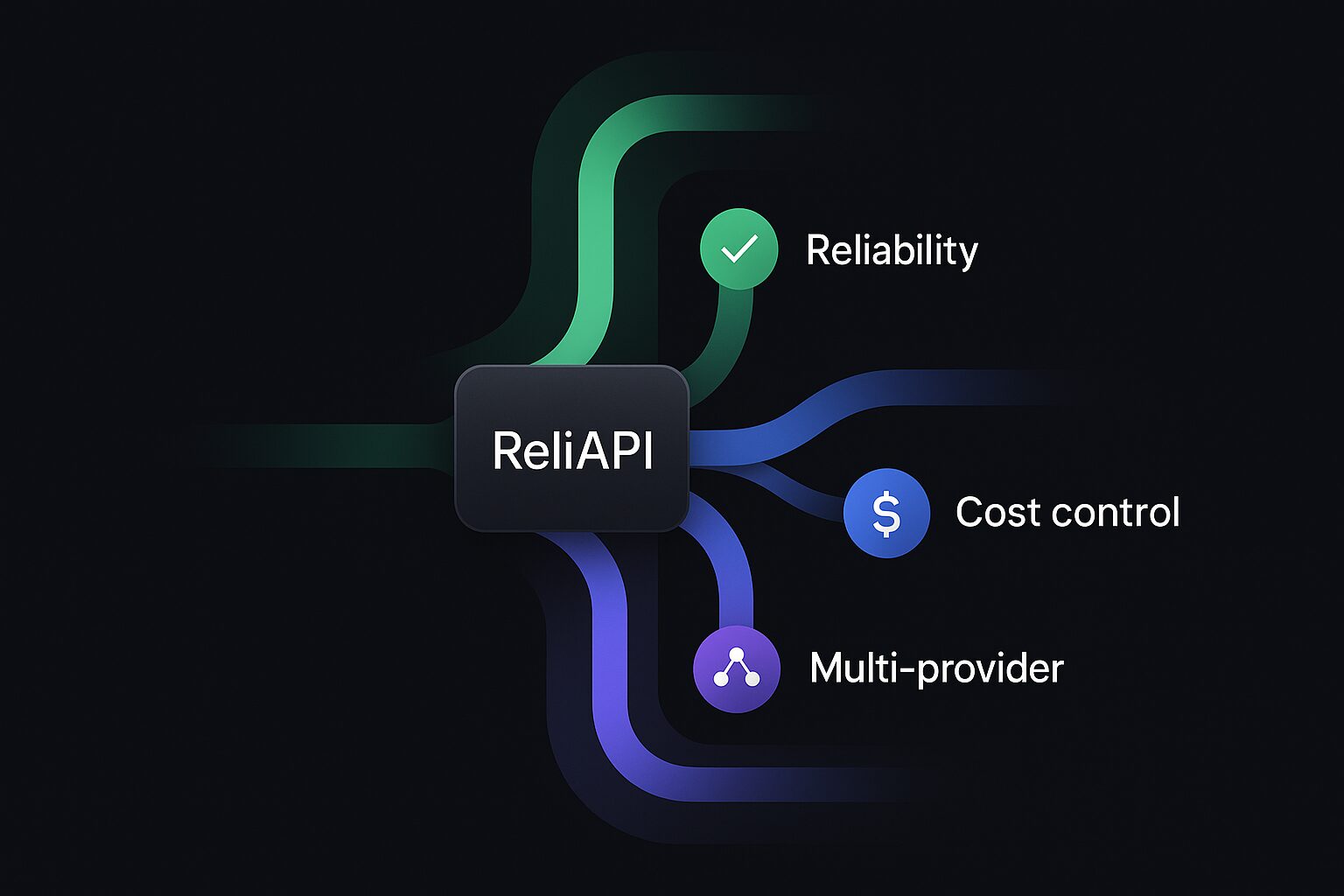
ReliAPI is an open-source reliability layer engineered specifically for HTTP APIs and LLM service calls (OpenAI, Anthropic, Mistral) providing idempotent request handling, intelligent caching, automatic retries with circuit breaker protection, and predictable cost controls. Launched on Product Hunt on December 4, 2025 (101 upvotes, 16 comments), ReliAPI addresses a critical infrastructure gap: the cascading failures, duplicate charges, and runaway costs that plague production applications when LLM APIs experience transient errors, rate limiting, or timeout issues without proper stability middleware handling these failure modes gracefully.
Unlike generic HTTP proxies or basic load balancers, ReliAPI implements LLM-aware patterns understanding token-based pricing, streaming responses, model-specific rate limits, and the idiosyncratic failure modes of generative AI services. The platform operates as a lightweight proxy layer adding only 15ms of latency overhead while providing smart caching that reduces API costs by 50-80% through intelligent response reuse, idempotency keys preventing duplicate charges during retry scenarios, hard budget caps rejecting expensive requests before execution, and automatic retry logic with exponential backoff and circuit breakers isolating failing downstream services.
Built by KikuAI Lab and available as free open-source software on GitHub with optional managed deployment through RapidAPI, ReliAPI democratizes enterprise-grade API reliability patterns previously accessible only to teams with dedicated infrastructure engineering resources. The system has been architected for language-agnostic integration working with any HTTP client (curl, Python requests, JavaScript fetch, Go http), enabling developers to add resilience through simple URL substitution rather than invasive code changes requiring specialized SDKs or framework-specific libraries.
Key Features
ReliAPI is packed with powerful features designed to eliminate API instability and cost unpredictability:
- Smart Caching Reduces Costs by 50-80%: The platform implements intelligent semantic caching that identifies functionally equivalent LLM requests even when prompts differ syntactically, storing responses in high-performance cache backends (Redis, in-memory) with configurable TTLs. When subsequent requests match cached entries based on prompt similarity thresholds and model parameters, ReliAPI returns instant responses bypassing expensive API calls entirely. This achieves documented 50-80% cost reductions for workloads with repetitive queries (customer support chatbots, documentation Q\&A, data labeling pipelines) where identical or near-identical prompts recur frequently. The caching layer handles streaming responses through chunk buffering, maintains cache coherence across distributed deployments, and supports cache warming for predictable high-traffic scenarios. Advanced features include partial cache hits for multi-turn conversations reusing context without full API calls, and cache invalidation strategies ensuring stale responses expire appropriately when underlying knowledge bases update.
- Idempotency Prevents Duplicate Charges During Retries: ReliAPI enforces idempotency through unique request fingerprinting preventing duplicate API charges when network failures trigger automatic retries. The system generates idempotency keys from request contents (prompt, model, parameters) and tracks inflight/completed requests in persistent storage. When retry logic re-submits requests after timeouts or transient errors, ReliAPI detects duplicates via idempotency keys and returns cached results rather than executing redundant API calls that multiply costs. This solves a critical production failure mode where naive retry implementations can trigger 3-5x cost explosions during outages as each retry attempt generates new billable requests without deduplication. The idempotency layer maintains strict ordering guarantees ensuring exactly-once semantics for mission-critical workflows where duplicate generations cause data corruption or user-facing inconsistencies.
- Hard Budget Caps Reject Expensive Requests Proactively: The platform implements pre-flight cost estimation analyzing prompt token counts, model pricing, and user-defined budget thresholds to reject requests exceeding cost limits before execution. Budget controls operate at multiple granularities including per-request caps preventing individual expensive queries, hourly/daily quotas limiting aggregate spend, and user/tenant-level budgets enabling multi-tenant cost isolation. When budget thresholds breach, ReliAPI returns structured error responses enabling graceful degradation rather than silent cost overruns discovered weeks later in invoices. The cost tracking integrates with real-time dashboards providing visibility into spend patterns, model-specific costs, and usage trends enabling proactive optimization. This budget governance proves especially critical for AI-powered applications exposing user-generated prompts where malicious actors or naive users could otherwise trigger four/five-figure API bills through lengthy conversations or adversarial inputs.
- Automatic Retries with Exponential Backoff and Circuit Breaker: ReliAPI implements sophisticated retry logic with exponential backoff algorithms gradually increasing delay between retry attempts (100ms, 200ms, 400ms, 800ms) preventing thundering herd problems that amplify outages when all clients simultaneously retry failed requests. The circuit breaker pattern monitors error rates and proactively fails fast when downstream services exhibit sustained failures rather than queueing requests that will timeout, reducing latency and preventing cascade failures. Circuit breakers transition through states (closed, open, half-open) based on configurable thresholds automatically recovering when services heal without manual intervention. The retry engine understands LLM-specific failure modes distinguishing retryable errors (rate limits, timeouts, 5xx server errors) from permanent failures (invalid API keys, unsupported models) avoiding wasteful retry cycles. Jitter randomization spreads retry attempts temporally preventing synchronized retry storms that overload recovering services.
- Real-Time Cost Tracking for LLM Calls: The platform provides comprehensive usage telemetry tracking token consumption, model-specific costs, request latency, cache hit rates, and error patterns through structured logging and metrics exports. Cost attribution operates at fine granularities enabling per-user, per-endpoint, per-model spend analysis identifying optimization opportunities. Telemetry integrates with observability stacks (Prometheus, Grafana, Datadog) through standard metrics formats enabling centralized monitoring alongside existing application metrics. Real-time cost dashboards surface actionable insights including unexpected usage spikes indicating bugs or abuse, model efficiency comparisons revealing opportunities to downgrade to cheaper alternatives, and cache effectiveness metrics guiding caching strategy tuning. Historical trend analysis enables capacity planning and budget forecasting based on actual usage patterns rather than guesswork.
- Works with OpenAI, Anthropic, Mistral, and HTTP APIs: ReliAPI supports major LLM providers including OpenAI (GPT-4o, GPT-4 Turbo, o1), Anthropic (Claude 3.5 Sonnet, Opus, Haiku), and Mistral models through provider-agnostic proxy implementation. The system automatically handles provider-specific API formats, authentication mechanisms, rate limit responses, and error codes without requiring application-level provider switching logic. Beyond LLM services, ReliAPI operates as general HTTP API reliability layer applicable to any JSON/REST API, enabling unified stability patterns across heterogeneous service dependencies. This universality allows teams to standardize reliability infrastructure rather than implementing custom solutions per provider or API type. Provider addition requires minimal configuration enabling rapid adoption of new LLM services without application code changes.
- Understands LLM-Specific Challenges: The platform implements specialized handling for LLM operational characteristics including token-based cost models requiring pre-flight estimation, streaming response protocols demanding chunk-level reliability, provider-specific rate limits necessitating intelligent throttling, and prompt/completion asymmetry where input costs differ from output costs. The system adapts retry strategies based on failure types (rate limit backoff vs. timeout retry) and maintains streaming fidelity through buffering mechanisms preventing partial response corruption. Cost tracking accounts for input/output token pricing asymmetries, caching multipliers (prompt caching discounts), and provider-specific rate structures. This LLM-native design delivers superior operational characteristics compared to generic API proxies lacking domain-specific optimizations.
- Language-Agnostic Integration Through URL Substitution: ReliAPI integrates through simple base URL replacement enabling any HTTP client library to benefit from reliability features without SDK dependencies or code rewrites. Developers change OpenAI API calls from
https://api.openai.com/v1tohttps://reliapi.proxy/v1and automatically inherit caching, retries, circuit breakers, and cost controls. This zero-integration-burden approach enables adoption across polyglot codebases (Python, JavaScript, Go, Java, Ruby) without maintaining language-specific SDK bindings. The proxy architecture supports both synchronous and asynchronous HTTP clients, streaming protocols, and custom headers enabling drop-in compatibility with existing application code. - Minimal Latency Overhead with 15ms Proxy Layer: Despite comprehensive reliability features, ReliAPI adds only 15ms of median proxy latency through high-performance architecture using async I/O, connection pooling, and optimized routing logic. For cache hits, latency approaches near-zero (<5ms) as responses serve from memory without downstream API calls. This performance profile ensures reliability improvements don’t degrade user experience or break latency-sensitive applications. The lightweight design enables deployment on cost-effective infrastructure rather than requiring expensive specialized hardware.
- Open-Source with Self-Hosting and Managed Options: Available under permissive open-source license on GitHub enabling free self-hosting, source code auditing, and community contributions. Teams deploy ReliAPI on existing infrastructure (Docker, Kubernetes, VMs) maintaining full control over data residency, security policies, and operational procedures. Alternatively, managed deployment through RapidAPI provides turnkey reliability with usage-based pricing eliminating infrastructure management overhead. The dual deployment model serves diverse organizational needs from startups requiring budget flexibility to enterprises mandating on-premises hosting for regulatory compliance.
How It Works
ReliAPI operates through a sophisticated request processing pipeline optimized for API reliability:
Stage 1: Request Ingestion and Authentication
Applications send HTTP requests to ReliAPI proxy endpoints rather than directly to LLM provider APIs. The proxy validates authentication credentials, extracts request metadata (model, parameters, prompt), and assigns unique request identifiers for tracking. For managed RapidAPI deployments, the system enforces subscription tier limits and billing integration. Self-hosted deployments support configurable authentication including API keys, OAuth, or pass-through to underlying provider credentials.
Stage 2: Idempotency Check and Duplicate Detection
ReliAPI generates idempotency keys from request fingerprints combining prompt content, model selection, sampling parameters, and client-provided idempotency headers. The system queries idempotency storage (Redis, PostgreSQL) checking whether identical requests have executed recently. For in-flight requests, the proxy returns 429 status codes instructing clients to retry after processing completes. For completed requests within idempotency windows, cached responses return immediately preventing duplicate charges. New requests proceed to subsequent stages with idempotency keys attached for retry deduplication.
Stage 3: Budget Validation and Cost Pre-flight
The cost estimation engine analyzes prompts using tokenization algorithms matching target model’s tokenizer, calculates expected input/output token consumption based on max_tokens parameters and historical patterns, and computes estimated costs using provider-specific pricing tables. If estimated costs exceed per-request limits or cumulative budget quotas, ReliAPI rejects requests with structured error responses containing cost estimates and budget threshold information. Approved requests proceed with cost metadata attached for post-execution verification.
Stage 4: Smart Cache Lookup
The caching layer generates cache keys from request content and parameters, checking high-performance cache backends for matching entries. Cache key generation implements semantic similarity rather than exact string matching, tolerating minor prompt variations that don’t affect semantic meaning. For cache hits, ReliAPI returns stored responses instantly with cache metadata headers indicating hit status and age. Cache misses proceed to downstream API execution with cache update scheduled post-response. Cache TTLs respect provider-specific recommendations balancing freshness against cost savings. The system supports cache hierarchies with L1 in-memory and L2 distributed Redis tiers optimizing for latency and scale.
Stage 5: Circuit Breaker Evaluation
Before forwarding requests to LLM providers, the circuit breaker evaluates target service health based on recent error rates, latency patterns, and timeout frequencies. If circuit breaker state is OPEN (provider experiencing outages), ReliAPI immediately returns error responses without attempting API calls, protecting applications from cascading failures and timeout accumulation. HALF_OPEN states allow probe requests testing service recovery. CLOSED states forward all traffic normally. Circuit breaker thresholds configure per-provider reflecting different reliability characteristics.
Stage 6: Request Execution with Retry Logic
ReliAPI forwards approved requests to target LLM provider APIs through connection pools with keep-alive optimization. The system monitors responses for retry-eligible errors including 429 rate limits, 502/503 server errors, and network timeouts. Retryable failures trigger exponential backoff retry logic with jitter randomization and maximum attempt limits. Idempotency keys prevent duplicate charges during retries by checking completion status before re-execution. Non-retryable errors (401 unauthorized, 400 bad request) fail immediately without retry attempts. Successful responses capture timing metrics, token counts, and cost data for telemetry.
Stage 7: Response Processing and Cache Population
Successful API responses undergo token counting validation ensuring billed usage matches provider-reported consumption, then populate cache backends with configured TTLs for subsequent request acceleration. Streaming responses buffer chunks maintaining fidelity while populating cache incrementally. The system appends custom headers to responses including X-ReliAPI-Cache-Status (HIT/MISS), X-ReliAPI-Cost (estimated request cost), X-ReliAPI-Tokens (input/output token counts), and X-ReliAPI-Latency (end-to-end timing breakdown).
Stage 8: Telemetry Export and Observability
Request completion triggers metrics export to configured observability backends including Prometheus time-series databases, structured logging to JSON log streams, and real-time dashboard updates. Metrics include cache hit rates, cost per request, error rates by provider and model, latency percentiles, and budget consumption rates. Alerting rules monitor thresholds triggering notifications for anomalies like unexpected cost spikes or elevated error rates indicating provider outages or application bugs.
Use Cases
Given its specialized capabilities, ReliAPI addresses various scenarios where API reliability and cost control are critical:
Reducing OpenAI and Anthropic Bills Through Intelligent Caching:
- Production chatbots answering repetitive customer support questions achieve 60-75% cost reductions caching common responses without degrading user experience
- Documentation Q\&A systems serving identical queries from multiple users eliminate redundant API calls through cache sharing across user sessions
- Data labeling pipelines processing similar examples benefit from cached classification responses accelerating throughput while reducing per-item costs
- Development environments executing test suites repeatedly avoid expensive API charges during CI/CD runs by caching deterministic test responses
Preventing Runaway API Costs in Development Environments:
- Accidental infinite loops in development code trigger budget caps stopping execution after threshold breaches rather than generating thousand-dollar invoices discovered post-incident
- Junior developers experimenting with LLM integrations operate within sandbox budgets preventing novice mistakes from impacting team resources
- Staging environments mirror production configurations while enforcing reduced budget limits enabling realistic testing without production-scale costs
- Cost-per-request limits prevent adversarial prompts or edge cases from triggering unexpectedly expensive API calls during exploratory development
Improving Application Reliability During API Outages:
- Automatic retry logic with exponential backoff handles transient provider failures gracefully recovering without manual intervention or cascading application errors
- Circuit breakers detect sustained outages and fail fast preventing timeout accumulation that would otherwise exhaust connection pools and degrade user-facing latency
- Cached responses provide degraded-but-functional service during provider outages returning slightly stale data rather than complete service unavailability
- Multi-provider fallback configurations (future roadmap) enable automatic failover to alternative LLM providers when primary services exhibit failures
Standardizing Error Handling Across LLM Providers:
- Unified error response formats abstract provider-specific API differences enabling application code to handle failures consistently regardless of backend model selection
- Structured error metadata includes retry guidance, cost estimates, and actionable troubleshooting information improving developer experience compared to raw provider errors
- Centralized logging aggregates errors across providers enabling holistic monitoring and pattern detection revealing systemic issues masked by provider-specific silos
- Idempotency guarantees ensure retry-safe operations preventing duplicate data generation or inconsistent state during failure recovery workflows
Cost Attribution and Usage Analytics:
- Per-user, per-endpoint, or per-tenant cost tracking enables chargeback models where internal teams or external customers receive itemized billing for LLM usage
- Model efficiency analysis compares cost-per-request across different models revealing opportunities to migrate workloads to cheaper alternatives without sacrificing quality
- Usage trend analysis identifies unexpected consumption patterns indicating bugs (infinite loops, redundant calls) or opportunities for optimization (caching additional prompts)
- Budget alerts notify stakeholders when approaching cost thresholds enabling proactive intervention before hard caps trigger service degradation
Pros \& Cons
Every powerful tool comes with its unique set of advantages and potential limitations:
Advantages
- Immediate Cost Savings via Intelligent Caching: Documented 50-80% cost reductions through smart caching for repetitive workloads provide rapid ROI justifying adoption effort within weeks for typical production applications. Unlike optimization strategies requiring extensive code refactoring or prompt engineering, caching delivers transparent savings without application changes.
- Language-Agnostic with Zero Integration Burden: Simple URL substitution enables adoption across polyglot codebases (Python, JavaScript, Go, Java, Ruby) without specialized SDKs, framework dependencies, or invasive code modifications. This accessibility democratizes enterprise reliability patterns beyond teams with dedicated infrastructure engineering resources, enabling solo developers and small teams to benefit from sophisticated stability features.
- Open-Source with Full Transparency: Free open-source availability under permissive license enables self-hosting, source code auditing for security/compliance verification, and community-driven enhancements. Organizations maintain control over data residency, deployment configurations, and operational policies without vendor lock-in risks. The public GitHub repository facilitates contributions, bug reports, and feature requests ensuring active development aligned with user needs.
- Minimal Latency Penalty (15ms) with Cache Acceleration: The lightweight proxy architecture adds negligible overhead (15ms median latency) for cache misses while delivering near-instant (<5ms) cache hit responses. This performance profile ensures reliability improvements don’t degrade user experience or break latency-sensitive applications like interactive chatbots requiring sub-second responsiveness.
- Prevents Catastrophic Cost Overruns: Hard budget caps and idempotency protections eliminate scenarios where bugs, infinite loops, or adversarial inputs trigger five-figure API bills discovered weeks later in invoices. This financial risk mitigation justifies adoption independent of cost optimization benefits, providing essential guardrails for production AI applications.
- Production-Ready with Enterprise Reliability Patterns: The platform implements battle-tested reliability patterns including circuit breakers, exponential backoff, idempotency, and observability integrations matching capabilities of dedicated infrastructure teams. This elevates smaller organizations and indie developers to enterprise-grade operational maturity without proportional investment in custom infrastructure engineering.
Disadvantages
- Adds Middleware Dependency to Critical Path: ReliAPI introduces an additional component in request paths creating operational dependency requiring monitoring, updates, and troubleshooting. Proxy failures become application failures, necessitating high-availability deployment configurations and operational runbooks. Teams must balance reliability benefits against increased architectural complexity and maintenance burden.
- Primarily for Text/LLM APIs, Not General-Purpose Data: While ReliAPI supports generic HTTP APIs, its optimization focus targets text-based LLM interactions rather than binary data transfers, file uploads, or high-throughput data APIs. Features like semantic caching and token-based cost tracking deliver limited value for non-LLM use cases. Organizations requiring unified API management across diverse endpoint types may need supplementary solutions for non-LLM services.
- Cache Effectiveness Depends on Workload Characteristics: Documented 50-80% cost savings assume workloads with significant query repetition (customer support, documentation Q\&A). Applications with highly unique prompts per request (creative content generation, personalized recommendations) achieve minimal cache hit rates limiting cost benefits. Teams must evaluate cache effectiveness for specific use cases rather than assuming universal applicability.
- Limited Multi-Provider Routing and Failover: Current implementation supports per-request provider selection but lacks sophisticated multi-provider routing, load balancing, or automatic failover capabilities offered by enterprise AI gateways like Portkey. Organizations requiring complex routing logic, A/B testing across providers, or zero-downtime failover may need supplementary gateway layers or wait for future ReliAPI enhancements.
- Self-Hosting Requires Infrastructure Expertise: While open-source availability enables self-hosting, production deployments require operational expertise managing Redis/caching backends, monitoring infrastructure, security hardening, and high-availability configurations. Small teams lacking DevOps resources may find self-hosting operationally burdensome compared to fully-managed alternatives despite lower direct costs.
- Early-Stage Project with Evolving Feature Set: ReliAPI represents an emerging tool launched December 2025 without extensive production battle-testing or mature ecosystem compared to established alternatives like Helicone or LiteLLM. Early adopters may encounter undocumented edge cases, evolving APIs requiring migration effort, or feature gaps necessitating custom workarounds. Organizations with low risk tolerance may prefer waiting for maturity indicators (community size, enterprise adoption, stability track record).
How Does It Compare?
ReliAPI vs. Helicone
Helicone is a popular open-source LLM observability platform emphasizing analytics, monitoring, and developer-friendly dashboards with proxy-based or async SDK integration.
Core Focus:
- ReliAPI: Reliability and cost optimization through caching, retries, circuit breakers, and budget controls
- Helicone: Observability and analytics with comprehensive request logging, user tracking, performance metrics, and debugging tools
Caching Capabilities:
- ReliAPI: Smart semantic caching as primary cost reduction mechanism delivering documented 50-80% savings
- Helicone: Includes caching features as part of gateway capabilities but secondary to observability mission
Reliability Features:
- ReliAPI: Dedicated circuit breakers, automatic retries with exponential backoff, idempotency guarantees, and failover logic
- Helicone: Supports retries and custom rate limiting through proxy integration but less emphasis on resilience patterns
Observability and Analytics:
- ReliAPI: Real-time cost tracking and basic telemetry export to standard monitoring stacks
- Helicone: Comprehensive analytics dashboards, session tracing for AI agents, user/feature-level metrics, detailed request inspection, and evaluation frameworks
Integration Approach:
- ReliAPI: Language-agnostic URL substitution requiring zero code changes
- Helicone: Both proxy (URL substitution) and async SDK integration offering flexibility; async integration removes proxy from critical path
Prompt Management:
- ReliAPI: No prompt versioning or A/B testing features
- Helicone: Native prompt management, versioning, experimentation frameworks, and evaluation scoring
Pricing:
- ReliAPI: Free open-source; optional RapidAPI managed deployment with usage-based pricing
- Helicone: Free tier with generous limits; paid plans for enterprise features and scale
When to Choose ReliAPI: For cost optimization through aggressive caching, when reliability features (retries, circuit breakers) are primary concern, and when minimal observability suffices.
When to Choose Helicone: For comprehensive observability, debugging, prompt experimentation, and when team collaboration features matter more than maximum cost savings.
ReliAPI vs. Portkey
Portkey is an enterprise AI gateway emphasizing governance, routing across 1600+ LLM providers, observability, and team collaboration with focus on production-grade management.
Enterprise Focus:
- ReliAPI: Indie/SMB-friendly open-source tool with self-hosting emphasis
- Portkey: Enterprise-first platform targeting large organizations requiring governance, compliance, and team workflows
Provider Coverage:
- ReliAPI: Supports OpenAI, Anthropic, Mistral, and generic HTTP APIs
- Portkey: Universal API supporting 1600+ LLM providers including obscure and emerging models with unified interface
Routing and Failover:
- ReliAPI: Basic provider selection without sophisticated routing or automatic failover
- Portkey: Advanced load balancing, automatic failover across providers, latency-based routing, and A/B testing infrastructure
Guardrails and Security:
- ReliAPI: Budget caps and cost controls preventing overruns
- Portkey: Comprehensive guardrails including PII detection/redaction, content filtering, prompt injection protection, and integration with Palo Alto Prisma AIRS for enterprise security
Governance Features:
- ReliAPI: Basic cost tracking and budget enforcement
- Portkey: Role-based access control (RBAC), team management, audit logging, compliance reporting, and fine-grained usage policies
Pricing:
- ReliAPI: Free open-source
- Portkey: Enterprise pricing with custom quotes; higher investment reflecting advanced feature set
When to Choose ReliAPI: For cost-conscious teams prioritizing caching-driven savings, open-source transparency, self-hosting control, and simple URL-substitution integration.
When to Choose Portkey: For enterprises requiring governance at scale, multi-team collaboration, comprehensive security guardrails, and support for diverse LLM providers through unified gateway.
ReliAPI vs. LiteLLM
LiteLLM is a Python-based library and proxy server enabling unified OpenAI-compatible interface for 100+ LLM providers with model switching, load balancing, and cost tracking.
Language Support:
- ReliAPI: Language-agnostic HTTP proxy working with any client library
- LiteLLM: Python SDK with proxy server for non-Python languages; Python-first design
Model Switching:
- ReliAPI: No automatic model fallback or provider switching intelligence
- LiteLLM: Core capability enabling seamless model substitution (GPT-4 → Claude) through unified API abstracting provider differences
Reliability Features:
- ReliAPI: Specialized caching, idempotency, circuit breakers, and retry logic purpose-built for stability
- LiteLLM: Basic retry support but less emphasis on resilience patterns compared to routing flexibility
Cost Tracking:
- ReliAPI: Real-time cost monitoring with budget caps and pre-flight estimation
- LiteLLM: Comprehensive cost tracking with custom pricing overrides, provider-specific discounts, and detailed spend analytics
Load Balancing:
- ReliAPI: No built-in load balancing across multiple instances or providers
- LiteLLM: Load balancing, rate limiting, and request queuing for production workloads
Caching:
- ReliAPI: Smart semantic caching delivering documented 50-80% cost reductions as primary value proposition
- LiteLLM: Caching support available but not emphasized as core feature
Deployment:
- ReliAPI: Standalone proxy requiring separate infrastructure
- LiteLLM: Python library embeddable in applications or deployable as standalone proxy server
Pricing:
- ReliAPI: Free open-source
- LiteLLM: Free open-source core; LiteLLM Proxy has hosted/enterprise options with usage-based pricing
When to Choose ReliAPI: For maximum caching efficiency, idempotency guarantees, circuit breaker resilience, and language-agnostic integration without Python dependencies.
When to Choose LiteLLM: For unified multi-provider interface enabling model switching, Python-native integration, and when load balancing/queuing capabilities are priorities.
ReliAPI vs. Self-Built Reliability Layers
Self-built solutions involve teams implementing custom caching, retry logic, and error handling within application code rather than using dedicated proxy infrastructure.
Development Effort:
- ReliAPI: Drop-in proxy requiring only URL substitution; zero custom code
- Self-Built: Requires weeks/months of engineering implementing caching backends, retry algorithms, circuit breakers, cost tracking, and observability integration
Maintenance Burden:
- ReliAPI: Community-maintained open-source with bug fixes and enhancements contributed by users
- Self-Built: Team owns ongoing maintenance including security updates, provider API changes, and feature additions
Best Practices:
- ReliAPI: Implements battle-tested reliability patterns (exponential backoff, jitter, circuit breakers) correctly from day one
- Self-Built: Requires expertise avoiding common pitfalls like thundering herds, duplicate charges, or cache invalidation bugs
Feature Completeness:
- ReliAPI: Comprehensive feature set including idempotency, semantic caching, budget controls, and telemetry out-of-box
- Self-Built: Typically implements subset of features due to time constraints; gaps discovered through production incidents
Customization:
- ReliAPI: Limited to proxy configuration options and extension points
- Self-Built: Unlimited customization tailored to exact application requirements and organizational patterns
When to Choose ReliAPI: For nearly all teams; engineering effort rarely justifies custom development versus adopting mature open-source solution.
When to Choose Self-Built: Only when highly specialized requirements (exotic caching strategies, proprietary cost models, non-standard providers) cannot be accommodated through ReliAPI customization.
Final Thoughts
ReliAPI represents a thoughtful solution to critical operational challenges facing production LLM applications: unstable API dependencies causing cascading failures, runaway costs from duplicate charges and missing budget controls, and lack of standardized reliability patterns accessible to teams without dedicated infrastructure expertise. The December 4, 2025 Product Hunt launch and open-source availability position it as a democratizing tool bringing enterprise-grade API reliability to indie developers, startups, and small teams previously unable to justify custom infrastructure investments.
What makes ReliAPI particularly compelling is its focused mission prioritizing reliability and cost optimization over feature proliferation. The platform excels at specific problems—caching-driven cost reduction, idempotency-protected retries, circuit breaker resilience—rather than attempting to replicate comprehensive AI gateway capabilities offered by enterprise alternatives. This specialization enables simplicity: URL substitution integration, minimal configuration overhead, and predictable behavior without extensive learning curves or operational complexity.
The documented 50-80% cost savings through intelligent caching prove especially valuable for workloads with repetitive query patterns (customer support chatbots, documentation Q\&A, data labeling). Combined with hard budget caps preventing catastrophic cost overruns and idempotency guarantees eliminating duplicate charges, ReliAPI addresses financial risks that justify adoption independent of reliability benefits. For cost-sensitive applications where LLM API expenses represent significant operational costs, caching alone delivers ROI measured in weeks.
The tool particularly excels for:
- Indie developers and bootstrapped startups operating under tight budget constraints where 50-80% LLM cost reductions materially impact runway and unit economics
- Development teams lacking dedicated infrastructure engineers who need enterprise reliability patterns without months of custom development implementing caching, retries, and circuit breakers
- Production applications with repetitive workloads (customer support, FAQ bots, documentation search) achieving maximum cache hit rates and corresponding cost savings
- Organizations prioritizing open-source transparency requiring source code auditing for security/compliance or maintaining on-premises deployments for data residency regulations
- Teams using multiple programming languages benefiting from language-agnostic HTTP proxy integration rather than Python-specific SDKs or framework dependencies
For enterprises requiring comprehensive AI governance features including role-based access control, PII detection/redaction, audit logging, and team collaboration workflows, Portkey’s \$10,000+/year enterprise platform provides superior capabilities despite significantly higher investment. For teams prioritizing observability, debugging, prompt experimentation, and detailed analytics over maximum cost savings, Helicone’s comprehensive dashboard and evaluation frameworks better serve development needs. For Python-native teams requiring unified multi-provider interfaces enabling model switching flexibility, LiteLLM’s SDK-first approach offers tighter language integration.
But for the specific intersection of “aggressive cost optimization through caching,” “production reliability via retries and circuit breakers,” and “zero-friction integration through URL substitution,” ReliAPI addresses genuine operational needs with specialized capabilities competitors don’t replicate. The platform’s primary limitations—middleware dependency adding operational complexity, limited multi-provider routing compared to enterprise gateways, and early-stage maturity lacking extensive production validation—reflect inherent tradeoffs of focused specialization rather than tool-specific weaknesses.
The critical strategic question isn’t whether reliability middleware matters for production LLM applications (cascading failures and cost overruns prove necessity), but whether teams will build custom solutions consuming weeks of engineering effort or adopt specialized tools like ReliAPI delivering equivalent capabilities through simple configuration. The zero-integration-burden approach trades maximum customization flexibility for immediate operational value—reasonable tradeoff for majority of applications without exotic requirements justifying bespoke development.
If your application suffers from unstable LLM API dependencies causing user-facing errors during provider outages, if unexpected API bills from bugs or retry storms create financial uncertainty, or if repetitive query patterns waste budget on redundant API calls cacheable with minimal staleness tolerance, ReliAPI provides accessible specialized solution worth evaluating through free self-hosting trial. The open-source availability eliminates financial risk enabling proof-of-concept testing with production workloads before committing to operational deployment.