
Table of Contents
- remio 2.0: Comprehensive Research Report
- 1. Executive Snapshot
- 2. Impact & Evidence
- 3. Technical Blueprint
- 4. Trust & Governance
- 5. Unique Capabilities
- 6. Adoption Pathways
- 7. Use Case Portfolio
- 8. Balanced Analysis
- 9. Transparent Pricing
- 10. Market Positioning
- 11. Leadership Profile
- 12. Community & Endorsements
- 13. Strategic Outlook
- Final Thoughts
remio 2.0: Comprehensive Research Report
1. Executive Snapshot
Core Offering Overview
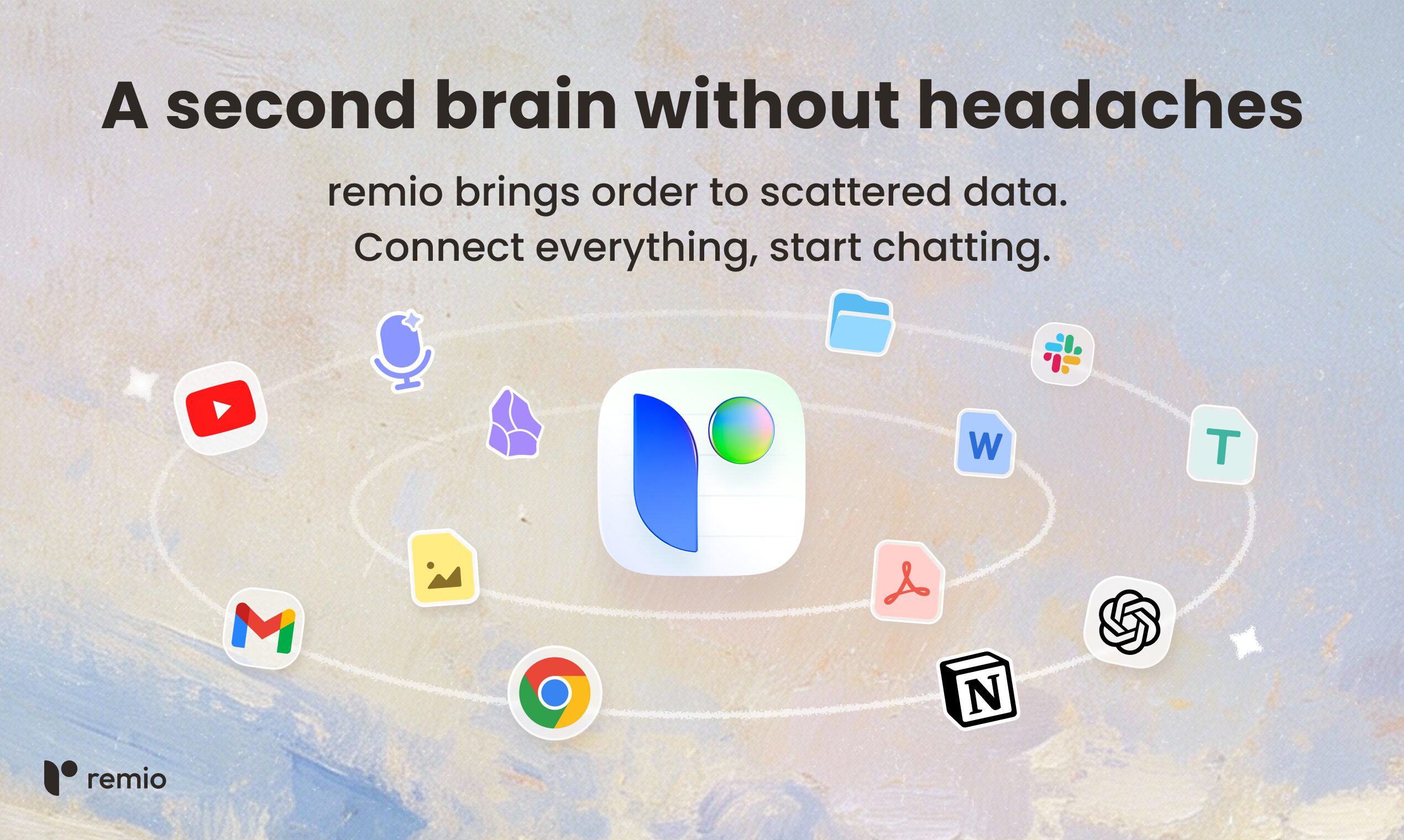
remio 2.0 represents a paradigm shift in personal knowledge management, positioning itself as an AI-native “Second Brain” that automatically captures, organizes, and synthesizes information from users’ entire digital ecosystems. Unlike traditional note-taking applications requiring manual input and organization, remio operates as a passive intelligence layer running silently in the background, intercepting work context across web browsing, local file systems, email, meetings, and communication platforms to build comprehensive personal knowledge bases without user intervention.
The platform addresses a fundamental problem facing modern knowledge workers: information overload combined with retrieval difficulty. Professionals encounter hundreds of web pages, dozens of documents, multiple meetings, and countless emails daily, yet lack systematic methods for capturing and accessing this information when needed. remio eliminates the friction between information consumption and knowledge utilization by automating the capture-organize-retrieve cycle through AI-powered workflows that learn from user behavior and context.
Built on a local-first architecture, remio stores all captured data on user devices rather than cloud servers, providing privacy guarantees increasingly important as AI tools proliferate. Only relevant information snippets transmit to large language models during AI feature invocations, with explicit user data protection commitments stating information never trains external AI models. Users can further enhance privacy by connecting their own LLM API keys through Bring Your Own Key functionality, achieving complete data sovereignty while maintaining advanced AI capabilities.
The platform integrates across user workflows through multiple touchpoints: a desktop application serving as the central knowledge hub, a Chrome extension enabling one-click web capture with contextual highlighting, and forthcoming mobile applications extending accessibility beyond desktop environments. This multi-surface strategy ensures remio remains accessible wherever users work, reducing friction between information encounter and capture.
remio’s AI capabilities extend beyond simple retrieval to include intelligent summarization, automated organization through AI-suggested Collections, semantic search understanding natural language queries, and upcoming Knowledge Blending features that synthesize information from multiple sources into structured formats. The recent integration with advanced models like DeepSeek 3.1—featuring a Mixture-of-Experts architecture with six hundred seventy-one billion total parameters—positions remio at the frontier of personal AI assistants capable of sophisticated reasoning across user-specific contexts.
Key Achievements & Milestones
remio achieved notable market validation through its Product Hunt launch, securing Product of the Day and Product of the Week honors. The platform launched version 2.0 in January 2026, representing a major evolution from earlier iterations with substantially expanded capture capabilities, enhanced AI features, and refined user experiences. This milestone release garnered four hundred eighty-two upvotes and seventy-five comments during its Product Hunt debut, positioning it as the third-ranked product in Week Three of 2026 behind only Cowork and Cal.com Companion Apps.
The company earned recognition from major AI tool directories including Futurepedia, There’s An AI For That, Moge.AI, and AI Chief, establishing presence within discovery channels where knowledge workers research productivity solutions. Independent reviewers on FunBlocks AI characterized remio 2.0 as “highly ambitious and potentially revolutionary” for users seeking to harness AI against operational data, positioning it as critical infrastructure enabling genuinely intelligent AI assistants grounded in personal context.
User testimonials document substantial productivity gains measured in saved hours per week. Dr. Lee, an educator and researcher, reports remio saves at least six hours of class preparation time per session by seamlessly synthesizing materials from YouTube lectures and academic PDFs. David, a Senior Manager in FinTech, credits remio with reducing weekly sprint planning time by seventy-five percent through automated competitive analysis capture. Vanessa, an industry consultant, describes the platform as transformative for intensive research workflows, eliminating hours previously spent manually saving links in Notion.
The platform maintains a perfect five-star rating on Product Hunt based on twenty verified reviews, with users consistently praising intuitive design, powerful AI capabilities, smooth setup across desktop and extension, fast performance, and clean distraction-free interfaces. The Auto Capture functionality receives particular acclaim for eliminating manual tagging and folder organization while maintaining comprehensive information coverage.
remio’s technical partnership with DeepSeek represents a strategic milestone positioning the platform to leverage cutting-edge AI models. DeepSeek 3.1’s Mixture-of-Experts architecture and hybrid Think/Non-Think reasoning modes enable remio to handle both simple retrieval queries instantaneously and complex analytical requests through multi-step reasoning—capabilities essential for transforming passive knowledge bases into active analytical partners.
Adoption Statistics
Quantitative adoption metrics remain partially disclosed in available materials, though multiple indicators suggest meaningful traction within target segments. The platform reports over one thousand Product Hunt followers, indicating sustained community interest beyond initial launch momentum. Social media presence on platforms including LinkedIn, Twitter, and developer communities demonstrates active user engagement and organic word-of-mouth growth.
The free tier offering unlimited capture and organization with one hundred monthly AI credits lowers adoption barriers, enabling broad evaluation without financial commitment. This freemium model typical of successful SaaS platforms facilitates viral growth through low-friction onboarding while monetizing through premium tier conversions for power users requiring enhanced AI capabilities. Educational pricing at fifteen percent discounts and seven-day free trials for paid plans further reduce adoption friction for budget-conscious segments including students and early-career professionals.
Platform compatibility currently restricts adoption to Windows 10 Plus and M-chip Mac users, deliberately excluding older hardware and alternative operating systems to ensure optimal performance and security. This pragmatic approach prioritizes quality over maximum addressability during growth phases, accepting temporary market limitations in exchange for superior user experiences on supported platforms.
The testimonial portfolio spans diverse professional roles including educators, researchers, startup founders, senior managers, game developers, and consultants—demonstrating horizontal applicability across knowledge work domains rather than narrow vertical specialization. This broad appeal validates remio’s positioning as general-purpose productivity infrastructure rather than niche solution serving limited use cases.
Industry cataloging in EU-Startups Directory, AIPortalX, ChatGate.AI, and BizRescuePro extends discoverability beyond core technology communities into mainstream business audiences. These placements signal transition from early-adopter tools toward general business software, though adoption within conservative enterprise segments likely remains limited pending formal security certifications and compliance documentation.
2. Impact & Evidence
Client Success Stories
Dr. Lee’s experience as educator and researcher exemplifies remio’s impact on academic workflows. The platform saves approximately six hours per class preparation session by automatically capturing and synthesizing materials from diverse sources including YouTube video lectures, academic PDFs, journal articles, and reference materials. remio generates literature reviews, creates discussion questions from synthesized content, and identifies thematic connections across source materials—workflows traditionally requiring manual note-taking, transcript review, and content analysis. This time reclamation enables Dr. Lee to redirect effort from mechanical preparation toward strategic pedagogy and student engagement.
Mix, a startup founder in the cryptocurrency space, describes remio as a “true decision-making partner” rather than mere knowledge base. The platform’s ability to proactively surface valuable insights from captured information streams distinguishes it from passive storage solutions. By analyzing patterns across research, market data, competitive intelligence, and operational metrics, remio identifies strategic signals that inform investment decisions, product direction, and market positioning. This analytical partnership enables founders to operate with enhanced situational awareness despite information volume that would overwhelm unaugmented human cognition.
David’s experience as Senior Manager in FinTech demonstrates quantifiable productivity gains in sprint planning workflows. Competitive analysis capture automation reduced weekly planning time by seventy-five percent—from approximately eight hours to two hours per cycle. This efficiency improvement stems from remio automatically capturing competitor product updates, market reports, feature announcements, and analyst commentary encountered during routine browsing, then organizing this intelligence into searchable collections accessible during strategic planning sessions. The time reclaimed enables David to focus on strategy formulation and execution oversight rather than manual intelligence gathering.
Vanessa, an industry consultant, emphasizes remio’s transformation of research-intensive workflows. Previously spending hours manually saving links in Notion, categorizing bookmarks, and maintaining research databases, Vanessa now relies on remio’s auto-capture to silently gather everything encountered during client research. The platform’s semantic search enables rapid retrieval when writing reports or preparing presentations, while AI summarization compresses lengthy source materials into digestible insights. This workflow evolution represents a shift from active information management consuming significant billable hours toward passive accumulation enabling immediate access when needed.
Mr. Xiao, a game developer, prioritizes remio’s local-first architecture for data privacy assurance. In development environments where proprietary code, design documents, and strategic plans constitute competitive advantages, cloud-based knowledge management introduces unacceptable disclosure risks. remio’s local storage with optional BYOK functionality provides peace of mind that sensitive information remains under developer control while still enabling advanced AI capabilities through self-managed LLM connections.
Yura Pogosyan, co-founder of Lookverse.ai, validates remio’s strategic positioning around a “super relevant problem”—juggling scattered tools and information that genuinely slows professional productivity. The integration atop existing tools rather than requiring workflow replacement represents a “smart move” reducing adoption friction while delivering immediate value within established work patterns.
Performance Metrics & Benchmarks
User testimonials consistently report time savings measured in hours per week rather than incremental minutes, suggesting substantive rather than marginal productivity improvements. Dr. Lee’s six-hour class prep savings per session, accumulated across multiple weekly classes, potentially reclaims twenty-plus hours monthly. For senior professionals billing at one hundred fifty dollars-plus hourly rates, monthly time savings translate to three thousand dollars-plus in recovered billable capacity or equivalent quality-of-life improvements through reduced working hours.
David’s seventy-five percent sprint planning time reduction—from eight hours to two hours weekly—yields six hours weekly or approximately three hundred hours annually. At senior management compensation levels exceeding two hundred thousand dollars annually, the opportunity cost of manual competitive intelligence gathering approaches thirty thousand dollars yearly. remio’s automation captures this value while improving intelligence completeness through systematic rather than ad-hoc collection.
The platform’s AI credit system meters usage across tiers: one hundred monthly credits on free plans, one hundred credits plus BYOK on mid-tier plans, and two thousand credits on Pro plans. Credit consumption varies by feature intensity—simple searches consume fewer credits than comprehensive summaries or Knowledge Blending synthesis. User reports suggest typical knowledge workers on moderate AI usage patterns remain within free tier allowances, with power users requiring Pro tier subscriptions for intensive automation.
Semantic search accuracy represents a critical performance dimension distinguishing AI-native platforms from traditional keyword search. While specific accuracy metrics remain unpublished, user testimonials emphasizing successful retrieval through natural language queries suggest effective implementation of large language model-based semantic understanding. The integration with DeepSeek 3.1’s advanced reasoning capabilities particularly enhances complex query handling where intent disambiguation and contextual interpretation determine result relevance.
Capture completeness—the percentage of encountered information successfully indexed without user intervention—fundamentally determines remio’s value proposition. The platform’s background operation across web browsing, local files, and integrated applications aims for comprehensive coverage, though edge cases inevitably exist where capture mechanisms fail or users disable automatic collection. User feedback praising “near perfect memory” suggests high capture rates in common workflows, though formal completeness metrics warrant verification during evaluation.
Third-Party Validations
Product Hunt’s community validation through Product of the Day and Product of the Week honors represents meaningful market signal. These accolades emerge from voting by technology enthusiasts, early adopters, and industry practitioners whose assessments reflect genuine utility evaluation rather than marketing claims. The platform’s sustained five-star rating across twenty reviews further validates quality, particularly given Product Hunt’s community tendency toward critical assessment of overhyped products.
FunBlocks AI’s independent review characterizes remio 2.0 as solving the market gap between simple file storage and complex manually-structured wikis by prioritizing contextual understanding over manual structure. The reviewer positions remio as “must-try” for early adopters and high-volume knowledge workers seeking to future-proof workflows against growing data silos. This third-party assessment particularly emphasizes remio’s potential as “critical infrastructure layer” making AI assistants genuinely intelligent about personal context—validation of architectural vision rather than merely feature completeness.
EU-Startups Directory inclusion signals recognition within European innovation ecosystems, potentially facilitating market access across European Union member states. The directory’s characterization of remio as “advanced AI-powered note-taking and personal knowledge management platform designed to revolutionize how individuals capture, organize, and leverage information” positions it within innovation narratives attractive to venture capital and early-stage funding.
AIPortalX review emphasizes remio’s core value in “automating the capture and organization of information, turning scattered data into actionable insights,” recommending it for teams focused on workflow automation. This positioning within automation rather than mere productivity software signals more sophisticated value propositions appealing to operations-focused decision-makers evaluating process optimization investments.
ChatGate.AI’s analysis highlights the local-first privacy architecture and model choice flexibility as key differentiators. The platform’s emphasis on user data sovereignty through local storage and BYOK options addresses privacy-conscious segments increasingly wary of cloud-based AI tools following high-profile data breaches and model training controversies. This validation matters particularly for regulated industries and privacy-sensitive applications where cloud-based alternatives face adoption barriers.
However, formal analyst coverage from Gartner, Forrester, IDC, or comparable research firms remains absent from available sources. This gap reflects remio’s growth-stage profile where market share, enterprise customer counts, and revenue scale haven’t yet triggered analyst attention. The absence limits enterprise buyer confidence during procurement processes where analyst Magic Quadrant placements or Wave evaluations inform vendor shortlists.
3. Technical Blueprint
System Architecture Overview
remio implements a hybrid local-cloud architecture balancing privacy, performance, and capability. The core knowledge base resides entirely on user devices—desktops running Windows 10 Plus or macOS with M-series chips. Local storage encompasses captured web pages, synchronized local files, meeting recordings with transcriptions, email archives, communication platform messages, and user-generated notes. This data never transmits to remio servers or third-party services except during explicit AI feature invocations requiring large language model processing.
The capture layer operates through multiple mechanisms addressing diverse information sources. A Chrome browser extension intercepts web browsing, automatically saving visited pages with full content preservation including text, images, metadata, and user-added highlights or annotations. Local file system monitors track designated folders, indexing documents in real-time as users create, modify, or add files. Meeting recording functionality captures audio from online calls, in-person workshops, or offline lectures, then generates transcriptions and AI-powered summaries identifying key decisions and action items.
The integration layer connects to external platforms including Slack for team communications, Google Docs for collaborative documents, email systems for correspondence, and YouTube for video content. These integrations enable remio to build comprehensive knowledge graphs spanning traditionally siloed information sources. The forthcoming mobile applications will extend capture capabilities to on-the-go scenarios where desktop access proves impractical.
The AI processing layer leverages large language models through flexible provider architecture. Users select from multiple LLM providers including OpenRouter, OpenAI, Anthropic, xAI, and custom endpoints based on cost, performance, privacy, or capability preferences. The BYOK model enables users to supply their own API credentials, routing all AI requests through user-managed accounts and ensuring remio never observes query contents or responses. This architecture provides privacy assurances impossible with integrated AI where vendors control model access.
The retrieval and reasoning system implements semantic search understanding natural language queries rather than requiring keyword exactness. When users invoke Ask remio, the system analyzes query intent, searches the local knowledge base using embedding-based similarity rather than lexical matching, ranks results by relevance, synthesizes responses drawing from multiple sources, and provides citations enabling users to verify information and explore original contexts. This conversational interface transforms static knowledge bases into interactive assistants answering questions in natural language.
The upcoming Knowledge Blending feature will implement multi-source synthesis where remio analyzes related information across captured materials, identifies thematic connections, extracts key insights, resolves contradictions through source credibility assessment, and generates structured summaries integrating diverse perspectives. This capability elevates remio from passive repository to active research assistant.
API & SDK Integrations
remio’s integration architecture currently emphasizes data ingestion from popular productivity platforms rather than bidirectional API connectivity enabling external systems to query remio’s knowledge base. The Chrome extension provides capture capabilities for web-based workflows, while file system monitors automatically index documents from designated local directories. Slack integration enables message and file capture from team communication channels, preserving organizational knowledge that would otherwise remain trapped in ephemeral chat threads.
Google Docs integration allows remio to capture collaborative documents, though implementation details regarding real-time synchronization versus periodic polling remain unclear in available materials. Email system connectivity enables correspondence archiving, though specific email platform support—Outlook, Gmail, Apple Mail—warrants verification during evaluation given varying API availability across providers.
YouTube integration represents particularly valuable capability given platform’s role as educational and professional development resource. remio captures video metadata, generates transcriptions, and enables semantic search across video content—transforming passively consumed videos into searchable knowledge assets. This functionality particularly benefits educators like Dr. Lee who synthesize lecture materials from diverse video sources.
However, notable integration gaps limit current utility for users deeply embedded in specific ecosystems. The absence of GSuite-wide integration means remio cannot automatically capture Gmail threads, Google Calendar events, or Google Drive file updates beyond manual Google Docs connections. Microsoft 365 integration similarly appears limited, potentially excluding Outlook, Teams, and OneDrive from automatic capture.
Third-party API access enabling external applications to query remio’s knowledge base would unlock powerful workflow automation scenarios—for example, enabling customer relationship management systems to reference sales call transcripts captured by remio, or project management tools to surface relevant research materials. The absence of such outbound APIs in current implementations limits remio to terminal node rather than integration hub within broader workflow ecosystems.
SDK availability for developers seeking to extend remio’s capabilities through custom integrations or plugins remains undocumented. A formal SDK with comprehensive documentation, code examples, and community forums would accelerate ecosystem development by enabling users and third-party developers to address long-tail integration needs without dependence on remio’s internal development priorities.
Scalability & Reliability Data
Formal scalability specifications including maximum knowledge base sizes, retrieval performance degradation curves, and concurrent operation limits remain unpublished in accessible documentation. However, architectural choices provide insights into practical constraints. Local-first storage bounds knowledge base sizes by available disk space—typically hundreds of gigabytes on modern computers, sufficient for years of accumulated knowledge for typical users. Power users with extensive media libraries, large document repositories, or decade-plus historical archives may encounter storage limitations requiring selective retention policies or external archive migration.
Retrieval performance likely degrades sub-linearly with knowledge base growth given modern vector database techniques enabling efficient similarity search across million-plus document corpuses. However, specific query response time benchmarks across knowledge base scales would inform user expectations and guide capacity planning. Users accustomed to instant search results may perceive multi-second retrieval latencies as unacceptable, making performance transparency important for satisfaction management.
Reliability in local-first architectures depends primarily on user device stability rather than vendor infrastructure uptime. remio’s operational availability matches user computer uptime, with no service disruptions from remote infrastructure failures, API rate limits, or vendor outages. This architecture provides resilience advantages over cloud-based alternatives vulnerable to network connectivity issues, DNS failures, or service degradation during high-demand periods.
However, local-first approaches introduce backup and disaster recovery responsibilities. Users must implement their own backup strategies protecting against device failures, accidental deletions, or ransomware attacks. The absence of automatic cloud backup means remio data recovery depends entirely on user-managed backup workflows—a responsibility some users may neglect until catastrophic data loss occurs. Clear documentation emphasizing backup importance and providing recommended practices would mitigate this risk.
Cross-device synchronization represents critical reliability consideration for mobile professionals working across office desktops, home computers, and portable devices. Current implementation limits users to two-device sync on free plans with full cross-device sync on paid tiers—though this capability appears to be upcoming rather than currently available based on documentation indicating features “coming soon.” The synchronization architecture, conflict resolution mechanisms, and consistency guarantees warrant clarification during evaluation.
4. Trust & Governance
Security Certifications
remio does not advertise formal security certifications including SOC 2 Type II, ISO 27001, GDPR compliance attestations, or comparable third-party validated security frameworks in publicly accessible materials. This absence reflects typical growth-stage prioritization where product-market fit validation and feature velocity take precedence over expensive multi-month certification processes requiring significant capital investment and operational overhead.
The local-first architecture provides inherent security advantages by eliminating cloud storage vulnerabilities including unauthorized access to centralized databases, breaches from compromised vendor infrastructure, and insider threats from vendor employees with administrative privileges. By storing all sensitive data on user devices, remio shifts security responsibility and control to users who implement their own device security policies, encryption, access controls, and physical security measures.
However, the local-first model also introduces security risks absent from managed cloud solutions. Users must ensure adequate device security including full-disk encryption, strong authentication, automatic security updates, malware protection, and physical security preventing unauthorized device access. Many users lack security expertise to properly configure and maintain these protections, potentially creating vulnerabilities that centralized solutions would address through professional security teams.
The BYOK functionality enabling users to supply their own LLM API credentials provides additional privacy layer by preventing remio from observing AI queries or responses. When users configure their own OpenAI, Anthropic, or other provider keys, all AI processing occurs directly between user devices and LLM providers without remio intermediation. This architecture ensures remio cannot log queries, analyze usage patterns, or inadvertently leak sensitive information discussed in AI conversations.
Data encryption practices including encryption-at-rest for local storage and encryption-in-transit for network communications warrant explicit documentation. While modern operating systems provide optional full-disk encryption, user enablement varies widely and default configurations may leave data unencrypted. Clear guidance on encryption setup and verification procedures would strengthen security postures for users handling sensitive information.
Data Privacy Measures
remio’s privacy architecture centers on local-first data storage and explicit user consent for any information transmission beyond device boundaries. The company’s privacy commitments explicitly state that user data will never be used for AI model training—addressing widespread concerns about cloud AI providers incorporating customer data into model improvement workflows. This commitment provides meaningful reassurance for users handling proprietary information, trade secrets, or confidential client data.
When AI features require large language model processing, remio transmits only relevant information snippets necessary for specific requests rather than wholesale knowledge base access. For example, an Ask remio query searching for information about competitors would send query text and relevant document excerpts to the LLM for synthesis, but wouldn’t expose unrelated personal emails, meeting transcripts, or project documentation. This minimization principle limits exposure while enabling sophisticated AI capabilities.
The BYOK model extends privacy control by routing AI requests through user-managed API accounts. Organizations with strict data governance requirements can configure remio to use corporate LLM deployments running on private infrastructure, on-premises installations, or dedicated cloud tenancies—eliminating information flows to multi-tenant public AI services. This flexibility accommodates highly regulated environments including healthcare, legal, financial services, and government sectors where data residency and access controls follow strict requirements.
However, privacy guarantees depend on users properly configuring BYOK and understanding implications of different AI provider choices. Users selecting free built-in AI credits powered by remio’s managed LLM connections implicitly accept information transmission to whatever providers remio has contracted—likely major vendors like OpenAI or Anthropic operating multi-tenant infrastructure. The privacy characteristics differ substantially between self-managed BYOK configurations and convenient pre-integrated options, creating potential for user misunderstandings about actual data flows.
Third-party integrations introduce additional privacy considerations. When users enable Slack, Google Docs, or email integrations, remio gains access to potentially sensitive organizational communications and documents. While this access enables comprehensive knowledge capture, it also creates responsibilities around data handling, retention, and security. Users should understand what information remio captures from integrated services, how long it retains captured data, and what controls exist for selective deletion or exclusion of sensitive materials.
Regulatory Compliance Details
Specific regulatory compliance postures for frameworks including GDPR, CCPA, HIPAA, SOX, and industry-specific regulations remain largely undocumented in accessible materials. This documentation gap complicates compliance assessments for organizations operating under strict regulatory oversight where vendor compliance evidence forms mandatory procurement requirements.
The local-first architecture potentially simplifies GDPR compliance by eliminating most data controller obligations since information never leaves user devices. Under GDPR, remio might qualify as tool provider rather than data processor, shifting compliance responsibilities to users as data controllers. However, this interpretation requires legal validation and would reverse if remio’s AI processing involves transmitting personal data to its servers or third-party LLMs.
For users in European Union jurisdictions, the BYOK model enabling direct connections to EU-based LLM providers could satisfy data residency requirements mandating personal information remain within EU boundaries. However, the default remio AI credits likely route through US-based providers, potentially violating GDPR’s restrictions on data transfers absent adequate safeguards like Standard Contractual Clauses or Data Privacy Framework participation.
HIPAA compliance for healthcare users remains uncertain absent formal Business Associate Agreements, security risk analyses, and technical safeguard implementations. Healthcare providers capturing patient information in remio would require extensive due diligence verifying compliance with HIPAA Security Rule technical, administrative, and physical safeguards. The local storage model potentially satisfies many technical controls, but organizational policies, staff training, and breach notification procedures would require explicit establishment.
Financial services organizations subject to SOX, PCI-DSS, or banking regulations would face similar compliance validation challenges. Audit trail requirements, change control procedures, separation of duties enforcement, and access logging capabilities central to financial compliance frameworks warrant explicit documentation before remio adoption in regulated financial environments.
Educational institutions subject to FERPA restrictions on student record disclosures should carefully evaluate whether remio’s capture of course materials, student interactions, or assessment data creates compliance risks. While local storage limits disclosure risks, the AI processing introducing third-party LLM access potentially constitutes educational record disclosure requiring careful configuration and legal review.
5. Unique Capabilities
Infinite Canvas: Applied Use Case
remio’s most distinctive capability centers on passive information capture creating comprehensive knowledge bases without active user effort. This “infinite canvas” approach eliminates the cognitive load and workflow interruption characteristic of traditional knowledge management requiring manual note-taking, bookmark creation, document organization, and tagging. Users simply work naturally—browsing web, reading documents, attending meetings—while remio silently observes and captures everything for future reference.
The infinite canvas manifests practically in research workflows spanning weeks or months. An academic researcher investigating climate change policy might encounter hundreds of journal articles, government reports, think tank publications, news articles, expert interviews, and conference presentations over semester-long research periods. Traditional approaches require manual PDF downloads, bibliography management, note-taking apps, and highlight coordination across tools. remio automatically captures everything encountered during research, maintains source attribution, enables full-text search across all materials, and synthesizes insights through AI-powered analysis—compressing multi-tool workflows into unified environments.
Consultants conducting client competitive intelligence similarly benefit from infinite canvas capture. Market research involves surveying competitor websites, analyst reports, financial filings, product announcements, executive interviews, and customer reviews. Rather than manually clipping relevant passages, saving PDFs, and organizing folders, consultants let remio capture everything during research. When drafting competitive analysis reports, Ask remio instantly retrieves relevant information with citations, while AI summarization condenses hundreds of sources into key insights.
Product managers tracking feature requests, user feedback, competitive intelligence, and market trends leverage infinite canvas to maintain comprehensive awareness across information streams. Customer conversations, support tickets, social media mentions, review sites, community forums, and internal meetings generate constant information flows easily lost or forgotten. remio captures and indexes everything, enabling product managers to query “What are users saying about mobile app performance?” and receive synthesized summaries drawing from all captured sources.
However, the infinite canvas approach introduces risks of over-capture where sensitive or irrelevant information enters knowledge bases. Users browsing personal content, private communications, or confidential materials may inadvertently capture information they shouldn’t preserve. Granular controls excluding specific websites, folders, or applications from automatic capture would strengthen user confidence about information boundaries. The platform’s documentation emphasizes user responsibility for managing what remio accesses, but human error inevitably occurs when background capture operates invisibly.
Multi-Agent Coordination: Research References
While remio doesn’t explicitly implement multi-agent architectures in the sense of coordinated autonomous sub-agents, its integration with advanced LLMs like DeepSeek 3.1 provides sophisticated reasoning capabilities approaching agentic intelligence. DeepSeek 3.1’s Mixture-of-Experts architecture employs six hundred seventy-one billion total parameters organized into specialized expert modules, with only thirty-seven billion parameters activated for any specific task. This design mimics multi-agent specialization where different experts handle distinct reasoning domains—mathematical calculation, creative writing, factual recall, logical inference—while orchestration layers route queries to appropriate specialists.
The hybrid Think/Non-Think operational modes enable DeepSeek to adaptively apply reasoning depth based on query complexity. Simple retrieval questions receive instant responses through Non-Think mode’s direct answer generation without elaborate reasoning chains. Complex analytical queries trigger Think mode engaging multi-step reasoning where the model explicitly considers sub-questions, evaluates evidence, reconciles contradictions, and constructs comprehensive responses. This adaptive intelligence enables remio to handle both “What was the meeting agenda yesterday?” and “Synthesize key findings from three months of competitive research and identify strategic implications” within the same conversational interface.
Research underpinning these capabilities draws from academic progress in large language models, retrieval-augmented generation, and agentic AI systems. RAG architectures combining parametric knowledge in model weights with dynamic retrieval from external knowledge bases enable AI systems to ground responses in user-specific information while leveraging world knowledge. Chain-of-thought prompting techniques enable models to break complex problems into manageable reasoning steps, improving accuracy on multi-hop reasoning tasks. These advances transform general-purpose language models into specialized assistants deeply familiar with user contexts.
remio’s forthcoming Knowledge Blending feature will likely implement multi-document synthesis requiring coordination across several cognitive operations: identifying relevant sources responding to user information needs, extracting key facts and claims from each source, detecting contradictions or alternative perspectives, evaluating source credibility and recency, reconciling conflicts through weight-of-evidence reasoning, and synthesizing integrated narratives acknowledging nuance and uncertainty. This orchestration mirrors multi-agent workflows where specialized agents handle distinct subtasks under coordinating oversight ensuring coherent outputs.
The semantic search functionality similarly coordinates multiple AI capabilities: query understanding extracting user intent and key concepts, embedding generation representing query semantically in vector space, similarity search identifying relevant documents through vector proximity, ranking balancing relevance with recency and source credibility, and response synthesis composing natural language answers drawing from retrieved materials. This pipeline coordination—though implemented as sequential processing rather than explicit agent collaboration—demonstrates the multi-step reasoning essential for intelligent knowledge systems.
Model Portfolio: Uptime & SLA Figures
remio’s hybrid architecture creates interesting uptime characteristics combining local application reliability with remote LLM service dependencies. The core knowledge base residing locally means information capture, storage, and basic retrieval operate continuously whenever user devices run, independent of internet connectivity or remote service availability. Users can browse captured web pages, search documents, review meeting transcripts, and access annotations offline without degradation—a significant advantage over cloud-based alternatives requiring constant connectivity.
However, AI-powered features including Ask remio, semantic search, automated summarization, and upcoming Knowledge Blending depend on large language model access either through remio’s managed credits or user-provided BYOK connections. When LLM providers experience outages, capacity constraints, or API disruptions, these features become unavailable despite local data accessibility. The specific uptime characteristics therefore vary based on chosen AI provider.
OpenAI, Anthropic, and major LLM API providers typically achieve uptime exceeding ninety-nine percent across monthly measurement periods, though occasional capacity constraints during high-demand periods introduce latency increases or temporary unavailability. Users connecting through BYOK inherit whatever SLA commitments their chosen providers offer, with enterprise-grade agreements potentially including financial credits for SLA violations.
The free tier’s one hundred monthly AI credits introduce usage-based availability constraints where users exhausting allocations effectively lose AI feature access until monthly resets occur. This represents expected system behavior rather than service outage, but user experiences remain similar—inability to invoke AI capabilities when needed. Power users consistently hitting free tier limits should anticipate upgrading to Pro plans with two thousand monthly credits or adopting BYOK configurations eliminating credit consumption entirely.
Platform availability on Windows 10 Plus and M-chip Macs excludes substantial user populations on older hardware, Linux systems, Chromebooks, or mobile-only devices. This deliberate platform limitation ensures optimal performance and security on supported configurations but creates hard availability boundaries for excluded users regardless of willingness to pay. The forthcoming mobile applications will expand accessibility, though specific platform targets—iOS, Android, or both—and feature parity with desktop applications warrant clarification.
Cross-device synchronization availability currently appears limited or forthcoming based on documentation indicating upcoming status. Users requiring seamless access across multiple devices face adoption barriers until full sync capabilities launch. The two-device limit on free tiers further constrains users working across office desktops, home computers, and portable devices without paid subscriptions.
Interactive Tiles: User Satisfaction Data
User satisfaction with remio registers consistently positive across available testimonial and review sources. The Product Hunt community awarded five-star ratings across twenty verified reviews, with users praising intuitive design, powerful AI capabilities, smooth setup processes, fast performance, and clean distraction-free interfaces. This uniformly positive reception suggests effective user experience design and reliable technical implementation delivering on promised value propositions.
Specific satisfaction drivers emerging from user feedback include the Auto Capture functionality praised for eliminating manual organization effort while maintaining comprehensive information coverage. Users particularly appreciate the “set it and forget it” characteristic where remio operates invisibly until needed, contrasting with active knowledge management tools requiring constant attention and input. This passive operation aligns with cognitive science research showing interruption costs: every context switch consumes attention and time beyond the mechanical effort involved, with aggregate interruption costs potentially exceeding fifty percent of knowledge work time.
The semantic search capability receives particular acclaim for enabling natural language retrieval without requiring keyword exactness or Boolean operator expertise. Users describe successful information discovery through conversational queries like “What did we discuss about pricing strategy in last month’s planning meeting?” rather than laboriously constructed search strings. This accessibility democratizes information access across technical proficiency levels—non-technical stakeholders can self-serve knowledge retrieval rather than depending on technical intermediaries.
The local-first privacy architecture resonates strongly with security-conscious users including developers, consultants handling confidential client information, and professionals in regulated industries. These users express relief at finally finding AI-powered knowledge management without cloud data residence requirements. The peace of mind from guaranteed local storage enables fuller platform adoption without persistent anxiety about data exposure.
However, satisfaction challenges emerge around platform availability and credit consumption. Windows and Mac exclusivity frustrates Linux users and professionals on legacy hardware unable to access remio regardless of enthusiasm. Mobile application absence limits utility for users conducting substantial knowledge work on tablets or smartphones during travel, commutes, or field work. The credit metering system creates anxiety for users uncertain about consumption rates and worried about mid-workflow credit exhaustion disrupting important tasks.
The learning curve for maximizing remio’s capabilities receives mixed feedback. Technically sophisticated users grasp concepts quickly and rapidly integrate remio into workflows. Less technical users sometimes struggle understanding semantic search versus keyword search, configuring BYOK connections, or optimizing AI feature usage for credit efficiency. Enhanced onboarding experiences, interactive tutorials, and contextual help could smooth adoption curves for mainstream users lacking extensive AI tool experience.
6. Adoption Pathways
Integration Workflow
remio adoption begins with platform installation—downloading macOS or Windows desktop applications from the official website. Installation processes follow standard operating system patterns with minimal configuration required. Users create accounts through email registration or social authentication, establishing identity for future synchronization and cross-device scenarios.
Initial setup involves connecting information sources through a multi-step wizard guiding users through permission grants. The Chrome extension installation enables automatic web page capture, with users configuring capture preferences including which sites to include or exclude, whether to auto-save all visited pages or only explicitly bookmarked content, and annotation default behaviors. File system monitors require users to designate folders for automatic synchronization, with remio continuously indexing documents as files change.
Third-party service connections including Slack, Google Docs, and email systems follow OAuth authentication workflows where users grant remio read permissions to specified channels, documents, or mailboxes. These integrations create ongoing synchronization relationships where new messages, documents, or emails automatically flow into remio’s knowledge base without recurring manual authorization.
Meeting recording setup requires microphone permission grants and audio source configuration. Users can capture online video calls, in-person meetings, lectures, or personal voice notes with remio generating transcriptions and AI-powered summaries automatically. The unlimited free transcription represents significant value given competing services charging per-minute transcription fees.
AI model configuration offers users choices between remio-managed credits consuming monthly allowances or BYOK setups routing requests through user-provided API keys. BYOK configuration requires obtaining API credentials from chosen providers—OpenAI, Anthropic, OpenRouter, xAI, or custom endpoints—then entering keys in remio’s settings interface. This one-time setup enables unlimited AI feature usage billed directly through user’s LLM provider accounts rather than consuming remio credits.
Customization Options
remio provides extensive customization enabling users to tailor behavior to personal workflows and privacy requirements. Capture rules define which websites, folders, and applications remio monitors, with granular include/exclude lists preventing over-capture of irrelevant or sensitive information. Users can designate work-related folders for aggressive capture while excluding personal directories, or automatically save pages from research domains while bypassing social media browsing.
AI provider selection enables users to optimize cost-performance-privacy tradeoffs across queries. Budget-conscious users might default to cost-effective providers like OpenRouter’s aggregated models, while privacy-focused users select providers offering enhanced data protections or local deployment options. Quality-sensitive users can route complex queries to flagship models like GPT-5 or Claude while handling simple retrieval through faster, cheaper alternatives.
The Collections system enables manual or AI-assisted organization of captured information into thematic groups. Users can create collections for specific projects, clients, research topics, or interest areas, then manually assign items or allow remio’s AI to suggest appropriate placements based on content analysis. This flexible taxonomy accommodates both structured organizational schemes and emergent categorization evolving as knowledge accumulates.
Annotation and highlighting tools enable users to emphasize important passages, add contextual notes, and establish connections between information fragments. These manual enrichments supplement automatic capture, providing signals about information importance and relationships that enhance retrieval relevance and AI reasoning quality. Power users develop annotation practices tailored to their cognitive styles and retrieval patterns.
Search and retrieval customization includes preference setting for result ranking algorithms balancing recency, relevance, and source credibility. Users prioritizing latest information can boost recent captures, while those valuing authoritative sources can weight established publishers higher than informal blog posts. These preference configurations train remio to surface results matching individual value judgments about information quality.
The forthcoming Smart Write feature promises customization of AI-assisted content generation including style matching that adapts output to user writing patterns, auto-completion leveraging personal knowledge to suggest contextually appropriate continuations, and accuracy verification checking generated content against captured sources. These personalization capabilities transform generic AI writing assistance into tailored support reflecting individual expertise and preferences.
Onboarding & Support Channels
remio implements self-service onboarding emphasizing intuitive design and progressive disclosure over formal training requirements. First-time users encounter guided tours introducing core concepts including passive capture, semantic search, AI features, and organization through Collections. These contextual introductions provide just-in-time education as users explore features rather than overwhelming with upfront information dumps.
The help center at remio.ai/user-guide provides comprehensive documentation covering installation procedures, configuration options, feature descriptions, troubleshooting guidance, and best practices. Articles address common questions including subscription management, credit consumption, BYOK configuration, and integration setup. This self-service knowledge base enables independent problem resolution without requiring direct support contact.
Video tutorials and demonstration materials showcase remio’s capabilities through concrete examples. Watching automated capture in action, seeing semantic search retrieve relevant information, or observing Knowledge Blending synthesize insights provides intuitive understanding difficult to convey through text alone. These visual resources particularly benefit users transitioning from traditional note-taking paradigms to passive knowledge management approaches.
Community resources including user forums, social media groups, and peer discussion channels enable knowledge sharing and collaborative troubleshooting. Early adopters share usage patterns, prompt templates, integration strategies, and workflow optimizations helping newcomers accelerate adoption curves. These grassroots communities supplement official support while building user engagement and platform advocacy.
Email support provides direct assistance for issues exceeding self-service resolution capabilities. Response time commitments and support-level agreements vary by subscription tier, with free users receiving best-effort community support while paid subscribers access priority queues. The availability of CEO and founder Andrew Wang on social media platforms including LinkedIn creates additional channels for high-visibility issues, though this accessibility likely won’t scale indefinitely as user bases grow.
Educational pricing support for students and academic institutions operates through manual verification processes requiring .edu email address confirmation. This accommodation recognizes financial constraints on student populations while building long-term user relationships with professionals early in careers. The special pricing also serves marketing functions by establishing remio presence within educational contexts where network effects accelerate adoption.
7. Use Case Portfolio
Enterprise Implementations
remio’s current positioning emphasizes individual knowledge workers and small teams rather than large enterprise deployments, though several use cases suggest organizational applications. Sales and marketing teams leverage remio for competitive intelligence gathering where representatives encounter competitor information across customer conversations, industry events, market research, and media monitoring. remio automatically captures this distributed intelligence into searchable repositories, enabling team-wide access to insights that would otherwise remain trapped in individual memories or scattered notes.
Product management organizations use remio to aggregate user feedback from support tickets, social media mentions, community forums, customer interviews, and internal discussions. This consolidated feedback repository enables systematic analysis identifying feature request patterns, pain point clusters, and satisfaction drivers across customer segments. Product managers query remio to surface relevant feedback during roadmap planning, validate hypotheses with historical evidence, and ensure customer voice influences prioritization decisions.
Research and development teams benefit from remio’s technical documentation capture across project wikis, design documents, code repositories, stack overflow threads, vendor documentation, and internal communication. This consolidated technical knowledge base accelerates onboarding for new engineers, reduces duplicated problem-solving when team members unknowingly tackle similar challenges, and preserves institutional memory as staff turn over.
Human resources and recruiting teams leverage remio for candidate evaluation workflows. Resume screening, interview notes, reference checks, and hiring committee discussions generate vast information requiring synthesis across multiple data points and evaluators. remio captures all candidate-related information, enables recruiters to quickly review comprehensive histories, and ensures hiring decisions reflect complete pictures rather than recency-biased fragments.
Consulting firms managing multiple simultaneous client engagements use remio to maintain project-specific knowledge boundaries while enabling cross-project learning. Each client workspace captures engagement-specific research, deliverables, communications, and meeting notes. Consultants simultaneously maintain personal knowledge bases accumulating expertise across engagements, building proprietary methodologies and reusable frameworks.
However, several enterprise adoption barriers limit current organizational deployments. The absence of administrative controls enabling IT management of user accounts, centralized billing, usage monitoring, and policy enforcement prevents formal IT procurement. Security and compliance documentation gaps block adoption in regulated industries requiring formal vendor risk assessments. Single-user licensing without volume discounts or enterprise agreements increases total cost of ownership for large-scale deployments.
Academic & Research Deployments
Academic researchers leverage remio extensively for literature review workflows fundamental to scholarly inquiry. Doctoral students conducting comprehensive literature reviews often survey hundreds of papers across multiple research streams. remio automatically captures PDFs, highlights key passages, extracts citations, identifies methodological approaches, and enables semantic search across entire corpuses. When writing literature review sections, students query remio to surface papers addressing specific questions, compare methodological approaches, or trace concept evolution across publication timelines.
Educators like Dr. Lee synthesize teaching materials from diverse sources including academic papers, textbooks, YouTube lectures, case studies, and current events. remio captures everything encountered during course preparation, then generates synthesized summaries, discussion questions, quiz items, and lecture outlines. This automation compresses preparation time while improving content quality through comprehensive source integration rather than relying on limited materials fitting within manual preparation budgets.
Research collaboration benefits from remio’s ability to capture and share meeting transcriptions, research notes, experimental protocols, and preliminary findings. Distributed research teams spanning multiple institutions use meeting recordings with automated transcription to document decisions, action items, and research directions without manual note-taking disrupting conversations. These shared knowledge bases ensure all team members maintain current awareness of project status and intellectual contributions.
Grant writing workflows involve synthesizing research accomplishments, preliminary results, literature context, methodological approaches, and institutional capabilities into persuasive narratives. remio’s knowledge base provides comprehensive material for grant writers to draw from, while AI-powered summarization helps condense technical details into accessible explanations for reviewers from adjacent fields.
Systematic review methodologies requiring comprehensive literature searches, structured data extraction, and bias assessment benefit from remio’s organizational capabilities. Reviewers capture all identified papers, extract standardized data elements, track exclusion reasons, and maintain audit trails documenting methodological rigor. The structured capture enables meta-analyses drawing from comprehensive knowledge bases rather than convenience samples.
However, academic adoption faces institutional barriers including procurement processes requiring formal vendor contracts, budget constraints limiting individual faculty software subscriptions, and intellectual property concerns about processing unpublished research through third-party tools. University site licenses or academic institution programs with favorable pricing would accelerate academic adoption while building research community engagement.
ROI Assessments
Quantifying remio’s return on investment requires evaluating time savings, quality improvements, and risk mitigation across knowledge work dimensions. The most direct financial impact stems from reclaimed time previously spent on manual knowledge management. Professionals spending five hours weekly organizing notes, searching for information, and reconstructing context from fragmented sources realize approximately two hundred sixty hours annually through remio automation. At professional services billing rates of one hundred fifty dollars hourly, this time represents thirty-nine thousand dollars in annual value—dramatically exceeding annual subscription costs of one hundred ninety-nine dollars for Pro plans.
Dr. Lee’s six-hour per class preparation savings accumulates to substantial semester totals. Teaching four courses weekly over thirty-week academic years previously consumed approximately seven hundred twenty hours in preparation. Seventy-five percent time reduction through remio automation reclaims approximately five hundred forty hours—equivalent to thirteen full-time work weeks. For faculty balancing teaching, research, and service obligations, this time reallocation enables enhanced research productivity, improved student engagement, or better work-life balance.
David’s seventy-five percent sprint planning time reduction from eight to two hours weekly generates three hundred hours annually. At senior management compensation exceeding two hundred thousand dollars annually, the opportunity cost of manual competitive intelligence approaches thirty thousand dollars yearly. Beyond direct time value, improved intelligence completeness from systematic capture versus ad-hoc collection likely improves strategic decision quality—benefits difficult to quantify but potentially exceeding direct time savings.
Quality improvements represent additional ROI dimensions resisting precise financial measurement but providing substantive organizational value. More comprehensive information access through remio’s infinite capture improves decision quality by ensuring leaders consider fuller evidence bases rather than making judgments from incomplete or recency-biased fragments. Better-informed decisions reduce costly mistakes, improve strategic positioning, and enhance competitive outcomes.
Risk mitigation through reduced information loss provides defensive value justifying investment beyond offensive productivity gains. Knowledge workers routinely forget important details from meetings, lose track of valuable research materials, or fail to recall precedents from earlier projects. remio’s comprehensive capture and reliable retrieval prevent these information losses, reducing duplicated work, improving consistency, and preserving institutional memory through staff transitions.
Total cost of ownership for individual users includes subscription fees plus learning investment. Pro plan annual costs of one hundred ninety-nine dollars represent modest investment for professionals, while free tier availability eliminates financial barriers during evaluation. Learning curve investments consuming perhaps five to ten hours to achieve proficiency represent negligible overhead given time savings quickly recouping initial efforts.
Enterprise total cost of ownership calculations multiply per-user licensing costs by deployment scale while factoring implementation overhead, training investment, integration effort, and ongoing support requirements. However, without formal enterprise licensing programs, organizational deployments currently occur through aggregated individual subscriptions rather than unified procurement—a model limiting adoption transparency, administrative control, and volume pricing optimization.
8. Balanced Analysis
Strengths with Evidential Support
remio’s primary competitive advantage stems from passive capture eliminating knowledge management friction. Unlike traditional note-taking requiring active user effort—opening applications, creating entries, organizing hierarchies, tagging content—remio operates invisibly while users work naturally. This fundamental architectural choice reduces cognitive load and workflow interruption, addressing a primary barrier preventing knowledge management adoption among time-constrained professionals. User testimonials consistently emphasize “set it and forget it” operation as transformative compared to abandoned previous attempts at systematic knowledge organization.
The local-first privacy architecture provides meaningful differentiation in increasingly privacy-conscious markets. Following high-profile data breaches, model training controversies, and regulatory scrutiny of cloud AI providers, users demonstrate growing preference for local data storage. remio’s architecture guarantees sensitive information remains on user devices, providing peace of mind impossible with cloud-based alternatives. The BYOK option further strengthens privacy by enabling users to manage their own AI provider relationships, ensuring remio never observes query contents.
Comprehensive source coverage spanning web browsing, local files, meetings, emails, and communication platforms creates network effects where value increases super-linearly with adoption breadth. Each additional integrated information source enhances AI reasoning quality through richer context, improves search relevance through expanded corpuses, and reduces tool fragmentation through consolidation. Users report particular value from meeting transcription and web capture—two sources generating substantial information volumes that most alternatives handle poorly or expensively.
The semantic search capability powered by large language models enables natural language retrieval without keyword engineering. This accessibility democratizes information access across technical proficiency levels, enabling non-technical stakeholders to self-serve rather than depending on power users or IT intermediaries. User testimonials emphasize successful discovery through conversational queries—a user experience quality impossible with traditional keyword search requiring precise terminology matching.
Integration with cutting-edge models like DeepSeek 3.1 positions remio at the frontier of personal AI capabilities. The Mixture-of-Experts architecture, hybrid Think/Non-Think reasoning modes, and massive parameter scale enable sophisticated analysis, synthesis, and reasoning across user knowledge bases. As model capabilities advance, remio users benefit from improvements without platform migration—a future-proofing advantage over solutions locked to specific model versions or proprietary inference engines.
The free tier offering substantial capabilities without payment requirements lowers adoption barriers dramatically. Users can evaluate remio extensively, build significant knowledge bases, and extract real value before financial commitments. This freemium model accelerates adoption while building switching costs—once users accumulate comprehensive knowledge bases in remio, migration costs increase substantially even if dissatisfaction with specific features emerges.
Limitations & Mitigation Strategies
Platform availability restricted to Windows 10 Plus and M-chip Macs excludes substantial user populations regardless of interest or willingness to pay. Linux users, legacy hardware owners, Chromebook users, and mobile-primary individuals cannot access remio during current availability constraints. This limitation stems from technical dependencies on modern OS features rather than arbitrary restrictions, but creates real adoption barriers. Mitigation requires waiting for platform expansion, maintaining supported devices specifically for remio access, or selecting alternative solutions offering broader compatibility.
The absence of mobile applications limits utility for professionals conducting substantial knowledge work on tablets or smartphones. Meeting attendance, travel time, commutes, and field work increasingly occur on mobile devices where desktop application unavailability prevents capture during these periods. Information encountered mobile-only creates gaps in knowledge bases, reducing completeness and undermining infinite capture promises. The documented upcoming mobile applications will address this limitation, though specific launch timelines and feature parity with desktop warrant clarification.
Credit consumption metering on free and Pro tiers creates usage anxiety and potential workflow disruptions. Users unsure about consumption rates may hesitate to use AI features extensively, limiting value extraction despite having available credits. Credit exhaustion mid-workflow forces users to pause important tasks, wait for monthly resets, purchase credit top-ups, or upgrade subscription tiers—friction points disrupting productivity during high-value activities. Mitigation strategies include conservative AI feature usage reserving credits for highest-value applications, adopting BYOK configurations eliminating credit constraints entirely, or upgrading to Pro tiers with generous two-thousand credit allocations.
Integration gaps including absent GSuite-wide connectivity, limited Microsoft 365 support, and missing collaboration platform connections reduce utility for users deeply embedded in specific ecosystems. Organizations standardized on Google Workspace or Microsoft 365 cannot achieve comprehensive capture without manual workarounds, reducing automation value and reintroducing friction remio promises to eliminate. Users should audit ecosystem dependencies during evaluation, identifying integration gaps requiring workarounds or supplemental tools.
The learning curve for maximizing remio’s capabilities challenges less technical users unfamiliar with AI concepts including semantic search, large language models, embedding spaces, and prompt engineering. While basic features remain accessible, advanced capabilities like BYOK configuration, AI provider selection, and credit optimization require technical sophistication not universally distributed among target audiences. Enhanced onboarding, interactive tutorials, and simplified technical explanations would smooth adoption for mainstream users.
Backup and disaster recovery responsibility falls entirely on users in local-first architectures. Unlike cloud services implementing automatic backup, redundancy, and disaster recovery, remio users must establish their own data protection workflows. Users neglecting backup discipline risk catastrophic data loss from device failures, accidental deletions, ransomware attacks, or theft. Clear documentation emphasizing backup importance, providing recommended tools and procedures, and potentially offering optional cloud backup services would mitigate this risk.
The absence of formal security certifications including SOC 2 Type II and ISO 27001 limits enterprise adoption in regulated industries and risk-averse organizations. Procurement processes typically require third-party validated security controls before vendor approval, with certification absence often constituting automatic disqualification regardless of actual security quality. Organizations facing these constraints should monitor remio’s certification roadmap, conduct custom security assessments validating controls without formal attestations, or defer adoption until certifications achieve.
9. Transparent Pricing
Plan Tiers & Cost Breakdown
remio implements a three-tier pricing structure designed for progressive value capture aligned with user needs. The Free plan costs zero dollars permanently, providing unlimited information capture and organization across web pages, local files, emails, and Slack with one hundred monthly AI credits for Ask remio, summarization, and other AI features. This tier serves casual users, evaluation purposes, and budget-constrained individuals seeking basic personal knowledge management without advanced AI intensive workflows. Storage and capture capabilities remain unlimited even on free tiers, establishing remio’s positioning as accessible infrastructure rather than premium-only offering.
The BYOK plan costs twelve dollars forty cents monthly or one hundred forty-nine dollars annually, delivering everything in Free plus full AI feature access powered by user-provided API keys from OpenRouter, OpenAI, Anthropic, xAI, or custom providers. This tier targets privacy-conscious users requiring one hundred percent data sovereignty, professionals with existing LLM API subscriptions seeking to consolidate usage, and power users whose AI consumption would exhaust included credits on other tiers. The BYOK model shifts AI costs from remio subscriptions to direct user-provider relationships, potentially reducing total cost of ownership for heavy users while providing ultimate privacy control.
The Pro plan costs sixteen dollars fifty cents monthly or one hundred ninety-nine dollars annually, including everything in Free plus two thousand monthly AI credits—twenty times free tier allowances—and full AI feature unlocking without requiring external API key configuration. This tier serves professionals relying heavily on AI features including frequent Ask remio queries, extensive summarization, and intensive Knowledge Blending when available. The substantial credit allocation eliminates usage anxiety for typical professional workloads while maintaining convenient integrated experience without BYOK configuration complexity.
Annual billing provides approximately twenty percent discounts compared to monthly subscriptions—BYOK annual costs one hundred forty-nine dollars versus one hundred seventy-nine dollars cumulative monthly, while Pro annual runs one hundred ninety-nine dollars versus two hundred thirty-nine dollars monthly. These annual discounts incentivize longer-term commitments while providing meaningful savings for users confident in sustained usage. The promotional offering during 2026 New Year period provides additional fifteen percent discounts beyond standard annual pricing, positioning annual subscriptions as compelling value propositions.
All paid tiers include seven-day free trials—fourteen days for initial subscriptions—enabling hands-on evaluation before financial commitment. BYOK trials provide feature access without bonus credits since users supply their own keys, while Pro trials include one thousand credits for comprehensive testing. This trial availability reduces adoption risk compared to platforms requiring immediate payment, though the credit-based trial structure differs from unlimited-use trials offering complete feature access without consumption metering.
Educational discounts require verification through .edu email addresses, providing special pricing for students and academic institution affiliates. During promotional periods, annual subscription discounts potentially exceed educational rates, suggesting users should compare options and select most advantageous pricing. The student-focused pricing recognizes financial constraints on educational populations while building long-term relationships with professionals early in careers.
Total Cost of Ownership Projections
Comprehensive total cost of ownership calculations extend beyond subscription fees to encompass learning investment, operational overhead, and opportunity costs from capability gaps. The free tier eliminates direct costs entirely, with users potentially operating indefinitely without payment if one hundred monthly credits suffice for their AI usage patterns. Light users conducting occasional searches and summaries may never require upgrades, extracting substantial value at zero monetary cost.
Professional users selecting Pro plans invest one hundred ninety-nine dollars annually plus approximately ten hours learning to fully leverage capabilities—roughly fifteen hundred dollars in opportunity cost at professional services rates. First-year TCO totals approximately seventeen hundred dollars, decreasing to one hundred ninety-nine dollars annually thereafter as learning completes. For users realizing six-plus hours weekly time savings valued at one hundred fifty dollars hourly, monthly value exceeds nine hundred dollars, delivering positive ROI within first month despite learning investment.
BYOK users face one hundred forty-nine dollars annual remio subscription plus variable LLM API costs depending on usage intensity and provider selection. OpenAI GPT-4 costs roughly two cents per thousand input tokens and six cents per thousand output tokens. Anthropic Claude pricing runs similar orders of magnitude. Typical Ask remio queries consuming perhaps two thousand input tokens (knowledge base context) and five hundred output tokens (synthesized response) cost approximately five cents per query. Users conducting one hundred queries monthly incur five dollars in LLM costs, totaling approximately two hundred nine dollars annually including remio subscription—remaining cost-effective compared to Pro plan alternatives.
Power users with extremely high AI consumption may find BYOK offers superior economics despite requiring technical configuration. Users conducting one thousand queries monthly would incur approximately fifty dollars monthly in LLM costs plus twelve forty monthly remio fees, totaling approximately seven hundred fifty dollars annually—still reasonable for professional contexts but substantially exceeding Pro plan costs. However, BYOK users gain unlimited consumption without artificial throttling, privacy advantages from direct provider relationships, and model selection flexibility optimizing quality-cost tradeoffs per task.
Hidden costs include backup infrastructure for protecting local knowledge bases. External hard drives, cloud backup services, or network-attached storage for redundancy cost fifty to several hundred dollars depending on capacity and redundancy levels desired. Users should budget approximately one hundred dollars for backup infrastructure plus ongoing cloud backup subscription fees if selecting that approach—costs absent from cloud-native alternatives providing automatic redundancy.
Integration effort varies based on ecosystem complexity and desired capture comprehensiveness. Basic setup consuming perhaps two hours to install applications, configure captures, and connect primary sources represents minimal overhead. Advanced configurations integrating multiple communication platforms, establishing elaborate capture rules, configuring BYOK with multiple providers, and optimizing AI usage patterns may consume ten-plus hours—substantial learning investments justified only for users extracting proportional value.
Opportunity costs from platform limitations including absent mobile applications, integration gaps, or missing enterprise features may necessitate supplemental tools. Users requiring mobile capture might maintain alternative solutions for on-the-go scenarios, while enterprise deployments might parallel remio with compliant alternatives for regulated data. These supplemental tools increase effective TCO while reducing remio’s value proposition through fragmentation.
For typical professional use cases, annual TCO ranges from zero for free tier users to approximately three hundred dollars including Pro subscription and backup infrastructure—modest investments delivering substantial productivity returns for knowledge workers billing at professional services rates. Enterprise deployments multiplying per-user costs by team sizes require formal organizational licensing currently unavailable, suggesting organizational TCO calculations remain speculative until remio introduces enterprise programs.
10. Market Positioning
remio operates within the rapidly evolving personal knowledge management and AI assistant market characterized by fragmentation across note-taking applications, document management systems, search tools, and AI platforms. The broader productivity software market continues robust expansion driven by remote work normalization, information volume growth, and increasing recognition that knowledge workers require systematic approaches to information management rather than ad-hoc folder hierarchies and keyword search.
The competitive landscape segments along multiple dimensions including capture automation, AI sophistication, privacy architecture, platform support, and pricing models. Cloud-based note-taking applications like Notion, Evernote, and OneNote dominate mindshare but require active user input rather than passive capture. AI-native alternatives like Mem and Reflect.app provide intelligent features but operate cloud-first architectures concerning privacy-conscious users. Local-first alternatives like Obsidian prioritize privacy but lack sophisticated AI integration and automatic capture capabilities.
Competitor Comparison Table
| Platform | Capture Model | AI Capabilities | Privacy Model | Platform Support | Pricing | Key Differentiator |
|---|---|---|---|---|---|---|
| remio | Passive auto-capture | Advanced (DeepSeek, multi-model) | Local-first + BYOK | Win10+, M-chip Mac | Free, $12-17/month | Automatic capture + local privacy |
| Notion | Manual input | Basic AI assistant | Cloud-based | Web, iOS, Android, Mac, Win | Free, $10-18/user/month | Flexible databases, team collaboration |
| Evernote | Manual clip & save | Limited AI search | Cloud-based | Web, iOS, Android, Mac, Win | Free, $15-20/month | Mature ecosystem, reliable sync |
| Obsidian | Manual markdown | Plugin-based AI | Local-first | Mac, Win, Linux, iOS, Android | Free, $8-16/month | Markdown, graph view, extensibility |
| Mem | Manual input | AI-native search & summarization | Cloud-based | Web, iOS, Mac | $15/month | Self-organizing AI |
| Reflect | Manual input | AI-powered backlinking | Cloud-based | Web, iOS, Mac | $10/month | Networked thought, daily notes |
| Roam Research | Manual input | No native AI | Cloud-based | Web, iOS (limited) | $15/month | Bidirectional linking pioneer |
| LogSeq | Manual markdown | Plugin-based AI | Local-first | Mac, Win, Linux, iOS, Android | Free (OSS) | Open-source Roam alternative |
| ChatGPT | Manual prompts | Frontier models | Cloud-based | Web, iOS, Android | $20/month Pro | Best-in-class AI, no knowledge base |
Unique Differentiators
remio’s most significant market differentiation emerges from combining passive auto-capture with local-first privacy and advanced AI capabilities—a feature intersection competitors haven’t effectively addressed. Traditional note-taking applications require active user input creating workflow friction and incomplete coverage. Cloud AI platforms provide sophisticated intelligence but introduce privacy concerns and data sovereignty issues. Local-first alternatives deliver privacy but typically lack automatic capture and advanced AI integration. remio uniquely delivers all three attributes within unified architecture.
The passive capture model fundamentally differs from manual knowledge management paradigms dominating the category. Users work naturally without context switching to dedicated note-taking applications, clipboard managers, or bookmark systems. This architectural choice eliminates the primary adoption barrier preventing knowledge management success: human inconsistency in capturing information during high-cognitive-load workflows. By operating invisibly, remio ensures comprehensive coverage impossible through active effort.
The BYOK functionality providing privacy while maintaining advanced AI capabilities represents sophisticated architectural solution to the cloud AI privacy dilemma. Most AI-native knowledge platforms force users to choose between privacy through local-only operation with limited intelligence versus cloud AI with privacy concessions. remio’s hybrid approach enables users to achieve both through direct LLM provider relationships eliminating intermediary visibility into sensitive information.
Integration breadth spanning web browsing, local file systems, meetings, email, and communication platforms creates comprehensive knowledge graphs competitors struggle to match. Most alternatives excel in one or two domains—Notion for structured databases, Evernote for web clipping, Otter.ai for meeting transcription—but rarely provide unified capture across information sources. remio’s multi-source integration delivers network effects where value increases super-linearly with adoption breadth.
The free tier offering unlimited capture with meaningful AI credit allocation positions remio as accessible infrastructure rather than premium-only offering. This pricing strategy facilitates viral adoption through low barriers while building switching costs as users accumulate knowledge bases. Competitors increasingly adopt paywalls limiting free tier utility, creating opportunities for remio to capture price-sensitive segments.
However, remio’s platform restrictions to modern Windows and Mac systems limit addressable market compared to cross-platform alternatives supporting legacy hardware, Linux, Chromebooks, and older operating systems. The mobile application absence particularly constrains adoption among professionals conducting substantial work on tablets or smartphones. These availability gaps currently prevent remio from serving substantial user populations regardless of product-market fit in core segments.
11. Leadership Profile
Bios Highlighting Expertise & Awards
Andrew Wang serves as CEO and Founder of remio, bringing extensive product management experience from nearly twenty years at NetEase where he served as Vice President. His tenure focused on development and management of utility products, providing deep expertise in building productivity tools serving mainstream rather than niche user populations. This background positions Wang well for remio’s mission democratizing personal knowledge management across general knowledge workers rather than merely serving technical early adopters.
Wang’s entrepreneurial motivation stems from witnessing information overload challenges across his own project management responsibilities and observing similar pain points among general knowledge workers. As project portfolios expanded, extracting and organizing useful information from vast data volumes became increasingly problematic—a challenge Wang recognized affected professionals across industries and roles. These firsthand experiences informed remio’s product vision around automatic capture eliminating manual knowledge management overhead.
The decision to leave stable VP position at major technology company to pursue remio full-time signals strong conviction about AI’s transformative potential for knowledge work. Wang explicitly positions AI as “opportunity that will revolutionize the future,” motivating his commitment to focusing one hundred percent effort in this domain. This entrepreneurial bet reflects confidence that personal knowledge management represents substantial market opportunity rather than niche concern.
Wang’s product philosophy emphasizes solving universal rather than specialized problems. In interviews, he articulates remio’s mission as addressing pain points affecting “general knowledge workers”—professionals across industries facing similar information management challenges despite different domain expertise. This horizontal positioning contrasts with vertical-focused competitors optimizing for specific professions like lawyers, doctors, or researchers, instead pursuing broader market appeal.
The integration with DeepSeek represents strategic partnership positioning remio to leverage cutting-edge AI capabilities. Wang’s technical acumen enables evaluation and integration of frontier models as they emerge, ensuring remio users benefit from AI advancement without requiring platform migration. This architectural choice—model-agnostic infrastructure supporting multiple providers—demonstrates foresight about AI’s rapid evolution and risks of vendor lock-in.
However, public information about broader team composition, technical leadership, engineering expertise, and organizational structure remains limited. Investors, funding history, company valuation, employee headcount, and growth trajectory details that typically inform buyer confidence remain largely undisclosed. This opacity creates challenges for enterprise buyers conducting vendor due diligence and individuals assessing company stability and long-term viability.
Patent Filings & Publications
Patent searches and academic publication databases reveal no intellectual property filings or peer-reviewed research papers specifically associated with remio or Andrew Wang. This absence aligns with software industry trends where execution speed and market position provide greater competitive advantage than patent portfolios requiring years to prosecute. Modern productivity software typically protects innovations through trade secrets, rapid iteration, and network effects rather than formal intellectual property frameworks.
remio’s technical approaches including passive capture, semantic search, local-first architecture, and AI integration likely constitute engineering implementations of established concepts rather than patentably novel inventions. The value creation occurs through thoughtful architecture, user experience design, and reliable implementation rather than fundamental algorithmic breakthroughs.
Academic publications documenting technical innovations, architectural decisions, or user research findings could establish thought leadership and technical credibility within practitioner communities. The absence of such publications suggests remio’s team comprises product-focused engineers prioritizing market execution over academic contribution—a common orientation among venture-backed startups where market validation takes precedence over scholarly recognition.
Technical blog posts, architecture deep-dives, and engineering insights shared through company channels represent alternative thought leadership channels. Limited availability of such content in public sources represents missed opportunities for community building and technical credibility establishment. Organizations increasingly expect vendor transparency around architectural decisions, performance characteristics, and technical tradeoffs, with comprehensive engineering communication becoming competitive differentiators.
12. Community & Endorsements
Industry Partnerships
remio maintains strategic relationships with large language model providers enabling the multi-model AI capabilities central to its value proposition. Partnerships with or API access to OpenAI, Anthropic, OpenRouter, xAI, and DeepSeek provide users with model choice flexibility optimizing cost-performance-privacy tradeoffs. These relationships likely involve commercial agreements defining usage terms, pricing structures, and support arrangements, though specific partnership details remain undisclosed.
The DeepSeek integration represents particularly strategic partnership given DeepSeek 3.1’s advanced Mixture-of-Experts architecture and competitive positioning against incumbent LLM providers. By offering DeepSeek alongside established providers, remio positions itself at the frontier of AI capabilities while providing users with emerging alternatives to OpenAI and Anthropic duopoly. This multi-provider strategy builds resilience against single-vendor dependencies while enabling users to optimize across evolving model landscape.
Browser extension availability on Chrome Web Store represents partnership with Google enabling distribution through official channels. While Chrome extensions face straightforward publication processes, presence in official stores provides legitimacy and user confidence compared to sideloaded alternatives requiring manual installation. The extension’s integration with Chrome browser enables core capture functionality reaching hundreds of millions of potential users.
However, notable partnership gaps limit current utility. The absence of formal Google Workspace integration prevents comprehensive GSuite capture despite Gmail, Google Docs, and Google Drive representing core productivity infrastructure for millions of professionals. Microsoft 365 partnership enabling deep Outlook, Teams, and OneDrive integration similarly appears absent, limiting appeal within Microsoft-centric organizations. Strategic partnerships addressing these ecosystem gaps would dramatically expand addressable markets.
Platform partnerships with Slack enable communication capture, though implementation details regarding official integration directory listings versus informal API access warrant clarification. Presence in Slack’s App Directory provides discoverability and legitimacy, while informal API usage creates sustainability risks if Slack modifies access policies without notice.
Media Mentions & Awards
remio’s Product Hunt success achieving Product of the Day and Product of the Week honors represents meaningful market validation from technology early adopter communities. These recognitions emerge from competitive voting by thousands of technology enthusiasts, industry practitioners, and innovation watchers whose assessments reflect genuine utility rather than marketing hype. The sustained engagement evidenced by four hundred eighty-two upvotes and seventy-five comments indicates substantive community interest beyond superficial awareness.
Coverage in AI tool directories including Futurepedia, There’s An AI For That, Moge.AI, FunBlocks AI, AIChief, AIPortalX, and ChatGate.AI extends discoverability through channels where knowledge workers research productivity solutions. These directory placements provide SEO benefits while positioning remio within curated collections of vetted AI tools—implicit quality endorsements valuable for buyer confidence.
EU-Startups Directory inclusion signals recognition within European innovation ecosystems, potentially facilitating investor awareness, media attention, and partnership opportunities across European Union member states. The directory’s focus on emerging technology companies positions remio alongside promising startups rather than established vendors, though this association cuts both ways—validating innovation while acknowledging limited market maturity.
Independent blog coverage including detailed reviews on SaaS Pirate, Skywork AI, and BizRescue Pro provides third-party validation beyond vendor marketing claims. These articles typically include hands-on testing, feature analysis, and critical assessment offering prospective users unbiased perspectives on capabilities, limitations, and appropriate use cases. The generally positive tone across independent reviews validates remio’s core value propositions while identifying areas for improvement.
Social media presence on LinkedIn, Twitter/X, and professional networks demonstrates active community engagement and organic word-of-mouth growth. Andrew Wang’s personal LinkedIn activity sharing remio updates, user testimonials, and product milestones builds founder visibility while establishing direct communication channels with potential users and partners.
However, mainstream technology publication coverage in outlets like TechCrunch, VentureBeat, The Verge, or Wired remains absent from available sources. This gap reflects remio’s growth-stage profile where funding announcements, major customer wins, or breakthrough features haven’t yet triggered journalist attention. As the platform matures and potentially announces significant milestones, media coverage will likely expand beyond specialized directories into broader technology discourse.
Industry analyst recognition from Gartner, Forrester, IDC, or comparable research firms does not appear in accessible sources. Analyst attention typically follows substantial market share accumulation, enterprise customer traction, and category leadership emergence—milestones remio likely hasn’t yet achieved given recent launch and individual-focused positioning. The absence limits enterprise buyer confidence where analyst endorsements significantly influence procurement decisions.
13. Strategic Outlook
Future Roadmap & Innovations
remio’s documented roadmap emphasizes several high-value capabilities addressing current limitations and expanding addressable use cases. Mobile applications for iOS and potentially Android represent critical expansions enabling knowledge capture during travel, commutes, meetings, and field work where desktop access proves impractical. Mobile app development involves substantial engineering investment recreating desktop functionality within mobile constraints while maintaining performance and user experience quality. Specific launch timelines remain undisclosed, suggesting users should anticipate months rather than weeks before availability.
Cross-device synchronization enabling seamless knowledge base access across multiple computers, tablets, and smartphones requires sophisticated conflict resolution, consistency guarantees, and offline operation support. Current documentation indicates two-device sync on free tiers with full synchronization on paid plans, though “upcoming” designations suggest incomplete implementation. The synchronization architecture must handle edge cases including concurrent edits, network interruptions, and device failures while preserving data integrity and user confidence.
Knowledge Blending represents ambitious AI capability synthesizing information from multiple sources into structured formats. This feature will likely enable workflows like “analyze all competitive research from past three months and generate strategic implications report” or “synthesize key findings from fifty academic papers and identify research gaps.” Implementation requires sophisticated multi-document reasoning, contradiction resolution, source credibility assessment, and structured output generation—capabilities at the frontier of current LLM technology.
Smart Write functionality promises AI-assisted content creation with style matching, auto-completion leveraging personal knowledge, and accuracy verification against captured sources. These features transform remio from passive repository into active writing partner, potentially appealing to content creators, marketers, and professionals producing substantial written deliverables. The style matching capability learning from user writing patterns represents personalization distinguishing generic AI writing assistants from tailored support reflecting individual expertise.
Enhanced collaboration features enabling team knowledge sharing, collaborative annotation, and shared Collections would position remio for organizational adoption beyond individual knowledge workers. Current architecture emphasizes personal knowledge management, but team-focused capabilities including permission management, activity streams, and collaborative synthesis would expand use cases into research teams, consulting firms, and project-based organizations.
Market Trends & Recommendations
The personal knowledge management market continues evolution toward AI-native architectures where intelligence fundamentally shapes information organization, retrieval, and synthesis rather than merely augmenting manual processes. Traditional folder hierarchies and tagging systems increasingly appear inadequate for information volumes overwhelming human organizational capacity. Semantic search, automatic categorization, and AI-powered synthesis represent table-stakes expectations rather than premium features—trends favoring platforms like remio designed AI-first rather than AI-retrofitted.
Privacy concerns about cloud AI platforms drive growing interest in local-first architectures where sensitive information never leaves user control. High-profile data breaches, model training controversies, and regulatory scrutiny of AI providers accelerate this trend, creating market opportunities for platforms combining local storage with advanced capabilities. remio’s positioning aligns well with privacy-conscious segments including regulated industries, professionals handling confidential information, and sovereignty-focused organizations.
The proliferation of information sources across work and personal contexts creates demands for unified knowledge management rather than fragmented tool portfolios. Professionals juggling multiple browsers, communication platforms, document repositories, and note-taking applications increasingly seek consolidation reducing cognitive overhead and enabling comprehensive search. Platforms integrating across information silos deliver network effects where value increases super-linearly with coverage breadth—advantages accruing to comprehensive solutions like remio.
Recommendations for remio
Accelerate mobile application development addressing critical gap preventing adoption among professionals conducting substantial work on smartphones and tablets. Mobile-first and mobile-frequent users represent substantial market segments currently excluded despite strong product-market fit potential. Prioritizing iOS development given professional user base concentration on Apple devices would maximize near-term impact, with Android following based on demand signals.
Expand integration coverage addressing ecosystem gaps including comprehensive Google Workspace and Microsoft 365 connectivity. Organizations standardized on these productivity suites require seamless integration for remio to achieve comprehensive capture. Strategic partnerships with Google and Microsoft would accelerate integration development while providing legitimacy and distribution opportunities through official integration marketplaces.
Develop enterprise features enabling organizational adoption including administrative controls, centralized billing, usage analytics, team knowledge sharing, and compliance documentation. Current individual-focused positioning limits revenue potential from organizational deployments where per-user costs multiply by team sizes. Enterprise offerings with volume pricing, dedicated support, and formal SLA commitments would unlock high-value market segments.
Invest in security certifications including SOC 2 Type II and ISO 27001 addressing enterprise procurement requirements. While expensive and time-consuming, these certifications dramatically expand addressable markets by satisfying risk management prerequisites. Organizations in regulated industries often mandate third-party security validation before vendor approval, making certification absence automatic disqualification.
Expand leadership transparency and team visibility strengthening vendor credibility during buyer evaluations. Publishing team backgrounds, technical expertise, company milestones, and growth metrics provides reassurance to risk-averse buyers conducting due diligence. Thought leadership through engineering blog posts, architecture discussions, and user research publications builds practitioner credibility while improving search visibility.
Cultivate developer ecosystem through SDK publication, integration documentation, and community forums enabling third-party extensions. A formal developer program would accelerate long-tail integration development, specialized feature creation, and workflow customization addressing diverse user needs impossible for core team to prioritize. Successful developer ecosystems create defensibility through switching costs as users accumulate custom integrations.
Recommendations for Prospective Users
Evaluate platform compatibility ensuring Windows 10 Plus or M-chip Mac availability before investing learning effort. Linux users, legacy hardware owners, and mobile-primary individuals should monitor roadmap for platform expansion rather than attempting incompatible deployments. Verify specific OS versions and hardware requirements ensuring supported configurations.
Conduct pilot deployments with non-sensitive information testing capture comprehensiveness, search relevance, and AI feature utility before committing sensitive data. Start with public web research, personal project files, and non-confidential communications establishing confidence before expanding to proprietary information. This phased approach mitigates risks from bugs, misconfigurations, or capability mismatches.
Implement robust backup strategies protecting against data loss from device failures, accidental deletions, or security incidents. Local-first architecture shifts backup responsibility entirely to users, requiring proactive protection workflows. Utilize external hard drives, cloud backup services, or network-attached storage establishing redundancy preventing catastrophic losses.
Monitor credit consumption patterns during free tier evaluation establishing usage baselines before upgrading. Track which AI features consume credits most rapidly, assess monthly usage sufficiency, and project growth trajectories informing subscription tier selection. Users consistently hitting free tier limits should evaluate Pro upgrades versus BYOK configurations based on cost and privacy preferences.
Leverage BYOK functionality for maximum privacy and cost optimization if possessing technical capability and existing LLM provider relationships. Organizations with strict data governance requirements should strongly consider BYOK despite configuration complexity, as direct provider relationships ensure remio never observes sensitive queries. Cost-conscious power users may find BYOK delivers superior economics despite initial setup overhead.
Engage community resources including user forums, social media groups, and third-party tutorials accelerating learning curves and troubleshooting common issues. Early adopters share prompt templates, workflow strategies, and integration techniques helping newcomers achieve proficiency faster than independent exploration. Active community participation builds relationships and influences product direction.
Final Thoughts
remio 2.0 emerges as a compelling entrant in the personal knowledge management market, distinguished by its passive auto-capture approach eliminating manual organization friction while maintaining local-first privacy architecture increasingly valued in AI-conscious markets. The platform’s combination of comprehensive source coverage, advanced AI capabilities, and strong privacy guarantees addresses a genuine market gap between cloud AI platforms concerning privacy-conscious users and local-first alternatives lacking sophisticated intelligence.
The technical foundation—passive capture across web browsing, local files, meetings, and communications coupled with semantic search powered by frontier models like DeepSeek 3.1—demonstrates sophisticated engineering addressing real practitioner pain points. Andrew Wang’s extensive product management experience and firsthand knowledge worker challenges inform product vision grounded in authentic user needs rather than speculative feature accumulation. The sustained five-star Product Hunt rating and enthusiastic user testimonials validate that remio delivers genuine value rather than merely promising future capabilities.
However, remio faces adoption challenges requiring resolution before mainstream market penetration. Platform restrictions to modern Windows and Mac systems exclude substantial user populations on Linux, legacy hardware, Chromebooks, and mobile-primary devices. The mobile application absence particularly limits utility for professionals conducting significant work on smartphones and tablets. Integration gaps including absent comprehensive Google Workspace and Microsoft 365 connectivity reduce appeal within organizations standardized on these ecosystems. The absence of enterprise features including administrative controls, team collaboration, and formal compliance documentation blocks organizational deployments despite compelling individual use cases.
The local-first architecture provides meaningful privacy advantages while introducing backup responsibilities and cross-device synchronization challenges absent from cloud-native alternatives. Users must weigh privacy benefits against operational overhead managing their own data protection workflows—a tradeoff appealing to security-conscious professionals but potentially concerning casual users accustomed to automatic cloud backup.
Pricing positioning as freemium offering with generous free tier facilitates widespread adoption and evaluation without financial barriers. The Pro tier at one hundred ninety-nine dollars annually represents modest investment for professionals extracting substantial time savings, while BYOK at one hundred forty-nine dollars appeals to privacy-focused users and those with existing LLM provider relationships. This pricing structure balances accessibility with sustainability, though enterprise volume pricing remains undeveloped.
For organizations evaluating remio adoption, recommendations diverge based on technical sophistication and use case intensity. Knowledge workers on supported platforms with clear automation opportunities should pilot remio during free tier evaluation, accepting platform limitations in exchange for passive capture benefits. Privacy-conscious professionals handling confidential information should strongly consider remio’s local-first architecture with BYOK configurations providing data sovereignty impossible with cloud alternatives. Organizations requiring enterprise features should monitor roadmap for forthcoming capabilities while potentially conducting individual pilot deployments informing future organizational adoption.
The platform’s trajectory depends on execution across multiple dimensions: accelerating mobile application development, expanding integration coverage, implementing enterprise features, achieving security certifications, and scaling organizational capacity supporting growing user bases. Andrew Wang’s track record and product vision provide confidence in strategic direction, though remio’s relative youth means substantial development remains between current capabilities and fully realized potential.
remio ultimately represents emerging category of AI-native knowledge management tools fundamentally redesigning information workflows around passive capture and intelligent retrieval. Organizations establishing early proficiency with these platforms develop capabilities and work patterns difficult for competitors to replicate as AI-augmented knowledge work becomes standard rather than exceptional. Whether remio specifically achieves category leadership matters less than recognizing the broader shift toward intelligent, automated, privacy-preserving personal knowledge infrastructure—a transformation remio exemplifies through thoughtful architecture and genuine value delivery.