Table of Contents
Overview
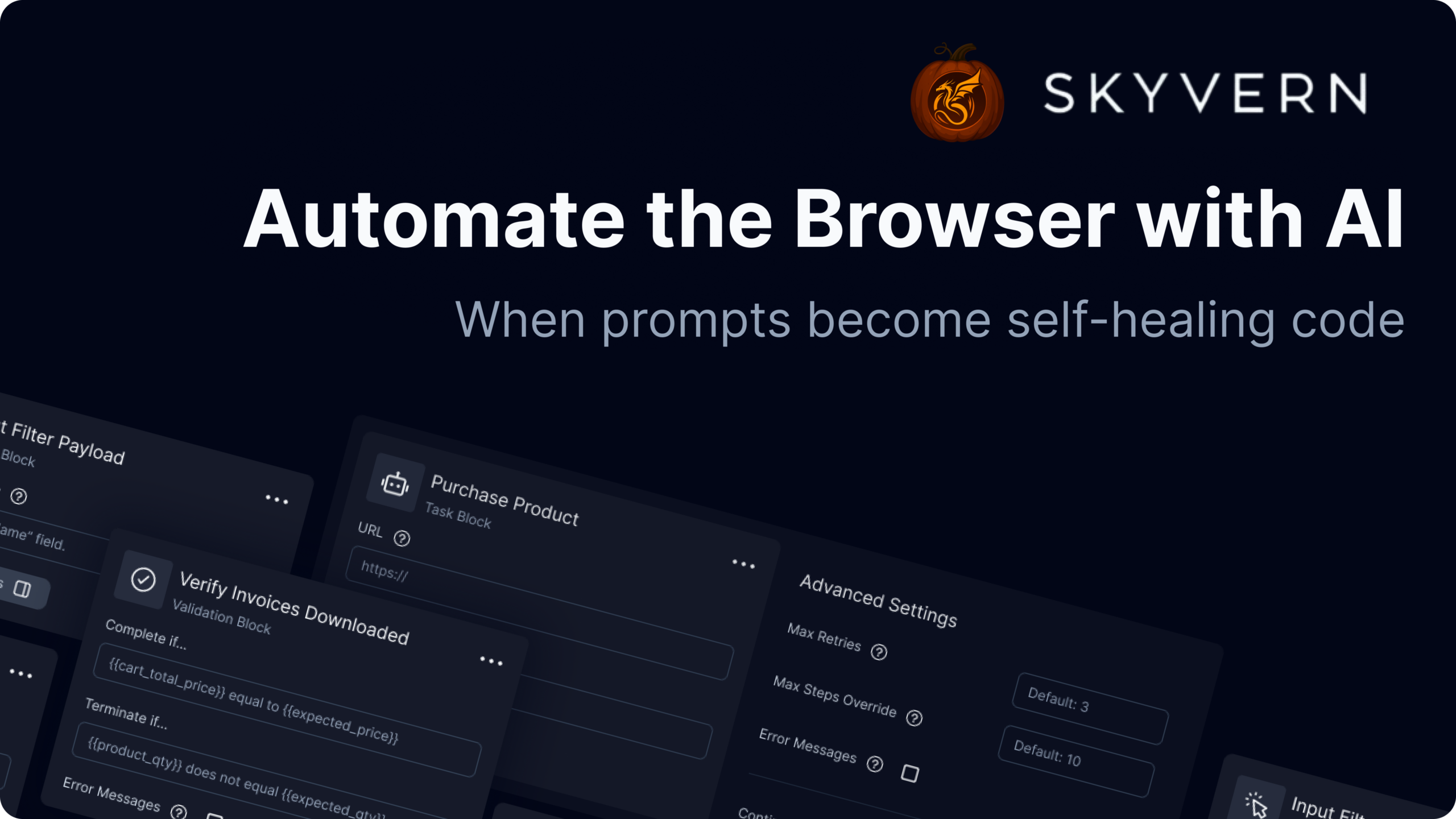
In the rapidly evolving landscape of AI-driven automation, Skyvern emerges as a transformative solution designed to revolutionize how businesses automate complex, browser-based workflows. This innovative open-source platform empowers companies to orchestrate sophisticated web interactions using Large Language Models (LLMs) and Computer Vision instead of traditional hard-coded scripts. By replacing tedious manual code maintenance with AI-generated and self-maintaining automation, Skyvern delivers remarkable efficiency gains, offering a 2.7x reduction in operational costs and a 2.3x increase in execution speed through its intelligent self-coding capabilities. Whether you’re looking to automate data extraction, streamline quality assurance testing, or reduce manual browser operations at scale, Skyvern offers a powerful, intelligent, and genuinely adaptable approach to workflow automation that learns and evolves as websites change.
Let’s dive deeper into what makes Skyvern stand out.
Key Features
Skyvern is equipped with advanced capabilities designed to solve real-world automation challenges:
LLM and Computer Vision for Browser Automation: Leverages multimodal AI to understand and interact with web pages as humans do, interpreting both visual elements and semantic context rather than relying on fragile DOM selectors or XPath expressions.
AI-Generated and Self-Maintaining Playwright Scripts: Automatically generates and continuously updates Playwright-based automation code based on natural language prompts. When websites change layouts or update their structure, Skyvern adapts automatically without requiring manual code updates.
Handles Multi-Step Workflows from Prompts: Users can describe complex, multi-step workflows in plain language, and Skyvern’s AI orchestrates the necessary browser interactions to achieve the desired outcome, handling conditional logic and dynamic decision-making throughout the process.
Open-Source and Cloud Deployment Options: Offers flexibility for deployment scenarios. The open-source version (available on GitHub at Skyvern-AI/skyvern) enables self-hosting with Docker, while the cloud-based solution provides managed infrastructure with zero setup overhead.
Improved Speed (2.3x faster) and Cost (2.7x cheaper) via Self-Coding: Recent enhancements enable Skyvern to write and maintain its own code, automatically optimizing execution paths and reducing token consumption on repeated runs through intelligent action caching and pattern recognition.
Advanced Handling of Complex Web Challenges: Native support for CAPTCHA solving, two-factor authentication (including TOTP/SMS), proxy networks, file uploads, and explainable AI that documents every action the system takes during execution.
How It Works
Skyvern’s operational architecture combines perception, reasoning, and action into an integrated system. Users initiate automation by providing natural language descriptions of their desired workflow through either the web interface or API. Skyvern’s backend then processes this prompt through multiple specialized components working in concert.
First, a Large Language Model (such as GPT-4o, Claude 3.5 Sonnet, or other configurable options) interprets the natural language instruction and reasons through the workflow’s requirements. Simultaneously, the system captures a screenshot of the target webpage and processes it through computer vision models to identify interactive elements—buttons, form fields, links, and other UI components—along with their spatial relationships and semantic meaning.
Rather than searching for elements using brittle selectors, Skyvern’s visual recognition system maps identified UI elements to the semantic instructions from the LLM. As the automation executes using Playwright, the system continuously monitors progress, captures results, and iteratively refines its approach. If a webpage changes its layout, Skyvern’s adaptive system re-evaluates the visual landscape and adjusts its actions accordingly—all without human intervention. This continuous feedback loop is what enables true self-maintenance and resilience to website changes that would break traditional automation scripts.
Use Cases
Skyvern’s versatility makes it invaluable across numerous automation scenarios:
Businesses Automating Repetitive Web Tasks: Ideal for data entry, web scraping, form filling across multiple sites, expense report processing, invoice management, and report generation—freeing internal teams from monotonous manual work.
QA Teams Testing Browser Interactions: Enables robust automated testing of web applications with natural language test definitions, automatically adapting to UI changes and reducing the maintenance burden that traditionally consumes 40-60% of QA automation effort.
Developers Prototyping Workflows Quickly: Offers a rapid way to build and test browser-based automation without writing extensive procedural code, accelerating proof-of-concept development and reducing time-to-automation.
Enterprises Reducing Manual Browser Operations: Helps large organizations scale automation across dozens or hundreds of workflows, significantly cutting labor costs while maintaining reliability across constantly-evolving web interfaces and legacy systems.
Integration and API Automation: Automate complex workflows that involve multiple SaaS platforms, requiring authentication, navigation between systems, and data transformation without traditional API access.
Pros \& Cons
Advantages
No-Code Automation: Empowers non-technical business users to create sophisticated browser automation workflows using natural language, eliminating the need for custom development and significantly lowering time-to-value.
Self-Improving Scripts: AI-generated automation adapts to website changes automatically. When companies redesign their interfaces, your automations continue functioning without requiring code maintenance—a massive advantage over traditional tools where UI changes typically trigger script failures.
Versatile for Dynamic Websites: Handles modern, constantly-evolving web applications where traditional static selectors (XPath, CSS) frequently fail. Works reliably with single-page applications, dynamic content loading, and real-time interface changes.
Transparent Execution: Explainable AI features provide detailed documentation of every action the system takes, enabling debugging, compliance verification, and confidence in automation behavior.
Handles Complex Web Challenges: Native support for CAPTCHA resolution, multi-factor authentication, proxy networks, and other security measures eliminates the need for complex custom solutions.
Disadvantages
Requires Monitoring for Initial Deployment: While self-improving, initial automation runs and critical workflows should be monitored to verify the system correctly interprets your requirements. Complex edge cases may occasionally require refinement or human guidance.
Visual Complexity Can Cause Issues: Highly cluttered interfaces, obfuscated UI elements, or unusual design patterns may occasionally confuse the computer vision component, requiring prompt adjustments or additional context.
Open-Source Version Requires Technical Setup: Self-hosting the open-source deployment requires Docker knowledge and infrastructure management, making it less accessible to non-technical teams compared to the cloud service.
May Struggle with Highly Specialized Interfaces: Proprietary desktop applications, specialized industry software with non-standard UX patterns, or extremely custom legacy interfaces may present challenges for visual recognition.
API Rate Limits on Cloud Service: Heavy usage of Skyvern’s cloud service depends on API rate limits and credit consumption, which may impact cost predictability for extremely high-volume automation scenarios.
How Does It Compare?
Skyvern occupies a genuinely unique position in the automation landscape by combining real-time AI reasoning with visual understanding. Understanding its competitive context requires examining several distinct categories:
Traditional Code-Based Browser Automation
Selenium WebDriver (current stable: v4.38.0 October 2025) remains the industry standard for cross-browser automation testing, with official language bindings for 5+ programming languages and an enormous ecosystem of plugins and frameworks. However, Selenium fundamentally requires developers to write and maintain code—specifically, selectors that break whenever websites change. Teams typically spend 40-60% of automation maintenance effort just updating these selectors. For organizations with dedicated development teams, existing Selenium infrastructure, and relatively stable interfaces, Selenium remains a reliable, battle-tested choice. But for rapid deployment, non-technical users, and dynamic websites, Selenium represents the old paradigm.
Playwright (by Microsoft) modernizes the traditional approach with improved architecture, better auto-wait capabilities, and cross-browser support, but still requires manual code maintenance when UIs change. Development teams appreciate its superior debugging experience and network interception capabilities, but it shares Selenium’s fundamental limitation: code-based maintenance.
Puppeteer (by Google) offers the fastest performance for Chrome/Chromium automation through DevTools Protocol but lacks cross-browser support and similarly depends on coded selectors.
Cloud-Based RPA Platforms
UiPath (2024.10 release with agentic AI) is a full-suite Robotic Process Automation platform addressing enterprise-wide process automation, not just browser tasks. UiPath includes process mining, document processing, task mining, and sophisticated governance features suited to large enterprises automating hundreds of workflows across legacy mainframes, Citrix, SAP, and modern applications. The comprehensive platform comes with correspondingly significant setup costs (12-18 months typical deployment), implementation overhead, and organizational complexity. For enterprises requiring organization-wide automation governance, multi-department orchestration, and integration with existing RPA infrastructure, UiPath is the established leader. For focused browser automation with minimal setup, UiPath is overkill.
Specialized Browser Automation Services
Browserless provides a headless Chrome-as-a-service API for simple browser operations—screenshots, PDF generation, content extraction. Unlike Skyvern, Browserless doesn’t provide intelligence or adaptation; it’s a managed infrastructure play requiring you to still define what actions to take. Best for serverless functions and simple one-off tasks rather than complex workflow automation.
Axiom.ai (backed by Y Combinator and SAP) is a no-code browser automation tool delivered as a Chrome extension. It’s user-friendly and requires no setup, but lacks the sophisticated AI reasoning of Skyvern. Axiom records user actions and replays them, making it excellent for simple, repetitive tasks on stable interfaces. It struggles when websites change because it’s fundamentally action-recording based rather than intent-based, and it doesn’t support complex conditional logic or multi-step workflows as elegantly as Skyvern.
AI-Driven Automation Competitors
IPRally and Simplex represent emerging AI-native automation platforms specifically targeting legacy enterprise portals. Simplex, for example, is pre-trained on systems like Coupa, SAP Ariba, and healthcare portals, offering faster deployment on specific verticals but less flexibility for general-purpose browser automation.
Positioning Summary
Skyvern distinctly differentiates itself through:
Intent-Based Automation Rather Than Code-Based: Unlike Selenium or Playwright where developers write procedural steps, Skyvern interprets natural language intent and reasons through the necessary actions—fundamentally different paradigm.
Self-Healing Without Maintenance: Traditional tools break when UIs change; Skyvern adapts automatically through visual reasoning, dramatically reducing the 40-60% of automation effort spent on maintenance.
Accessibility for Non-Developers: Unlike UiPath’s extensive setup requirements or Selenium’s development expertise, Skyvern enables business users to build sophisticated automations through conversational prompts.
Open-Source Flexibility Plus Managed Cloud: Offering both community self-hosting and managed cloud provides deployment flexibility that monolithic platforms can’t match.
For organizations seeking fast automation deployment, non-technical user empowerment, minimal maintenance overhead on dynamic websites, and cost-efficient scaling, Skyvern represents a genuinely new category: AI-native browser automation. For enterprises requiring organization-wide governance and process orchestration, UiPath remains appropriate. For teams with strong development capabilities and existing Selenium infrastructure, migration should be evaluated based on specific pain points. But for the majority of business use cases involving web automation—where currently either manual work persists or expensive professional services are required—Skyvern offers a compelling new alternative that previous technology simply could not provide.
Final Thoughts
Skyvern represents a significant evolutionary step forward in browser automation, offering a powerful synthesis of Large Language Models, computer vision, and practical browser control. Its ability to generate, understand, and adapt automation from natural language prompts makes complex web workflows accessible to broader organizational audiences, while its improved speed and cost-effectiveness through self-coding provide compelling business value. The platform’s open-source foundation combined with managed cloud options offers deployment flexibility suited to organizations of varying technical sophistication.
For any organization looking to enhance operational efficiency, reduce manual labor, minimize automation maintenance overhead, and future-proof their web-based operations against constant website changes, Skyvern offers an intelligent, genuinely adaptive, and highly promising solution. Whether as a complement to existing automation infrastructure or as a replacement for brittle legacy scripts, Skyvern deserves consideration in your automation strategy evaluation.