
Table of Contents
Overview
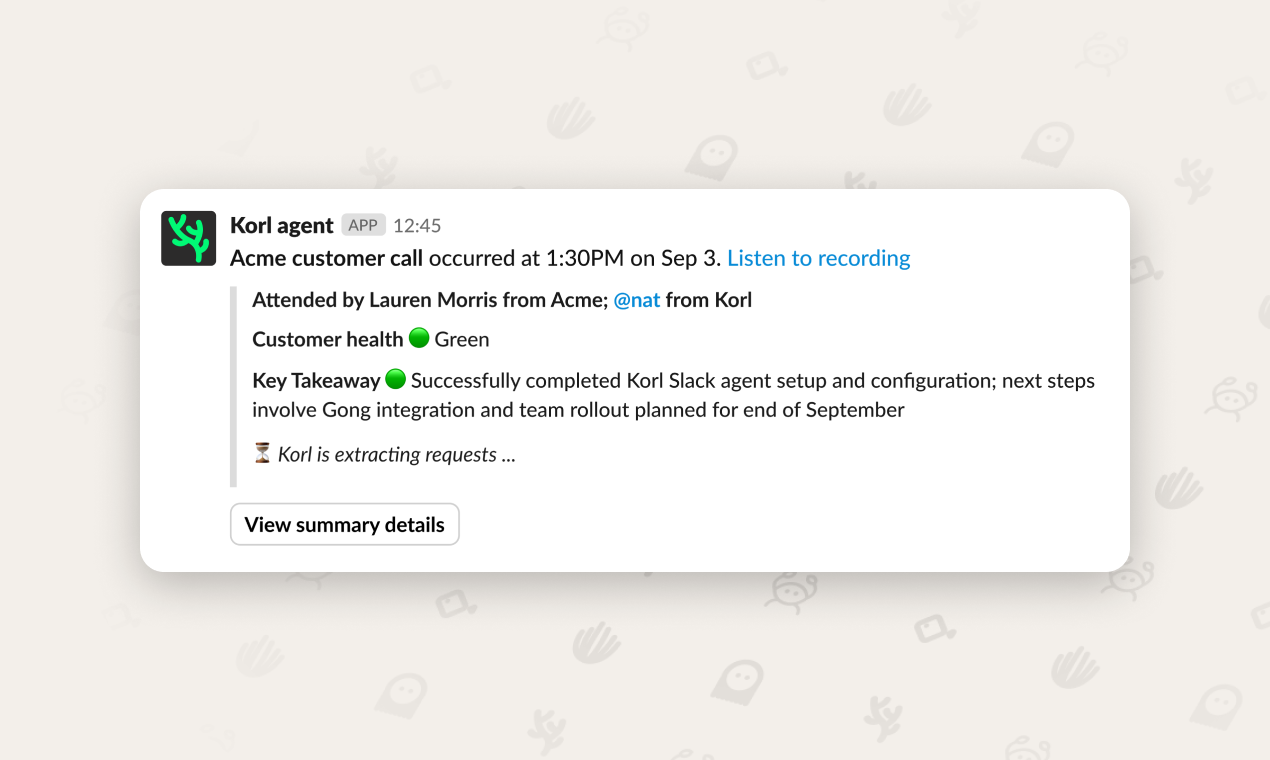
In the fast-paced world of product development and customer success, ensuring customer feedback is heard and acted upon is paramount. Yet, feature requests often fall into a “black hole,” leaving customers feeling unheard and product teams lacking crucial insights. Enter Korl’s Slack Agent, an innovative AI tool designed to bridge this gap by automatically capturing and tracking customer feature requests directly from your existing call recordings, streamlining the entire feedback loop without requiring you to adopt new, complex tools.
Launched on Product Hunt on December 4, 2025, and developed by Korl (a platform previously focused on AI-powered customer presentations), the Slack Feature Request Agent empowers Customer Success Managers (CSMs) to avoid the dreaded request black hole and provides Product teams with unprecedented visibility into customer needs. The agent operates entirely within Slack, eliminating context-switching friction and integrating seamlessly with existing workflows including Gong, Zoom, Fathom, Fireflies for transcript extraction, and Jira or Linear for ticket management.
Key Features
Korl’s Slack Agent is packed with powerful features designed to automate and optimize your customer feedback workflow:
- Auto-Extraction from Gong/Zoom/Fireflies/Fathom: The agent intelligently extracts feature requests directly from customer calls recorded in popular platforms like Gong, Zoom, Fathom, and Fireflies using advanced Large Language Models (LLMs) trained to distinguish between general feedback and actionable feature requests. It analyzes conversation transcripts automatically, identifying specific product enhancement suggestions with contextual understanding, eliminating manual data entry and note-taking burden on customer-facing teams.
- Slack-Based Routing and Review: Once extracted, requests are routed to a dedicated Slack channel with conversation context for easy review and collaboration. The system formats requests with relevant conversation details, customer information, and source links, allowing your team to discuss and prioritize efficiently without leaving Slack. This centralized workflow maintains audit trails between customer conversations and development tickets.
- One-Click Jira or Linear Ticket Creation/Updating: From Slack, product managers can create new Jira or Linear tickets or update existing ones with a single click using slash commands, ensuring seamless integration with your development workflow. The system pre-populates tickets with details from customer conversations, including verbatim quotes, customer context, and priority indicators. Teams can categorize, assign, and prioritize requests without switching between platforms, reducing the typical 3-5 day delay to seconds.
- Automated Customer Closing-the-Loop Notifications: When a feature ships, the agent automatically drafts personalized update messages in Slack referencing the original request and specific customer use cases. CSMs can customize and send these updates directly from Slack to demonstrate closed-loop communication, ensuring customers feel heard and valued. This automation prevents the common oversight of forgetting to notify customers who requested completed features.
- AI-Powered Request Matching and Deduplication: The system uses AI to correlate requests across multiple customers, identifying demand patterns automatically and surfacing likely existing issues for quick linking. Configurable matching logic reduces duplicate tickets by detecting similar requests and suggesting consolidation, ensuring product teams see actual demand rather than fragmented duplicates.
- Transcript Quality Independence Through Contextual Analysis: While dependent on transcript availability, the agent is designed to handle varying transcript quality through contextual analysis that interprets meaning even when exact transcription isn’t perfect. The LLM-based extraction focuses on intent and patterns rather than requiring word-perfect transcriptions.
- Multi-Source Integration Without Tool Proliferation: The agent consolidates feature request capture from multiple conversation platforms (Gong, Zoom, Fathom, Fireflies) without requiring teams to learn or adopt separate feedback management systems. Customer-facing teams continue using their existing call recording tools while product teams benefit from centralized aggregation.
- Permission-Based Routing and Stakeholder Visibility: Configurable routing rules ensure requests reach the right stakeholders automatically based on request type, customer tier, or product area. The system provides product teams with quantifiable demand metrics for specific features, helping prioritize roadmap decisions based on actual customer need rather than anecdotal impressions.
How It Works
Korl’s Slack Agent operates with a smart, automated workflow that integrates seamlessly into your existing tools:
Stage 1: Transcript Ingestion
The process begins by ingesting transcripts from your call recording tools such as Gong, Zoom, Fathom, or Fireflies. The agent connects to these platforms through API integrations, continuously monitoring new call recordings as they become available. No manual uploads or data exports required—the system automatically accesses conversation data.
Stage 2: Intelligent Feature Request Extraction
Leveraging advanced Large Language Models (LLMs), the agent then intelligently identifies and extracts specific feature requests from these transcripts. The AI is trained to distinguish between general feedback (“I wish this were easier”), questions that imply missing features (“How can I do X?”), and explicit feature requests (“We need the ability to…”). Contextual understanding enables the system to capture nuanced requests that might be buried in longer conversations.
Stage 3: Slack Channel Posting with Context
A concise summary of each identified request is posted to a dedicated Slack channel with full conversation context including the customer’s name and contact information (if available), a summary of the specific request, relevant quotes from the conversation, and a direct link to the original call recording in Gong/Zoom/Fathom/Fireflies. This provides Product Managers with all necessary context without requiring them to listen to full calls.
Stage 4: Review, Edit, and Approval Workflow
Here, a Product Manager can easily review the extracted request, edit or clarify the summary if needed, determine if it’s a new request or relates to an existing feature, and approve it for ticket creation. The Slack interface enables quick triage without specialized tools or complex workflows, with team discussion happening directly in the thread.
Stage 5: Jira or Linear Ticket Synchronization
Once approved, the item is synced directly to Jira or Linear, either as a new ticket or an update to an existing one, ensuring nothing gets lost. The synchronization preserves customer context, conversation links, and relevant metadata, creating a complete paper trail from customer request to development backlog. The automated workflow eliminates the typical manual copying between systems that introduces errors and delays.
Stage 6: Closing the Loop When Features Ship
When the feature is completed and shipped, the agent detects status changes in Jira or Linear and automatically drafts personalized customer notifications in Slack. CSMs review the draft, customize if needed, and send it directly to customers, completing the feedback loop and demonstrating responsiveness. This final step, often overlooked in manual workflows, strengthens customer relationships and retention.
Use Cases
Korl’s Slack Agent offers immense value across various teams, transforming how customer feedback is managed and acted upon:
Product Managers Aggregating Feedback from Sales Calls:
- Gain a clear, aggregated view of customer needs and feature requests directly from sales conversations rather than relying on filtered summaries from account executives
- Inform your product roadmap with real-world insights backed by verbatim customer quotes and measurable demand signals
- Identify patterns across multiple customers requesting similar capabilities, validating roadmap priorities with quantifiable data
CS Teams Ensuring Requests Don’t Get Lost:
- Empower Customer Success teams to confidently tell customers their feedback is being captured and tracked automatically, avoiding the frustration of lost requests and improving customer satisfaction
- Reduce the administrative burden of manually logging every feature request mentioned during quarterly business reviews or check-in calls
- Demonstrate value during renewals by showing customers a history of their requests and which ones have been delivered
Automating Release Notes to Specific Customers:
- Automatically notify specific customers when a feature they requested has shipped, providing a personalized and proactive communication experience that strengthens relationships
- Reduce the manual effort of cross-referencing completed features against customer request lists, a task that often doesn’t happen due to time constraints
- Create competitive differentiation by demonstrating responsiveness to customer needs during renewal discussions
RevOps and Operations Teams Reducing Request Processing Time:
- Streamline the backlog of data requests that traditionally bog down operations teams, enabling faster support for business needs
- Scale customer intelligence gathering without proportionally scaling headcount, as automation handles routine capture and routing
- Provide executives with visibility into customer demand trends without manual report compilation
Sales Teams Referencing Fulfilled Requests During Renewals:
- Access historical request data demonstrating customer-driven product development during renewal conversations
- Show tangible evidence of listening to customer feedback, differentiating from competitors who appear less responsive
- Reduce churn by proactively addressing the perception that “they don’t listen to us”
Pros \& Cons
Korl’s Slack Agent brings significant advantages to the table, though it also comes with a few considerations:
Advantages
- Automates Manual Entry and Eliminates Note-Taking: Drastically reduces the time and effort spent manually logging feature requests from call notes, freeing CSMs and product managers from tedious administrative work. What typically requires 15-30 minutes per call for manual documentation now happens automatically in seconds.
- Ensures Customers Feel Heard Through Closed-Loop Communication: By closing the loop with automated notifications when features ship, the tool helps build stronger customer relationships and trust. Customers receive tangible evidence that their feedback influenced product direction, improving retention and Net Promoter Scores.
- Integrates with Existing Stack (Jira/Linear/Gong/Zoom/Fireflies): Works seamlessly with tools you already use, minimizing disruption and adoption hurdles. No need to train teams on new feedback management platforms or change existing workflows—the agent layers automation onto current processes.
- Reduces Feature Request Processing Time from Days to Seconds: The typical delay between a customer mentioning a request and it appearing in the product backlog shrinks from 3-5 days (or never) to real-time, preventing lost opportunities and competitive losses while customers wait for responses.
- Quantifies Demand with Multi-Customer Correlation: The AI-powered matching identifies when multiple customers request similar capabilities, providing product teams with demand signals rather than anecdotal impressions. This data-driven prioritization improves roadmap decisions.
- No Adoption Barrier for Customer-Facing Teams: CSMs, account managers, and sales representatives don’t need to learn a new tool—they simply continue having customer conversations as usual while the agent handles capture automatically.
Disadvantages
- Dependent on Transcription Quality and Accuracy: The accuracy of feature extraction relies heavily on the quality of the call recording tool’s transcription. Poor audio quality, heavy accents, or noisy recordings can reduce extraction reliability, though the LLM-based approach provides some resilience through contextual interpretation.
- Requires Adoption of Specific Call Recording Tools: To leverage its full capabilities, users must be utilizing compatible call recording platforms like Gong, Zoom with transcription enabled, Fathom, or Fireflies. Organizations without these tools would need to adopt them first, adding implementation complexity and cost.
- AI Matching Can Produce False Positives: While AI matching reduces duplicates, it can also produce false positives (incorrectly linking unrelated requests) or miss nuanced asks that appear superficially similar but address different problems. Some human review remains necessary to validate AI suggestions.
- Limited to Conversation-Based Feedback: The agent only captures requests mentioned in recorded calls, missing feedback submitted through other channels like support tickets, in-app feedback forms, community forums, or email. Organizations need complementary tools for comprehensive feedback capture across all channels.
- Early-Stage Product with Limited Track Record: As a recently launched tool (December 2025), Korl’s Slack Agent lacks the battle-testing and feature maturity of established feedback management platforms. Early adopters may encounter evolving features and unknown edge cases.
How Does It Compare?
Korl’s Slack Agent vs. Productboard
Productboard is a mature product management platform emphasizing centralized feedback collection, prioritization frameworks, and roadmap communication.
Feedback Capture:
- Korl’s Slack Agent: Automatic extraction from call recordings with AI-powered identification; top-of-funnel automation eliminating manual input
- Productboard: Multi-channel feedback portal with email integrations, browser extensions, and API connections; typically requires manual input or forwarding
Workflow Integration:
- Korl’s Slack Agent: Operates entirely within Slack without requiring users to adopt a new platform; lightweight automation layer
- Productboard: Standalone platform requiring users to log in, navigate interface, and manage feedback within dedicated tool
Prioritization:
- Korl’s Slack Agent: Basic demand quantification through multi-customer correlation; primarily focuses on capture rather than prioritization
- Productboard: Sophisticated prioritization frameworks (RICE, WSJF, custom scoring) with revenue impact analysis and strategic alignment tools
Roadmap Communication:
- Korl’s Slack Agent: Automated closing-the-loop notifications when features ship; simple status updates
- Productboard: Public customer portals, comprehensive roadmap visualization, customizable views, and stakeholder communication tools
Scope:
- Korl’s Slack Agent: Specialized tool solving call-based feature request capture and notification automation
- Productboard: Comprehensive product management suite covering feedback, prioritization, roadmaps, and stakeholder alignment
When to Choose Korl’s Slack Agent: For automating feature request capture from customer calls, when Slack-native workflow is priority, and when lightweight automation without platform adoption is preferred.
When to Choose Productboard: For comprehensive product management including prioritization frameworks, public roadmaps, stakeholder communication, and when managing feedback from all channels beyond just calls.
Korl’s Slack Agent vs. Dovetail
Dovetail is a customer intelligence platform specializing in qualitative research analysis, user interview synthesis, and deep research insights.
Core Focus:
- Korl’s Slack Agent: Operational feature request tracking from customer conversations with agentic workflow automation
- Dovetail: Qualitative research repository and analysis platform for user interviews, usability tests, and research synthesis
Analysis Depth:
- Korl’s Slack Agent: Lightweight extraction of specific feature requests; surfaces actionable items for product backlog
- Dovetail: Deep qualitative analysis with tagging, theme identification, sentiment analysis, and research insights synthesis
Workflow:
- Korl’s Slack Agent: Continuous operational workflow automatically extracting, routing, and closing-the-loop on requests in real-time
- Dovetail: Project-based research analysis typically conducted in dedicated research cycles; less continuous operational focus
Automation:
- Korl’s Slack Agent: Fully automated extraction, routing, ticketing, and notification workflow without manual intervention
- Dovetail: Semi-automated transcription and AI-assisted analysis; requires researcher involvement for tagging, synthesis, and insights
User Base:
- Korl’s Slack Agent: CSMs, account managers, product managers managing operational feedback loops
- Dovetail: User researchers, UX designers, product managers conducting formal research studies
Data Sources:
- Korl’s Slack Agent: Call recordings from Gong, Zoom, Fathom, Fireflies
- Dovetail: User interviews, usability tests, surveys, feedback sessions, and research artifacts
When to Choose Korl’s Slack Agent: For continuous operational feature request tracking with automated ticket creation and closing-the-loop workflows.
When to Choose Dovetail: For in-depth qualitative research analysis, user interview synthesis, and when building a centralized research repository for cross-functional insights.
Korl’s Slack Agent vs. Savio
Savio is a dedicated feature request tracking tool emphasizing Slack integration, centralized feedback management, and closing-the-feedback-loop automation.
Core Similarity:
- Both focus on Slack-native workflows for feature request tracking
- Both enable logging feedback without leaving Slack
- Both emphasize closing-the-loop when features ship
Request Capture:
- Korl’s Slack Agent: Automatic AI extraction from call transcripts (Gong, Zoom, Fathom, Fireflies); no manual logging required
- Savio: Manual logging from Slack messages using reactions or slash commands; requires CSMs to actively send messages to Savio
Automation Level:
- Korl’s Slack Agent: Fully automated extraction without user action; AI identifies and surfaces requests automatically
- Savio: Semi-automated; users must explicitly mark Slack messages as feedback, though Savio simplifies the process
Multi-Channel Support:
- Korl’s Slack Agent: Specialized for call recordings; doesn’t capture feedback from other channels
- Savio: Integrates with multiple channels (Slack, email, Intercom, Zendesk, Help Scout, Salesforce, HubSpot) for comprehensive feedback capture
Feedback Organization:
- Korl’s Slack Agent: Routes to Slack for review with basic context; primary organization happens in Jira/Linear
- Savio: Dedicated feedback vault with advanced organization, tagging, customer segmentation, MRR tracking, and prioritization tools
Pricing:
- Korl’s Slack Agent: Pricing not publicly disclosed; likely part of broader Korl platform
- Savio: Transparent tiered pricing starting around \$50/month scaling with feature requests and team size
When to Choose Korl’s Slack Agent: For automatic extraction from call recordings without manual logging, when AI-powered identification eliminates user effort.
When to Choose Savio: For comprehensive multi-channel feedback tracking (beyond just calls), advanced organization and prioritization, and when transparent pricing is important.
Korl’s Slack Agent vs. Zapier Custom Automation
Zapier is a no-code automation platform enabling custom workflows between thousands of apps.
Implementation:
- Korl’s Slack Agent: Out-of-the-box solution with pre-built LLM-powered extraction and domain-specific logic for feature requests
- Zapier: Custom workflow requiring manual setup, configuration, and ongoing maintenance by users
Intelligence:
- Korl’s Slack Agent: Intelligent LLM-powered extraction distinguishing feature requests from general feedback, questions, and complaints
- Zapier: Rules-based automation without AI; cannot distinguish request types or extract nuanced asks without extensive custom logic
Closing-the-Loop:
- Korl’s Slack Agent: Automated, personalized customer notifications when features ship with context from original request
- Zapier: Generic notifications possible but lack personalization, context, and customer-specific references without significant custom development
Maintenance:
- Korl’s Slack Agent: Vendor-maintained with updates and improvements deployed automatically
- Zapier: User-maintained workflows requiring ongoing adjustments when tools update, APIs change, or business needs evolve
Cost:
- Korl’s Slack Agent: Fixed platform cost (pricing not publicly disclosed)
- Zapier: Task-based pricing that scales with volume; complex workflows can become expensive at scale
When to Choose Korl’s Slack Agent: For intelligent, domain-specific feature request automation without custom development or maintenance.
When to Choose Zapier: For general-purpose automation across diverse tools, when custom workflows beyond feature requests are needed, or when budget for specialized tools is limited.
Korl’s Slack Agent vs. Manual Process
Manual feature request tracking involves CSMs manually documenting requests in spreadsheets, docs, or directly in Jira/Linear.
Capture Rate:
- Korl’s Slack Agent: Near-100% capture of call-based requests through automated extraction
- Manual Process: Estimated 30-60% capture rate; requests forgotten, deprioritized, or lost in meeting notes
Time Investment:
- Korl’s Slack Agent: Seconds for automated extraction; minutes for review and triage
- Manual Process: 15-30 minutes per call for documentation; 3-5 days typical delay from request to ticket
Consistency:
- Korl’s Slack Agent: Standardized extraction and formatting; every request captured uniformly
- Manual Process: Inconsistent documentation quality depending on individual CSM habits, time pressure, and memory
Closing-the-Loop:
- Korl’s Slack Agent: Automated drafting of personalized notifications when features ship
- Manual Process: Often overlooked due to time constraints; requires manual cross-referencing of completed features against customer lists
Scalability:
- Korl’s Slack Agent: Scales linearly with call volume without additional effort
- Manual Process: Doesn’t scale; more calls require proportionally more CSM time for documentation
When to Choose Korl’s Slack Agent: For nearly all organizations with customer calls and feature requests; ROI from time savings and improved capture rate typically justifies investment.
When to Choose Manual Process: Only when call volume is extremely low (few calls per week), when budget constraints prevent tool adoption, or during early startup phase before processes are established.
Final Thoughts
Korl’s Slack Agent presents a compelling solution for any organization looking to streamline their customer feedback process and ensure no valuable insight is lost in the common “feature request black hole” that plagues product teams. By intelligently automating the extraction, routing, and follow-up of feature requests, it not only saves countless hours but also significantly enhances customer satisfaction and product visibility.
The December 4, 2025 Product Hunt launch positions Korl’s Slack Agent in the growing category of AI-powered workflow automation tools that layer intelligence onto existing platforms rather than replacing them. The tool addresses a genuine pain point: customer-facing teams have valuable conversations containing product feedback, but manual documentation is tedious, inconsistent, and often incomplete. Automation solves this by ensuring every call-based request is captured without additional effort from already-busy CSMs.
What makes Korl’s Slack Agent particularly compelling is its focus on the complete feedback loop—not just capture, but also routing for triage, ticket creation in development tools, and crucially, closing the loop with customers when features ship. This end-to-end automation differentiates it from simpler transcript analysis tools that stop at extraction or general feedback platforms that require significant manual effort.
While its effectiveness is tied to the quality of your call transcriptions and your existing tool stack (particularly requiring Gong, Zoom, Fathom, or Fireflies for call recording), its benefits in creating a more responsive and customer-centric product development cycle are undeniable. The specialized focus on call-based feature requests means organizations need complementary tools for comprehensive feedback management across all channels, but for the specific use case of customer conversation intelligence, Korl offers meaningful automation.
The tool particularly excels for:
- B2B SaaS companies with high-touch customer success models involving regular customer calls
- Product teams struggling to aggregate feature requests from sales and CS conversations
- Customer Success organizations seeking to demonstrate responsiveness during renewals and QBRs
- Organizations already using Gong, Zoom, Fathom, or Fireflies for call recording and seeking to extract more value from existing conversation data
- Teams using Slack as their primary collaboration platform and wanting to minimize tool-switching
For organizations requiring comprehensive feedback management across all channels (support tickets, in-app feedback, community forums, emails), platforms like Productboard or Savio provide broader coverage. For teams conducting formal qualitative research and user interviews, Dovetail offers deeper analysis capabilities. But for the specific intersection of “call-based feature request extraction,” “Slack-native workflow,” and “automated closing-the-loop,” Korl’s Slack Agent represents a purpose-built solution addressing a workflow gap that generic tools don’t fully solve.
If you’re struggling with the “request black hole” where customer conversations contain valuable product feedback that never makes it into your backlog or where customers complain “we told you about this six months ago but nothing happened,” Korl’s Slack Agent might just be the intelligent assistant you need to bridge that gap and create a truly customer-responsive product development culture.