
Table of Contents
Overview
Snyk AI-BOM is an experimental command-line tool and API that generates comprehensive Software Bill of Materials specifically for AI applications, mapping critical dependencies including AI models, datasets, external services, and Model Context Protocol (MCP) connections. Launched on Product Hunt on December 4, 2025 (101 upvotes, 16 comments), Snyk AI-BOM addresses a fundamental visibility gap in modern AI development: the opaque supply chain of AI components where organizations lack systematic inventories of which models, datasets, agent frameworks, and external AI services their applications consume—creating compliance, security, and governance blind spots as AI usage proliferates across engineering teams without centralized oversight.
Unlike traditional Software Bill of Materials (SBOM) tools tracking package dependencies, Snyk AI-BOM extends this concept specifically for AI-native architectures, identifying foundational models (GPT-4, Claude, Gemini), open-source models (Llama, Mistral), training datasets, AI agent libraries (LangChain, AutoGPT), tool-calling patterns, and critically—MCP dependencies representing connections between AI systems and external tools/data sources. The system outputs standardized CycloneDX v1.6 JSON format (the industry-standard SBOM specification supporting AI/ML Bill of Materials since September 2023), enabling integration with existing compliance workflows, vulnerability tracking systems, and procurement policies.
Built by Snyk (YC W15, 1000+ employees, leader in developer security) and currently available in experimental preview to all Snyk customers through CLI v1.1298.3+, API endpoints, and MCP server integration, AI-BOM represents first-mover advantage in “AI supply chain security”—establishing governance frameworks for the AI-native era where prompts, models, and agent workflows replace traditional code-centric development. The tool has been architected to answer critical questions security and engineering leaders face: What AI models does our organization use? Which teams deployed Claude vs. OpenAI? Are we inadvertently exposing sensitive data through untracked AI integrations? What happens when a model we depend on gets deprecated or compromised?
Key Features
Snyk AI-BOM is packed with powerful features designed to illuminate AI supply chain dependencies:
- Auto-Detection of AI Models and Datasets: The CLI automatically analyzes Python source code to identify imported AI models from popular providers (OpenAI GPT-4/GPT-4 Turbo/o1, Anthropic Claude 3.5 Sonnet/Opus/Haiku, Mistral models, Google Gemini) and open-source alternatives (Llama, Falcon, BERT variants). The system detects model references through SDK imports (openai, anthropic, mistralai), configuration files, environment variables, and hardcoded API calls. For each identified model, the output includes model name, version, provider/supplier, model card URLs when available, license information, and usage context. The tool similarly identifies training datasets referenced in code including Hugging Face datasets, custom data loaders, and proprietary training sets—capturing dataset names, versions, sources, and metadata critical for understanding data provenance and potential bias concerns.
- Mapping of Model Context Protocol (MCP) Dependencies: A groundbreaking feature analyzes MCP implementations to visualize previously hidden connections between AI systems and external tools/services. The system identifies three MCP component types: MCP clients (components in your code initiating connections to servers), MCP servers (local scripts or remote services providing tools/resources), and tools/resources (specific functions or data made available by servers). The generated dependency graph shows complete chains like: application → mcp-client → mcp-server → tool, exposing external service dependencies that traditional SBOM tools miss entirely. This MCP visibility proves critical as AI agents increasingly connect to databases, APIs, internal tools, and third-party services through MCP standardized protocols—creating new attack surfaces and compliance obligations requiring systematic tracking.
- CycloneDX v1.6 JSON Output with AI/ML-BOM Support: Snyk outputs standardized CycloneDX format (ratified as ECMA-424 international standard), specifically leveraging the AI/ML-BOM capabilities introduced in CycloneDX v1.5 (June 2023) and refined in v1.6 (April 2024). The JSON structure includes metadata sections for AI-specific components, dependency relationships showing which models depend on which datasets or services, vulnerability tracking compatible with existing SBOM analysis tools, and license compliance information for model usage rights. This standardization enables interoperability with enterprise vulnerability management systems (Dependabot, Snyk Open Source, JFrog Xray), compliance frameworks (SOC 2, ISO 27001, NIST AI Risk Management), and procurement workflows requiring AI asset inventories. Organizations already using CycloneDX for traditional SBOMs seamlessly extend their tooling to AI components without proprietary format adoption.
- Visualization of AI Supply Chain through HTML Reports: The tool generates interactive HTML visualizations embedding AI-BOM data into navigable dependency graphs illustrating relationships between applications, models, datasets, MCP connections, and external services. The visual format enables non-technical stakeholders (executives, compliance officers, procurement teams) to comprehend AI supply chain complexity without parsing JSON schemas. The graphs highlight critical paths showing how user-facing applications depend on specific models, which in turn connect to external APIs through MCP servers—making abstract dependency chains concrete and actionable. Visualization proves especially valuable for documenting complex agentic workflows where AI agents orchestrate multiple models, tools, and data sources in ways that resist textual description.
- Integration with Snyk Ecosystem for Vulnerability Management: AI-BOM outputs integrate with Snyk’s comprehensive developer security platform, enabling unified vulnerability tracking across traditional code dependencies and AI components. Organizations already using Snyk for dependency scanning, container security, or infrastructure-as-code analysis extend their existing workflows to AI assets without adopting separate tooling. The integration enables centralized dashboards showing vulnerabilities across entire technology stacks (packages, containers, infrastructure, and now AI models), consolidated alerting when models contain known vulnerabilities or licensing issues, and policy enforcement preventing deployment of non-compliant AI components. This ecosystem integration reduces operational fragmentation compared to point solutions requiring separate security infrastructure for AI versus traditional development.
- Detection of AI Agent Libraries and Tool-Calling Patterns: Beyond individual models, the system identifies AI agent frameworks (LangChain, AutoGPT, BabyAGI, CrewAI) enabling autonomous AI systems that chain multiple model calls and tool executions. The tool analyzes code patterns associated with tool calling—functions exposed to AI models enabling database queries, API invocations, file system access, or external service integrations. This agent-aware scanning proves critical as organizations increasingly deploy agentic AI systems that autonomously orchestrate complex workflows rather than simple prompt-response interactions. Understanding which agent frameworks and tool patterns exist across codebases enables risk assessment specific to autonomous AI behaviors including unauthorized data access, unintended API charges, or cascading failures from agent decision chains.
- Support for Compliance and Governance Requirements: The standardized AI-BOM format facilitates compliance with emerging AI regulations including the EU AI Act requiring risk assessment and documentation for high-risk AI systems, upcoming SEC cybersecurity disclosure rules potentially covering AI dependencies, and industry-specific regulations (HIPAA for healthcare AI, GDPR for EU data processing, CCPA for California consumer data). The structured inventory enables organizations to answer regulatory questions like: Which AI systems process personal data? What models underpin high-risk decision-making? Can we demonstrate supply chain integrity for deployed AI components? The audit trail proves especially valuable during compliance assessments, security incidents requiring forensic analysis of AI component provenance, or vendor risk reviews evaluating third-party AI dependencies.
- Tracking “Shadow AI” Usage Preventing Unauthorized Deployment: Shadow AI represents the phenomenon where individual developers or teams deploy AI integrations without centralized approval—creating unknown cost exposures, data leakage risks, and compliance violations. Snyk AI-BOM enables systematic discovery of unauthorized AI usage by scanning all codebases across organizations, identifying which repositories contain AI model integrations, surfacing teams using expensive models without budget approval, and detecting data exposure through unvetted AI service connections. Real-world examples from Reddit discussions highlight teams discovering \$2,000 Claude API charges from “experimental” integrations running against entire knowledge bases over weekends—incidents preventable through systematic AI-BOM scanning before production deployment.
- MCP Server Integration Enabling Real-Time Security Scanning: Beyond CLI batch analysis, Snyk provides experimental MCP server implementation integrating security scans directly into AI-powered development environments (Claude Desktop, Cursor, Windsurf, Continue, GitHub Copilot). Developers working in MCP-enabled tools trigger Snyk scans through natural language prompts without leaving flow state, receiving instant security feedback about AI components they reference in code. This “secure at inception” approach embeds security where AI-native development begins—with prompts—rather than retroactively scanning codebases after deployment. The MCP integration represents Snyk’s broader vision for AI-native security workflows adapting to “vibe coding” paradigms replacing traditional development processes.
- API Access for Enterprise Integration and Automation: The AI-BOM API (version 2025-07-22) enables programmatic access supporting enterprise workflows including automated scanning across all repositories in Snyk organizations, CI/CD pipeline integration blocking deployments containing non-compliant AI components, custom dashboards aggregating AI usage metrics across business units, and alert systems notifying security teams when specific models or MCP connections appear in codebases. The API facilitates building custom tooling like ai-bom-scan (open-source tool from Snyk Labs) searching organization-wide for specific AI frameworks (“deepseek”, “openai”, “anthropic”) and reporting which repositories contain matches—enabling targeted governance enforcement rather than manual code reviews.
How It Works
Snyk AI-BOM operates through sophisticated static analysis and pattern matching:
Stage 1: Environment Setup and Authentication
Users install Snyk CLI v1.1298.3 or later from the stable release channel (note: early documentation referenced preview channel but current guidance uses stable releases). Authentication occurs via snyk auth opening web browser for account login, or by setting SNYK_TOKEN environment variable for CI/CD integrations. Organizations with multiple Snyk organizations specify target org via --org=<ORG_ID> parameter or configure default through snyk config set org=<ORG_ID>.
Stage 2: Repository Scanning and Code Analysis
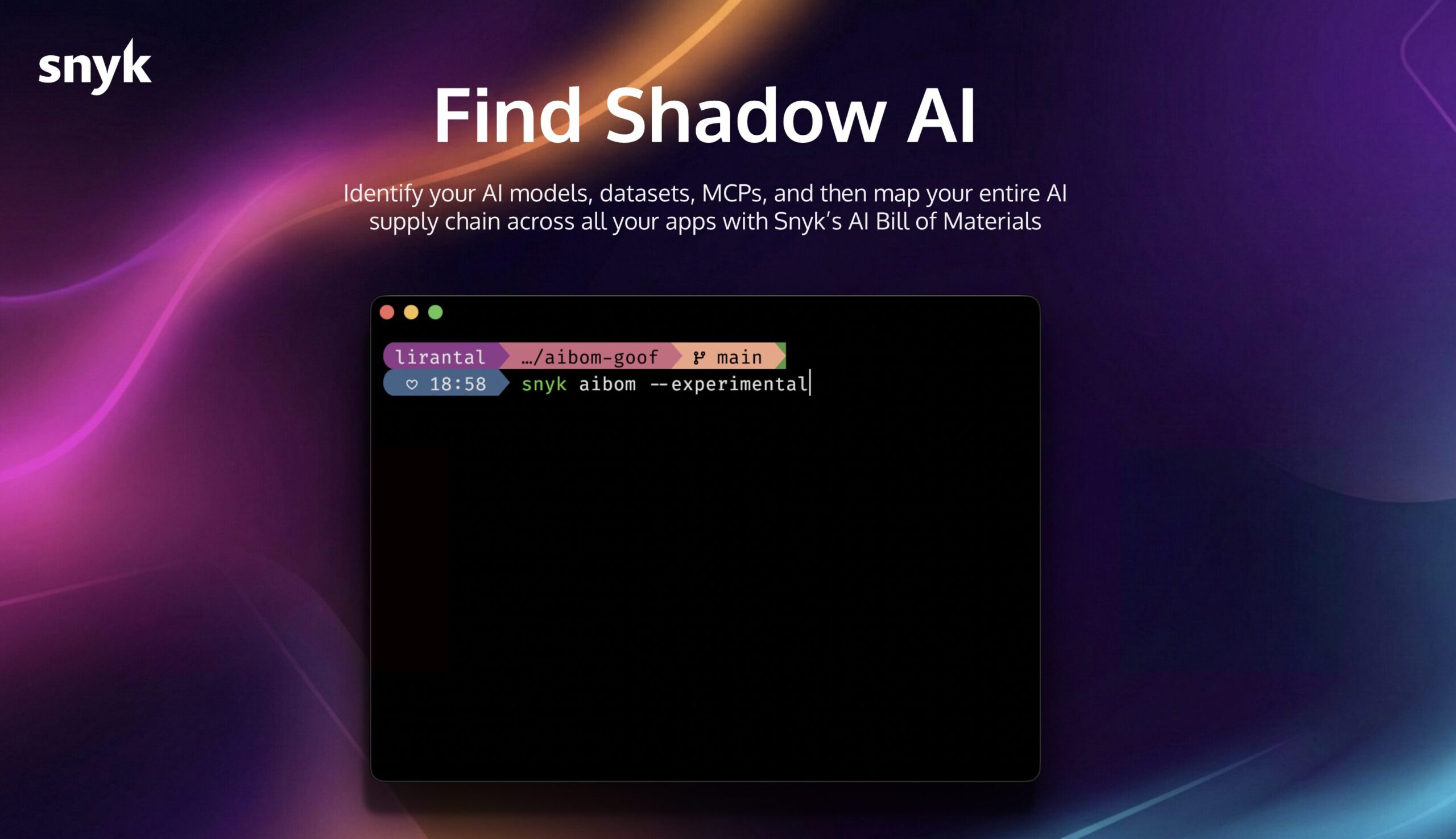
From Python project root directories (current limitation: Python-only support), users execute snyk aibom --experimental triggering static analysis of source code, configuration files, environment variables, requirements.txt dependencies, poetry.lock or Pipfile.lock for package managers, and imported modules. The scanner implements pattern matching identifying AI framework imports (openai, anthropic, mistralai, langchain, autogpt, llamaindex), model identifier strings (gpt-4, claude-3.5-sonnet, llama-70b), API endpoint references, and MCP SDK usage patterns. Unlike dynamic analysis requiring code execution, static scanning operates safely without running potentially malicious code or consuming API credits.
Stage 3: AI Component Identification and Classification
Identified components are classified into taxonomy categories defined by CycloneDX AI/ML-BOM specification: foundational models (commercial LLMs from OpenAI/Anthropic/Google), open-source models (Llama, Mistral, local deployments), datasets (Hugging Face datasets, custom training data), agents (identified via LangChain/AutoGPT patterns), tools (functions exposed for model tool calling), and MCP components (clients, servers, tools, resources). Each component captures metadata including name, version, supplier/provider, license information, model card URLs, and usage context (which source files reference each component).
Stage 4: MCP Dependency Graph Construction
For Model Context Protocol usage, the system constructs dependency chains showing relationships: application code depends on MCP client libraries, MCP clients connect to MCP server endpoints (local or remote), MCP servers provide specific tools or resources. This multi-level dependency mapping exposes complete paths from application entry points to external services accessed through MCP—visibility impossible with traditional dependency scanners treating MCP connections as opaque network calls. The graph identifies security-critical relationships like AI applications accessing internal databases, APIs with customer data, or external SaaS tools through MCP-mediated connections requiring governance controls.
Stage 5: CycloneDX JSON Generation
Collected component data and dependency relationships are serialized into CycloneDX v1.6 JSON format conforming to ECMA-424 international standard. The JSON includes metadata sections (timestamp, tool version, organization ID), component arrays (models, datasets, agents, tools, MCP servers/clients), dependency relationships (parent-child connections between components), and compliance metadata (licenses, model cards, usage restrictions). The standardized format enables import into vulnerability management platforms, compliance tracking systems, and procurement databases without custom parsing logic.
Stage 6: Optional HTML Visualization
When users specify --html flag, the system embeds JSON data into interactive HTML visualization rendering dependency graphs with nodes representing components (models, datasets, MCP servers) and edges showing relationships (model depends on dataset, MCP client connects to server). The visualization supports filtering by component type, highlighting critical paths, and drilling into component details. HTML format enables sharing with non-technical stakeholders, embedding in compliance documentation, or presenting to executive leadership requiring comprehensible AI supply chain representations.
Stage 7: Output and Integration
Generated AI-BOM files are saved to disk via --json-file-output parameter specifying output paths, or displayed to stdout for pipeline integration. Organizations ingest outputs into Snyk’s vulnerability management platform for centralized tracking, commit AI-BOM files to repositories documenting AI dependencies alongside traditional SBOMs, or integrate with SIEM/GRC platforms (Splunk, ServiceNow, OneTrust) for compliance workflows. The API enables automated scanning across entire organizations, scheduled audits detecting new AI usage, and alerting workflows notifying security teams when policy violations occur.
Stage 8: Continuous Monitoring and Update Detection
Organizations establish recurring AI-BOM generation (daily/weekly CI/CD scans) detecting changes in AI dependencies: new models introduced by development teams, version upgrades of existing models, additional MCP connections to external services, or removal of deprecated components. Diff analysis comparing current AI-BOM against previous versions highlights supply chain evolution, enabling change management workflows requiring approval before production deployment. This continuous monitoring prevents “shadow AI” proliferation where unauthorized integrations accumulate undetected until causing incidents.
Use Cases
Given its specialized capabilities, Snyk AI-BOM addresses various scenarios where AI supply chain visibility is critical:
Security Audits of AI Applications:
- Systematic inventory of all AI components enables security teams to assess attack surfaces specific to AI systems including model poisoning risks, prompt injection vulnerabilities, data exfiltration through MCP connections, and supply chain compromises in third-party models
- Identification of unauthorized or deprecated models facilitates risk reduction by flagging components lacking security updates, models with known vulnerabilities, or services from unvetted providers
- MCP dependency mapping exposes external services AI systems access, enabling network segmentation policies, access control reviews, and data classification enforcement preventing sensitive data leakage through AI tool integrations
Compliance Reporting for EU AI Act and Emerging Regulations:
- EU AI Act Article 11 requires technical documentation for high-risk AI systems including description of system components and supply chain relationships—exactly what AI-BOM provides in standardized format
- Financial services organizations subject to model risk management requirements (SR 11-7) document AI model inventories, version control, and vendor dependencies through AI-BOM audit trails
- Healthcare HIPAA compliance demonstrates which AI models process protected health information (PHI), proving data minimization and vendor BAA coverage through systematic dependency tracking
Tracking “Shadow AI” Usage Preventing Unauthorized Cost Exposure:
- Engineering managers discover teams deploying unauthorized AI integrations consuming organizational API budgets without approval—like Reddit user reporting \$2,000 surprise Claude charges from “experimental” integration
- CFOs obtain visibility into AI spending by identifying which business units use expensive commercial models versus cost-effective open-source alternatives, enabling budget allocation optimization
- Security teams detect data exfiltration risks from developers connecting AI systems to internal databases, customer data stores, or proprietary knowledge bases without security review
Visualizing Complex Agentic Workflows for Architecture Review:
- Development teams document autonomous AI agent architectures showing how agents chain multiple model calls, invoke external tools, and orchestrate data flows—essential for debugging when agent behavior becomes unpredictable
- Architecture review boards assess proposed AI systems’ complexity and external dependencies before approving production deployment, preventing over-complex agent designs with excessive failure modes
- Incident response teams reconstruct AI system behavior during post-mortems by referencing AI-BOM documentation showing exactly which models, tools, and services were involved in problematic workflows
Vendor Risk Management for AI Supply Chain Dependencies:
- Procurement teams identify which critical business processes depend on specific AI vendors (OpenAI, Anthropic, Google), enabling contract negotiation leverage and business continuity planning for vendor outages
- Legal departments assess licensing obligations for open-source models, ensuring compliance with restrictive licenses (Apache 2.0 vs. commercial use restrictions) and avoiding IP infringement
- Executive leadership obtains portfolio view of AI technology choices across organization, identifying over-concentration on single vendors creating resilience risks or opportunities to standardize on preferred providers
Pros \& Cons
Every powerful tool comes with its unique set of advantages and potential limitations:
Advantages
- First-Mover in AI Supply Chain Security: Snyk AI-BOM establishes the first comprehensive SBOM framework specifically for AI dependencies, creating early mover advantage in defining standards and best practices for emerging AI governance requirements. As regulatory bodies worldwide develop AI compliance frameworks (EU AI Act, US Executive Order on AI, industry-specific guidance), organizations using AI-BOM possess documentation infrastructure competitors must retroactively build.
- Supports New MCP Standard Enabling Future-Proof Architecture: Model Context Protocol represents Anthropic’s emerging standard for AI-to-tool connections supported by major AI development platforms (Claude Desktop, Cursor, GitHub Copilot, Continue, Windsurf). By building MCP detection into AI-BOM, Snyk ensures the tool remains relevant as AI development shifts toward standardized agent-to-service protocols rather than proprietary integration patterns. This forward compatibility protects investment in AI-BOM tooling as ecosystem matures.
- Leverages Snyk’s Established Trust and Ecosystem: Organizations already using Snyk for developer security (1000+ employees, YC W15, trusted by Fortune 500) seamlessly extend existing workflows to AI components rather than adopting standalone point solutions. The unified platform reduces operational complexity, training overhead, and vendor proliferation compared to managing separate security tools for traditional code versus AI dependencies.
- Standardized CycloneDX Output Enabling Interoperability: Unlike proprietary formats requiring custom tooling, CycloneDX (ECMA-424 international standard) ensures AI-BOM outputs integrate with existing vulnerability management platforms, compliance frameworks, and procurement systems. Organizations already processing CycloneDX SBOMs for traditional software extend their pipelines to AI components without format conversion or custom parsers.
- Free Experimental Access Lowering Adoption Barriers: Current experimental status provides free access to all Snyk customers eliminating budget approval hurdles during evaluation phase. Organizations assess AI-BOM value through production testing before committing resources, reducing adoption risk compared to commercial alternatives requiring upfront investment.
- Addresses Critical “Shadow AI” Discovery Gap: Real-world incidents (surprise API bills, unauthorized data exposure) demonstrate genuine need for systematic AI usage discovery. Snyk AI-BOM provides actionable solution to documented problem rather than speculative feature, justifying adoption through measurable risk reduction preventing costly security/compliance incidents.
Disadvantages
- Experimental/Early Stage with Potential Breaking Changes: Snyk explicitly warns AI-BOM is experimental and subject to breaking changes without notice—creating adoption risk for production workflows depending on stable APIs. Early adopters may experience feature changes, output format modifications, or functional regressions requiring code updates. Organizations with low risk tolerance should monitor tool maturity before establishing critical dependencies.
- Currently Limited to Python Projects Only: The v1.1298.3 implementation supports exclusively Python codebases, excluding JavaScript/TypeScript (dominant in web AI applications), Java (enterprise AI systems), Go (infrastructure AI tools), and C++/Rust (performance-critical AI). Multi-language organizations must wait for expanded language support or implement custom scanning for non-Python AI usage, limiting comprehensive visibility.
- Requires Snyk CLI Adoption and Integration: Organizations not currently using Snyk must install CLI tools, configure authentication, integrate into CI/CD pipelines, and train teams on new workflows—adoption friction absent from integrated solutions within existing development tools. Small teams or resource-constrained organizations may deprioritize deployment versus more urgent security initiatives.
- Static Analysis Limitations Versus Runtime Visibility: CLI static analysis detects AI dependencies present in source code but misses runtime-generated model calls, dynamic MCP connections established through configuration, or AI integrations loaded via plugins/extensions. Complete AI supply chain visibility requires runtime monitoring supplementing static analysis—capabilities not yet available in AI-BOM’s current implementation.
- MCP Detection Limited to Official SDK Patterns: While AI-BOM detects official MCP SDK usage, custom MCP implementations or alternative protocols connecting AI systems to external tools may evade detection. Organizations using proprietary agent frameworks or non-standard integration patterns require custom detection rules or supplementary scanning tools achieving comprehensive MCP visibility.
- No Direct Vulnerability Scoring for AI-Specific Risks: Unlike traditional SBOMs linking to CVE databases with quantified vulnerability scores, AI-BOM lacks mature vulnerability intelligence for AI-specific threats (model poisoning, prompt injection, adversarial attacks). Organizations must manually assess AI component risks using external research rather than automated risk scoring guiding prioritization—capability gap expected to narrow as AI vulnerability databases mature.
How Does It Compare?
Snyk AI-BOM vs. CycloneDX Specification
CycloneDX is the OWASP-backed open standard (ECMA-424) for Software Bill of Materials with AI/ML-BOM support introduced in v1.5.
Tool vs. Standard:
- Snyk AI-BOM: Implementation tool generating CycloneDX-compliant AI-BOMs through automated code scanning
- CycloneDX: Specification defining data format and schema without providing generation tooling
Practical Use:
- Snyk AI-BOM: Automated AI dependency detection from codebases requiring no manual BOM creation
- CycloneDX: Enables standardized representation once AI components are identified but requires tools like Snyk to populate data
Ecosystem Integration:
- Snyk AI-BOM: Integrates with Snyk’s vulnerability management platform for actionable security workflows
- CycloneDX: Vendor-neutral standard supporting interoperability across diverse tooling ecosystems
Language Support:
- Snyk AI-BOM: Currently Python-only in experimental release
- CycloneDX: Language-agnostic standard applicable to any programming environment with appropriate tooling
When to Choose Snyk AI-BOM: For automated AI-BOM generation from Python codebases with minimal manual effort.
When to Choose CycloneDX: When evaluating multiple AI-BOM generation tools or requiring vendor-neutral standard for procurement specifications.
Snyk AI-BOM vs. Protect AI (ModelScan \& Guardian)
Protect AI focuses on ML model security scanning for malware, vulnerabilities, and model integrity through ModelScan (open-source) and Guardian (enterprise platform).
Core Focus:
- Snyk AI-BOM: AI supply chain visibility through dependency mapping and SBOM generation
- Protect AI: Model security scanning detecting malicious code, vulnerabilities, and tampering within model files
Scanning Approach:
- Snyk AI-BOM: Static code analysis identifying AI component references and dependencies
- Protect AI: Model file analysis scanning serialized models (PyTorch .pt, TensorFlow SavedModel, Pickle) for embedded malware
Security Coverage:
- Snyk AI-BOM: Tracks which models/datasets organizations use enabling risk assessment but doesn’t scan model files for threats
- Protect AI: Deep model inspection detecting model serialization attacks, credential theft, data poisoning, backdoors
Supply Chain Visibility:
- Snyk AI-BOM: Comprehensive dependency mapping including MCP connections and agent frameworks
- Protect AI: Focused on model artifact security without broader supply chain dependency tracking
Deployment Integration:
- Snyk AI-BOM: Developer-focused CLI integrated into Snyk ecosystem
- Protect AI Guardian: Enterprise gateway intercepting Hugging Face model downloads with policy enforcement
Pricing:
- Snyk AI-BOM: Free experimental feature in Snyk CLI
- Protect AI: ModelScan open-source free; Guardian enterprise custom pricing
When to Choose Snyk AI-BOM: For AI supply chain visibility, compliance documentation, and tracking AI usage across organizations.
When to Choose Protect AI: For detecting malicious code within model files, securing Hugging Face model downloads, and enterprise model security gateways.
Snyk AI-BOM vs. HiddenLayer
HiddenLayer provides comprehensive AI security platform including Model Scanner, AI Detection \& Response (AIDR), Automated Red Teaming, and Model Inventory.
Platform Scope:
- Snyk AI-BOM: Specialized CLI tool for AI-BOM generation and supply chain mapping
- HiddenLayer: Full-stack AI security platform spanning development through production
Model Scanning:
- Snyk AI-BOM: Identifies which models codebases reference without scanning model files
- HiddenLayer Model Scanner: Analyzes 30+ model formats for malware, vulnerabilities, backdoors, and integrity issues
Runtime Protection:
- Snyk AI-BOM: Static analysis without runtime monitoring capabilities
- HiddenLayer AIDR: Real-time threat detection for deployed models protecting against prompt injection, adversarial attacks, model extraction
Red Teaming:
- Snyk AI-BOM: No adversarial testing capabilities
- HiddenLayer: Automated security testing using OWASP Top 10 attack techniques generating risk assessments
Inventory Management:
- Snyk AI-BOM: Generates point-in-time AI-BOMs requiring manual aggregation across repositories
- HiddenLayer: Centralized model inventory with automated discovery, security status tracking, and continuous monitoring
Target Audience:
- Snyk AI-BOM: Development teams requiring compliance documentation and supply chain visibility
- HiddenLayer: Enterprise security operations teams needing comprehensive AI security across MLOps lifecycle
Pricing:
- Snyk AI-BOM: Free experimental
- HiddenLayer: Enterprise pricing with custom quotes targeting Fortune 100 and government agencies
When to Choose Snyk AI-BOM: For lightweight AI supply chain documentation, compliance reporting, and integration with existing Snyk workflows.
When to Choose HiddenLayer: For comprehensive AI security including runtime protection, automated red teaming, and enterprise-grade model inventory management.
Snyk AI-BOM vs. Manual AI Dependency Tracking
Manual tracking involves teams maintaining spreadsheets, wikis, or documentation listing AI components used across organization.
Automation:
- Snyk AI-BOM: Automated code scanning discovering AI dependencies without manual cataloging
- Manual: Requires developers manually reporting AI usage through surveys, intake forms, or documentation
Accuracy:
- Snyk AI-BOM: Systematic code analysis detecting undocumented AI usage including shadow AI
- Manual: Relies on team honesty and memory; frequently incomplete as developers forget to document experimental integrations
Scalability:
- Snyk AI-BOM: Scans hundreds of repositories in minutes generating comprehensive organization-wide AI-BOMs
- Manual: Scales poorly beyond handful of teams; updating documentation across large organizations consumes hours monthly
MCP Visibility:
- Snyk AI-BOM: Automatically maps complex MCP dependency chains showing external service connections
- Manual: MCP relationships too complex for manual documentation; teams lack visibility into indirect dependencies
Compliance:
- Snyk AI-BOM: Standardized CycloneDX output accepted by auditors and compliance frameworks
- Manual: Custom spreadsheets require translation into compliance artifacts during audits
When to Choose Snyk AI-BOM: For nearly all organizations; automation justifies adoption versus error-prone manual tracking.
When to Choose Manual: Only for smallest teams (1-3 developers) using single AI service without compliance requirements.
Final Thoughts
Snyk AI-BOM represents a watershed moment in AI security by extending proven SBOM concepts to the emerging domain of AI supply chains, providing first-mover advantage in governance frameworks for AI-native development. The December 4, 2025 Product Hunt launch and experimental availability to all Snyk customers position it as early-stage innovation addressing genuine pain points documented through real-world incidents (surprise API bills, unauthorized data exposure, compliance audit failures) rather than speculative concerns.
What makes Snyk AI-BOM particularly compelling is its recognition that AI development creates fundamentally different supply chain characteristics than traditional software. While conventional SBOMs track package dependencies, AI applications depend on commercial LLM APIs, open-source models from Hugging Face, training datasets with licensing implications, autonomous agent frameworks, and critically—MCP connections to external tools/services that don’t appear in package manifests. This new dependency landscape requires purpose-built tooling understanding AI-specific components, which Snyk AI-BOM provides through its focus on models, datasets, agents, and MCP mappings.
The Model Context Protocol detection specifically deserves emphasis as unique competitive advantage. MCP represents Anthropic’s emerging standard for AI-to-tool connections supported by major platforms (Claude Desktop, Cursor, GitHub Copilot), creating new supply chain layer requiring visibility. By building MCP detection into AI-BOM, Snyk future-proofs the tool as AI development shifts toward standardized agent protocols. This forward compatibility proves especially valuable given the experimental status—organizations adopting AI-BOM now benefit as both the tool and broader MCP ecosystem mature together.
The tool particularly excels for:
- Compliance and governance teams facing EU AI Act documentation requirements or preparing for emerging US AI regulations needing systematic AI component inventories
- Security organizations combating shadow AI proliferation where teams deploy unauthorized AI integrations creating unknown attack surfaces and cost exposures
- Engineering leadership requiring visibility into AI technology choices across business units to negotiate vendor contracts, assess vendor lock-in risks, and optimize AI spending
- Audit and risk management functions needing defensible documentation of AI supply chains during regulatory examinations or third-party security assessments
- Development teams using Snyk who seamlessly extend existing vulnerability management workflows to AI components without adopting separate tooling
For organizations requiring comprehensive AI security beyond dependency visibility, HiddenLayer’s full-stack platform (\$100,000+/year enterprise pricing) provides model scanning for embedded malware, runtime protection against adversarial attacks, and automated red teaming—capabilities Snyk AI-BOM doesn’t address. For teams needing model file security specifically, Protect AI’s ModelScan (open-source) or Guardian (enterprise) scan serialized models for malicious code that AI-BOM’s code analysis wouldn’t detect. For non-Python environments, organizations must wait for language support expansion or implement custom scanning solutions achieving comparable visibility.
But for the specific intersection of “AI supply chain visibility,” “compliance documentation,” and “shadow AI discovery,” Snyk AI-BOM provides unique value through systematic dependency mapping impossible via manual tracking or repurposed traditional SBOM tools. The platform’s primary limitations—experimental status with potential breaking changes, Python-only support, and static analysis gaps versus runtime visibility—reflect expected early-stage constraints rather than fundamental design flaws, with roadmap evolution likely addressing these gaps as tool matures.
The critical strategic question isn’t whether AI supply chain visibility matters (regulatory trajectory and real-world incidents prove necessity), but whether organizations will adopt systematic tooling like Snyk AI-BOM or rely on inadequate manual tracking that fails audit scrutiny and misses shadow AI risks. The zero-cost experimental access eliminates financial barriers enabling production testing, while Snyk’s established ecosystem trust reduces adoption friction compared to unknown vendors.
If your organization struggles to answer “What AI models do we use?”, if compliance teams face upcoming regulatory audits requiring AI system documentation, or if shadow AI proliferation creates financial and security risks from unauthorized integrations, Snyk AI-BOM provides accessible specialized solution worth evaluating through free experimental deployment. The standardized CycloneDX output ensures investment translates across vendors if alternative AI-BOM tools emerge, while first-mover advantage positions early adopters ahead of competitors scrambling to build governance frameworks when regulations enforce compliance deadlines.