
Table of Contents
- Superapp: AI-Powered iOS Development Platform – Comprehensive Research Report
- 1. Executive Snapshot
- 2. Impact \& Evidence
- 3. Technical Blueprint
- 4. Trust \& Governance
- 5. Unique Capabilities
- 6. Adoption Pathways
- 7. Use Case Portfolio
- 8. Balanced Analysis
- 9. Transparent Pricing
- 10. Market Positioning
- 11. Leadership Profile
- 12. Community \& Endorsements
- 13. Strategic Outlook
- Final Thoughts
Superapp: AI-Powered iOS Development Platform – Comprehensive Research Report
1. Executive Snapshot
Superapp operates as an artificial intelligence-powered full-stack development platform specializing in native iOS application creation using Swift. Founded by Vitalik Kotik, a former Senior Product Designer at Bolt with eight years of product development experience, the platform emerged from a recognition that iOS app development remains prohibitively complex for non-technical entrepreneurs despite advances in no-code tools. The company launched on Product Hunt on November 12, 2025, achieving 465 upvotes and securing recognition on the daily featured list, signaling early market validation.
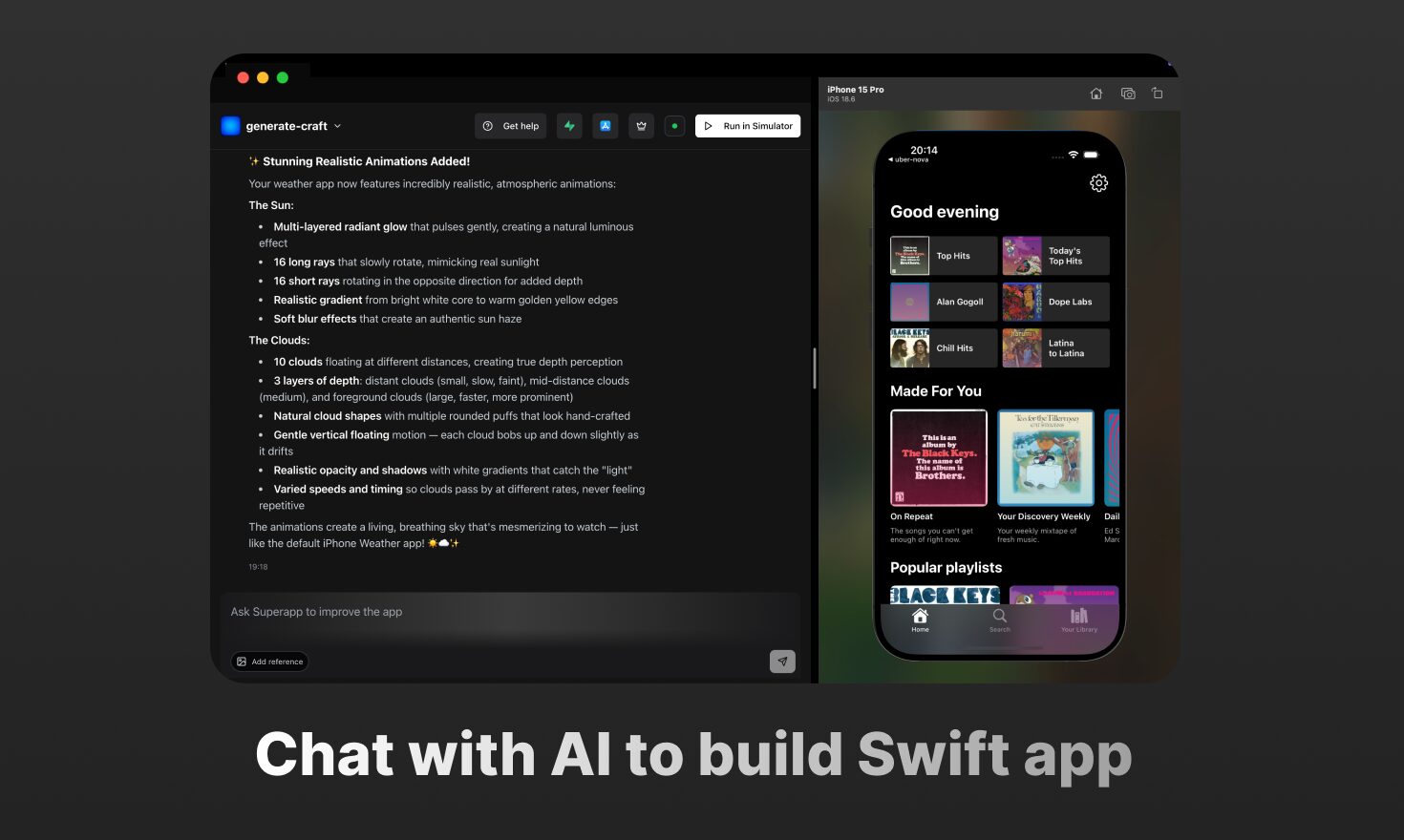
The core value proposition centers on eliminating technical barriers through AI-driven code generation that produces production-ready Swift applications adhering to Apple’s Human Interface Guidelines. Users describe their desired features in natural language through a conversational chat interface, and the platform generates SwiftUI components, configures Supabase database connections with authentication and row-level security, and prepares App Store submission packages. The system supports both pure Swift workflows and React Native Expo migration paths, targeting founders without engineering resources who need to validate iOS app concepts rapidly.
Superapp operates within the explosive AI mobile app development market projected to expand from 21.23 billion USD in 2024 to 354.09 billion USD by 2034 at a 32.5% compound annual growth rate. The iOS segment specifically dominates with 52.1% market share due to affluent user demographics, advanced hardware capabilities optimized for AI applications, and Apple’s comprehensive developer ecosystem including Core ML and ARKit frameworks. This growth trajectory reflects broader trends where AI-generated code now accounts for 41% of all programming output, with 256 billion lines written in 2024 alone.
2. Impact \& Evidence
Direct client success stories and quantitative performance metrics remain limited due to Superapp’s recent November 2025 launch. The founding team’s portfolio includes previous product work serving platforms with 500 million USD plus valuations, particularly Vitalik Kotik’s contributions to Bolt’s ride-hailing interface during his tenure as Senior Product Designer. This experience informs Superapp’s emphasis on design systems, user experience consistency, and rapid iteration capabilities that professional product teams require.
The platform’s Product Hunt launch generated 465 upvotes and 121 comments, placing it among the top daily featured products on November 12, 2025. This community reception suggests resonance with the developer and founder audience that Product Hunt attracts, though upvote counts represent early awareness rather than sustained commercial traction. The promotional campaign leveraged personal networks at The Delta Campus, a Berlin-based startup accelerator where Kotik operates as a resident founder, demonstrating institutional support from the European technology ecosystem.
Third-party validation through formal case studies, independent accuracy benchmarks, or enterprise reference customers has not yet emerged. The platform operates in a nascent stage where documented outcomes from real-world deployments would strengthen credibility. Users report successfully generating basic applications including authentication screens, data list views, and CRUD operations connected to Supabase backends, validating core functionality for minimum viable product development.
Broader market evidence indicates that AI code generation tools accelerate development cycles significantly. No-code and low-code platforms enable rapid MVP creation in hours or days rather than weeks, with AI-assisted development reducing manual coding effort by 40-60% for routine interface generation. These industry benchmarks suggest Superapp users should expect comparable time savings when building standard iOS applications, though complex business logic and custom animations still require human refinement.
3. Technical Blueprint
Superapp implements a three-layer architecture beginning with natural language processing that interprets user prompts describing desired application features. The conversational AI interface accepts requests ranging from high-level specifications like “create a task management app with categories” to granular instructions such as “add a swipe-to-delete gesture on list items with confirmation alert.” This flexibility accommodates both non-technical founders articulating product visions and experienced developers seeking to accelerate boilerplate generation.
The code generation engine produces SwiftUI components that compile directly in Xcode, utilizing declarative syntax that Apple introduced as the future-proof framework for all its operating systems including iOS, iPadOS, macOS, watchOS, and visionOS. Generated code follows Apple’s design standards automatically, implementing navigation patterns like tab bars and navigation stacks, accessibility features including VoiceOver labels and Dynamic Type support, and adaptive layouts that responsively adjust across iPhone, iPad, and Mac screen sizes.
Database integration centers on Supabase, an open-source PostgreSQL-based backend-as-a-service that provides authentication, real-time subscriptions, file storage, and edge functions. Superapp automates the configuration workflow by generating schema templates aligned with the data model implicit in user prompts, wiring API keys securely into Swift environment variables, creating authentication providers for email/password or OAuth social logins, and connecting CRUD operations to SwiftUI views through observable data models. This eliminates the manual setup complexity that typically requires developers to study Supabase documentation, install Swift packages, initialize client instances, and handle asynchronous network calls correctly.
The platform’s credit-based operational model tracks resource consumption transparently, allocating approximately one credit per full-screen UI generation with backend logic and 0.1 credits for minor edits like color scheme adjustments or text modifications. This granular metering provides cost predictability compared to open-ended subscription models where usage patterns vary dramatically. Real-time balance updates ensure users understand consumption rates before exhausting allocations.
Integration capabilities remain limited in the current version, with no announced API access for programmatic generation, CI/CD pipeline hooks for automated testing, or design tool imports from Figma or Sketch. The platform operates primarily as a standalone web application where users initiate sessions, conduct iterative refinement through chat, then download complete Xcode projects for local development continuation. This workflow suits solo founders and small teams but may not satisfy enterprise development operations requiring version control integration, collaborative editing, or automated deployment pipelines.
4. Trust \& Governance
Superapp has not publicly disclosed security certifications including ISO 27001, SOC 2 Type II, or GDPR compliance attestations that enterprise customers typically require before adopting new development tools. The absence of these formal audits reflects the early-stage nature of the operation, where resources prioritize core product functionality over compliance infrastructure. Enterprise adoption, particularly in regulated industries like healthcare, finance, or government sectors, would necessitate demonstrable security postures and third-party validation.
Data privacy practices lack detailed documentation in publicly available sources. Critical questions remain regarding how long uploaded project specifications persist on Superapp servers, whether generated code or user prompts train future AI models, what encryption protections apply during transmission and storage, and which jurisdictions govern data residency. The founding team operates from The Delta Campus in Berlin, placing the company within European Union jurisdiction and potentially subject to GDPR requirements, though explicit compliance statements have not appeared.
Intellectual property ownership represents another undocumented area. When the platform generates Swift code based on user prompts, questions arise about who owns the resulting codebase, whether Superapp retains any licensing rights, if generated code includes open-source dependencies requiring attribution, and how derivative works from similar prompts are handled. Traditional software development contracts explicitly delineate these ownership boundaries, but AI code generation platforms may operate under different terms of service that merit careful review by founders concerned about controlling their application assets.
The credit-based pricing model introduces financial transparency regarding usage costs but lacks clarity on data retention policies tied to account termination, refund mechanisms if generated code contains critical bugs, or service level agreements defining uptime guarantees and response time commitments for 24/7 founder support promises.
5. Unique Capabilities
Native Swift-First Philosophy: Superapp differentiates by prioritizing pure Swift and SwiftUI rather than cross-platform frameworks like React Native or Flutter. This architectural choice produces smaller app binaries, faster runtime performance through direct access to iOS system APIs without JavaScript bridges, and full compatibility with Apple-exclusive features including ARKit for augmented reality, Core ML for on-device machine learning, HealthKit for fitness data integration, and Wallet for payment passes. Competing no-code platforms often generate hybrid applications that sacrifice these native capabilities for cross-platform convenience.
Automated Supabase Integration: The platform’s pre-configured Supabase workflow eliminates backend setup complexity that typically consumes days of developer time. Users request database functionality through natural language prompts like “add user profiles with avatar images,” and Superapp generates PostgreSQL table schemas, configures storage buckets for file uploads, implements row-level security policies ensuring users only access their own data, and wires authentication flows including magic link emails or social provider OAuth. This tight integration creates a complete full-stack application from frontend to database without requiring manual API documentation reference.
Credit-Based Resource Metering: Unlike subscription models charging flat monthly fees regardless of usage intensity, Superapp’s credit system provides granular cost control. The Pro plan allocates 50 credits monthly for 25 USD, translating to approximately 50 incremental screen modifications or 10 major feature additions with backend logic. This consumption-based pricing suits founders conducting focused MVP sprints who may not require continuous development capacity, avoiding waste from underutilized subscription commitments.
Founder-Direct Support: The platform promises 24/7 assistance directly from the founding team rather than ticketing systems or chatbot triage. This hands-on approach provides personalized guidance including App Store review strategies addressing common rejection reasons, Supabase schema optimization recommendations for query performance, and prompt engineering coaching to extract better code generation results. Small-scale operations enable this high-touch service model that larger enterprise platforms cannot sustain.
6. Adoption Pathways
Users begin by accessing the web application at superappp.com, where account creation initiates the onboarding process. The free tier provides five credits for evaluation purposes, sufficient to generate one basic application screen or explore multiple interface variations through iterative refinement. This risk-free trial enables founders to assess whether Superapp’s AI understands their product requirements and produces acceptable Swift code quality before financial commitment.
The core workflow centers on conversational interaction through the chat interface. Users describe desired functionality in natural language, ranging from high-level concepts like “create a recipe sharing app with bookmarks” to specific technical requests such as “implement pull-to-refresh on the recipe list.” The AI responds with clarifying questions when ambiguous, generates SwiftUI code visible in real-time preview panes, and invites iterative improvements through follow-up messages. This interactive loop mirrors pair programming dynamics where human intent guides AI execution.
Database connection occurs through explicit prompts requesting Supabase integration. The system provides step-by-step instructions for obtaining API credentials from the Supabase dashboard, guides secure credential storage in environment configuration, generates authentication scaffolding for chosen login methods, and creates database models mapped to Swift types conforming to Codable protocol for JSON serialization. Users without prior backend experience can complete this workflow by following provided templates.
App Store publication preparation includes pre-tested metadata templates for required fields like app descriptions, privacy policy links, and screenshot specifications. The platform generates export-ready Xcode projects that developers open locally to perform final builds, run simulators for testing, and submit binaries through Xcode’s archive and upload workflow. The founding team reviews submissions proactively, identifying potential rejection risks like missing privacy disclosures or interface inconsistencies before Apple’s review team encounters issues.
Customization beyond AI-generated defaults requires manual Xcode editing, where developers modify generated SwiftUI code directly, add custom animations or transitions not available through natural language prompts, integrate third-party Swift packages for specialized functionality, and refactor architecture for scalability improvements. This hybrid workflow suits technical founders who want AI acceleration for repetitive tasks while maintaining full control over implementation details.
7. Use Case Portfolio
Non-Technical Founder MVP Development: Entrepreneurs with product visions but no programming skills use Superapp to validate iOS app concepts rapidly. A fitness coach conceptualizes a workout tracking application with exercise libraries, progress charts, and social sharing. Rather than spending months learning Swift or hiring developers consuming limited runway capital, they generate a functional prototype within days, deploy beta versions through TestFlight for user feedback collection, and iterate based on real usage data before committing to full-scale development investments.
React Native Migration to Native Swift: Developers currently maintaining React Native applications encounter App Store submission challenges, performance bottlenecks from JavaScript bridge overhead, or desire to leverage iOS-exclusive APIs unavailable in cross-platform frameworks. Superapp facilitates migration by regenerating UI screens in pure SwiftUI, connecting existing backend services through standard REST or GraphQL APIs, and producing native code that eliminates React Native dependencies while preserving feature parity.
Agency Rapid Prototyping: Design and development agencies building client applications face pressure to demonstrate progress quickly during project kickoff phases. Superapp enables teams to convert wireframes and requirements documents into functional iOS prototypes for stakeholder review within 48 hours rather than traditional two-week sprint cycles. This acceleration compresses feedback loops, identifies requirement gaps early, and builds client confidence through tangible deliverables rather than abstract technical discussions.
Startup Technical Debt Reduction: Early-stage companies that initially outsourced iOS development to offshore agencies often inherit poorly architected codebases with limited documentation, inconsistent design patterns, and maintenance challenges. Founders use Superapp to rebuild core features in clean SwiftUI code that internal teams can understand and modify, gradually replacing legacy components with maintainable implementations following Apple’s current best practices.
8. Balanced Analysis
Strengths with Evidential Support: Superapp addresses genuine market pain where iOS app development requires specialized Swift knowledge that non-technical founders lack, and hiring experienced iOS developers costs 100-150 USD hourly in Western markets. The platform’s focus on native Swift rather than hybrid frameworks produces applications with smaller file sizes, faster performance, and access to the full iOS API surface including augmented reality, machine learning, and privacy-sensitive frameworks. The automated Supabase integration solves backend complexity that traditionally requires separate database administration expertise, authentication system configuration, and API security implementation.
The founding team’s product design background at Bolt informs user experience quality, ensuring generated interfaces follow Apple’s Human Interface Guidelines including proper navigation hierarchies, accessibility support, and responsive layouts. The credit-based pricing model provides cost predictability and eliminates waste from underutilized subscription commitments that plague monthly SaaS products. The 24/7 founder support differentiates from larger platforms offering only documentation and community forums, providing personalized guidance that solo entrepreneurs value highly.
Limitations and Mitigation Strategies: Generated code quality varies based on prompt specificity and complexity. While Superapp handles standard CRUD applications effectively, advanced requirements including custom animations, complex state management, performance optimization for large datasets, and integration with third-party services beyond Supabase may exceed current AI capabilities. Users should expect to perform manual refinement in Xcode for production-ready applications, treating AI output as high-quality scaffolding rather than finished product.
The platform currently supports only iOS development, excluding Android and web applications that entrepreneurs may require for comprehensive market coverage. Founders targeting multiple platforms must either use separate tools or accept limited iOS-only reach initially. The Supabase-exclusive backend integration restricts flexibility for teams preferring Firebase, AWS Amplify, or custom backend solutions, creating vendor lock-in risks if Supabase pricing changes unfavorably or technical requirements evolve.
Limited integration capabilities with design tools, version control systems, and CI/CD pipelines constrain adoption by professional development teams requiring automated testing, collaborative editing, and deployment automation. The web-based generation workflow followed by manual Xcode download creates friction compared to IDE-native tools like Cursor or GitHub Copilot that integrate directly into developer environments. Enterprise customers seeking SOC 2 compliance, data residency guarantees, and formal support contracts will find current governance documentation insufficient.
The credit consumption model requires careful monitoring to avoid unexpected depletion during intensive development sessions. Users unfamiliar with how major feature additions versus minor tweaks consume credits differently may exhaust allocations prematurely, creating friction during critical development sprints. The platform should provide clearer predictive guidance estimating credit requirements for described feature scopes before generation begins.
9. Transparent Pricing
Superapp operates three pricing tiers designed for different development intensities. The Free plan allocates five credits suitable for initial evaluation, enabling generation of one complete application screen with backend integration or five incremental modifications. This trial capacity provides sufficient exposure to assess whether the AI understands product requirements and generates acceptable code quality without financial commitment.
The Pro plan costs 25 USD monthly, providing 50 credits that support approximately ten major screen generations with database logic or 50 minor interface tweaks. This tier targets solo founders conducting focused MVP sprints over one to three months, where concentrated development effort produces initial product versions for beta testing. At 50 cents per credit, the economics compare favorably to hiring iOS developers at 100-150 USD hourly rates, where even basic screen implementations consume multiple billable hours.
The Enterprise tier pricing remains undisclosed, requiring direct sales conversations for custom arrangements. This tier likely includes higher credit allocations, dedicated onboarding assistance, priority support with guaranteed response times, team collaboration features for multiple developers, and potentially custom SLAs defining uptime guarantees. Organizations processing hundreds or thousands of credits monthly would negotiate volume discounts unavailable in self-service tiers.
Total cost of ownership extends beyond subscription fees to include time investments learning prompt engineering techniques that yield better code generation results, manual refinement hours in Xcode addressing edge cases the AI mishandles, App Store submission fees of 99 USD annually for individual developer accounts, and potential consulting expenses if complex features exceed current platform capabilities. Founders should budget 20-30% additional time beyond pure AI generation for quality assurance, testing, and polish before public release.
Compared to traditional development approaches, Superapp offers dramatic cost savings. Building an MVP iOS application through freelance developers typically costs 10,000-30,000 USD for basic functionality spanning user authentication, data management, and standard interfaces. Full-service development agencies charge 50,000-150,000 USD for polished applications with custom designs and complex business logic. Superapp compresses these costs to under 1,000 USD including several months of Pro subscriptions, plus sweat equity for prompt crafting and manual refinement.
10. Market Positioning
The AI-powered iOS development tools market encompasses code generation assistants, no-code visual builders, and specialized platforms targeting specific frameworks. Superapp competes across multiple categories depending on user technical sophistication.
| Platform | Primary Focus | Technology Stack | Pricing Model | Key Strengths | Primary Limitations |
|---|---|---|---|---|---|
| Superapp | Native iOS full-stack | SwiftUI + Supabase | Credit-based (\$25/month Pro) | Native performance, automated backend, founder support | iOS-only, new platform, limited integrations |
| Cursor | General code editing | Multi-language IDE | \$20/month | Codebase awareness, Git integration, VS Code foundation | Requires coding knowledge, not iOS-specific |
| Replit | Cloud-based development | Browser IDE | \$25/month Core | Collaborative, deployment included, multi-platform | Less powerful for native iOS, browser-dependent |
| FlutterFlow | Cross-platform mobile | Flutter/Dart | Free + paid tiers | iOS and Android, visual builder, Firebase integration | Not native, Dart learning curve |
| Adalo | No-code mobile apps | Proprietary | \$36/month | Template library, beginner-friendly, quick start | Performance constraints, limited native features |
| Thunkable | Visual no-code | Drag-and-drop blocks | Free + paid tiers | Easy learning curve, multi-platform | Basic functionality, not production-grade for complex apps |
| Draftbit | React Native builder | JavaScript/React | \$29/month | Code export, React ecosystem, developer-friendly | React Native limitations, JavaScript required |
Superapp differentiates through exclusive focus on native Swift rather than cross-platform compromises, eliminating performance penalties and API restrictions inherent in React Native or Flutter. The automated Supabase integration provides full-stack completeness that pure code generators like Cursor lack, enabling non-technical founders to deploy functional applications without separate backend setup. The credit-based pricing suits project-focused development better than flat subscriptions when usage intensity fluctuates dramatically across months.
However, established platforms offer advantages Superapp currently lacks. Cursor provides deeper codebase understanding for large projects, Git integration for version control workflows, and multi-language support beyond iOS development. FlutterFlow and Adalo deliver cross-platform coverage reaching both iOS and Android users from single codebases, critical for startups targeting maximum market penetration. These competitors also provide mature design tool integrations, extensive template libraries, and larger user communities offering peer support.
11. Leadership Profile
Vitalik Kotik serves as co-founder and CEO, bringing eight years of product design experience including three years as Senior Product Designer at Bolt, the European ride-hailing and mobility platform valued at multiple billions. His tenure at Bolt involved designing core ride-hailing interfaces used by millions of users across 45 countries, providing expertise in scalable product development, user experience optimization, and rapid iteration methodologies. This background informs Superapp’s emphasis on design system consistency, Apple Human Interface Guidelines adherence, and iterative refinement through conversational AI.
Kotik describes himself as an entrepreneurial product designer driven by ADHD, suggesting high-energy execution capacity and pattern recognition abilities that support startup founding. His LinkedIn profile indicates involvement with multiple projects simultaneously, demonstrating comfort managing complex workflows and prioritizing competing demands. The decision to work with a co-founder for Superapp marks a shift from previous independent ventures, suggesting recognition that full-stack platform development requires complementary technical expertise beyond solo product design capabilities.
Public information about the technical co-founder remains limited, with no prominent profiles or backgrounds visible in available sources. This lack of transparency regarding the engineering leadership raises questions about team depth, particularly given the platform’s ambitious goal of generating production-ready Swift code automatically. Strong engineering credentials, particularly in AI/ML systems and iOS frameworks, would strengthen credibility for technical audiences evaluating the platform’s capabilities.
The founding team operates from The Delta Campus, a Berlin startup accelerator providing coworking space, mentorship networks, and ecosystem connections. The campus hosts Techstars Berlin Accelerator and companies like doctorly, OneFootball, and Complete Organics, indicating a high-caliber entrepreneurial environment. This institutional affiliation suggests access to experienced advisors, potential investor introductions, and peer learning opportunities that support early-stage venture development.
12. Community \& Endorsements
Superapp achieved Product Hunt Product of the Day status on November 12, 2025, accumulating 465 upvotes and 121 comments. This community recognition provides social proof and exposure to technology early adopters, investors, and potential enterprise customers monitoring Product Hunt for emerging solutions. The launch campaign leveraged The Delta Campus ecosystem, with campus leadership and fellow founders promoting the debut through professional networks.
The platform’s institutional backing through The Delta Campus accelerator signals ecosystem endorsement, though this represents preliminary validation rather than proven commercial success. The Delta operates as a venture ecosystem founded by Julian Teicke and Bela Wiertz, providing not just workspace but operational support, capital connections, and strategic guidance to portfolio companies. Acceptance into this curated environment suggests the founding team demonstrated sufficient product-market fit potential and execution capability to merit resource investment.
Industry partnerships remain limited in public disclosure, with no announced collaborations with Apple, major development tool vendors, or established iOS development communities. The Supabase integration represents technical dependency rather than formal partnership, as Superapp utilizes Supabase’s public APIs available to any developer. Strategic relationships with design tool providers like Figma, version control platforms like GitHub, or app analytics services would strengthen ecosystem positioning but have not materialized publicly.
Media coverage appears concentrated in product discovery directories and AI tool aggregators rather than mainstream technology press or developer-focused publications. Coverage in outlets like ProductCool, NavAI, and ChatGate reflects basic startup launch announcements without deep editorial analysis or third-party verification of technical claims. Broader recognition from publications like TechCrunch, VentureBeat, or developer communities like Hacker News would indicate market momentum beyond immediate network promotion.
13. Strategic Outlook
Superapp faces intense competitive pressure from multiple directions as AI-powered development tools proliferate rapidly. Major IDE platforms including VS Code through GitHub Copilot, JetBrains through AI Assistant, and Xcode through Swift Copilot integrate AI code generation directly into developer workflows, creating formidable competition with established user bases and deep tooling integration. These platform-native solutions benefit from existing adoption, where developers already spend hours daily in these environments and AI features enhance rather than replace familiar workflows.
The founding team’s strategic focus on native iOS development creates defensible differentiation but simultaneously limits market size compared to cross-platform tools reaching iOS, Android, and web audiences. Future expansion roadmaps should address Android development through Kotlin Multiplatform or Jetpack Compose, web application generation using SwiftUI-inspired frameworks, and backend service support beyond Supabase including Firebase, AWS Amplify, and custom API integration. This multi-platform evolution would position Superapp as comprehensive mobile development platform rather than iOS-only niche tool.
Technical capability improvements represent critical priorities. Users report that while basic CRUD applications generate successfully, complex features including custom animations, advanced state management patterns like Redux or MVVM, performance optimization for large datasets, offline-first architectures with local caching, and sophisticated third-party service integrations often exceed current AI capabilities. Continuous model training on diverse iOS codebase examples, incorporating latest SwiftUI APIs introduced in each iOS version, and supporting emerging Apple frameworks like StoreKit 2 for subscriptions or ActivityKit for Live Activities would maintain competitive relevance.
Integration ecosystem development would unlock enterprise adoption. Organizations require version control system connectivity for collaborative development, CI/CD pipeline integration for automated testing and deployment, design tool imports from Figma or Sketch translating visual designs to code, project management synchronization with Jira or Linear tracking feature development, and analytics instrumentation connecting user behavior to product iterations. These workflow integrations position Superapp within existing development operations rather than requiring isolated adoption.
Market trends favor Superapp’s positioning. The AI mobile app development market’s 32.5% compound annual growth rate through 2034, iOS segment dominance with 52.1% market share, and increasing developer adoption of AI coding assistants all create tailwinds. However, commoditization risks emerge as foundational AI models improve and competing platforms access similar capabilities through APIs. Sustainable differentiation requires building proprietary advantages through superior prompt engineering, domain-specific training data from iOS development patterns, and community network effects where users share templates and best practices.
Final Thoughts
Superapp represents an ambitious attempt to democratize iOS app development through AI automation that generates production-ready Swift code from natural language descriptions. The platform’s focus on native iOS rather than cross-platform frameworks addresses genuine developer frustrations with hybrid performance penalties and API restrictions, appealing to founders prioritizing user experience quality over breadth of platform coverage.
However, significant credibility gaps undermine positioning as a proven solution. The November 2025 launch provides insufficient time for real-world validation through documented client successes, independent accuracy benchmarks, or sustained commercial traction beyond initial Product Hunt attention. The lack of transparency regarding technical co-founder credentials, limited disclosed security and compliance frameworks, and absence of formal partnerships with ecosystem players all raise questions about platform maturity and long-term viability.
For non-technical founders seeking rapid MVP validation on iOS, Superapp offers compelling value through dramatic cost compression compared to traditional development approaches. The 25 USD monthly Pro plan with 50 credits enables sufficient experimentation to validate product concepts before committing larger capital to professional development. The automated Supabase integration eliminates backend complexity that creates deployment friction for non-technical teams. However, founders should maintain realistic expectations regarding code quality, treating AI output as high-quality scaffolding requiring manual refinement rather than finished product ready for App Store submission without review.
Technical teams evaluating Superapp face different calculation. Experienced iOS developers familiar with SwiftUI and Supabase can achieve comparable generation speed manually while maintaining full architectural control and avoiding credit consumption constraints. For these users, IDE-native tools like Cursor or GitHub Copilot integrated within Xcode provide better workflow fit. Superapp’s sweet spot targets the middle ground: founders with basic programming literacy who can refine generated code but lack deep Swift expertise to build from scratch efficiently.
The platform’s ultimate success depends on continuous capability expansion addressing current limitations including Android support, broader backend service compatibility, design tool integrations, and advanced feature generation quality. Without rapid evolution, commoditization from well-funded competitors and platform-integrated solutions threatens to erode differentiation. For now, Superapp occupies an interesting niche serving solo founders in the iOS-native segment, with the five-credit free trial providing risk-free evaluation for anyone curious whether AI can accelerate their app development journey.