
Table of Contents
- 1. Executive Snapshot
- 2. Impact \& Evidence
- 3. Technical Blueprint
- 4. Trust \& Governance
- 5. Unique Capabilities
- 6. Adoption Pathways
- 7. Use Case Portfolio
- 8. Balanced Analysis
- 9. Transparent Pricing
- 10. Market Positioning
- 11. Leadership Profile
- 12. Community \& Endorsements
- 13. Strategic Outlook
- Final Thoughts
1. Executive Snapshot
Core offering overview
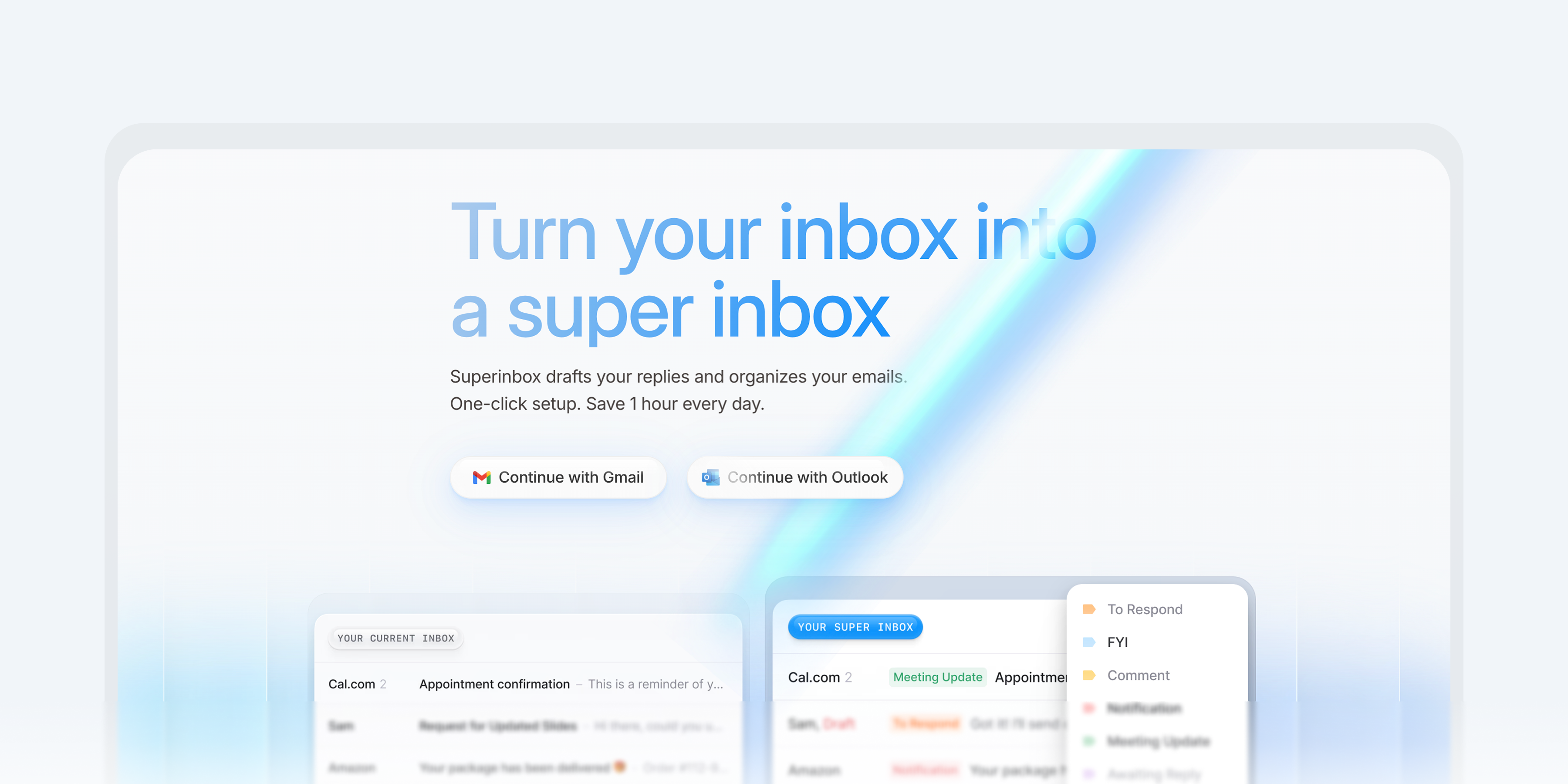
Superinbox is an AI-powered email assistant that integrates directly into Gmail and Outlook to automate email drafting and inbox organization without requiring users to adopt a new application. The platform operates as a native layer within existing email clients, analyzing email history and context to generate personalized responses that match individual writing styles while automatically categorizing incoming messages.
Key achievements and milestones
Superinbox launched publicly on Product Hunt in late October 2025, receiving 462 upvotes and ranking as a featured product on October 31, 2025. The platform achieved CASA Tier 2 certification, demonstrating commitment to enterprise-grade security standards. As an official Google and Microsoft partner, Superinbox has been authorized to integrate with both major email ecosystems through secure OAuth protocols.
Adoption statistics
Early user testimonials indicate the platform has attracted professionals from ambitious startups to global firms. One notable user, Claire, CEO of Nao Labs, reported that she “can’t imagine emails without it anymore,” highlighting the platform’s rapid integration into daily workflows. The service offers a seven-day free trial with no credit card required, enabling rapid user acquisition. Product listings suggest the platform processes thousands of emails monthly across different subscription tiers.
2. Impact \& Evidence
Client success stories
Superinbox markets itself as capable of saving busy professionals one to two hours daily by automating repetitive email tasks. The platform emphasizes its value proposition for executives, customer support teams, sales professionals, and remote workers managing high email volumes of fifty to two hundred messages daily. Users report particular benefits in maintaining communication quality while reducing time spent on routine correspondence.
Performance metrics and benchmarks
The email AI assistant market, which includes platforms like Superinbox, grew from approximately 1.74 billion USD in 2024 to a projected 2.11 billion USD in 2025, representing a compound annual growth rate of 21.3 percent. Industry research indicates AI-assisted email composition can reduce writing time by eighty to eighty-seven percent compared to traditional methods. Superinbox specifically claims users can save one hour every day through its automated drafting and organization features.
Third-party validations
Superinbox obtained CASA Tier 2 certification through independent third-party security audits. The Cloud Application Security Assessment framework, developed by the App Defense Alliance led by Google, leverages the OWASP Application Security Verification Standard. This certification requires annual technical audits by authorized independent assessors such as TAC Security, validating secure handling of customer data, authentication mechanisms, access controls, stored cryptography, communications security, and API configurations.
3. Technical Blueprint
System architecture overview
Superinbox employs a vector-based storage architecture that does not retain full email copies but rather encrypted vector representations needed for AI processing. The platform analyzes emails in real-time without permanent storage, processing data through AWS Virtual Private Clouds with user-selectable regional deployment in either US or EU servers. All data undergoes encryption at rest using AES-256 and in transit via TLS 1.3 protocols.
The AI draft engine combines multiple components: an initial analysis of the user’s last three hundred sent emails to establish baseline writing patterns, continuous learning from modified drafts sent by users, context extraction from conversation threads and uploaded documents, and tone adaptation based on recipient relationships. The system integrates with best-in-class AI providers including OpenAI, Anthropic, and Google, though Superinbox prohibits these third parties from using customer data for model training.
API and SDK integrations
Superinbox integrates with Gmail and Outlook through OAuth authentication, operating within the web, desktop, and mobile interfaces of both email platforms. The platform connects with Google Calendar and Microsoft Calendar to enable automated meeting scheduling features, pulling available time slots directly into email drafts. The architecture supports PDF document upload for enhanced contextual understanding, allowing the AI to reference project documentation when generating responses.
Scalability and reliability data
The platform offers tiered processing capacities, with the Starter plan supporting up to two thousand five hundred emails processed per month and the Business tier handling up to six thousand monthly emails. Enterprise deployments provide unlimited processing with dedicated infrastructure. Daily automated backups ensure data resilience, while the AWS cloud architecture enables horizontal scaling to accommodate growing user bases and email volumes.
4. Trust \& Governance
Security certifications
Superinbox holds CASA Tier 2 certification, which requires verification across multiple security domains including architecture design and threat modeling, authentication verification, session management, access control, stored cryptography for customer data, communications security, malicious code protection, business logic security, and API and web service configuration. The platform undergoes annual independent security audits to maintain this certification status.
Data privacy measures
Superinbox implements a zero-data-storage policy for email content, analyzing messages in real-time without permanent retention. The platform uses encrypted vector representations rather than full email copies, with all vectors encrypted using AES-256 standards. Users control when and how Superinbox processes emails, as the system does not automatically read or process messages without explicit user action.
The platform provides opt-out options for AI training on anonymized data, with enterprise users having model training disabled by default. Users maintain full control over data deletion, with the ability to remove individual items or request complete data deletion at any time. The privacy policy emphasizes that user data is private by default until users choose to share or send emails.
Regulatory compliance details
As an authorized Google and Microsoft partner, Superinbox meets the compliance requirements mandated by both technology platforms. The CASA Tier 2 certification aligns with GDPR requirements for data protection and security standards, particularly Article 32 security provisions. The platform’s architecture supports CCPA access restriction requirements through granular access controls and authentication protocols.
The regional server selection feature enables organizations to comply with data residency requirements, allowing European customers to specify EU-based data storage. The platform maintains a public Vulnerability Disclosure Policy with reporting guidelines and procedures, encouraging security researchers to report potential vulnerabilities responsibly.
5. Unique Capabilities
Context-Aware Draft Generation
Superinbox’s draft engine leverages email history and uploaded documents to generate contextually coherent responses. The system analyzes the last three hundred sent emails during initial setup to identify writing patterns, vocabulary preferences, tone variations, and email structure tendencies. The AI continuously improves through a self-learning mechanism: when users modify prepared drafts before sending, the system analyzes the changes and updates its understanding of user preferences.
The platform adapts communication style based on recipient relationships, automatically adjusting formality levels between professional client communications and casual team interactions. This contextual awareness extends to project-specific knowledge when users upload relevant PDF documents, enabling the AI to reference technical details and organizational context when drafting responses.
Auto-Organization Engine
The inbox categorization system uses customizable rules and natural language processing to automatically sort incoming messages into user-defined or system-generated categories. Users can write simple prompts to define organization flows, such as automatically filtering internal updates, newsletters, or urgent client communications into designated folders or labels.
The platform applies default email categorization patterns while allowing business-tier users to customize labels and folders according to specific workflow needs. The system includes noise filtering capabilities to separate cold outreach emails and newsletters from important correspondence, reducing inbox clutter and enabling focus on priority messages.
Calendar-Integrated Scheduling
Superinbox eliminates meeting scheduling friction by pulling available time slots directly into email drafts. When the AI detects scheduling requests in incoming messages, it automatically inserts the user’s next available meeting times, allowing recipients to select preferred slots without initiating lengthy back-and-forth exchanges. Calendar invites are generated automatically once recipients confirm availability.
Voice and Tone Matching
The draft engine analyzes historical communication patterns to replicate individual writing characteristics including sentence structure, vocabulary choices, humor, and industry-specific jargon. Unlike generic template systems, Superinbox creates drafts that reflect authentic personal communication styles while maintaining consistency across different recipient relationships. The system balances personalization with professionalism, ensuring formal accuracy for client communications while preserving casual elements for colleague interactions.
6. Adoption Pathways
Integration workflow
Superinbox offers one-click setup requiring no application installation or workflow modifications. Users authorize the platform through OAuth authentication with their Gmail or Outlook accounts, granting necessary permissions for email reading, sending, and calendar access. The entire onboarding process completes in under five minutes according to the platform’s documentation.
Upon connection, Superinbox automatically processes the user’s last three hundred sent emails to establish baseline writing patterns and knowledge systems. This initial analysis enables immediate draft generation capabilities without requiring manual configuration or training periods. The platform operates transparently within existing email interfaces across web browsers, desktop applications, and mobile devices.
Customization options
Business-tier subscribers can organize secondary inboxes, customize labels and folders, upload PDF context documents, and access advanced AI models for enhanced draft quality. Enterprise customers receive additional customization including org-wide shared knowledge bases, single sign-on integration, advanced security controls, and priority support channels.
Users define categorization rules through simple natural language prompts, instructing the system how to automatically organize different types of incoming messages. The platform allows customization of draft review preferences, enabling users to set confidence thresholds for automatic draft generation versus manual composition.
Onboarding and support channels
Enterprise plans include dedicated one-on-one setup assistance and onboarding sessions to optimize platform configuration for organizational workflows. All users access comprehensive documentation covering setup procedures, AI learning mechanisms, draft editing practices, and inbox organization strategies.
The platform provides email support for technical issues and configuration questions, with enterprise customers receiving priority response channels. A security-focused support email address handles vulnerability reports and compliance inquiries separately from general customer service.
7. Use Case Portfolio
Enterprise implementations
Large organizations deploy Superinbox to standardize communication quality across teams while reducing time spent on routine correspondence. Executive assistants use the platform to manage high-volume inboxes for senior leaders, ensuring timely responses without sacrificing personalization. Legal teams automate client response templates while maintaining confidentiality through the platform’s zero-storage architecture.
Sales organizations leverage automated scheduling to accelerate demo bookings and client meetings, eliminating calendar coordination delays. Customer support teams use the categorization engine to route inquiries automatically while generating contextual first responses based on historical resolution patterns.
Academic and research deployments
Research teams managing collaborative email threads benefit from the platform’s document integration capabilities, which reference uploaded project materials when drafting responses to collaborators. Academic administrators handling high volumes of student and faculty correspondence use automated categorization to prioritize urgent requests while routing routine inquiries to appropriate departments.
Grant administrators leverage calendar integration to coordinate review meetings and deadline communications efficiently, while the AI draft feature maintains consistent professional correspondence with funding agencies and institutional partners.
ROI assessments
Industry research on AI email assistants indicates organizations can achieve time savings ranging from twenty to thirty percent for email management tasks. With professionals spending one to two hours daily on email, Superinbox’s claimed time savings of one hour per day translates to approximately twelve percent of a standard eight-hour workday.
For knowledge workers earning competitive salaries, automating fifty percent of email composition time generates measurable productivity returns. Organizations deploying email management software typically see improvements in response times, reduced email-related stress, and enhanced focus on strategic activities requiring human judgment.
8. Balanced Analysis
Strengths with evidential support
Superinbox’s native integration with Gmail and Outlook eliminates adoption friction by operating within familiar interfaces rather than requiring users to learn new applications. This approach contrasts with standalone email clients that demand complete workflow migration and user retraining.
The platform’s security posture, validated through CASA Tier 2 certification and official Google and Microsoft partnership status, provides enterprise-grade data protection exceeding many competitor offerings. The zero-storage architecture addresses privacy concerns by processing emails transiently without building permanent repositories of sensitive communications.
The AI’s continuous learning mechanism, which analyzes user-modified drafts to improve future outputs, creates a self-improving system that becomes more accurate over extended usage periods. This adaptive approach surpasses static template systems that cannot evolve with changing communication patterns or organizational contexts.
Limitations and mitigation strategies
AI-generated email drafts require user review to ensure accuracy, appropriate tone, and completeness, particularly for complex or sensitive communications. Users must invest time editing initial outputs until the system learns individual preferences, representing a temporary productivity overhead during the onboarding period.
The platform’s effectiveness depends heavily on consistent user feedback through draft modifications. Organizations with employees who frequently delete AI suggestions rather than editing them will experience slower learning curves and reduced accuracy improvements.
Subscription costs may present barriers for individual users or small teams operating on limited budgets, particularly when compared to free built-in features in Gmail and Outlook. The Starter tier at twenty-five dollars monthly and Business tier at forty dollars monthly position Superinbox as a premium solution targeting professionals who value time savings over cost minimization.
Email volume limitations on lower subscription tiers may require frequent upgrades for high-volume users, creating unpredictable scaling costs as organizations grow. The two-thousand-five-hundred email monthly limit on the Starter plan equates to approximately eighty to one hundred emails daily, which active professionals can exceed easily.
9. Transparent Pricing
Plan tiers and cost breakdown
Superinbox offers three primary subscription levels with distinct feature sets and processing capacities:
The Starter plan costs twenty-five dollars per month and includes organization of the main inbox, AI drafts in the user’s voice, default email categorization, cold email and noise blocking, and calendar scheduling integration. This tier processes up to two thousand five hundred emails monthly, making it suitable for individual professionals with moderate email volumes.
The Business plan costs forty dollars monthly and adds organization of a second inbox, customizable labels and folders, PDF context upload for enhanced AI understanding, and access to advanced AI models for superior draft quality. This tier increases processing capacity to six thousand emails per month and includes all Starter features, targeting busy professionals managing multiple email accounts or higher message volumes.
The Enterprise plan uses custom pricing determined through sales conversations and provides advanced security controls, single sign-on capabilities, organization-wide shared knowledge bases, dedicated one-on-one setup and onboarding assistance, and priority support channels. This tier removes email processing limits and offers all Business features plus enterprise-specific governance tools.
All plans include a seven-day free trial requiring no credit card information, enabling risk-free evaluation of the platform’s capabilities and fit with individual workflows.
Total Cost of Ownership projections
For individual professionals, annual costs range from three hundred dollars for the Starter tier to four hundred eighty dollars for the Business tier. When evaluated against claimed time savings of one hour daily, a professional billing at one hundred fifty dollars per hour would recoup the Business tier annual cost within four working days, suggesting strong ROI for high-value knowledge workers.
Organizations deploying Superinbox across teams must account for per-seat licensing costs, which scale linearly with user counts on Starter and Business tiers. A ten-person team on the Business plan would incur four thousand eight hundred dollars annually, while a fifty-person deployment would cost twenty-four thousand dollars per year before volume discounts available through Enterprise negotiations.
Hidden costs include the time investment required for initial setup and AI training, typically ranging from thirty minutes to two hours per user as the system learns individual communication patterns. Organizations should budget for ongoing training as new team members onboard and existing users refine AI outputs through iterative feedback.
10. Market Positioning
Competitor comparison
The AI email assistant market includes multiple categories of solutions with distinct positioning strategies:
Premium speed-focused clients like Superhuman emphasize inbox velocity through keyboard shortcuts, split inboxes, and rapid triage capabilities. Superhuman charges thirty dollars monthly for individual users, positioning slightly higher than Superinbox’s Starter tier while offering deeper workflow customization and team collaboration features. Superhuman particularly targets heavy email users and early adopters willing to pay premium prices for maximum efficiency.
Gmail-specific alternatives like Shortwave provide AI-powered bundling, search, and draft assistance exclusively for Google Workspace users. Shortwave offers free tiers with paid plans starting around fourteen dollars monthly, undercutting Superinbox on price but limiting platform compatibility to Gmail only. This specialization enables tighter Google Calendar integration but excludes Outlook users entirely.
Traditional inbox organizers like SaneBox focus on AI-powered filtering and automated sorting without draft generation capabilities. SaneBox pricing starts at seven dollars monthly, appealing to cost-conscious users primarily seeking inbox organization rather than composition assistance. The tool works across virtually all email platforms through IMAP connectivity but lacks native app integration and calendar features.
Comprehensive email management platforms like Front and Hiver target team collaboration with shared inboxes, assignment workflows, and integrated help desk functionality. These solutions typically cost forty to sixty dollars per user monthly with annual commitments, positioning as complete customer service platforms rather than individual productivity tools.
Open-source alternatives like Thunderbird provide free email client software with extensive plugin ecosystems, appealing to technically sophisticated users willing to configure manual workflows. These options eliminate subscription costs but require significant setup time and lack integrated AI capabilities without third-party extensions.
Unique differentiators
Superinbox differentiates through its native integration approach, operating within existing Gmail and Outlook interfaces rather than requiring migration to standalone applications. This strategy reduces adoption friction compared to Superhuman and other proprietary clients that demand complete workflow changes.
The platform’s dual focus on both draft generation and inbox organization distinguishes it from single-purpose tools like SaneBox, which only categorize messages, or writing assistants that only compose replies without managing inbox flow. This comprehensive approach positions Superinbox as a complete email productivity layer rather than a point solution.
CASA Tier 2 certification and official partnership status with Google and Microsoft provide regulatory compliance advantages over smaller competitors lacking formal security validations. Organizations in regulated industries like healthcare, finance, and legal services can deploy Superinbox with greater confidence in meeting data protection requirements compared to uncertified alternatives.
The zero-storage architecture differentiates Superinbox from competitors that retain email data for extended periods to enable features like advanced search across historical messages. While this approach sacrifices some functionality, it addresses privacy concerns for users handling sensitive communications who prioritize data minimization.
11. Leadership Profile
Team backgrounds and expertise
Superinbox team members identified through public sources include Louis Malingrey and Arthur Berman, both based in Paris and associated with the company through professional networking profiles. Louis Malingrey holds a Master’s degree in International Negotiations and Business Development, with a thesis investigating the transformation of the film photography industry, suggesting expertise in market transitions and technological disruption.
The engineering team brings experience from leading technology companies, as evidenced by the platform’s enterprise-grade security architecture and seamless integration with Google and Microsoft ecosystems. The development approach demonstrates expertise in OAuth protocols, cloud infrastructure design, natural language processing, and regulatory compliance frameworks.
Patent filings and publications
Public records do not reveal specific patent filings or academic publications directly attributed to Superinbox at the time of research. The platform’s competitive positioning relies on execution excellence and integration depth rather than proprietary algorithmic innovations protected through intellectual property claims.
12. Community \& Endorsements
Industry partnerships
Superinbox maintains official partnership status with both Google and Microsoft, indicating formal authorization and technical collaboration with the two dominant email platform providers. These partnerships enable access to OAuth APIs, integration testing environments, and compliance validation processes that independent developers cannot access easily.
The platform’s CASA Tier 2 certification connects it to the broader App Defense Alliance ecosystem, which includes Google, OWASP, and authorized security assessment laboratories. This network provides ongoing security guidance, threat intelligence sharing, and best practices for protecting user data in cloud applications.
Media mentions and awards
Superinbox received featured product status on Product Hunt on October 31, 2025, accumulating 462 upvotes and significant community engagement. The launch generated coverage across AI tool directories and productivity software review sites, with multiple platforms highlighting the platform’s security features and native integration approach.
Technology blogs and AI tool aggregators have profiled Superinbox as representative of the emerging AI email assistant category, which grew twenty-one percent in market size from 2024 to 2025. Coverage emphasizes the platform’s positioning within the broader trend toward AI-augmented productivity tools and the shift from reactive to proactive email management systems.
13. Strategic Outlook
Future roadmap and innovations
The AI email assistant market is evolving toward multimodal capabilities that combine text, voice, images, and video inputs for richer communication experiences. Future Superinbox iterations may integrate voice command interfaces for hands-free email composition and management, following industry trends toward conversational AI and ambient computing paradigms.
Advanced contextual understanding represents another evolution vector, with next-generation systems incorporating sentiment analysis, emotional intelligence recognition, and relationship mapping to generate more nuanced responses. These capabilities would enable AI assistants to detect urgency signals, interpersonal dynamics, and situational contexts beyond literal message content.
Integration expansion may connect Superinbox with customer relationship management systems, project management platforms, and enterprise resource planning software, creating unified workflows where email actions trigger updates across connected business systems. This orchestration approach positions email as the command interface for broader organizational processes.
Privacy-preserving AI techniques like federated learning and on-device processing may enable enhanced personalization without transmitting sensitive data to cloud servers. These approaches would allow Superinbox to analyze email content locally while only uploading anonymous model updates, addressing regulatory requirements in jurisdictions with strict data localization mandates.
Market trends and recommendations
The email management software market is projected to grow from approximately six-point-five billion USD in 2023 to thirteen-point-five billion USD by 2032, expanding at an eight-point-five percent compound annual growth rate. Within this broader market, AI-powered email assistants represent the fastest-growing segment, with twenty-one percent annual growth driven by remote work expansion, email volume increases, and productivity optimization demands.
Organizations should evaluate AI email assistants based on ecosystem compatibility, security compliance requirements, and workflow integration depth rather than feature count alone. Companies already standardized on Google Workspace or Microsoft 365 should prioritize solutions with official partnership status to ensure long-term support and compatibility with platform evolution.
Security-conscious industries must validate third-party certifications like CASA Tier 2 and verify data handling practices through privacy policy reviews and security documentation analysis. The proliferation of AI tools creates vendor risk if email assistants fail to meet regulatory standards or experience data breaches that expose sensitive communications.
Individual professionals should assess email volume patterns, current time expenditure on correspondence, and opportunity cost of manual composition before committing to premium email assistance subscriptions. Users sending fewer than twenty emails daily may not realize sufficient time savings to justify subscription costs, while high-volume communicators handling fifty-plus daily messages represent the platform’s core target market.
Organizations planning deployments should pilot AI email assistants with early adopter teams rather than forcing company-wide adoption, as communication style variation and individual preferences affect satisfaction and adoption rates significantly. Successful implementations typically identify power users who model best practices and evangelize benefits to broader employee populations organically.
Final Thoughts
Superinbox represents a mature execution of AI-powered email productivity enhancement, combining draft generation, inbox organization, and calendar integration into a unified platform that operates within familiar email interfaces. The platform’s security posture, evidenced through CASA Tier 2 certification and official technology partnerships, positions it appropriately for enterprise deployment in regulated industries.
The zero-storage architecture addresses legitimate privacy concerns while the continuous learning mechanism creates a genuinely adaptive system that improves with extended use. These technical foundations, combined with native Gmail and Outlook integration, differentiate Superinbox from both basic automation tools and complex standalone email clients requiring workflow migration.
Market positioning at twenty-five to forty dollars monthly places Superinbox in the premium productivity segment, targeting professionals who value time savings over cost minimization. The platform’s value proposition becomes compelling for knowledge workers billing at high hourly rates, where one-hour daily time savings justify subscription costs within days.
Organizations evaluating Superinbox should focus on use case alignment rather than feature completeness, identifying specific email pain points that AI drafting and automated organization can address effectively. Sales teams coordinating meetings, customer support handling routine inquiries, and executives managing high-volume correspondence represent strong fit scenarios where the platform delivers measurable productivity gains.
The broader market trajectory favors integrated AI assistants that augment existing workflows rather than requiring adoption of entirely new platforms. Superinbox’s strategic bet on native integration positions it well for continued growth as email remains central to professional communication despite the proliferation of alternative collaboration tools.