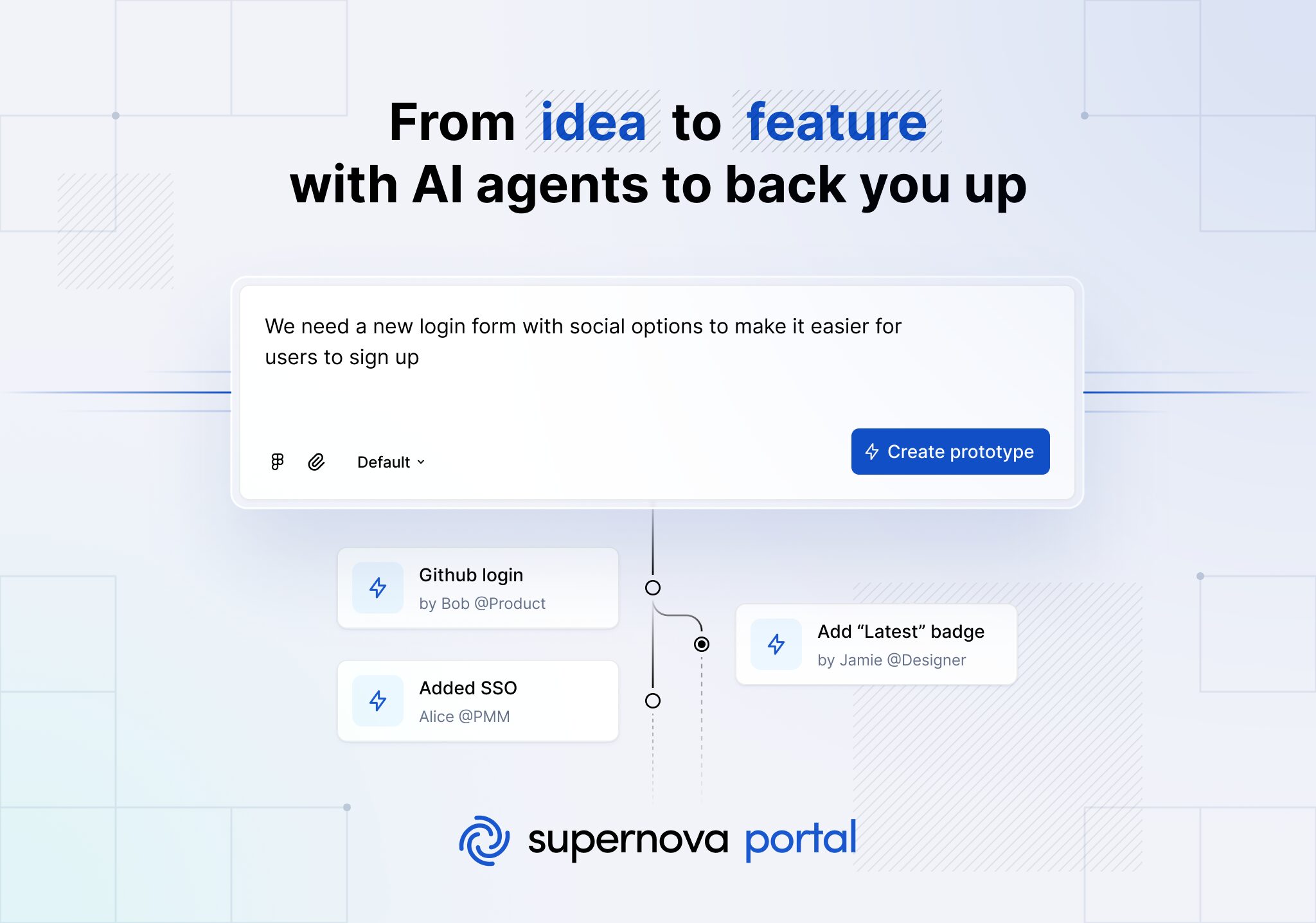
Overview
Supernova is an AI-powered collaborative platform engineered specifically for product teams seeking to accelerate feature delivery without sacrificing brand consistency or design system governance. Launched in November 2025 and backed by Series A funding of €7.85 million from Taiwania Capital, Supernova transforms how product managers, designers, and engineers collaborate from ideation through implementation. The platform bridges the chronic disconnect between design and development through intelligent prototyping, automatic code generation, and deep design system integration. Whether exploring new ideas, documenting brand guidelines, or managing complex multi-product design systems, Supernova enables teams to deliver features in a fraction of the traditional timeframe while maintaining meticulous adherence to brand standards and design system principles.
Key Features
Supernova offers a comprehensive ecosystem designed to eliminate fragmentation across the product development lifecycle.
- AI-driven collaborative prototyping: Transform concepts into interactive, brand-aligned prototypes through intelligent prototyping that understands your design tokens and themes. AI automatically maintains brand standards across all prototypes, eliminating the need to manually reapply styling. Build working prototypes before writing documentation, enabling faster stakeholder alignment and early validation.
- Deep design system integration: Manage design systems as living, interconnected ecosystems rather than static documentation. Import and synchronize design tokens directly from Figma Variables or Tokens Studio, maintaining automatic synchronization that ensures designs stay aligned with code. Govern components with detailed metadata, custom properties, and governance dashboards. Support multiple brands, products, or platforms within a single design system through the dedicated Brands feature.
-
Intelligent design token management: Create a source of truth for design tokens with detailed token views, token aliases, and custom metadata. Configure brand-specific code export pipelines that automatically deliver tokens in the formats your technology stack requires—whether CSS, JavaScript, XML, or other formats. Access tokens anywhere through the integrated Raycast extension for instant design system lookup within development workflows.
-
Automatic PRD and specification generation: Convert prototypes and design concepts directly into actionable product requirements and detailed specifications that your entire team understands. AI generates high-quality product documentation synchronized with your prototypes, eliminating the manual documentation burden. Specifications remain automatically synchronized with prototypes and code, saving hours of duplicate effort.
-
Production-ready code generation: Generate clean, production-ready code directly from prototypes that aligns with your company’s design system standards and technology stack. Push generated code directly into popular development environments including Cursor, VS Code, and GitHub. Support multiple frameworks including React, Angular, Flutter, iOS, Android, and others, ensuring developers have correct patterns from project inception.
-
Branching and isolated experimentation: Explore bold design directions and feature variations in isolated threads without impacting the main project workflow. Branch and experiment freely with parallel development paths, keeping work organized while allowing your team to test multiple solutions side-by-side. Merge changes smoothly without stepping on each other’s toes through intelligent conflict resolution.
-
Figma ecosystem integration: Seamlessly import Figma files, variables, and themes directly into Supernova. Maintain automatic synchronization so your Supernova workspace always reflects the latest design decisions from Figma. Leverage Figma Variables to power design token automation and consistency across all prototypes and generated code.
-
Collaborative governance and specifications: Facilitate real-time collaboration through threaded comments, built-in chat, and intelligent decision-making threads. AI agents learn from conversations and automatically update specifications and documentation based on team discussions. Enable stakeholders including Chief Product Officers and leadership to participate as viewers with commenting privileges, gathering executive buy-in without additional licensing costs.
-
Intelligent design system portal: Query your design system in natural language and receive instant answers about tokens, components, and usage patterns. The AI-powered Portal eliminates design system gatekeepers and accelerates team autonomy. Every team member can access Portal at no additional cost, with AI queries using your existing workspace credits.
How It Works
Supernova transforms product development from siloed workflows into seamless collaboration. Teams begin by creating prototypes leveraging either Supernova’s built-in theme capabilities or by importing design tokens directly from their Figma Variables or Tokens Studio. The AI-driven prototyping engine automatically applies brand standards to every prototype element, maintaining consistency from first concept to high-fidelity design.
As ideas solidify, Supernova generates structured product specifications and detailed documentation directly from prototypes. Rather than designers handing off static files to engineers, the platform creates living specifications that remain synchronized with both the prototype and eventually the deployed code. The platform automatically coordinates all related documents, ensuring design system guidelines, specifications, and code generation pipelines stay perfectly aligned.
Teams collaborate through threaded conversations, with the AI agent learning from discussions and automatically updating documentation. Stakeholders participate as viewers, leaving contextual comments that feed into specification refinement. When ready, the platform generates production-ready code for your target technology stack and pushes it directly into development environments.
The branching system enables parallel exploration. Different team members can experiment with distinct approaches to the same feature, each working in isolated contexts that don’t interfere with the main project. Once viable directions emerge, teams simply merge the best ideas. For larger product organizations managing multiple brands or products, the Brands feature allows managing all design system variations within a single, unified platform while maintaining brand-specific code pipelines and documentation.
Use Cases
Supernova serves diverse scenarios across the product development lifecycle.
- Rapid prototyping for stakeholder alignment: Quickly transform product concepts into interactive prototypes that look like finished products. Share prototypes with stakeholders for immediate feedback and buy-in before committing to development work. The AI-generated specifications accompanying prototypes provide clear direction for technical teams.
-
Accelerated feature delivery with design system integrity: Move features from concept to development-ready specifications in hours rather than weeks. Automated code generation and specification creation eliminate tedious handoff documentation. Every feature maintains design system consistency through automatic token application and governance rules.
-
Centralized design system management for scale: Maintain a single source of truth for design standards that the entire organization understands. Thousands of team members access the intelligent Portal to find tokens, components, and usage patterns instantly. Design system managers empower their teams with self-service access rather than becoming documentation gatekeepers.
-
Multi-brand and multi-product coordination: Manage multiple brands or product lines within a unified design system framework. Each brand maintains separate token sets, documentation contexts, and code export pipelines while sharing governance infrastructure and core components. Updates to shared components propagate across all brands automatically.
-
Stakeholder alignment and executive buy-in: Include executives, product leaders, and stakeholders in the design and specification review process at no additional cost. Collaborative threads capture strategic decisions and build organizational alignment before development begins. Comments and approvals flow directly into final specifications.
-
Code and documentation synchronization: Eliminate the constant drift between design documentation and implemented code. As code changes, specifications update automatically. As specifications evolve, design tokens propagate through code pipelines. This bidirectional synchronization ensures single source of truth across all artifacts.
-
Onboarding distributed product teams: New team members access a unified platform showing design system foundations, living documentation, interactive prototypes, and code examples. Raycast extension provides IDE-integrated access to design tokens. Consistent onboarding accelerates time to productivity for engineering and design organizations.
Pros & Cons
Advantages
- Unified platform eliminates workflow fragmentation: Rather than juggling Figma, documentation tools, code repositories, and communication platforms, all work happens in a connected ecosystem. This integration dramatically reduces coordination overhead and eliminates documentation drift.
-
AI-powered automation accelerates delivery: AI handles tedious tasks including prototype styling consistency, specification generation, and documentation updates. Teams focus on strategy and creative problem-solving rather than manual handoff work.
-
Design system governance at scale: Built specifically for organizations that need design system maturity, the platform scales from small teams to enterprises managing complex multi-brand architecture. Governance rules, brand separation, and code pipelines grow with your organization.
-
True collaborative alignment across disciplines: Product managers, designers, engineers, and stakeholders collaborate in shared contexts with synchronized understanding. Threaded conversations and shared specifications eliminate cross-functional miscommunication that typically delays delivery.
-
Enterprise-grade collaboration and security: Hundreds of enterprises trust Supernova for managing critical design system infrastructure. Role-based permissions, SOC 2 compliance, and enterprise security standards meet corporate governance requirements.
-
Vendor-backed innovation with strong financial foundation: Series A funding and Y Combinator backing demonstrate market validation. Continuous product innovation—including the recent Portal launch—shows active roadmap development focused on team-wide productivity.
Disadvantages
-
Requires design system maturity to unlock full value: Teams without established design systems may find the platform overwhelming initially. Foundational work to define tokens, component architecture, and governance must precede optimal Supernova utilization. Small teams with informal design practices may benefit from simpler alternatives.
-
Learning curve for advanced features: While core prototyping and basic documentation are intuitive, mastering advanced capabilities including code pipelines, brand separation, and portal customization requires dedicated learning time and team enablement investment.
-
SaaS subscription model represents ongoing operational cost: The platform operates on subscription pricing rather than one-time licensing. While cost-effective for teams eliminating multiple tool subscriptions, it represents recurring expense requiring budget allocation.
-
Complex customization for unique architectures: While the platform supports extensive customization, teams with highly unusual design system structures or non-standard development stacks may encounter limitations requiring workarounds or compromises.
How Does It Compare?
When evaluating design system management platforms in 2025, Supernova competes within a diverse ecosystem serving different organizational needs. Zeroheight, Knapsack, Storybook, Interplay, Tokens Studio, and custom coded solutions represent the primary competitive landscape.
Zeroheight specializes in design system documentation with strong Figma and Storybook integration. Zeroheight excels at creating beautiful, accessible design documentation and syncing documentation with design files automatically. However, Zeroheight remains fundamentally documentation-first. It lacks Supernova’s AI-driven prototyping capabilities, automatic specification generation from prototypes, and code generation from design systems. Zeroheight’s strength is documentation presentation; Supernova’s is end-to-end product development acceleration.
Knapsack provides design system management with component governance and documentation. Similar to Zeroheight, Knapsack focuses on documentation and component cataloging. It lacks Supernova’s AI prototyping engine, specification generation, and direct code-to-dev-environment integration. For teams prioritizing documentation organization, Knapsack provides excellent features; for teams seeking to accelerate product delivery, Supernova’s additional capabilities provide meaningful differentiation.
Storybook, the open-source alternative, provides free component documentation and testing capabilities. Storybook’s strength lies in developer accessibility and the active open-source community. Storybook lacks design system governance, specification management, and the intelligent AI features that Supernova provides. However, Storybook’s zero cost makes it attractive for resource-constrained teams willing to accept reduced functionality.
Interplay focuses on connecting React and Figma components with strong token management and guidelines authoring. Interplay competes most directly with Supernova in the React ecosystem. However, Supernova’s broader technology stack support, Figma Variables integration, and Portal capabilities provide advantages for teams using diverse frameworks. Interplay’s depth in React development may appeal to React-specialized teams.
Tokens Studio provides design token management as a Figma plugin. Tokens Studio is lightweight and cost-effective for teams whose primary need is token management from Figma to code. However, Tokens Studio lacks the prototyping, specification generation, and collaboration features that Supernova provides. Teams needing only token pipelines benefit from Tokens Studio’s simplicity; teams requiring full product development acceleration choose Supernova.
Supernova’s differentiation rests on several pillars unavailable in competing solutions: AI-driven prototyping automatically applies brand standards and themes, eliminating tedious manual restyling. Automatic PRD and specification generation directly from prototypes creates alignment documents without manual authoring. Deep Figma integration including Variables synchronization and code generation covering multiple technology stacks provides end-to-end automation. The intelligent Portal transforms design system documentation from static reference into actionable, queryable knowledge. Collaborative governance through stakeholder participation and AI-informed discussions aligns organizations before development begins.
For product teams seeking to maximize development velocity while maintaining design system integrity, Supernova’s unified ecosystem and AI capabilities provide meaningful advantages. Teams prioritizing only documentation would better serve through specialized solutions. Teams with minimal design system maturity should establish foundations before leveraging Supernova’s advanced capabilities. For organizations managing complex design systems, multiple product lines, or seeking to eliminate design-to-development handoff friction, Supernova’s comprehensive platform represents the most capable solution in the market.
Pricing and Accessibility
Supernova operates on a SaaS subscription model with pricing tiers designed to scale from small product teams through enterprise organizations. Free tier access enables evaluation of core capabilities. Stakeholder viewers—including executives and product leaders—access comments and review capabilities without requiring paid licenses, reducing organizational cost while enabling broader participation. Annual subscription discounts provide cost efficiency for long-term commitments.
Final Thoughts
Supernova represents the evolution of design system platforms from documentation tools into comprehensive product development accelerators. Backed by €7.85 million in Series A funding and validated by strong Product Hunt reception (187+ upvotes on November 4, 2025), the platform demonstrates both market confidence and user validation. With the recent launch of Supernova Portal and deep AI integration throughout the platform, the company is positioning design systems not as bureaucratic governance overhead but as competitive advantage enabling rapid, consistent delivery at scale.
For product organizations ready to break free from fragmented workflows and maximize development velocity, Supernova delivers a compelling proposition. The combination of AI-driven prototyping, automatic specification generation, deep design system integration, and collaborative governance creates a platform genuinely worthy of the promise to deliver features 10x faster. While teams without design system maturity should establish foundations first, and resource-constrained organizations might find lower-cost alternatives sufficient, product teams with established design systems and delivery velocity ambitions will find Supernova an invaluable asset. The platform transforms the relationship between design and development from handoff friction into genuine collaboration, positioning modern product teams to compete and ship with unprecedented speed.