
Table of Contents
Overview
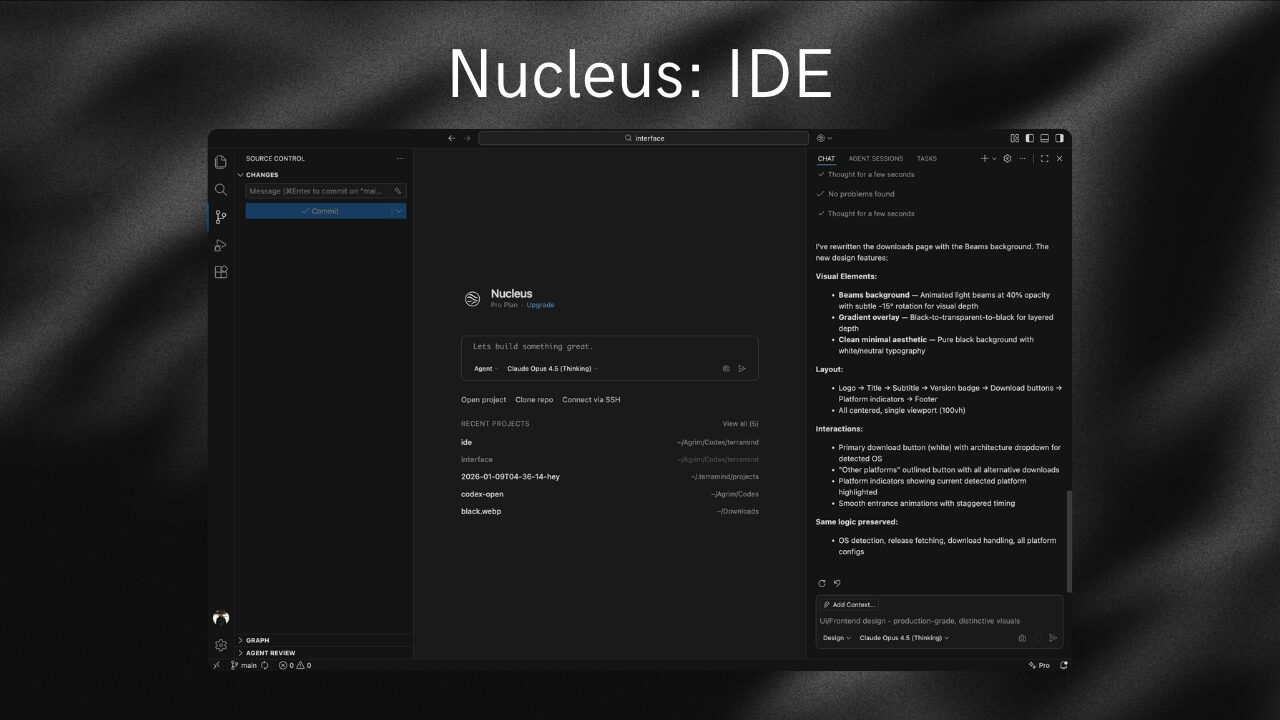
Terramind Nucleus is an integrated development operations (DevOps) platform designed to consolidate coding, collaboration, and deployment into a single ecosystem. It functions as a central technical hub that connects your code editor with version control systems, command-line interfaces, and cloud infrastructure. By acting as the “connective tissue” of the software development lifecycle, it aims to eliminate toolchain fragmentation and accelerate development velocity through deep AI integration.
Important Correction: It is critical to distinguish between Terramind (the AI ecosystem for developers) and Teramind (a well-known employee monitoring and DLP tool). Terramind Nucleus belongs to the former, an AI-native startup ecosystem often referred to as an “AI SuperApp” platform.
Key Features
- IDE-Native Development: Directly embeds within popular code editors like VS Code and JetBrains, providing real-time code analysis and AI-driven refactoring without requiring context switching.
- AI-Assisted Code Reviews: Automates the review process by analyzing code commit patterns to forecast potential test failures or security vulnerabilities before they reach production.
- Automated Pull Request Orchestration: Integrates with GitHub and GitLab to auto-generate PRs, trigger pre-merge checks, and prioritize critical reviews based on historical impact data.
- Cloud Agent Deployment: Utilizes lightweight, containerized agents to execute CI/CD jobs across major cloud providers (AWS, Azure, GCP) with predictive load scaling.
- Cross-App Connectivity: Unique among DevOps tools, it connects directly to the broader Terramind suite, allowing project context from notes, calendars, and documentation to inform coding tasks.
How It Works
Nucleus operates as a multi-surface platform accessible via an IDE extension, a command-line interface (CLI), or through cloud-based agents. When a developer writes code, the IDE-native AI provides immediate feedback and linting. Once code is pushed, the system’s “Agentic” layer takes over, orchestrating the creation of pull requests and running automated security scans. The platform uses machine learning models to correlate code changes with past deployment logs, predicting build failures and suggesting optimizations. For deployment, containerized agents handle the transition to cloud environments, maintaining a SOC 2-compliant audit trail throughout the process.
Use Cases
- DevOps Engineers: Teams managing multi-cloud deployments can use Nucleus to unify fragmented tools and automate infrastructure-as-code validation via Terraform.
- High-Velocity Development Teams: Organizations looking to reduce “PR lag” by using AI to prioritize reviews and automate routine documentation tasks.
- Security-Conscious Organizations: Firms requiring automated, real-time security scanning within the IDE to prevent vulnerable code from ever being committed.
- Solo Developers and Startups: Individual makers can leverage the “free starter credits” to access a professional-grade DevOps pipeline without the complexity of manual setup.
Pros & Cons
Advantages
- End-to-End Unification: Successfully bridges the gap between the editor, version control, and cloud deployment in one interface.
- Context-Aware Intelligence: Gains an “EEAT” edge by using data from related Terramind apps (Notes, Drive, etc.) to provide more relevant code suggestions.
- Infrastructure Flexibility: Supports hybrid deployments with both cloud-hosted and self-hosted agents for air-gapped or sensitive networks.
- Improved MTTR: Benchmark tests suggest a 40% reduction in mean-time-to-resolution for build failures due to its predictive AI engine.
Disadvantages
- Early Preview Stability: As a relatively new ecosystem, users may encounter bugs or incomplete documentation for advanced edge cases.
- Credit-Based Costs: While a free tier exists, high-frequency users or enterprise-scale deployments will require significant credit purchases for full automation.
- Learning Curve: The “Agentic” approach to PR orchestration and deployment differs from standard manual scripting, which may require team retraining.
How Does It Compare?
GitHub Copilot
- Scope: Primarily focuses on code completion and chat-based assistance within the editor.
- Differentiation: While Copilot leads in raw code generation speed (especially with GPT-5 integration), Nucleus offers a wider scope that includes PR orchestration, automated security scans, and cloud agent management.
- Key Distinction: Copilot is a developer-centric assistant; Nucleus is a full-team DevSecOps ecosystem.
GitLab / GitLab Duo
- Scope: A comprehensive DevSecOps platform covering the entire lifecycle from planning to security.
- Differentiation: GitLab Duo is strong on enterprise-grade security and “Explain-this-diff” features, but Nucleus is more IDE-native and “agent-centric,” providing a smoother experience for those who prefer to stay within their code editor.
- Key Distinction: GitLab is traditionally “web-first” for collaboration; Nucleus is “editor-first” with deep AI orchestration.
Claude Code
- Scope: A specialized CLI-based agent for autonomous coding tasks using the Claude 3.5/3.7 models.
- Differentiation: Nucleus actually integrates with Claude Code (and other frontier models), providing a graphical and agentic wrapper around these CLI tools to make them more accessible for team-wide workflows.
- Key Distinction: Claude Code is a tool; Nucleus is the environment where that tool (and others) can be managed effectively.
Cursor
- Scope: An AI-native code editor (forked from VS Code) designed for deep model integration.
- Differentiation: Cursor is an excellent standalone editor, but Nucleus focuses on the “connective tissue” between any IDE and the rest of the DevOps pipeline (PRs, deployments, cloud agents).
- Key Distinction: Cursor is a replacement for your editor; Nucleus is a layer that enhances your existing editor and connects it to the cloud.
Final Thoughts
Terramind Nucleus marks a pivot in the developer tool market from “AI-assisted” to “AI-orchestrated.” By unifying the IDE, CLI, and cloud agents, it addresses the long-standing problem of toolchain fragmentation. Its unique connectivity to a broader app ecosystem—where notes and calendars inform code context—provides a level of personalization that general-purpose tools lack. While its early-stage status means teams should anticipate some iteration on features, Nucleus offers a compelling glimpse into a future where the mechanical parts of the development lifecycle are handled autonomously, allowing engineers to focus purely on high-level architecture and creative problem-solving.