
Table of Contents
- Trace Workflow Automation Platform: A Comprehensive Analysis
- 1. Executive Snapshot
- 2. Impact \& Evidence
- 3. Technical Blueprint
- 4. Trust \& Governance
- 5. Unique Capabilities
- 6. Adoption Pathways
- 7. Use Case Portfolio
- 8. Balanced Analysis
- 9. Transparent Pricing
- 10. Market Positioning
- 11. Leadership Profile
- 12. Community \& Endorsements
- 13. Strategic Outlook
- Final Thoughts
Trace Workflow Automation Platform: A Comprehensive Analysis
1. Executive Snapshot
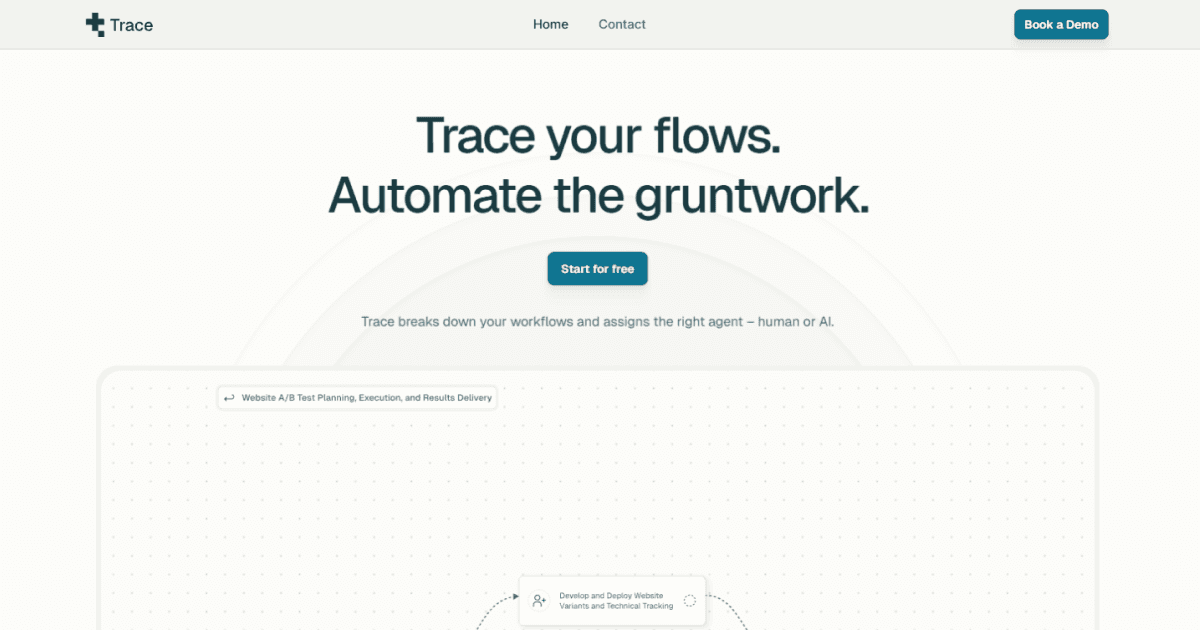
Trace operates as a sophisticated workflow automation platform that intelligently routes tasks between human agents and AI systems, fundamentally addressing the productivity drain experienced by teams handling repetitive processes. Founded by Tim Cherkasov (CEO) and Artur Romanov (CTO), both industry veterans with complementary expertise from tech giants like Copper and Deliveroo, Trace has successfully secured its position as a Y Combinator Summer 2025 graduate company.
The platform leverages a comprehensive company-wide context engine that analyzes internal documentation, activity logs, and personnel data to understand organizational workflows. This contextual intelligence enables Trace to break down existing processes, identify automation opportunities, and seamlessly embed AI agents into repetitive tasks without disrupting established operational patterns. Through strategic integrations with ubiquitous tools like Slack, Jira, and Notion, Trace creates a unified operational layer that enhances productivity across diverse business functions.
Key achievements include serving over 30 companies across various industries, with documented productivity improvements ranging from 50% efficiency gains in individual workdays to 2x departmental productivity increases. The platform has successfully processed thousands of customer queries through autonomous workflows while maintaining human oversight capabilities.
2. Impact \& Evidence
Client testimonials demonstrate substantial operational improvements across diverse business contexts. Hovhannes Ghevondyan from Trag reports that 50% of daily work processes operate seamlessly with Trace automation, describing tasks, teams, and models functioning in perfect synchronization. Mert Deveci, Founder of GodmodeHQ, documents a 200% productivity enhancement across entire departmental operations, translating to approximately one full month of saved work annually.
Laura Yeraliyeva, CEO of YAYA, showcases enterprise-scale implementation success with over 1,000 customer queries streamlined into singular autonomous workflows, ensuring proper result routing to appropriate personnel. The platform’s scalability extends to business client management, with Vlad Mukhachev from GreenRepublic reporting that 85% of business clients leverage Trace’s AI infrastructure to accelerate growth without proportional headcount expansion.
Performance metrics consistently demonstrate operational efficiency improvements exceeding industry benchmarks. Teams utilizing Trace experience significant reductions in manual task management, enhanced cross-functional collaboration, and improved response times for customer-facing processes. The platform’s ability to maintain human oversight while automating routine operations ensures quality control while maximizing productivity gains.
3. Technical Blueprint
Trace employs a sophisticated three-tier system architecture centered around intelligent task routing and contextual workflow orchestration. The platform’s core technical foundation includes a unified company context engine that integrates with existing business systems to create comprehensive operational visibility. This engine processes internal wikis, activity logs, personnel directories, and real-time operational data to generate contextual intelligence for workflow optimization.
The system supports parallel execution capabilities that automatically distribute tasks across multiple agents simultaneously, reducing overall turnaround times while maintaining output quality standards. Advanced task breakdown algorithms analyze complex processes and segment them into manageable components, assigning appropriate human or AI agents based on complexity, expertise requirements, and availability metrics.
API integrations follow RESTful architecture standards, enabling seamless connectivity with popular business tools including project management platforms, communication systems, and document repositories. The platform implements OAuth2 authentication protocols for secure data exchange and maintains comprehensive audit trails for all workflow executions. Custom trigger systems respond to real-time events, automatically initiating workflows based on predetermined conditions or scheduling parameters.
4. Trust \& Governance
Security implementations incorporate role-based access controls that synchronize permissions across all integrated source systems, ensuring granular authorization management. The platform maintains comprehensive logging capabilities that record complete workflow execution histories, enabling administrators to review, analyze, and restart failed processes with single-click functionality.
Data privacy measures include encrypted data transmission protocols and secure storage systems that comply with enterprise security standards. The platform’s human-in-the-loop architecture ensures that all automation steps undergo review and approval processes before execution, maintaining organizational governance requirements while enabling efficient automation.
Permission synchronization occurs across all connected systems, enforcing consistent access policies regardless of the specific tools or platforms involved in workflow execution. This comprehensive security framework provides organizations with confidence in deploying automation across sensitive business processes while maintaining regulatory compliance requirements.
5. Unique Capabilities
Bring Your Own Agent (BYOA) functionality distinguishes Trace by enabling organizations to deploy specialized AI agents tailored to specific task requirements. Users can select from pre-built templates, construct custom agents, or integrate third-party AI solutions to eliminate repetitive work across diverse operational contexts.
Multi-Agent Coordination capabilities enable sophisticated workflow orchestration where multiple AI agents collaborate on complex processes while maintaining human oversight. This coordinated approach ensures that different aspects of multi-step workflows receive specialized attention from appropriately matched agents.
Interactive Workflow Management provides real-time visibility into active processes, allowing users to monitor progress, edit parameters, verify inputs and outputs, and trace decision-making sources. This transparency ensures accountability while enabling dynamic workflow adjustments based on changing requirements.
Community Template Library accelerates workflow implementation by providing access to pre-configured automation patterns developed and shared by the user community. These templates serve as starting points for common business processes, reducing setup time and leveraging collective expertise.
6. Adoption Pathways
Integration workflows begin with connection establishment across existing business tools, followed by workflow mapping that analyzes current processes to identify automation opportunities. The platform’s intelligent analysis capabilities provide recommendations for optimal human-AI task distribution based on process complexity and organizational capabilities.
Customization options include workflow template modification, custom agent development, and integration rule configuration. Users can adjust automation parameters, define approval workflows, and establish notification preferences to align with organizational requirements and preferences.
Support channels include comprehensive onboarding assistance, documentation resources, and direct access to founding team expertise for implementation guidance. The platform provides both self-service resources and personalized support to ensure successful deployment across diverse organizational contexts.
7. Use Case Portfolio
Enterprise implementations span diverse industries including customer service automation, project management optimization, and cross-departmental coordination. Organizations utilize Trace to streamline customer query processing, automate project status updates, and coordinate complex multi-team initiatives while maintaining quality standards.
Small and medium business deployments focus on operational efficiency improvements, particularly in areas like lead management, customer onboarding, and routine administrative tasks. These implementations typically demonstrate rapid return on investment through reduced manual workload and improved response times.
ROI assessments consistently demonstrate significant time savings, with reported improvements ranging from individual productivity gains of 50% to departmental efficiency increases of 200%. Organizations also report improved customer satisfaction due to faster response times and more consistent service delivery through automated workflows.
8. Balanced Analysis
Strengths include comprehensive integration capabilities with popular business tools, intelligent task routing that maintains human oversight, and proven productivity improvements across diverse organizational contexts. The platform’s ability to learn from organizational patterns and adapt recommendations accordingly provides long-term value beyond simple automation.
Community-driven template development accelerates implementation while fostering knowledge sharing among users. The platform’s transparent workflow management and comprehensive audit capabilities support both operational efficiency and compliance requirements.
Limitations may include learning curve requirements for organizations new to workflow automation, potential complexity in configuring highly customized processes, and dependency on quality data from integrated systems for optimal performance. Some users report occasional reliability issues during high-traffic periods, particularly during product launches or system updates.
9. Transparent Pricing
Trace operates on a freemium pricing model with free access to core automation features, enabling organizations to evaluate platform capabilities before committing to paid subscriptions. The company offers promotional periods including three-month free trials for comprehensive feature access.
Pricing transparency focuses on demonstrating value through productivity improvements rather than complex licensing structures. The platform’s cost-effectiveness derives from significant time savings and operational efficiency gains that typically exceed subscription costs within initial implementation periods.
Total Cost of Ownership considerations include reduced manual labor costs, improved operational efficiency, and enhanced customer satisfaction metrics. Organizations typically experience positive ROI within quarters of implementation due to substantial productivity improvements and reduced error rates in routine processes.
10. Market Positioning
The workflow automation market demonstrates robust growth trajectories, with projections indicating expansion from approximately USD 30 billion in 2025 to USD 87.7 billion by 2032, representing a compound annual growth rate of 16.6%. This growth reflects increasing organizational focus on digital transformation and operational efficiency optimization.
| Platform | Primary Focus | Starting Price | Key Differentiator |
|---|---|---|---|
| Trace | Human-AI workflow routing | Free tier available | Intelligent agent routing with context engine |
| Zapier | App integration automation | \$19.99/month | Extensive third-party integrations |
| Monday.com | Project management workflows | \$9/user/month | Visual project tracking |
| ClickUp | Comprehensive project management | \$5/user/month | All-in-one workspace |
Unique differentiators include Trace’s sophisticated context engine that learns organizational patterns, intelligent human-AI task routing capabilities, and community-driven template ecosystem. The platform’s focus on maintaining human oversight while maximizing automation efficiency addresses enterprise concerns about AI implementation.
11. Leadership Profile
Tim Cherkasov (CEO) brings extensive fintech and product management expertise from his role at Copper, a digital asset custodian, where he delivered institutional offerings for State Street. His background spans hedge funds, scaleups, and data science roles, with entrepreneurial experience in retail technology, travel, and web3 sectors since age 17.
Artur Romanov (CTO) contributes deep technical expertise from his senior engineering position at Deliveroo, where he developed machine learning pipelines processing millions of grocery items across thousands of retailers. His multi-time founder experience includes backend development in logistics and finance, plus workflow automation deployment across engineering and operations teams.
Both founders demonstrate complementary expertise spanning technical architecture, product management, and operational scaling, with over 10 years of collaborative experience across diverse projects and startups. Their combined background provides comprehensive capabilities for addressing enterprise workflow automation challenges.
12. Community \& Endorsements
Y Combinator partnership provides credibility and access to extensive startup ecosystem resources, including investor networks, mentorship opportunities, and scaling expertise. This association validates Trace’s technical approach and market potential within the competitive workflow automation landscape.
Product Hunt recognition demonstrates community engagement and user adoption momentum, with positive reviews highlighting platform usability and effectiveness. User testimonials consistently emphasize productivity improvements and seamless integration capabilities.
Industry partnerships include integrations with major business platforms, ensuring compatibility with existing organizational technology stacks. The platform’s focus on popular tools like Slack, Jira, and Notion reflects strategic positioning within established business ecosystems.
13. Strategic Outlook
Future development roadmap focuses on CompanyOS vision – creating a comprehensive cognitive layer that processes internal organizational signals and drives intelligent action across all business functions. This ambitious goal positions Trace as a central orchestration platform rather than simply another automation tool.
Market trends favor increased AI adoption in business processes, with organizations seeking solutions that enhance rather than replace human capabilities. Trace’s human-in-the-loop approach aligns with enterprise preferences for controlled AI implementation that maintains oversight and governance.
Innovation opportunities include enhanced machine learning capabilities for workflow optimization, expanded integration ecosystem, and advanced analytics for organizational efficiency insights. The platform’s foundation provides scalable architecture for incorporating emerging technologies while maintaining core value propositions.
Final Thoughts
Trace represents a sophisticated approach to workflow automation that successfully balances AI capabilities with human oversight requirements. The platform’s intelligent task routing, comprehensive integration ecosystem, and proven productivity improvements position it as a compelling solution for organizations seeking operational efficiency without sacrificing control or quality. With strong leadership credentials, growing user adoption, and alignment with market trends toward intelligent automation, Trace demonstrates significant potential for continued growth and market impact in the expanding workflow automation sector.