Table of Contents
- Overview
- Key Features
- How It Works
- Use Cases
- Pros & Cons
- How Does It Compare?
- Zapier (No-Code Visual Workflow Platform)
- n8n (Low-Code Workflow Automation)
- UiPath (Enterprise Robotic Process Automation)
- Make (formerly Integromat – Visual Workflow Automation)
- Claude Opus or GPT-4 with Custom Integrations (Manual AI-Code Generation)
- Python or NodeJS Scripting Plus Scheduling Tools (Developer Approach)
- Turbotic’s Distinct Positioning
- Final Thoughts
Overview
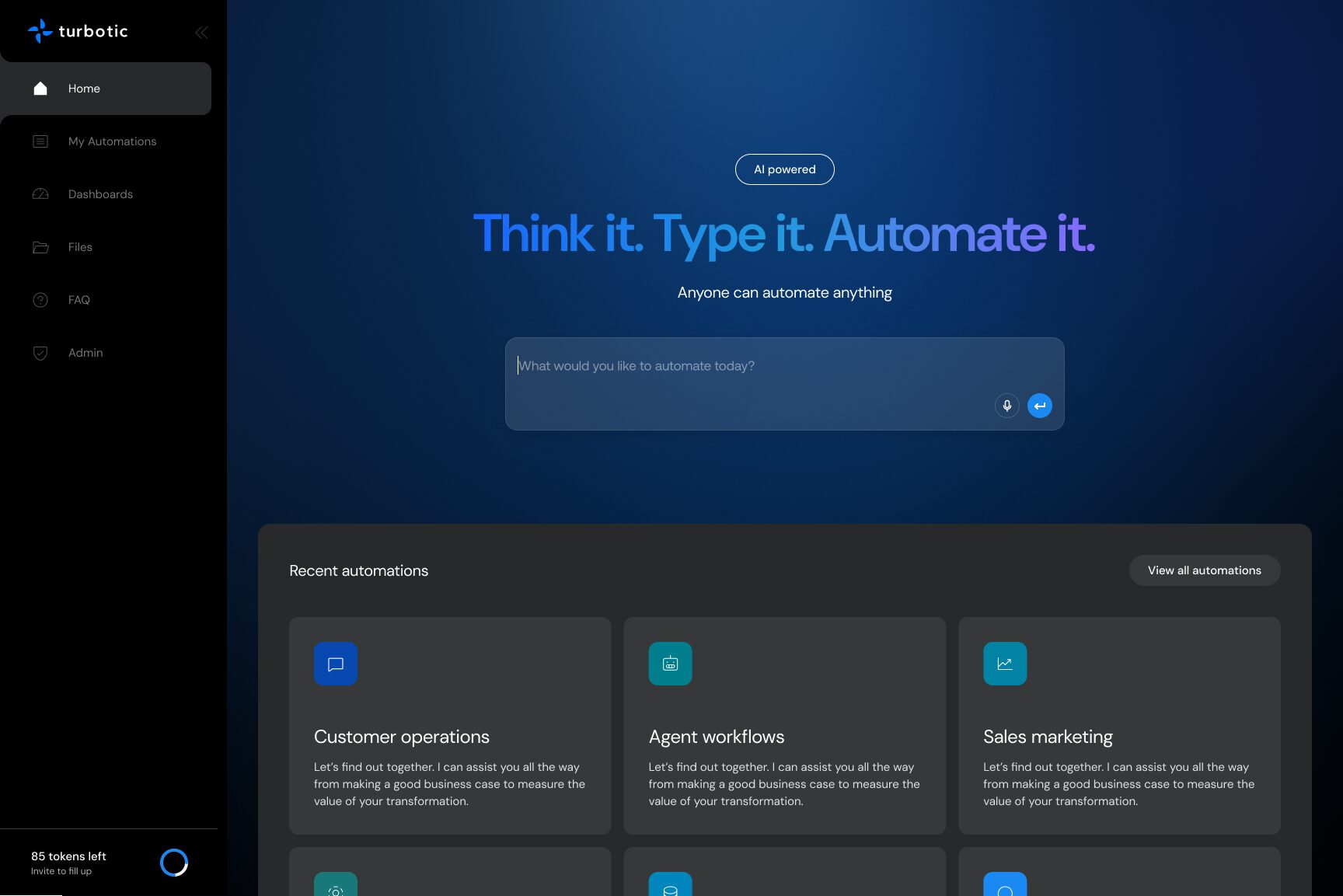
Business automation at scale has traditionally required choosing between three unsatisfactory options: hiring specialized RPA developers, managing complex enterprise platforms with steep learning curves, or settling for limited integration capabilities. Turbotic Automation AI addresses this challenge through an AI-first platform designed for non-technical users to describe workflow automations in plain English, with the platform automatically generating, testing, and maintaining executable automation code. Founded in 2020 by Swedish entrepreneur Theo Bergqvist, Turbotic evolved from RPA orchestration tooling to AI-powered automation by 2022, reaching 95%+ code generation accuracy by May 2025. The platform targets SMBs, operations teams, and business users seeking to automate complex workflows—across email, databases, APIs, and SaaS tools—without writing code or depending on developer resources.
Key Features
Turbotic Automation AI combines natural language interfaces with sophisticated code generation and self-repair capabilities.
- Natural-Language Chat-Based Automation Building: Users describe desired automations in plain English (“Fetch emails from the last 24 hours and summarize for the CEO”), and Turbotic’s AI translates these descriptions into executable automation code. Clarifying questions help refine ambiguous requests before code generation begins.
- AI-Generated Code That Runs on Actual Execution Scripts: Unlike visual builders limited to pre-built connectors, Turbotic generates actual executable code that can call any API, manipulate databases, or integrate with web services. This provides unlimited integration flexibility without waiting for native connector development.
Comprehensive App and Service Integration (1000+): Supports connecting to major SaaS platforms (Salesforce, HubSpot, Jira, ServiceNow, Zoom, Slack, email systems) and can integrate with any service offering an API or webhook without requiring pre-built connectors.
Complex Multi-Step Workflow Capabilities: Handles sophisticated automation sequences including email parsing and analysis, data classification using LLMs (GPT-4, Claude, Cohere, Mistral), conditional logic, database updates, multi-step API chains, and adaptive responses based on content analysis.
Self-Healing Automation with Automatic Error Detection and Repair: Monitors automation execution in real-time, detects errors or failures, automatically diagnoses root causes, rewrites problematic code sections, and retests repairs without human intervention. This dramatically reduces maintenance overhead compared to traditional automation.
AI Model Flexibility as Building Blocks: Supports multiple AI providers (OpenAI, Anthropic Claude, Cohere, Mistral, and open-source models) as pluggable components within automations, enabling specialized model selection for specific tasks within complex workflows (e.g., Claude for reasoning-heavy analysis, Mistral for efficient summarization).
Real-Time ROI and Impact Metrics: Dashboards track tangible business metrics including time saved per automation, cost reduction calculations, hours freed from manual work, and direct business value impact—moving beyond execution logs to business-outcome metrics.
Enterprise Governance and Collaboration Features: Team collaboration, approval workflows, role-based access controls, and audit trails enable enterprise-grade operational governance while maintaining accessibility for non-technical team members building automations.
Self-Testing and Automated Validation: Automations automatically test themselves during creation and after code repairs, reducing deployment risk and ensuring functionality before going live.
How It Works
Turbotic Automation AI operates through a streamlined, three-stage workflow: describe, build, and execute with continuous self-monitoring.
The user initiates the process by describing a desired automation in natural language through a chat interface. For example: “When I receive an email from a client, extract key information, check it against our database, assign priority based on urgency, and send me a summary with next steps.” The AI assistant asks clarifying questions to disambiguate requirements, understand edge cases, and confirm technical approach. Once the user confirms, Turbotic generates executable automation code—not visual workflows or pre-built templates, but actual code capable of executing sophisticated logic.
The platform generates production-ready code that the user can review before deployment. The automation is then deployed and executed on Turbotic’s infrastructure, running on a schedule (daily, hourly, etc.) or triggered by specific events (incoming email, webhook, scheduled time). Unlike traditional automation builders, Turbotic executes actual code rather than interpreting visual builders—enabling unlimited capability.
Critically, Turbotic continuously monitors automation execution. When errors occur (API failures, data inconsistencies, unexpected formats), the system detects them, analyzes root causes, and automatically rewrites the problematic code sections. It then retests the repaired automation and returns it to normal execution without human intervention. This self-healing capability means automations adapt to changing APIs, data structures, and business logic without requiring developer maintenance.
Throughout execution, InsightIQ analytics dashboard tracks automation performance, calculates business impact (time saved, cost reduction), identifies patterns, and suggests optimization opportunities. Teams can monitor entire automation portfolios and their collective business impact in real-time.
Use Cases
Turbotic addresses automation needs across business functions where complex workflows create operational bottlenecks.
- Email-Based Workflow Automation: Automatically fetch, parse, and analyze incoming emails; extract structured data; classify content using AI; trigger downstream actions (updating CRM, creating tickets, sending notifications); and generate summaries for human review. Handles volume spikes without scaling headcount.
Lead Qualification and Sales Pipeline Automation: Automatically receive inbound inquiries, classify leads by qualification criteria, trigger follow-up sequences (SMS, email, calls), populate CRM automatically, and send prioritized leads to sales teams. Response times improve by 90%, sales time to close improves, and manual data entry is eliminated.
HR and Recruitment Operations: Automatically screen resumes by comparing against job requirements, extract candidate information into structured format, rank candidates by fit score with reasoning, send customized responses to candidates, and populate applicant tracking systems. Reduces screening time from 15 minutes per resume to 30 seconds.
Compliance and Document Processing: Automatically scan documents for compliance requirements, identify missing or incorrect information, generate compliance reports, and send alerts to appropriate teams. Reviews that took days now complete in minutes with higher accuracy.
Inventory and Supply Chain Management: Monitor inventory levels in real-time across multiple systems, automatically trigger purchase orders when stock falls below thresholds, track shipments, update availability across sales channels, and alert teams to potential shortages before they impact customers.
Internal Reporting and Business Intelligence: Generate weekly or daily summaries across multiple data sources (CRM, accounting systems, project management tools), compile metrics into dashboards, identify anomalies and trends, and send executive summaries to leadership. Reporting that previously required manual compilation now runs automatically.
Customer Support Ticket Triage: Automatically receive incoming support tickets, classify by issue type and severity, route to appropriate support agents or teams based on specialization, generate initial response suggestions, and escalate high-priority issues immediately.
Multi-System Data Synchronization: Keep data synchronized across disparate systems (ERP, CRM, HR platform, etc.) through automated polling and updates, eliminating manual data entry between systems and ensuring single source of truth.
Pros & Cons
Advantages
- Dramatically lower barrier to automation creation: Plain-English descriptions enable non-technical users to build sophisticated automations without coding, RPA training, or developer resources.
Unlimited integration flexibility: AI-generated code calls any API, removing the constraint of pre-built connectors. If a service has an API, Turbotic can automate it immediately.
Significant code accuracy achievement: Reaching 95%+ code generation accuracy (as of May 2025) means generated automations frequently work without modification, dramatically increasing deployment velocity.
Self-healing reduces maintenance burden: Automatic error detection and repair means automations adapt to changing APIs and data structures without human intervention—a substantial operational advantage.
Transparent business value metrics: ROI dashboards showing time saved, cost reduction, and business impact help justify automation investments and identify high-value opportunities.
Enterprise governance without complexity: Collaboration features, approval workflows, and audit trails enable organizational scaling while maintaining accessibility.
Cost positioning: Positioned as less expensive than Zapier for complex workflows and simpler than enterprise RPA platforms (UiPath, Blue Prism) typically requiring developer resources.
Proven at scale: Hack the Future 2025 event demonstrated 1,600 automations created in five days, validating real-world speed and ease-of-use claims.
Disadvantages
Relatively new platform with limited production history: Founded 2020, Automation AI product launched November 2025—limited track record compared to established competitors. Long-term reliability and support maturity require validation.
AI-generated code may require occasional adjustment: While 95%+ accuracy is substantial, edge cases, unusual business logic, or specific formatting requirements may require code review and manual refinement by technical users.
Dependency on AI model accuracy and API stability: Automation quality depends on both Turbotic’s code generation models and stability of connected services’ APIs. External API changes can require automation adjustments.
Self-healing effectiveness depends on error patterns: While self-healing addresses common error scenarios, novel or unexpected failures may still require human investigation and manual code adjustment.
Pricing model and cost transparency not fully detailed: Comparison to “cheaper than Zapier” lacks specificity regarding absolute pricing, per-automation costs, or scaling economics for enterprises with hundreds of automations.
Data security and vendor risk considerations: Users must carefully evaluate data residency policies, security certifications (SOC 2, ISO 27001), and business continuity provisions before entrusting sensitive workflows to newer platforms.
Learning curve for optimal prompt engineering: While plain-English descriptions are accessible, users may need to experiment with specific phrasing to generate optimal automation code for complex scenarios. Some trial-and-error may be necessary.
Potential rate-limiting on API calls: Heavy automation users might encounter rate limiting from connected services, requiring careful throttling and sequencing of API calls within Turbotic automations.
How Does It Compare?
Turbotic Automation AI occupies a specific niche within the automation market: AI-first generation of executable code from natural language descriptions. Understanding competitive positioning requires recognizing distinct approaches and target markets:
Zapier (No-Code Visual Workflow Platform)
Zapier dominates the SMB automation market with 6,000+ pre-built app connectors, drag-and-drop workflow builder, and pricing starting $19/month for non-technical users. Zapier’s strength lies in simplicity—connecting common business applications through visual “Zaps” (trigger → action sequences). Over 4+ million users leverage Zapier for straightforward automation.
Key differences from Turbotic: Zapier is connector-library-based, limited to pre-built integrations; Turbotic generates code to call any API. Zapier’s visual builder is simpler for basic workflows; Turbotic enables complex multi-step logic. Zapier requires waiting for connector development; Turbotic accesses new services immediately. Zapier is established with extensive documentation; Turbotic is newly launched. Best suited for: Non-technical users automating straightforward workflows between common applications; teams prioritizing simplicity over feature richness.
n8n (Low-Code Workflow Automation)
n8n provides open-source and cloud-hosted workflow automation with 800+ pre-built integrations, visual workflow builder, and JavaScript customization for advanced use cases. n8n targets developers and technical operations teams comfortable with visual workflows plus code customization.
Key differences from Turbotic: n8n requires understanding workflow visual design concepts; Turbotic uses conversational natural language. n8n requires learning JavaScript for advanced scenarios; Turbotic generates code automatically. n8n offers self-hosting for data sovereignty; Turbotic appears cloud-only (needs verification). n8n has open-source option; Turbotic is SaaS. n8n mature with large community; Turbotic newly launched. Best suited for: Technical teams wanting open-source flexibility and self-hosting options; developers comfortable with visual workflows plus code; organizations requiring data sovereignty.
UiPath (Enterprise Robotic Process Automation)
UiPath dominates enterprise RPA with Studio (visual RPA development), StudioX (for business users), extensive process mining, AI capabilities, and enterprise security. UiPath targets large enterprises automating legacy system interaction, high-volume repetitive processes, and complex business workflows.
Key differences from Turbotic: UiPath focuses on UI automation (automating human interactions with legacy systems); Turbotic focuses on API automation and system integration. UiPath requires RPA training and developer expertise; Turbotic uses natural language. UiPath targets 6-12 month enterprise deployments; Turbotic targets minutes-to-hours. UiPath costs $5,000-50,000+/month for enterprise; Turbotic likely $100-1,000/month (unconfirmed). UiPath established with extensive ecosystem; Turbotic newly launched. Best suited for: Large enterprises automating legacy system workflows; organizations with existing RPA programs; complex UI-heavy processes requiring screen automation.
Make (formerly Integromat – Visual Workflow Automation)
Make provides visual workflow automation with 1,000+ app connectors, advanced logic, and team collaboration. Make positions between Zapier’s simplicity and n8n’s customization.
Key differences from Turbotic: Make uses visual workflows; Turbotic uses conversational natural language. Make requires learning workflow builder interface; Turbotic requires describing intent in English. Make strong on workflow logic; Turbotic stronger on API integration flexibility. Both enable non-developer automation; Turbotic potentially with lower friction. Best suited for: Teams wanting intermediate complexity between Zapier and n8n; users comfortable with visual workflows; organizations needing advanced logic beyond simple triggers and actions.
Claude Opus or GPT-4 with Custom Integrations (Manual AI-Code Generation)
Advanced users manually prompt LLMs to generate automation code, then implement in-house orchestration. This approach offers unlimited flexibility but requires technical expertise to handle API integration, deployment, error handling, and maintenance.
Key differences from Turbotic: No structured platform—requires building custom infrastructure. Infinite code flexibility; limited by prompt engineering skill. No monitoring or self-healing—requires custom implementation. Minimal recurring cost (just API fees); Turbotic has SaaS subscription. Requires significant technical effort; Turbotic abstracts complexity. Best suited for: Large tech companies with custom infrastructure; teams with substantial engineering resources willing to build bespoke solutions.
Python or NodeJS Scripting Plus Scheduling Tools (Developer Approach)
Traditional developer approach using Python/NodeJS to write custom scripts plus cron/scheduler for execution. Offers complete flexibility and control but requires coding expertise and ongoing maintenance.
Key differences from Turbotic: Requires developer expertise; Turbotic requires business user conversation. Full code control; potentially more maintenance overhead. No-platform dependencies; Turbotic provides managed infrastructure. Best suited for: Development-heavy organizations with in-house engineering resources; scenarios requiring highly customized logic; teams comfortable managing custom code deployment.
Turbotic’s Distinct Positioning
Turbotic uniquely combines several characteristics:
Conversational Interface for Code Generation: Unlike competitors using visual builders or requiring code, Turbotic translates natural language into executable code—reducing friction for business users while maintaining power of actual code execution.
Unlimited API Integration Without Waiting for Connectors: Code generation means any API-based service can be integrated immediately; not constrained by pre-built connector libraries or waiting for platform developers to build integrations.
Self-Healing Automation Capability: Automatic error detection and repair (as of November 2025 release) is unique among mainstream automation platforms, dramatically reducing maintenance burden.
AI Model Flexibility: Support for multiple LLM providers as pluggable components within automations enables specialized model selection for optimal task performance.
Target Segment: Positioned between Zapier (too simple for complex workflows) and UiPath (too heavy for rapid SMB/ops deployment), targeting mid-market operations teams and technically-savvy business users seeking power with accessibility.
For organizations seeking to rapidly deploy sophisticated multi-step automations without developer dependencies, with self-maintaining code and unlimited API integration, Turbotic offers a compelling alternative to both pre-built connector platforms and enterprise RPA systems. Success depends on continued platform maturity, self-healing reliability in production, and pricing competitiveness versus both Zapier (for simplicity) and UiPath (for enterprise).
Final Thoughts
Turbotic Automation AI represents a meaningful evolution in business automation, applying advances in generative AI and large language models to reduce barriers for non-technical users to build sophisticated workflows. The platform’s positioning—combining natural language interfaces, unlimited API integration, self-healing capabilities, and real-time ROI metrics—addresses genuine friction points in existing automation platforms.
The 95%+ code generation accuracy (achieved by May 2025) and demonstrated speed (1,600 automations in five days at Hack the Future 2025) suggest the platform has achieved technical maturity for immediate launch. For organizations tired of choosing between Zapier’s limitations, n8n’s complexity, or UiPath’s heavyweight infrastructure, Turbotic offers a focused alternative.
However, realistic assessment acknowledges the platform’s newness. Founded in 2020 and launching Automation AI in November 2025, Turbotic has limited production history compared to established competitors. Early adopters should conduct thorough proof-of-concept evaluation using their actual workflows, carefully assess data residency and security compliance requirements, and maintain contingency plans if the platform encounters unexpected scaling challenges.
For tech-savvy operations teams, growth-stage companies, and business users frustrated with existing automation limitations, Turbotic merits serious evaluation as a pragmatic alternative combining accessibility, power, and emerging self-healing capabilities. The vision of “automation for anyone” is compelling, and the early results suggest meaningful progress toward that goal.