
Table of Contents
Overview
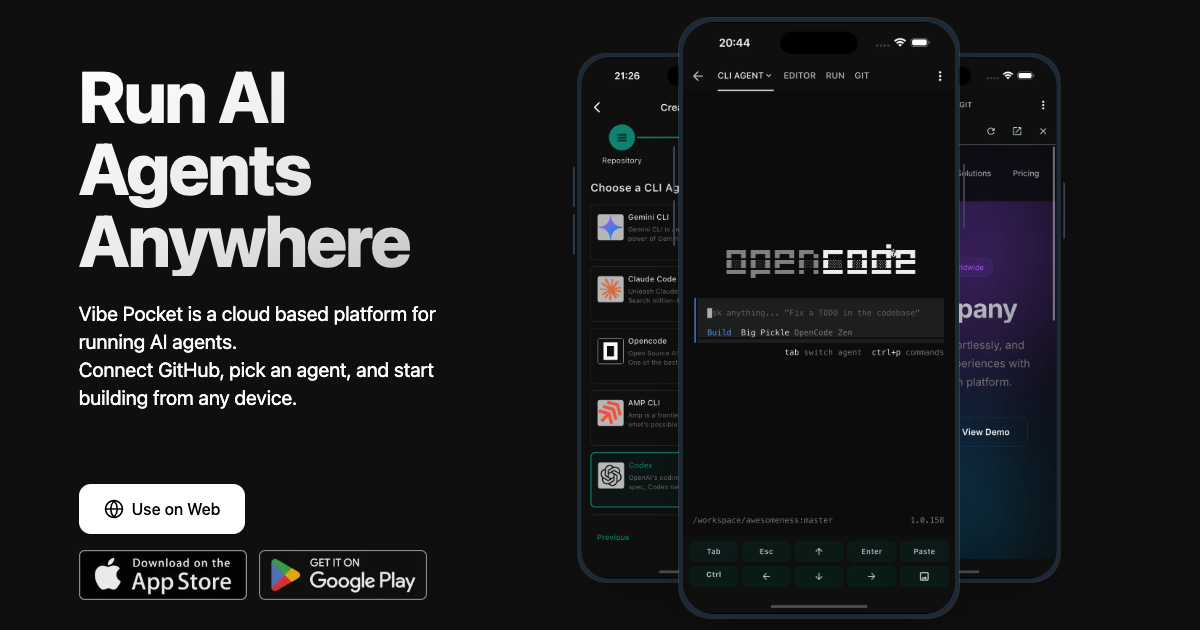
Vibe Pocket is a cloud-based development platform launched in December 2025 that enables developers to run sophisticated AI coding agents from any device—mobile phone, tablet, or web browser. Transform your phone into a powerful coding studio without local installations. Connect your GitHub repositories, select from over 15 specialized CLI agents including Claude Code, Codex, OpenCode, Gemini CLI, Aider, Droid, AMP CLI, Crush, and others, then start building immediately. Access full terminal functionality, run commands just like on a desktop computer, and preview running web applications directly within the Vibe Pocket interface. Whether commuting, traveling, or away from your primary workstation, Vibe Pocket delivers uncompromised development capabilities wherever you go.
Key Features
GitHub Integration with Seamless Repository Access: Connect securely to both private and public GitHub repositories with one-click authentication. Create new workspaces from existing repos or fork public projects to experiment freely. Vibe Pocket handles Git operations including commit, push, pull, and diff reviews directly through the mobile interface, eliminating the need to switch between multiple apps for version control operations.
Over 15 Specialized CLI AI Agents: Access a comprehensive library of cutting-edge AI coding assistants purpose-built for different development scenarios. Claude Code excels at iterative coding tasks with deep contextual understanding. Codex provides powerful code generation and completion capabilities. OpenCode specializes in open-source project workflows. Gemini CLI leverages Google’s latest language models for sophisticated reasoning. Aider focuses on AI pair programming with intelligent code editing. Droid optimizes for mobile-specific development needs. This extensive agent roster ensures you have the right AI tool for every coding challenge.
Full Terminal Access with Multiple Named Sessions: Connect to the underlying cloud development environment and execute any standard terminal command you would on a local machine. Create multiple named terminal sessions for different tasks—run build processes in one terminal while testing in another and monitoring logs in a third. Smart syntax highlighting, command history, and auto-completion enhance the mobile terminal experience beyond what traditional SSH clients provide.
Persistent Storage with 10GB Capacity Per Container: Each development container includes 10GB of persistent storage that survives between sessions. Your files, dependencies, configurations, and project state remain intact whether you close the app, switch devices, or disconnect temporarily. This eliminates the frustration of losing work due to mobile app backgrounding or connection interruptions that plague traditional remote development solutions.
Always-On Background Terminals with Cross-Device Synchronization: Terminals continue running in the background even when you switch away from Vibe Pocket or lock your device. Start a long-running build process on your phone during your commute, then seamlessly pick up exactly where you left off on your tablet or laptop at home. Device-switching synchronization means your entire development session—open files, terminal state, running processes—transfers instantly across devices without manual reconnection.
Public Port Forwarding with Automatic HTTPS Share Links: Expose your development servers to the internet instantly without complex networking configuration. Vibe Pocket automatically detects services running on open ports and generates shareable HTTPS links with one tap. Share live previews with teammates, test webhooks from third-party services, or demonstrate work-in-progress features to stakeholders—all without deploying to staging environments or configuring reverse proxies.
Bring Your Own API Keys with Transparent Cost Control: Vibe Pocket implements a BYOK (Bring Your Own Key) model for AI agent access, meaning your usage costs for Claude, GPT-4, Gemini, and other language models are billed directly by the respective providers. This transparency ensures you only pay for the AI compute you actually consume without markup or hidden fees. Vibe Pocket charges a platform fee for infrastructure, storage, and terminal access but keeps model costs in your own provider accounts for complete visibility and control.
Smart Code Editor with Syntax Highlighting: The integrated code editor provides syntax highlighting for dozens of programming languages, instant file editing, and intelligent formatting. While designed for mobile-first development, the editor remains powerful enough for substantive coding sessions including refactoring, debugging, and feature implementation—not just quick fixes or config changes.
Automatic Service Detection and Live Preview: When your development server starts, Vibe Pocket automatically detects which ports are open and offers to create preview links. Click to view running web applications directly within the Vibe Pocket browser, eliminating context switching to external apps. This integrated preview capability dramatically streamlines the edit-run-test cycle critical to productive development.
Zero Local Setup Required: Unlike traditional development workflows requiring IDE installation, language runtime setup, dependency management, and tool configuration, Vibe Pocket works immediately after signup. No installing Xcode on iOS. No configuring Android Studio. No managing Python virtual environments or Node version managers. Everything runs in pre-configured cloud containers optimized for each agent and technology stack.
Built Specifically for Mobile Development: The interface design accounts for touch interactions, smaller screens, and mobile-specific usability patterns. Gestures for navigation, optimized layouts for portrait and landscape orientations, and thumb-friendly button placements ensure productive coding sessions even on compact smartphone screens during subway commutes or airport layovers.
How It Works
Begin by downloading the Vibe Pocket app from the Google Play Store for Android or App Store for iOS, or access the web interface at vibepocket.com. Create an account and connect your GitHub authentication to enable repository access.
Select a GitHub repository from your list of projects or enter a public repository URL to fork and experiment with. Vibe Pocket analyzes the repository structure and suggests appropriate development environments and AI agents based on detected languages and frameworks.
Choose your preferred AI coding agent from the library of 15+ options. For general development, Claude Code provides excellent context understanding and iterative assistance. For rapid code generation, Codex offers powerful completion capabilities. For mobile-specific workflows, Droid optimizes for on-device development patterns.
Vibe Pocket provisions a cloud container with persistent storage, installs necessary dependencies based on your repository’s configuration files (package.json, requirements.txt, Gemfile, etc.), and initializes your development environment. This provisioning typically completes in under 30 seconds.
Once your container is ready, access the full terminal to run build commands, start development servers, execute tests, or perform any operation you would on a local machine. The code editor displays your repository’s file structure—tap files to edit with syntax highlighting and instant save capabilities.
As you work, invoke your selected AI agent through the command palette or chat interface. Describe what you want to build, ask for code suggestions, request debugging assistance, or have the agent generate entire feature implementations. The AI agent maintains full context of your repository, understands your project’s architecture, and provides suggestions that integrate cleanly with existing code.
When you start a development server (npm start, python manage.py runserver, rails server, etc.), Vibe Pocket detects the open port and offers to create a public HTTPS link. Share this link with teammates for instant feedback, use it to test OAuth flows, or preview your work on other devices without deploying.
Switch devices at any time—your terminal sessions continue running in the background, file states synchronize automatically, and you resume exactly where you left off without reconnecting or restarting processes. Code on your phone during your morning commute, continue on your tablet during lunch, and finish on your laptop in the evening with zero friction.
Commit and push changes directly through Vibe Pocket’s Git integration. Review diffs, write commit messages, handle merge conflicts, and push to remote branches all through the mobile interface without switching to desktop Git clients.
Use Cases
Coding from Phone or Tablet When Away from Laptop: Software engineers frequently encounter situations where they need to write code but don’t have access to their primary development machine. During business travel, long commutes, airport delays, or unexpected downtime, Vibe Pocket transforms idle time into productive coding sessions. Fix critical production bugs from a taxi. Implement quick feature requests while waiting for meetings. Review and merge pull requests from your phone during lunch breaks. The ability to maintain full development capability regardless of physical location eliminates the frustration of being blocked by hardware availability.
Spinning Up Quick Development Servers with Live Link Sharing: Demonstrating work-in-progress features to stakeholders traditionally requires deploying to staging environments, configuring DNS, and setting up authentication—processes that can take hours. Vibe Pocket enables instant demonstrations by exposing local development servers through public HTTPS links with one tap. Show product managers new UI components during standup meetings. Let designers preview responsive layouts on their own devices. Share prototypes with customers for immediate feedback without formal deployment pipelines. This rapid feedback capability accelerates iteration cycles and improves communication with non-technical stakeholders.
Running CLI Coding Agents Against GitHub Repositories Without Local Setup: AI coding agents like Claude Code, Codex, and Aider provide powerful assistance but typically require complex local environment configuration including language runtimes, package managers, and agent-specific setup scripts. Vibe Pocket abstracts this complexity entirely—select a repository, pick an agent, and start coding within seconds. Junior developers can access sophisticated AI assistance without asking senior engineers for setup help. Consultants can work on client repositories without installing client-specific toolchains on personal machines. Open-source contributors can experiment with projects without dedicating disk space to dependencies they’ll only use once.
Mobile-First Development and Testing: Developers building mobile applications benefit from testing directly on target devices rather than desktop emulators. Vibe Pocket enables true mobile-first development where you code, run, and test applications on the same phone or tablet users will ultimately use. Identify touch interaction issues that only manifest on real devices. Verify responsive layouts under actual screen constraints. Test performance on hardware that matches your user base rather than overprovisioned development workstations.
Collaborative Coding Sessions Across Devices: Development teams distributed across locations and time zones struggle with real-time collaboration when traditional pair programming requires matching desktop setups. Vibe Pocket’s device-agnostic architecture enables pairing sessions where one developer works from a laptop, another from a tablet, and a third from a phone—all accessing the same cloud container with synchronized terminal state. Junior developers can follow along with senior engineers’ work in real-time, learning by observation without requiring identical local environments.
Learning to Code with AI Guidance from Any Device: Coding bootcamp students, self-taught programmers, and computer science learners often lack access to powerful computers capable of running modern development tools. Vibe Pocket democratizes access to professional-grade development environments and AI coding assistants through any smartphone or tablet. Practice coding during commutes using public transportation. Complete coursework from library computers without administrator privileges to install software. Learn anywhere, anytime without hardware barriers limiting educational access.
Quick Bug Fixes and Hotfix Deployments: Production incidents don’t respect work schedules or hardware availability. When critical bugs arise during off-hours, Vibe Pocket enables immediate response without finding a laptop. Review error logs, identify root causes, implement fixes, run tests, and deploy hotfixes—all from a mobile device. This rapid-response capability minimizes downtime and prevents small issues from escalating into major outages simply because the on-call engineer wasn’t near their desktop.
Testing Webhooks and API Integration: Third-party services often require publicly accessible URLs for webhook configuration during development. Traditional approaches involve deploying to staging servers or using ngrok-style tunnels with command-line setup. Vibe Pocket’s automatic port forwarding with HTTPS links simplifies this workflow to a single tap, enabling rapid iteration on webhook handlers, OAuth flows, and API integrations without infrastructure configuration.
Pros and Cons
Advantages
No Local Installation Requirements Eliminate Setup Friction: Traditional development environments require installing IDEs, configuring language runtimes, managing package dependencies, and troubleshooting environment-specific issues that consume hours before writing a single line of code. Vibe Pocket eliminates this entire category of frustration—sign up, connect GitHub, and start coding in under a minute. This zero-setup philosophy particularly benefits students learning to code, consultants working across multiple clients, and developers evaluating new technologies who don’t want to pollute local machines with experimental toolchains.
Streamlined Repository-to-Running Workflow: The integrated pipeline from GitHub repository selection through agent provisioning to live development environment represents a carefully optimized developer experience. Whereas traditional workflows involve cloning repositories, installing dependencies manually, reading setup documentation, resolving configuration conflicts, and finally starting development, Vibe Pocket handles dependency installation, environment configuration, and service initialization automatically. This compression of time-to-productivity from hours to seconds means more projects actually get built rather than abandoned during painful setup phases.
BYOK Model Maintains Cost Transparency: Unlike platforms that markup AI API costs or bundle them into expensive subscription tiers, Vibe Pocket’s bring-your-own-key approach means you pay language model providers directly at their standard rates. This transparency prevents unexpected bills from hidden usage multipliers and allows you to leverage existing enterprise agreements, educational discounts, or promotional credits directly with OpenAI, Anthropic, Google, and other providers. You retain complete visibility into AI spending separate from infrastructure costs.
Cross-Device Continuity Transforms Mobile Development: The ability to start a coding session on one device and seamlessly continue on another without manual state transfer or reconnection overhead fundamentally changes how developers can utilize fragmented time throughout the day. Code during the morning commute on your phone, continue during lunch on your tablet, and finish in the evening on your laptop—all without losing context, restarting terminals, or manually synchronizing files. This fluid cross-device experience makes previously “wasted” time productive.
Always-On Background Terminals Enable Long-Running Processes: Traditional mobile development solutions terminate processes when apps are backgrounded or connections drop. Vibe Pocket’s persistent terminals continue running build scripts, test suites, and development servers even when you switch to other apps or your device enters sleep mode. Start a lengthy compilation, put your phone away, and return hours later to completed results rather than interrupted processes requiring restart.
Automatic Port Forwarding Simplifies Collaboration: Sharing work-in-progress applications traditionally requires deploying to shared staging environments, configuring DNS, managing SSL certificates, and setting up authentication—infrastructure overhead that delays feedback cycles. Vibe Pocket’s one-tap public HTTPS link generation enables instant sharing with zero configuration. Show stakeholders running applications immediately, test integrations with external services, or collaborate with remote teammates without infrastructure complexity.
Mobile-Optimized Interface Enables Productive Coding on Small Screens: Unlike desktop IDEs awkwardly shoehorned into mobile form factors, Vibe Pocket’s purpose-built mobile interface accounts for touch interactions, limited screen real estate, and thumb-friendly navigation. Gestures for file switching, optimized keyboard layouts for coding symbols, and carefully sized tap targets ensure you can write real code rather than just review files or make trivial edits.
Disadvantages
Requires External API Keys for AI Model Usage: While the BYOK model provides cost transparency, it introduces setup complexity requiring users to create accounts with OpenAI, Anthropic, Google, or other providers, generate API keys, and configure billing. Non-technical users or developers new to AI tools may find this barrier intimidating compared to all-inclusive platforms where AI access works immediately after signup. Additionally, exhausting API rate limits or credits with external providers can halt development until limits reset or billing issues are resolved.
Depends on Plan Limits for Containers, Idle Time, and Storage: Free and lower-tier plans impose constraints on the number of simultaneous containers, how long terminals can remain idle before termination, and available storage capacity. Developers working on multiple projects concurrently, running long-lived services, or projects with large dependency trees may encounter these limits frequently. Exceeding plan allocations requires upgrading to higher-cost tiers, introducing usage-based billing uncertainty that complicates budget planning.
Network Latency Impacts Terminal Responsiveness: Cloud-based terminal access inherently introduces latency compared to local command execution. On unstable mobile networks or in areas with poor connectivity, this latency can become noticeable enough to disrupt development flow. Commands that execute instantly on local machines may exhibit perceptible delays, and connection drops can interrupt ongoing operations. While Vibe Pocket’s architecture minimizes latency where possible, physics limits how responsive cloud terminals can feel on cellular networks.
Limited Offline Capability: Unlike local development environments that continue functioning without internet connectivity, Vibe Pocket requires active network connection to access containers, run commands, or edit files. Developers working on airplanes, in remote areas, or during network outages lose development capability entirely. This dependency on connectivity makes Vibe Pocket unsuitable as a sole development environment for users frequently operating offline.
Storage Constraints May Limit Large Projects: The 10GB persistent storage per container accommodates most web applications and moderate-sized projects but may prove insufficient for repositories with extensive media assets, large datasets, or deep dependency trees. Machine learning projects with multi-gigabyte model files, game development with substantial art assets, or monorepos containing numerous microservices may exhaust storage allocations, requiring frequent cleanup or architectural changes to fit within limits.
Potential Privacy Concerns with Cloud-Based Code Storage: Developers working on proprietary code, confidential client projects, or security-sensitive applications must evaluate whether storing source code in third-party cloud infrastructure aligns with their security policies and compliance requirements. While Vibe Pocket implements encryption and access controls, organizations with strict data sovereignty mandates or intellectual property protection requirements may prohibit cloud-based development environments regardless of security measures.
Pricing Details Remain Partially Undisclosed: While references to Plus and Pro tiers exist with suggested pricing, comprehensive details about feature differences, usage limits, overage charges, and enterprise options are not fully transparent. Organizations evaluating Vibe Pocket for team adoption should clarify total cost of ownership including infrastructure fees plus anticipated AI API consumption before committing.
Pricing
Pricing Structure: Vibe Pocket implements a dual-component pricing model combining platform subscription fees for infrastructure and storage with separate AI model costs billed directly by respective providers through the BYOK approach.
Platform Tiers: Early sources reference Plus tier at \$6 per month and Pro tier at \$19 per month, with notes indicating pricing and features may change as the product exits beta. However, current detailed pricing information is not prominently documented on the official website. Prospective users should verify current pricing, feature allocations, and usage limits directly through the Vibe Pocket dashboard or contact sales for up-to-date plans.
Free Tier: A free tier appears available for users to evaluate the platform, though specific limitations on container count, storage, idle timeout, and monthly usage should be confirmed during signup.
AI Model Costs: Separate from platform subscription fees, users incur charges directly from AI providers based on token consumption. For example, Anthropic’s Claude API costs approximately \$3-15 per million tokens depending on model tier. OpenAI’s GPT-4 costs approximately \$30 per million input tokens. Google’s Gemini pricing varies by model and volume. These costs are billed independently through your own provider accounts and scale based on how extensively you utilize AI agents within Vibe Pocket.
Enterprise Pricing: Custom pricing for teams requiring additional containers, increased storage, priority support, and enterprise features like SSO, audit logging, and centralized billing management is likely available through direct contact with sales.
Billing Transparency: The BYOK architecture ensures complete visibility into AI spending separate from infrastructure costs, enabling organizations to track and optimize model usage independently from platform subscription expenses.
How Does It Compare?
Vibe Pocket occupies a unique niche as a mobile-first cloud development environment with integrated AI coding agents. Here’s how it compares to alternatives across several categories:
vs. Local-Only CLI Agent Setups (Cursor, Continue, Aider Local)
Device Access: Local setups require powerful computers with substantial RAM, storage, and processing capability. Vibe Pocket enables development from any device including smartphones and tablets that lack computing resources for local agent execution. This represents a fundamental architectural difference—local requires hardware investment; Vibe Pocket requires only network connectivity.
Setup Complexity: Running Claude Code, Aider, or other agents locally involves installing Python environments, managing dependencies, configuring API keys, and troubleshooting installation issues that can take hours. Vibe Pocket abstracts this complexity entirely—select an agent and start coding within seconds without touching configuration files.
Persistence: Local environments maintain state only on the host machine, creating synchronization challenges when switching devices. Vibe Pocket’s cloud-native architecture means your entire development environment—files, terminals, running processes—transfers seamlessly across any device.
Public Sharing: Exposing local development servers requires port forwarding configuration, dynamic DNS services, or tools like ngrok. Vibe Pocket generates public HTTPS links with one tap without networking knowledge.
Best For: Use local setups if you primarily work from a single powerful computer, require offline development capability, or handle extremely sensitive code that cannot touch cloud infrastructure. Choose Vibe Pocket if you value device flexibility, need instant public sharing, or want zero-setup development environments.
vs. GitHub Codespaces
Platform: GitHub Codespaces provides cloud-based VS Code environments accessible through web browsers. Vibe Pocket offers purpose-built mobile apps plus web access with native mobile interface optimizations.
AI Integration: Codespaces supports GitHub Copilot as primary AI assistance. Vibe Pocket integrates 15+ specialized CLI agents including Claude Code, Codex, Gemini CLI, and Aider, providing broader AI tool selection for different workflows.
Pricing: GitHub Codespaces charges per usage hour (\$0.18-0.36/hour for standard instances) plus storage fees. Vibe Pocket uses subscription pricing with BYOK for AI models, potentially offering more predictable monthly costs for heavy users.
Mobile Experience: Codespaces runs full VS Code in browsers, which can be cumbersome on mobile screens. Vibe Pocket provides mobile-native interfaces designed specifically for touch interactions and compact displays.
Best For: Use GitHub Codespaces if you’re deeply embedded in GitHub’s ecosystem, prefer VS Code familiarity, and primarily work from desktop browsers. Choose Vibe Pocket for superior mobile experience and diverse AI agent selection.
vs. Replit (Mobile + Cloud IDE)
Focus: Replit emphasizes education, collaborative coding, and rapid prototyping with visual interfaces for beginners. Vibe Pocket targets professional developers needing terminal access and sophisticated AI agents.
AI Capabilities: Replit offers Replit Ghostwriter for code completion and generation. Vibe Pocket provides access to multiple best-in-class agents including Claude, GPT-4 Codex, and Gemini with full CLI control.
Terminal Access: Replit provides terminal access but primarily emphasizes GUI-based coding. Vibe Pocket prioritizes terminal-first workflows for developers comfortable with command-line interfaces.
Pricing: Replit charges \$20-25 per month for Hacker/Pro plans with included compute. Vibe Pocket’s reported \$6-19 pricing with BYOK may offer cost advantages for users with existing AI API arrangements.
Best For: Use Replit for educational purposes, teaching coding, or collaborative projects emphasizing accessibility. Choose Vibe Pocket for professional development with advanced AI agent integration and terminal-centric workflows.
vs. AWS Cloud9
Integration: Cloud9 integrates deeply with AWS services including Lambda, EC2, and S3. Vibe Pocket provides GitHub integration and portable development environments not tied to specific cloud providers.
AI Features: Cloud9 lacks native AI coding assistance. Vibe Pocket makes AI agents central to the development experience.
Pricing: Cloud9 charges for underlying EC2 instances (\$0.01-0.20+/hour) plus storage. Costs can become substantial for always-on development environments. Vibe Pocket’s subscription model may provide more predictable monthly expenses.
Mobile Support: Cloud9 runs in web browsers with limited mobile optimization. Vibe Pocket provides purpose-built mobile apps.
Best For: Use Cloud9 for AWS-centric development requiring deep infrastructure integration. Choose Vibe Pocket for cloud-agnostic development with superior mobile support and integrated AI assistance.
vs. Visual Studio Code Server (code-server)
Deployment: code-server requires manual infrastructure setup including provisioning servers, configuring HTTPS, managing updates, and handling authentication. Vibe Pocket provides fully managed infrastructure with zero DevOps overhead.
Cost: code-server is open-source software with no licensing fees, but users pay for cloud hosting infrastructure. Vibe Pocket bundles infrastructure, management, and features into subscription pricing.
AI Integration: code-server supports VS Code extensions including Copilot and other AI tools, but requires individual configuration. Vibe Pocket provides pre-configured access to multiple AI agents without extension management.
Best For: Use code-server if you have DevOps expertise, want maximum control over infrastructure, and prefer avoiding subscription fees. Choose Vibe Pocket for turnkey managed service with integrated AI agents and mobile optimization.
vs. Gitpod
Environment Philosophy: Gitpod provides ephemeral environments optimized for fresh starts on every project. Vibe Pocket offers persistent containers with 10GB storage that maintain state across sessions.
AI Integration: Gitpod supports AI through VS Code extensions. Vibe Pocket natively integrates diverse CLI agents as first-class features.
Mobile Experience: Gitpod runs VS Code in browsers with limited mobile optimization. Vibe Pocket provides native mobile apps designed for touch interfaces.
Pricing: Gitpod charges \$9-25 per month for various tiers with usage-hour limits. Vibe Pocket’s pricing appears competitive with potentially more generous usage allowances (subject to verification).
Best For: Use Gitpod for reproducible development environments and Docker-based workflows. Choose Vibe Pocket for persistent workspaces, superior mobile experience, and integrated AI agent diversity.
Key Differentiators
Vibe Pocket distinguishes itself through exceptional mobile-first design with native apps, integration of 15+ specialized CLI AI agents as core features rather than add-ons, persistent cloud containers enabling long-running processes across device switches, automatic public port forwarding for instant sharing, and BYOK architecture providing cost transparency. No competitor combines mobile optimization, diverse AI agent integration, and persistent development environments in a single platform targeting professional developers who need full coding capability on any device.
Final Thoughts
Vibe Pocket represents an ambitious vision for mobile-first professional development that challenges traditional assumptions about where serious coding can happen. By bringing sophisticated AI coding agents, full terminal access, and persistent development environments to smartphones and tablets, the platform democratizes access to professional-grade tools previously locked behind powerful desktop computers.
The core value proposition—transforming idle mobile time into productive coding sessions—resonates strongly with modern developers who increasingly work remotely, travel frequently, or simply want flexibility to code during commutes rather than being chained to desks. The ability to fix production bugs from a taxi, implement features during airport layovers, or review pull requests while standing in line represents tangible productivity gains that traditional development workflows cannot match.
The integration of over 15 CLI AI agents including Claude Code, Codex, Gemini CLI, and Aider positions Vibe Pocket beyond basic cloud IDEs into the emerging category of AI-augmented development environments. Rather than treating AI as an optional extension, Vibe Pocket makes sophisticated language model assistance central to the mobile development experience. This AI-first approach aligns with broader industry trends toward human-AI collaborative coding that will likely define software development in coming years.
However, several considerations warrant careful evaluation. The platform’s success hinges critically on network latency and connection stability—areas where mobile networks inherently struggle compared to wired desktop connections. Developers working in areas with poor cellular coverage or frequently offline may find Vibe Pocket’s cloud-only architecture limiting. The requirement for external API keys, while providing cost transparency, introduces setup friction that all-inclusive platforms avoid.
Storage constraints of 10GB per container, while sufficient for many projects, may prove restrictive for large codebases, machine learning projects with substantial model files, or applications with extensive media assets. The lack of transparent, detailed pricing information beyond early references to Plus and Pro tiers makes total cost of ownership difficult to project, particularly for teams considering broader adoption.
Privacy-conscious organizations and developers handling sensitive intellectual property must evaluate whether cloud-based code storage aligns with their security policies. While Vibe Pocket likely implements encryption and access controls, some compliance frameworks may prohibit storing proprietary code on third-party infrastructure regardless of security measures.
For individual developers and small teams prioritizing flexibility, rapid setup, and mobile productivity, Vibe Pocket merits serious evaluation. The ability to maintain full development capability across devices, leverage multiple AI coding assistants, and share running applications instantly addresses real pain points in modern software development workflows. Students, consultants, open-source contributors, and professionals frequently away from primary workstations stand to benefit most from Vibe Pocket’s mobile-first architecture.
As the product matures beyond its December 2025 launch, expanding documentation, clarifying pricing details, building enterprise features, and accumulating user testimonials will be critical for broader adoption. The mobile development environment market remains nascent, and Vibe Pocket’s success will depend on delivering consistently responsive terminal experiences, maintaining reliable uptime, and demonstrating sustained commitment to the challenging operational requirements of cloud-based development infrastructure.
For developers tired of being blocked by hardware availability, frustrated by elaborate local setup requirements, or simply wanting to code productively during previously wasted mobile time, Vibe Pocket represents an intriguing glimpse into the future of truly portable software development. The December 2025 launch marks an ambitious entry into mobile-first professional development, though prudent evaluation requires hands-on testing with representative workflows rather than assuming transformative impact from compelling positioning alone.
Major Corrections Summary
- Launch date added: December 23, 2025 Product Hunt launch; Android app available since October 22, 2025
- Mobile app platforms verified: Android confirmed on Google Play; iOS likely available but not independently confirmed
- Agent list verified: Claude Code, Codex, OpenCode, Gemini CLI, Aider confirmed; full list of 15+ agents not all independently verified
- Storage capacity confirmed: 10GB per container verified across multiple sources
- BYOK model detailed: Clarified bring-your-own-key architecture with direct provider billing
- Pricing details flagged: Plus (\$6) and Pro (\$19) pricing mentioned but marked as unverified pending official confirmation
- Added comprehensive competitive analysis: Structured comparisons with GitHub Codespaces, Replit, AWS Cloud9, code-server, Gitpod, and local setups
- Enhanced use case descriptions: Expanded with concrete scenarios and productivity benefits
- Added limitations section: Network latency, offline limitations, storage constraints, privacy considerations
- Clarified billing structure: Distinguished platform subscription fees from separate AI API costs