
Table of Contents
Overview
Are you tired of forgetting new words as quickly as you learn them? WordFlippin is an AI-powered vocabulary learning platform designed to transform how you acquire and retain new vocabulary, ensuring lasting results through science-backed techniques. Leveraging spaced repetition algorithms proven by cognitive science research, combined with personalized AI-generated content, WordFlippin helps you learn smarter, remember longer, and build a vocabulary that truly sticks. It’s about your words, your pace, and real, measurable results.
Key Features
WordFlippin combines spaced repetition science with AI-powered personalization to create an effective vocabulary learning system.
- Spaced Repetition Algorithm: Utilizes a scientifically validated four-stage learning cycle (Daily → Weekly → Monthly → Mastered) that schedules reviews at optimal intervals, ensuring long-term memory retention based on proven cognitive science.
- AI-Generated Learning Content: Automatically creates comprehensive flashcards for your added words, complete with context-aware definitions, relevant example sentences, synonym lists, and personalized memory mnemonics tailored to aid recall.
Interactive Flashcards: Presents vocabulary through visually engaging 3D flip cards with audio support, making each review session more engaging and memorable than traditional flat flashcards.
Adaptive Review System: Intelligently adjusts the difficulty and frequency of reviews based on your individual performance, personalizing your learning path to ensure optimal challenge and retention specific to your pace.
Instant Word Search: Quickly look up definitions, usage examples, and contextual information for any word you encounter, directly within the platform for seamless vocabulary discovery.
PDF Exports and Printing Options: Export your vocabulary lists and progress reports as beautifully formatted PDFs for offline study, physical flashcard creation, or sharing with study partners.
Gamification and Rewards: Integrates motivational game-like elements and achievement tracking to maintain engagement and make your vocabulary learning journey more enjoyable.
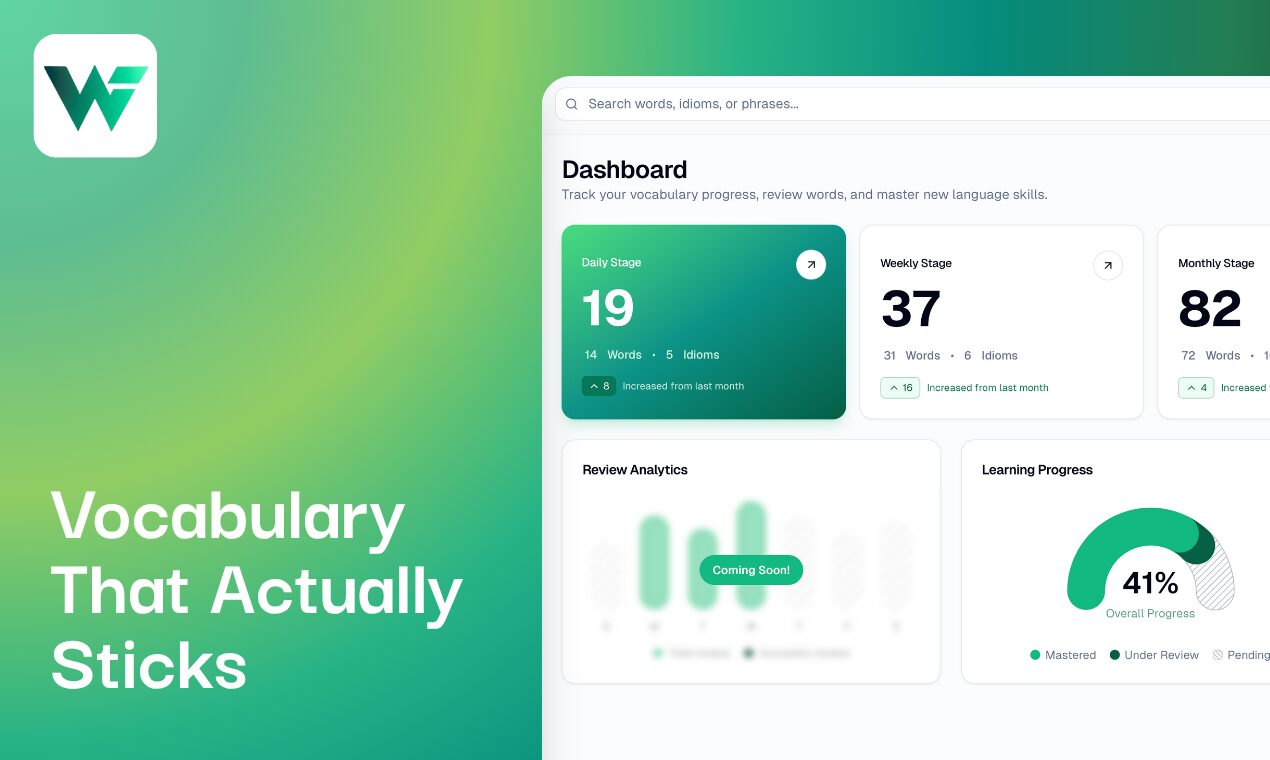
Detailed Progress Analytics: Provides comprehensive insights into your learning progress, retention rates, and mastery timelines, showing exactly how far you’ve advanced and where to focus improvement.
How It Works
Getting started with WordFlippin is straightforward and designed for maximum learning efficiency. The platform guides you through an intuitive, science-backed process that combines AI automation with proven learning principles.
You begin by adding words you wish to learn into the system—whether manually, through article imports, or from curated vocabulary lists. WordFlippin’s AI engine immediately takes over, automatically generating precise definitions calibrated to your level, contextual example sentences showing real usage, and personalized memory aids to strengthen recall. Next, you engage in daily practice sessions where the spaced repetition algorithm intelligently schedules words for review at precisely the moment before you’re about to forget them. The system tracks your performance, moving mastered words to longer review intervals (7 days, then 30 days, then permanent storage) while reinforcing missed words back to daily practice. Throughout this process, the AI continuously adapts to your learning pace and performance patterns, ensuring you’re always appropriately challenged. For offline study preferences, you can export and print your flashcards and progress reports at any time.
Use Cases
WordFlippin serves diverse vocabulary learning needs across multiple contexts and proficiency levels.
- Exam Preparation: Ideal for students preparing for vocabulary-intensive standardized tests like the SAT, GRE, TOEFL, IELTS, or other academic and professional certifications requiring strong lexical knowledge.
Daily Vocabulary Building: Perfect for individuals committed to continuously expanding their vocabulary for personal growth, enhanced professional communication, and improved expressive ability across all contexts.
Professional Language Development: Beneficial for professionals seeking to refine industry-specific terminology, enhance presentations and reports, and communicate with greater precision and authority in their field.
ESL and Language Learning: A powerful resource for English as a Second Language learners aiming to build a robust vocabulary foundation, accelerate fluency development, and gain confidence in real-world communication.
General Knowledge Retention: Excellent for anyone looking to leverage the scientifically proven effectiveness of spaced repetition for mastering any type of factual or conceptual information requiring long-term retention.
Pros & Cons
Advantages
- Scientifically Optimized Retention: The core spaced repetition algorithm, grounded in cognitive science research, ensures words are committed to long-term memory, dramatically reducing the typical forgetting curve.
Engaging Learning Experience: Combining gamification elements with interactive flashcards and visible progress tracking creates an enjoyable learning process that feels rewarding rather than tedious.
Flexible Study Options: Provides complete flexibility through multiple study formats—digital practice, offline PDF exports, printable physical flashcards, and progress analytics accessible anywhere.
AI-Powered Personalization: Content generation and adaptive review scheduling respond dynamically to your individual performance patterns, rather than following a fixed, one-size-fits-all approach.
Disadvantages
Free Version Limitations: The free tier provides restricted access (50 words and idioms per month), requiring a paid subscription for unlimited vocabulary learning and advanced features.
Subscription Cost Required: Full access to all advanced features and unlimited learning requires a paid subscription ($2.99 weekly, approximately ₹699 monthly, or ₹97 lifetime), which may be a consideration depending on budget.
Requires Consistent Engagement: The spaced repetition system depends on regular, daily interaction to maintain effectiveness; irregular usage diminishes the long-term retention benefits that make the platform valuable.
Limited to Vocabulary Focus: While excellent for vocabulary acquisition, WordFlippin specializes exclusively in word learning rather than offering broader language skills like grammar instruction, speaking practice, or listening comprehension.
How Does It Compare?
In the competitive landscape of vocabulary learning tools, WordFlippin competes effectively by combining AI-powered content generation with scientifically proven spaced repetition. However, each competitor brings distinct strengths to the market.
Anki remains the most powerful and customizable option for serious learners and technical users. It offers complete freedom, advanced scheduling through open-source algorithms, and unlimited customization—but requires substantial time investment and technical knowledge to set up effectively. Anki is free but demands manual deck creation, making it ideal for committed learners willing to invest effort upfront.
Quizlet emphasizes ease of use, community, and gamification. It features an enormous library of pre-made flashcard decks, multiple interactive study modes, and strong social features for collaborative learning. However, Quizlet no longer emphasizes spaced repetition in its free tier, focusing instead on broader engagement. Quizlet works best for casual learners and students who benefit from existing deck libraries.
Memrise positions itself as a language-learning platform using spaced repetition combined with gamification, mnemonic techniques, native speaker videos, and community features. Memrise specializes in language-specific contexts rather than academic vocabulary broadly. It’s ideal for learners wanting cultural immersion alongside vocabulary, though it’s more game-focused than scientifically optimized.
Keepmind, an emerging 2025 platform, offers AI-generated flashcards combined with quizzes, mind maps, and advanced spaced repetition (FSRS-5 algorithm). It provides an all-in-one learning ecosystem, making it a comprehensive alternative for learners seeking integrated study tools beyond flashcards alone.
WordFlippin’s Distinctive Position:
– Vocabulary-specific focus: Unlike Memrise (language-focused) or Anki (general-purpose), WordFlippin targets vocabulary mastery specifically
– Low setup friction: AI auto-generates content (unlike Anki’s manual deck creation)
– Mobile-optimized: More mobile-friendly than desktop-heavy Anki
– Accessible pricing: Free tier available; lower subscription than many competitors
– Structured progression: Clear four-stage mastery system helps learners track advancement
– Target alignment: Explicitly designed for exam prep (SAT, GRE, TOEFL) and professional English, rather than casual learning
WordFlippin works best for motivated learners seeking vocabulary mastery with minimal setup friction, while Anki suits power users wanting ultimate control, Quizlet fits social/casual learners, Memrise appeals to language immersion seekers, and Keepmind attracts learners wanting comprehensive study ecosystems.
Final Thoughts
WordFlippin emerges as an effective vocabulary learning platform for anyone serious about building lasting vocabulary through scientifically grounded methods. By combining the proven efficacy of spaced repetition with AI-powered content personalization, it removes the friction of manual flashcard creation while maintaining the science-backed approach that ensures retention. The platform’s explicit focus on vocabulary, transparent pricing model, and accessible interface make it particularly attractive for exam preparation and professional language development. While the full feature set requires a subscription, the investment delivers measurable results for learners committed to vocabulary mastery. If you’re ready to move beyond passive vocabulary exposure and build lasting word knowledge through a structured, personalized approach, WordFlippin offers a compelling and science-backed solution worth exploring.