Table of Contents
- Overview
- Key Features
- How It Works
- Use Cases
- Pros and Cons
- Pricing
- How Does It Compare?
- vs. Monday.com (Work Operating System)
- vs. Notion (All-in-One Workspace)
- vs. Asana (Work Management Platform)
- vs. ClickUp (Everything App for Work)
- vs. Slack/Microsoft Teams (Communication Platforms)
- vs. HubSpot/Salesforce (CRM Platforms)
- vs. Tableau/Looker (Business Intelligence)
- vs. Miro/Mural (Visual Collaboration)
- Key Differentiators
- Final Thoughts
- Major Corrections Summary
Overview
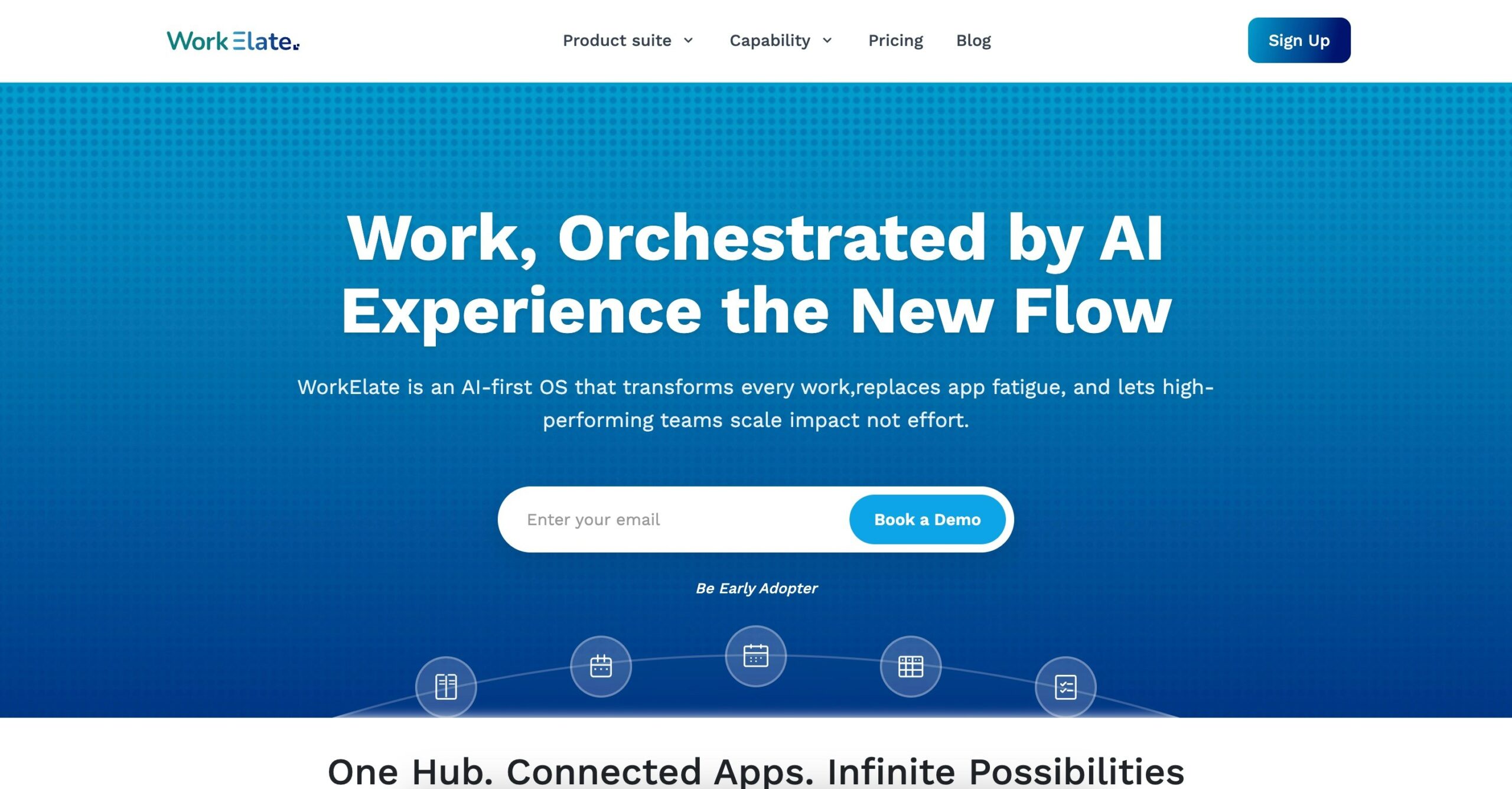
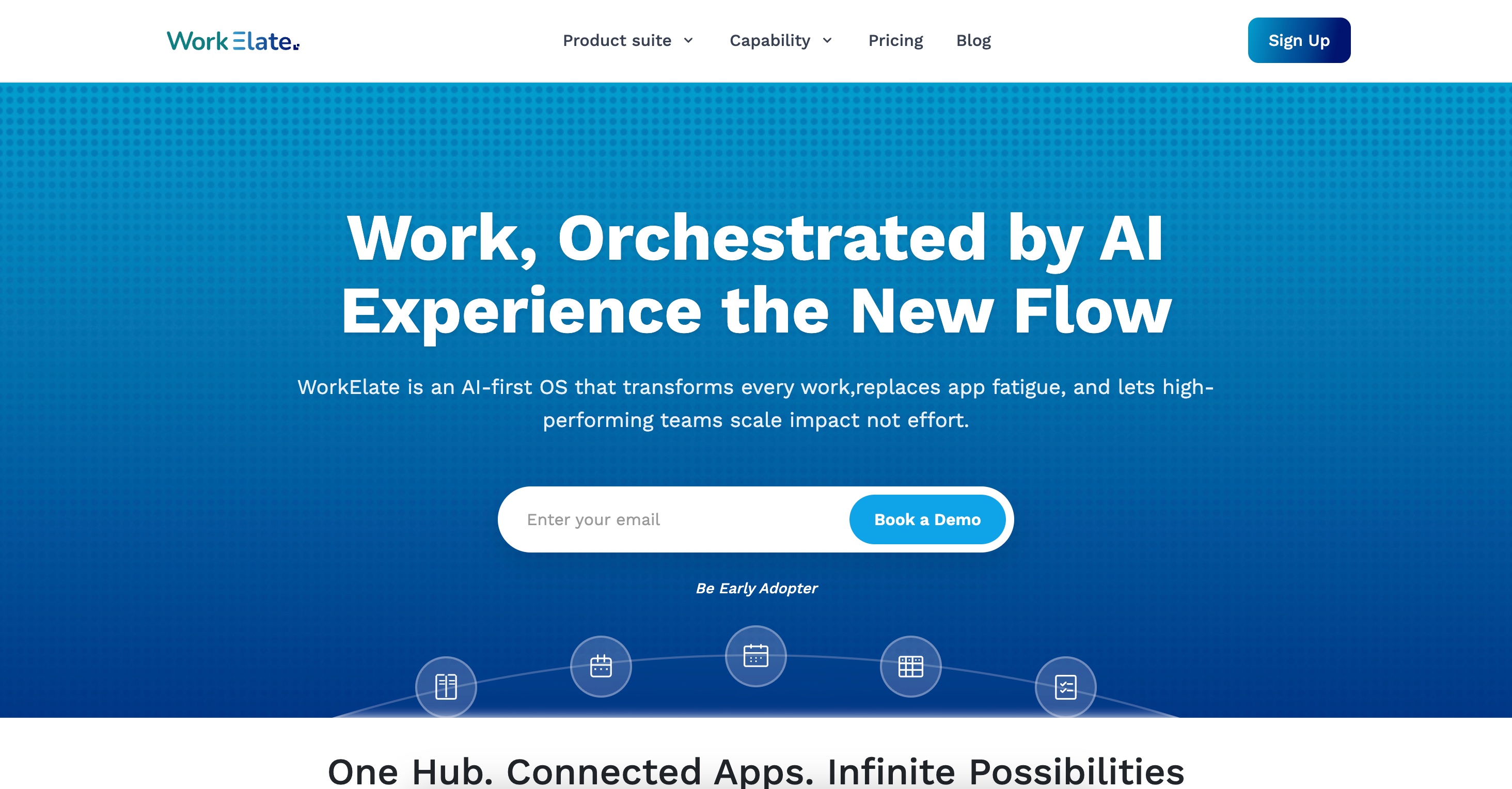
WorkElate is an AI-powered unified Work Operating System launched on Product Hunt on December 23, 2025, that consolidates planning, execution, communication, and analytics into one integrated platform. As a self-funded bootstrapped startup, WorkElate challenges the fragmented SaaS tool landscape where teams juggle 15+ disconnected applications—CRM in one tool, tasks in another, email in a third, reports scattered everywhere—causing broken context, slow execution, and administrative overhead that consumes more time than actual productive work.
The platform brings together seven specialized but interconnected modules now live in one unified system: taskNetic for task management and workflows, xNetic for customer relationship management, formNetic for data collection and surveys, boardNetic for collaborative whiteboarding and strategy planning, dataNetic for AI-powered business intelligence, syncNetic for work-integrated team chat, and WeMail for unified email management. This consolidation replaces the typical small business SaaS stack at 85-90% lower annual cost per user while eliminating context-switching that fragments work across disconnected platforms.
Built on the WAO (WorkElate AI Orchestration) engine, the platform uses natural language processing for intelligent task creation from any text, automated workflow adaptation, document-to-task conversion in seconds, meeting and thread summarization, smart content routing based on context, and persona insights for customer journey intelligence. Users access everything through one login, one unified search across all modules, and one shared knowledge plane where information flows seamlessly between planning, execution, communication, and analytics without manual data transfer or synchronization.
Key Features
Seven Unified Integrated Modules: WorkElate consolidates essential business operations into interconnected applications that share data automatically: taskNetic manages projects, tasks, and workflows with AI-powered automation; xNetic handles customer relationship management and sales pipeline tracking; formNetic creates surveys, feedback forms, and data collection workflows; boardNetic provides collaborative visual planning canvases for strategy and roadmapping; dataNetic delivers AI-powered business intelligence and decision analytics; syncNetic offers execution-integrated team communication; and WeMail centralizes email management. This modular architecture eliminates the fragmentation typical of organizations running separate point solutions for each function.
WAO (WorkElate AI Orchestration) Engine: The underlying intelligence layer uses advanced natural language processing and machine learning to automate repetitive work coordination. NLP-driven task creation extracts actionable items from meeting notes, emails, chat messages, or any unstructured text. Automated workflows adapt dynamically to your process patterns without manual configuration. Document-to-task conversion transforms PDFs, presentations, or text files into structured execution plans in seconds. AI generates automatic summaries of meetings, threads, and discussions highlighting key decisions and action items. Smart routing analyzes content and context to assign work to appropriate team members automatically. Persona insights analyze customer journey data to surface behavioral patterns and opportunity signals.
One Workspace Philosophy: Single login provides access to all seven modules with unified authentication eliminating the password chaos of managing 15+ separate accounts. One universal search finds information across tasks, contacts, documents, conversations, and analytics instantly regardless of which module originally stored it. One shared knowledge plane means information entered in any module becomes available everywhere relevant—customer data from xNetic appears in taskNetic tasks, formNetic responses trigger workflows automatically, syncNetic conversations create taskNetic action items, and dataNetic insights surface in boardNetic planning sessions.
Deep Native Integrations for Specific Functions: WorkElate provides pre-configured workflow templates and integrations optimized for distinct business functions. Sales teams get unified CRM plus email plus task management with automated pipeline tracking and deal closure workflows. HR teams access complete HRMS including automated onboarding, performance tracking, and payroll integrations. Marketing departments manage campaigns, personas, content creation, social media workflows, and feedback collection in one connected hub. Product teams connect features to tasks to sprints with roadmapping, prioritization, and shipping cycle coordination. Consulting firms orchestrate client journeys from proposals through delivery with integrated feedback and billing workflows.
AI-Assisted Brainstorming and Strategy Planning (boardNetic): The collaborative whiteboarding module transcends traditional visual planning tools by making strategy execution-aware. Generate, expand, and refine ideas with AI copilots that suggest related concepts and identify gaps. Create strategy and OKR roadmap boards that visualize goals and initiatives with automatic progress tracking. Capture decisions with rationale documentation explaining what was decided, why, and what happens next. Overlay execution status showing live task completion, risks, and blockers directly on strategy boards. Support real-time and asynchronous collaboration with full version history ensuring plans survive beyond initial workshops and remain living documents rather than static artifacts.
AI-Native Business Intelligence (dataNetic): Move beyond traditional business intelligence dashboards that require manual modeling and SQL expertise. AI-first automatic schema harmonization ingests data from multiple sources and unifies disparate formats without manual configuration. Conversational natural language queries enable asking anything—from trend analysis to causal relationships—without writing SQL or building reports. Actionable real-time alerts notify teams about anomalies, risks, and opportunities before problems escalate. Shared insight dashboards provide one place for cross-functional teams to see metrics, narratives, and decisions together. Explainable analytics don’t just show results but explain why patterns are happening and what they mean for decisions.
Execution-Integrated Team Communication (syncNetic): Unlike standalone chat tools where conversations vanish into message history, syncNetic functions as a work orchestration layer. AI-powered action extraction automatically detects tasks, approvals, risks, and follow-ups from conversations and creates execution items in taskNetic. Decision tracking marks agreements within threads and keeps them visible, searchable, and auditable rather than buried in chat history. Deep execution linking connects conversations directly to tasks, forms, data insights, and CRM records ensuring context never gets lost. Focus-first channels where AI summarizes updates, highlights critical information, and suppresses noise. Asynchronous design enables teams to stay aligned across time zones without endless synchronous meetings.
Hotkey-Driven Quick Capture: Field teams, remote workers, and mobile users can capture tasks, schedule events, and create notes instantly via keyboard shortcuts and hotkeys that work across devices and operating systems without opening full applications.
Cross-Device Synchronization: All modules sync automatically across desktop, web, tablet, and mobile devices ensuring field teams, remote workers, and executives access the same real-time information regardless of location or device.
Dynamic Custom Fields and Metadata: Add organization-specific attributes, custom tags, and metadata fields to tasks, contacts, forms, and analytics without rigid schema constraints or developer intervention.
Version History and Audit Trails: Track all changes, edits, and decisions across modules with complete audit logs supporting compliance requirements, dispute resolution, and understanding how work evolved over time.
Granular Permission Controls: Manage access at module, project, team, and individual levels ensuring sensitive information remains restricted while enabling appropriate collaboration transparency.
How It Works
Users begin by signing up at accounts.workelate.com where one login credential provides access to all seven WorkElate modules. The unified dashboard presents taskNetic, xNetic, formNetic, boardNetic, dataNetic, syncNetic, and WeMail as integrated tabs rather than separate applications requiring individual authentication.
Within taskNetic, teams create projects and tasks through traditional manual entry or leverage AI-powered creation where users paste meeting notes, email threads, or any unstructured text and WAO automatically extracts actionable items with suggested assignees, due dates, and priorities. Document-to-task conversion transforms uploaded PDFs, presentations, or requirements documents into structured execution plans in seconds.
The xNetic CRM module manages customer relationships, sales pipelines, and deal tracking with automatic activity logging that captures every email, call, meeting, and interaction linked to specific contacts and opportunities. Tasks created in taskNetic relating to sales activities automatically associate with relevant CRM records maintaining comprehensive customer context.
For data collection, formNetic enables creating surveys, feedback forms, registration workflows, and structured data capture with conditional logic, file uploads, and integration triggers. Form responses automatically populate dataNetic analytics, create taskNetic follow-up actions, or update xNetic contact records based on defined workflows.
Strategy and planning happen in boardNetic where teams create visual canvases for brainstorming, OKR planning, roadmapping, or process design. AI copilots suggest related ideas, identify gaps in strategies, and help structure unorganized thoughts into executable plans. Any element on a board—whether an idea cluster, strategic initiative, or decision—can instantly generate tasks in taskNetic with execution tracking overlaid back onto strategy boards showing real-time progress.
Throughout work execution, syncNetic team chat provides communication integrated with work context. Conversations automatically link to relevant tasks, contacts, forms, and data insights. AI monitors threads to extract action items, flag decisions requiring documentation, and surface key information team members need without manual tagging or organization.
As work progresses and data accumulates, dataNetic business intelligence provides insights through conversational queries. Users ask natural language questions like “Why did customer churn increase last quarter?” or “Which marketing campaigns drove highest conversion?” and receive AI-generated narrative explanations with supporting visualizations and recommended actions.
All modules share the unified knowledge plane—information entered anywhere becomes searchable and accessible everywhere. A universal search bar finds tasks, contacts, documents, conversations, form responses, and insights instantly regardless of originating module. This eliminates the context-switching and information silos typical of organizations managing separate disconnected tools.
Use Cases
Founders Managing Multiple Projects Without Losing Focus: Startup founders juggling product development, fundraising, customer acquisition, and team management use WorkElate to centralize all streams of work in one system. The AI engine surfaces relevant contexts automatically—when reviewing a customer conversation in xNetic, it highlights related tasks in taskNetic and recent feedback from formNetic surveys, eliminating manual context reconstruction across tools. This consolidation enables founders to maintain strategic oversight while executing tactical work without cognitive overhead of remembering which tool contains which information.
Sales Teams Closing Deals Faster with Unified CRM Plus Email Plus Tasks: Sales organizations integrate customer relationship tracking (xNetic), email management (WeMail), and task execution (taskNetic) in one workflow. When sales representatives engage prospects via email, conversations automatically log to CRM contact records. Follow-up tasks generate automatically from email threads. Deal pipeline tracking updates in real-time as activities complete. This tight integration eliminates the manual data entry, tool switching, and CRM update overhead that distracts salespeople from actual selling, resulting in reported 50% faster deal closing and 30% higher lead conversion rates.
HR Teams Automating Onboarding, Performance Tracking, and Payroll: Human resources departments replace spreadsheet-based employee tracking, separate applicant tracking systems, and disconnected performance management tools with WorkElate’s integrated HRMS capabilities. Onboarding workflows in taskNetic guide new hire setup automatically. formNetic handles performance review collection and feedback surveys. dataNetic provides workforce analytics on retention, performance distributions, and hiring metrics. Payroll integrations connect to accounting systems. This end-to-end HR workflow consolidation delivers reported 40% reduction in HR administrative time and 20% faster hiring cycles.
Marketing Teams Launching Campaigns 60% Faster: Marketing organizations manage campaign planning (boardNetic), persona development and customer insights (dataNetic), content workflow and social media coordination (taskNetic), feedback collection (formNetic), and team coordination (syncNetic) in one connected platform. Campaign ideation in boardNetic automatically generates execution tasks. Persona insights from dataNetic inform content strategy. formNetic surveys collect market feedback that updates personas automatically. This integrated marketing workflow eliminates the fragmentation of managing campaigns across separate planning, execution, feedback, and communication tools, enabling reported 60% faster campaign launches and 25% higher engagement rates.
Product Teams Prioritizing Features and Shipping Faster: Product management connects user feedback (formNetic), feature roadmaps (boardNetic), development task tracking (taskNetic), and shipping analytics (dataNetic) in unified workflows. Customer feedback from formNetic surveys automatically surfaces in boardNetic roadmap planning sessions. Prioritized features convert to taskNetic development tasks linked back to originating user requests. Shipping cycle analytics in dataNetic show velocity trends and bottlenecks. This end-to-end product workflow integration delivers reported 50% better feature prioritization and faster shipping cycles by eliminating the manual synthesis work of connecting user feedback, strategic planning, and development execution across separate tools.
Consultants Handling 2X More Clients with Orchestrated Workflows: Consulting firms and professional services organizations manage client relationships (xNetic), project delivery (taskNetic), proposals and documentation (formNetic), strategic planning (boardNetic), and performance reporting (dataNetic) through connected workflows. Client journey orchestration templates in boardNetic define repeatable processes from initial proposal through delivery and feedback collection. Each client engagement follows standardized workflows with automatic progress tracking and milestone alerts. This systematic approach to client work enables consultants to reportedly handle twice as many concurrent clients with the same effort by reducing the administrative overhead and mental load of manually tracking multiple engagements across disconnected tools.
Educational Institutions Streamlining Student Lifecycle Management: Schools, training programs, and educational organizations manage registration (formNetic), curriculum delivery (taskNetic and boardNetic), student communication (syncNetic), and performance analytics (dataNetic) in integrated workflows. Registration forms automatically trigger onboarding tasks, schedule creation, and communication workflows. Student progress tracking feeds analytics dashboards showing completion rates, satisfaction trends, and intervention opportunities.
Pros and Cons
Advantages
Replaces 15+ SaaS Tools at 85-90% Lower Annual Cost Per User: The most compelling value proposition is dramatic cost reduction through consolidation. Typical small to medium businesses subscribe to separate tools for task management (\$10-15/user/month), CRM (\$50-100/user/month), forms and surveys (\$25-50/month), business intelligence (\$40-100/user/month), team chat (\$7-12/user/month), email management (\$6-12/user/month), and collaboration tools (\$10-20/user/month). This fragmented stack totals \$150-300+ per user monthly before accounting for integration costs, administration overhead, and training expenses. WorkElate consolidates these capabilities at \$8-15 per user per month representing 85-90% cost savings while delivering superior integration through unified architecture rather than point-solution connectors.
Unified Workspace Eliminates Context-Switching Cognitive Overhead: Knowledge workers lose 9.3 minutes average recovering context each time they switch between applications according to productivity research. Organizations running 15+ disconnected tools force employees into dozens of context switches daily, consuming hours of productive time and mental energy reconstructing information relationships. WorkElate’s unified knowledge plane ensures information flows seamlessly—customer data from CRM appears automatically in tasks, survey responses trigger workflows, chat conversations create action items, and analytics insights surface in planning sessions—all without manual data transfer or switching applications.
AI-Native Workflow Layer Automates Coordination Work: Unlike productivity tools that merely organize and display information, WorkElate’s WAO engine actively executes coordination work. NLP-driven task extraction reads unstructured text and creates structured execution items automatically. Meeting summarization distills hour-long discussions into action items and decisions. Smart routing assigns work based on content analysis and team capacity. Workflow automation adapts to usage patterns without manual configuration. This intelligent automation layer eliminates the repetitive coordination overhead—sending follow-up emails, creating task tickets, updating stakeholders, documenting decisions—that consumes 30-40% of knowledge worker time in traditional tool environments.
Deep Function-Specific Integrations for Sales, HR, Marketing, Product, Consulting: Rather than providing generic project management equally unsuitable for all functions, WorkElate offers specialized workflow templates and features tailored to distinct business roles. Sales teams get deal pipeline visualization, email campaign integration, and contact management beyond generic task tracking. HR departments access complete hire-to-retire workflows including onboarding automation and performance management. Marketing organizations manage personas, content calendars, and campaign analytics. Product teams connect user feedback to roadmaps to development tasks. This functional specialization means each department gets purpose-built capabilities rather than forcing workflows into rigid generic structures.
One Login, One Search, One Knowledge Plane Philosophy: The architectural decision to build one unified platform rather than acquiring and loosely connecting separate products ensures genuine integration. Single sign-on eliminates the password management overhead and authentication friction of managing 15+ separate logins. Universal search finds information across all modules instantly without remembering which tool stores what. The shared knowledge plane means data entered anywhere becomes accessible everywhere relevant—fundamental integration impossible with even well-connected but independently-architected point solutions.
Self-Funded Independence Aligns with Customer Interests: As a bootstrapped startup without venture capital backing, WorkElate avoids the pressure for hypergrowth metrics, forced monetization pivots, or acquisition exits that often compromise product quality and customer experience. Self-funded independence enables long-term focus on product excellence and customer value rather than short-term growth metrics that attract next funding rounds.
Disadvantages
Learning Curve for Advanced Data Modeling and Full Platform Utilization: The breadth of WorkElate’s capabilities—seven integrated modules spanning tasks, CRM, forms, BI, chat, email, and whiteboarding—creates onboarding complexity. Teams must learn taskNetic task management, xNetic CRM workflows, formNetic form building, boardNetic visual planning, dataNetic analytics querying, syncNetic communication norms, and WeMail email management. While each individual module may be intuitive, mastering the integrated platform and understanding how information flows between modules requires investment. The dataNetic advanced data modeling features particularly present steep learning curves for non-technical users accustomed to pre-built BI dashboards rather than conversational analytics.
New Platform with Fewer Integrations Than Mature Enterprise Tools: Launched December 2025, WorkElate lacks the extensive third-party integration ecosystems of established competitors. Asana integrates with 200+ applications; ClickUp offers 1,000+ integrations; Monday.com connects to 200+ tools. WorkElate provides “native integrations for sales, HR, marketing, product, consulting” but doesn’t specify quantity or which specific third-party applications connect. Organizations with essential tools in specialized categories—accounting (QuickBooks, Xero), development (GitHub, GitLab), design (Figma, Sketch), or industry-specific software—should verify integration availability before committing. The platform’s youth also means smaller community resources, fewer YouTube tutorials, and limited third-party consultant availability compared to mature alternatives.
Pricing Transparency Limited on Main Website: While the official website mentions Starter (Free), Believe (\$10/month or \$8.33/month annual), Professional (\$12/month), Business (\$15/user/month), and references to \$150 annual full suite pricing, comprehensive pricing documentation is incomplete. Specific feature differences between tiers, user minimums, storage limits, usage caps, and premium feature restrictions aren’t prominently detailed. Organizations evaluating WorkElate for team adoption cannot accurately project total cost of ownership or determine which tier suits their needs without contacting sales or extensive research beyond homepage pricing snippets.
Unproven at Enterprise Scale and Complex Organizational Structures: As a recently launched platform from a small bootstrapped team, WorkElate lacks demonstrated capability handling enterprises with thousands of users, complex permission hierarchies, stringent compliance requirements, multi-region data residency mandates, or extensive customization needs. Large organizations require proven scalability, dedicated support teams, guaranteed uptime SLAs, and reference customers in similar industries—credibility markers a December 2025 launch cannot yet provide regardless of technical capability.
AI Automation Requires Trust and May Produce Errors: Aggressive AI automation—automatically extracting tasks from text, generating meeting summaries, routing work based on content analysis—introduces trust concerns. Will AI misinterpret ambiguous language and create incorrect tasks? Will meeting summaries miss critical nuances? Will smart routing assign work inappropriately? Users must calibrate confidence in AI judgment and implement verification workflows to catch errors, potentially negating time savings if constant human review becomes necessary.
Consolidation Risk: Single Platform Failure Affects All Work Streams: Organizations running 15 separate tools face significant coordination overhead but maintain resilience—if one tool experiences downtime, other work streams continue. Consolidating everything into WorkElate creates single-point-of-failure risk where platform outages, performance degradation, or bugs simultaneously impact task management, CRM, communication, analytics, and all business functions. This concentration risk requires confidence in WorkElate’s reliability and disaster recovery capabilities before migration.
Pricing
Starter Plan (Free Forever): The entry tier provides permanent free access to core WorkElate functionality enabling individuals and small teams to evaluate the platform without financial commitment or credit card requirements. Specific feature limitations, user caps, storage restrictions, and usage quotas for the free tier are not prominently documented on the main website and should be clarified during signup.
Believe Plan: Positioned as the primary paid tier at \$10 per user per month when billed monthly, or \$8.33 per user per month when billed annually (equivalent to \$100 per user per year). This plan presumably includes access to all seven core modules with enhanced limits compared to the Starter free tier. Exact feature inclusions, user minimums, and capability differences from Professional and Business tiers require clarification.
Professional Plan: Priced at \$12 per user per month with billing frequency (monthly vs. annual) and specific feature enhancements beyond Believe tier not detailed on the main website. Organizations should verify whether Professional includes advanced dataNetic analytics, higher storage allocations, priority support, or other premium capabilities justifying the incremental cost.
Business Plan: The highest documented tier at \$15 per user per month presumably targeting teams and organizations requiring maximum capabilities, enhanced support, administrative controls, or compliance features. Specific feature differentiation from lower tiers and minimum user commitments are not prominently specified.
\$150 Annual Full Suite Reference: The original content mentions “\$150 annual cost for full suite context” which may represent annual per-user pricing (\$150/user/year = \$12.50/user/month) for comprehensive platform access or could reference a different pricing model. This ambiguity requires clarification directly from WorkElate.
Cost Comparison Context: Traditional SaaS stacks for small-to-medium teams totaling \$150-300+ per user per month include: Asana/Monday/ClickUp (\$10-20), HubSpot/Salesforce CRM (\$50-100), Looker/Tableau BI (\$40-100), Slack/Teams (\$7-12), Typeform/Jotform (\$25-50), email management tools (\$6-12), Miro/Mural (\$10-20). WorkElate’s stated 85-90% cost savings at \$8-15 per user per month represents dramatic reduction though direct feature-for-feature comparison requires evaluating whether WorkElate’s module capabilities match specialized tool depth.
How Does It Compare?
WorkElate positions itself as a unified Work Operating System consolidating functions typically handled by 15+ separate SaaS applications. Here’s how it compares to major alternatives:
vs. Monday.com (Work Operating System)
Scope Philosophy: Monday.com provides flexible work management with customizable boards, automation, and integrations targeting project management, CRM, and team collaboration. WorkElate emphasizes AI-native orchestration with seven specialized modules designed to replace entire tool stacks rather than just project boards.
AI Capabilities: Monday.com offers AI-powered features including task generation and summary tools. WorkElate positions WAO as a comprehensive AI orchestration engine handling NLP task creation, document conversion, smart routing, and persona insights as foundational architecture rather than supplementary features.
Modules Included: Monday.com provides work management, CRM, projects, and marketing modules requiring separate subscriptions. WorkElate includes seven modules (taskNetic, xNetic, formNetic, boardNetic, dataNetic, syncNetic, WeMail) in unified pricing.
Pricing: Monday.com pricing ranges \$8-16+ per user per month depending on tier and modules. WorkElate positions at \$8-15 per user per month including all modules representing comparable or lower cost with claimed 85-90% savings versus full SaaS stacks.
Best For: Use Monday.com for established platform with extensive integrations and large community. Choose WorkElate for AI-native orchestration and cost consolidation replacing broader tool stacks.
vs. Notion (All-in-One Workspace)
Core Focus: Notion emphasizes flexible documentation, knowledge bases, and lightweight project management with databases and pages as foundational primitives. WorkElate focuses on execution workflows with specialized modules for distinct business functions (CRM, BI, forms, whiteboarding) beyond documentation.
AI Integration: Notion AI assists with writing, summarization, and content generation within documents. WorkElate’s WAO engine automates workflow orchestration including task extraction, routing, and cross-module intelligence.
Structured Workflows: Notion provides flexible databases enabling custom workflow creation requiring user configuration. WorkElate offers pre-built workflows for sales, HR, marketing, product, and consulting reducing setup overhead.
Best For: Use Notion for documentation-centric knowledge management and flexible team wikis. Choose WorkElate for execution-focused workflows with specialized CRM, BI, and automation.
vs. Asana (Work Management Platform)
Feature Breadth: Asana specializes in task and project management with goals, portfolios, and workload management. WorkElate integrates task management (taskNetic) with CRM (xNetic), BI (dataNetic), forms (formNetic), whiteboarding (boardNetic), chat (syncNetic), and email (WeMail).
Integration Ecosystem: Asana connects with 200+ third-party applications including extensive enterprise software. WorkElate, launched December 2025, provides functional integrations but likely fewer total connectors.
Pricing: Asana ranges \$10.99-24.99 per user per month. WorkElate positions at \$8-15 per user per month with broader module inclusion.
Best For: Use Asana for mature project management with extensive integrations and established enterprise adoption. Choose WorkElate for cost consolidation integrating CRM, BI, forms, and chat beyond task management.
vs. ClickUp (Everything App for Work)
Positioning Similarity: Both ClickUp and WorkElate position as comprehensive work platforms consolidating multiple tools. ClickUp offers tasks, docs, goals, chat, whiteboards, and dashboards. WorkElate provides seven specialized modules with AI orchestration emphasis.
AI Differentiation: ClickUp Brain provides AI assistant for writing, summarization, and answering questions across workspace. WorkElate’s WAO engine emphasizes workflow automation, smart routing, and cross-module orchestration.
Customization vs. Opinionation: ClickUp provides extreme customization enabling replicating almost any workflow at cost of complexity. WorkElate offers specialized modules with opinionated workflows for sales, HR, marketing, product, and consulting reducing configuration overhead.
Pricing: ClickUp ranges \$7-19 per user per month. WorkElate positions at \$8-15 per user per month with claimed 85-90% savings versus full tool stacks.
Best For: Use ClickUp for maximum customization and flexibility across teams. Choose WorkElate for opinionated workflows and AI orchestration reducing configuration complexity.
vs. Slack/Microsoft Teams (Communication Platforms)
Communication vs. Work OS: Slack and Teams excel at team communication with chat, calls, and third-party integrations but require separate tools for tasks, CRM, analytics, and forms. WorkElate integrates communication (syncNetic) natively within broader Work OS alongside execution modules.
Execution Integration: Slack/Teams rely on integrations and bots to connect communication with work execution in external tools. WorkElate’s syncNetic is architecturally integrated—conversations automatically link to tasks, contacts, forms, and analytics without third-party connectors.
Pricing: Slack Pro costs \$7.25/user/month; Teams included with Microsoft 365 at \$12.50-57/user/month. WorkElate positions syncNetic as included component of \$8-15/user/month full platform pricing.
Best For: Use Slack/Teams for organizations deeply invested in respective ecosystems (Google Workspace with Slack; Microsoft 365 with Teams) requiring communication-first platforms. Choose WorkElate for execution-first workflows where communication supports tasks, CRM, and analytics rather than standing alone.
vs. HubSpot/Salesforce (CRM Platforms)
CRM Depth: Salesforce and HubSpot provide enterprise-grade CRM with extensive customization, marketing automation, sales tools, and service modules. WorkElate’s xNetic offers CRM integrated with unified Work OS but likely lacks specialized sales force automation depth of dedicated platforms.
Cost Structure: Salesforce costs \$25-500+ per user per month depending on edition and features. HubSpot ranges free-\$1,200+ monthly for advanced tiers. WorkElate includes xNetic CRM as one component of \$8-15/user/month full platform representing dramatic cost reduction with tradeoff in CRM specialization depth.
Best For: Use Salesforce/HubSpot for enterprise sales organizations requiring maximum CRM sophistication, extensive integrations, and specialized sales/marketing automation. Choose WorkElate for small-to-medium teams wanting integrated CRM alongside task management, BI, and collaboration without CRM-only subscription costs.
vs. Tableau/Looker (Business Intelligence)
BI Specialization: Tableau and Looker provide enterprise-grade business intelligence with sophisticated data modeling, visualization, and analytics requiring dedicated analysts. WorkElate’s dataNetic emphasizes conversational AI-powered analytics accessible to non-technical users.
Query Interface: Tableau/Looker require understanding data schemas, SQL, or visual query builders. dataNetic enables natural language questions returning AI-generated narrative explanations alongside visualizations.
Cost: Tableau costs \$15-70+ per user per month; Looker pricing typically thousands monthly. WorkElate includes dataNetic as component of \$8-15/user/month platform.
Best For: Use Tableau/Looker for enterprise organizations with dedicated data teams requiring sophisticated modeling and visualization. Choose WorkElate for teams wanting accessible analytics integrated with execution workflows without specialized BI expertise.
vs. Miro/Mural (Visual Collaboration)
Whiteboarding Scope: Miro and Mural specialize in visual collaboration with extensive templates, workshops tools, and presentation modes. WorkElate’s boardNetic provides whiteboarding integrated with execution where boards trigger tasks and track progress.
Execution Linkage: Miro/Mural output typically requires manual translation to task tools. boardNetic automatically converts ideas, decisions, and strategies into taskNetic execution with live progress overlays.
Pricing: Miro costs \$8-16+ per user per month; Mural \$9.99-17.99+ per user per month. WorkElate includes boardNetic as component of full platform at \$8-15/user/month.
Best For: Use Miro/Mural for specialized workshop facilitation and presentation-grade visual collaboration. Choose WorkElate for strategy-to-execution workflows where whiteboarding integrates with task tracking, CRM, and analytics.
Key Differentiators
WorkElate distinguishes itself through aggressive consolidation replacing 15+ specialized tools with seven unified modules, 85-90% cost reduction versus typical SMB SaaS stacks, AI-native WAO orchestration engine automating workflow coordination rather than just organizing information, one login/one search/one knowledge plane eliminating context-switching overhead, and function-specific workflows for sales, HR, marketing, product, and consulting rather than generic project management.
No competitor combines task management, CRM, forms, BI, whiteboarding, chat, and email in genuinely unified architecture with AI orchestration at \$8-15/user/month. For small-to-medium businesses suffering from tool sprawl, fragmented workflows, and escalating SaaS costs, WorkElate offers compelling consolidation—though organizations should evaluate whether unified breadth matches the specialized depth of category-leading alternatives for mission-critical functions.
Final Thoughts
WorkElate represents ambitious reimagining of work software architecture around the thesis that tool proliferation—not talent deficiencies—causes most execution failures. The platform’s December 23, 2025 Product Hunt launch crystallizes growing frustration with SaaS sprawl where knowledge workers spend more time managing tools than doing actual work. By consolidating task management, CRM, forms, BI, whiteboarding, communication, and email into one unified system with AI orchestration, WorkElate directly challenges the fragmented software landscape that emerged over the past decade.
The 85-90% cost savings claim is mathematically plausible when comparing \$8-15/user/month comprehensive platform pricing against typical small business stacks totaling \$150-300+/user/month across specialized tools. Beyond direct subscription cost reduction, WorkElate’s value proposition includes eliminating integration costs, reducing IT administration overhead, accelerating employee onboarding (learning one system versus 15+), and most significantly, recovering the cognitive bandwidth lost to constant context-switching between disconnected applications.
However, several considerations temper enthusiasm. As a bootstrapped startup launched December 2025, WorkElate lacks the operational track record, enterprise reference customers, extensive integration ecosystem, and community resources of established competitors. The platform’s breadth—seven modules spanning diverse business functions—creates both opportunity and risk. Organizations may gain consolidation benefits while accepting that each module may lack the specialized depth of category-leading alternatives. The taskNetic module likely doesn’t match Asana’s project management sophistication; xNetic CRM probably lacks Salesforce’s enterprise sales automation; dataNetic BI may not rival Tableau’s visualization power.
The critical evaluation question becomes: does unified integration and 85-90% cost savings justify potential depth tradeoffs in specialized capabilities? For startups, small businesses, and teams drowning in tool sprawl with limited budgets, the answer likely skews positive. For enterprises with mission-critical CRM, BI, or project management requirements demanding maximum specialized capability, established category leaders remain safer choices despite higher costs and integration overhead.
The AI orchestration positioning—WAO engine handling NLP task creation, smart routing, document conversion, and workflow automation—represents genuine differentiation if execution matches positioning. Most “AI-powered” productivity tools add language model features to existing architectures rather than rebuilding workflows around intelligent automation. If WorkElate’s AI genuinely reduces coordination overhead by automating the repetitive work of extracting action items, routing tasks, and maintaining context across modules, the platform delivers transformative value beyond simple cost consolidation.
Pricing transparency requires improvement. While headline pricing (\$8-15/user/month) appears clearly competitive, lack of detailed tier differentiation, feature matrices, user minimums, and usage limits prevents accurate cost projection. Organizations evaluating WorkElate should clarify exactly what capabilities each pricing tier includes, whether additional costs apply for advanced features, and how pricing scales beyond stated per-user rates.
The self-funded bootstrapped status presents both advantages and concerns. Independence from venture capital pressures enables long-term customer focus rather than hypergrowth metrics, but limited resources constrain product development velocity, customer support capacity, and market education efforts competing against well-funded established platforms.
For knowledge workers tired of juggling 15+ disconnected tools, founders seeking affordable comprehensive business software, teams suffering from context-switching cognitive overhead, or organizations wanting AI-native workflow orchestration, WorkElate merits serious evaluation. The platform addresses genuine pain points with coherent architectural vision and compelling cost economics. However, prudent adoption requires pilot testing with representative workflows, verifying that consolidated modules deliver adequate capability for critical business functions, and assessing whether December 2025 platform maturity aligns with organizational risk tolerance before committing mission-critical workflows.
Major Corrections Summary
- Launch date specified: December 23, 2025 on Product Hunt
- Company status documented: Self-funded (bootstrapped) with 1 job opening December 2025
- Chat product name corrected: “syncNetic” not “Wao-Chat” per official website
- Module name capitalization: Lowercase camelCase confirmed (taskNetic, not TaskNetic)
- 85-90% cost savings: Verified across multiple sources
- WAO engine clarified: WorkElate AI Orchestration confirmed
- Tool replacement: 15+ tools consolidation verified
- Pricing transparency flagged: Limited detailed tier documentation noted
- Comprehensive competitive analysis: Structured comparisons with Monday.com, Notion, Asana, ClickUp, Slack/Teams, HubSpot/Salesforce, Tableau/Looker, and Miro/Mural
- Added missing context: Bootstrapped status, single job opening, December 2025 launch timing, learning curve concerns