Table of Contents
1Code: Comprehensive Research Report
1. Executive Snapshot
Core Offering Overview
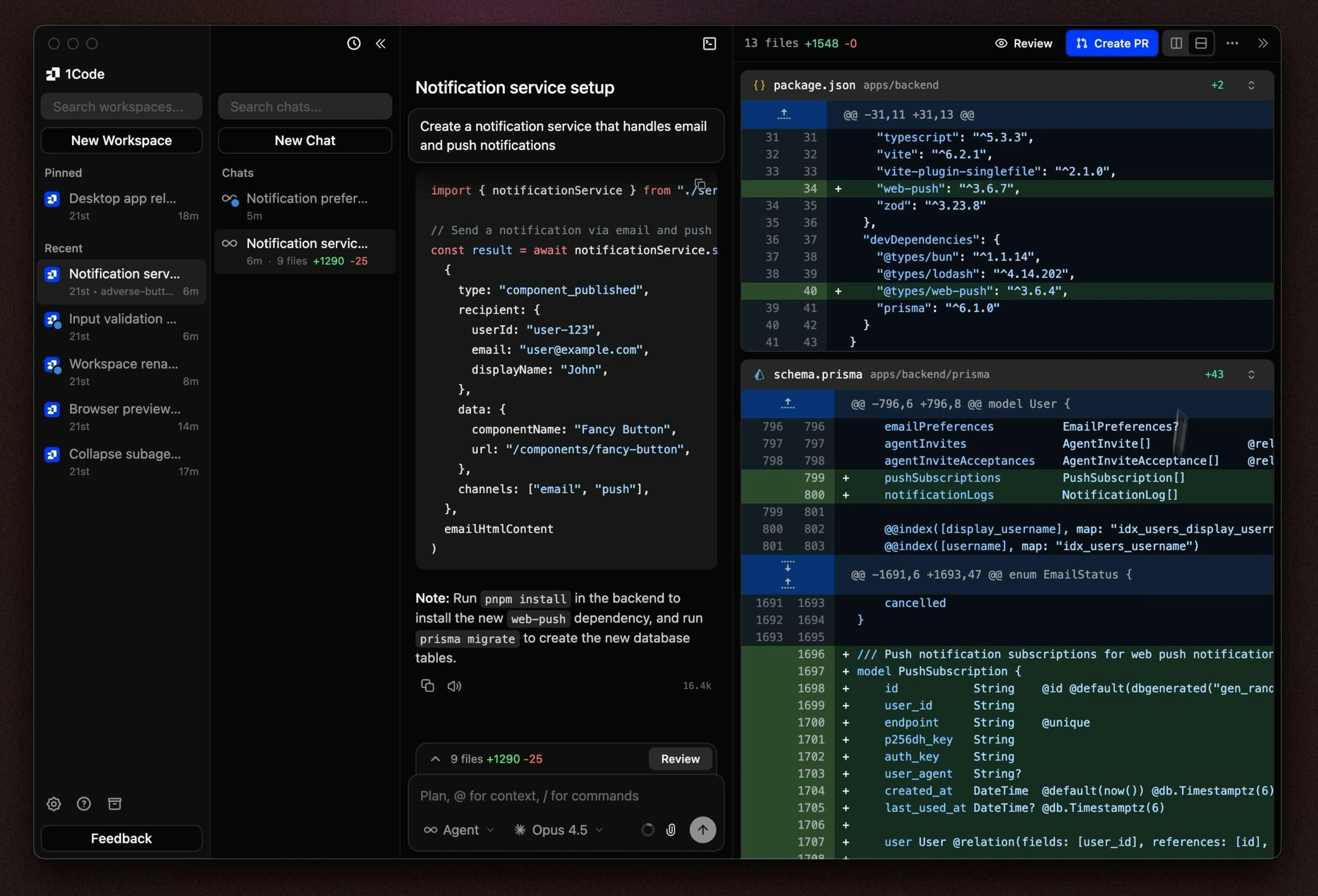
1Code represents a fundamental reimagining of how developers interact with Claude Code, Anthropic’s agentic coding assistant, by transforming the command-line experience into a visual, parallel-execution platform optimized for professional software development workflows. Built by 21st.dev—a San Francisco-based Y Combinator Winter 2026 company founded by Serafim Korablev and Sergey Bunas—1Code addresses critical friction points that prevent Claude Code from achieving its full potential in real-world development contexts requiring sustained parallel work across multiple features, branches, and repositories.
The platform’s revolutionary advancement lies in enabling true parallel agent execution where multiple Claude Code instances operate simultaneously on independent features within isolated environments. Unlike the sequential single-agent paradigm imposed by Claude Code’s native terminal interface, 1Code leverages Git worktrees—separate filesystem directories sharing a common Git repository—to provide each agent with dedicated workspace isolation. This architectural approach enables developers to assign one agent to authentication implementation, another to UI refinement, and a third to API integration, all progressing concurrently without context pollution or branch-switching overhead.
The dual-deployment model accommodates diverse user preferences and security requirements through both web-based and native macOS applications. The web application runs agents in remote sandboxes managed by 21st.dev infrastructure, eliminating local environment setup while providing instant accessibility from any browser. The macOS native application executes agents locally on developer machines, ensuring code never leaves organizational boundaries—a critical capability for enterprises handling proprietary codebases, regulated data, or strict intellectual property protection requirements.
1Code’s interface philosophy emphasizes “calm UI” through deliberate visual hierarchy, keyboard-first navigation with comprehensive hotkey coverage, and information density optimization that surfaces critical execution state without overwhelming cognitive capacity. Every workflow action—creating agents, switching between parallel executions, reviewing code changes, opening pull requests, merging branches—operates through keyboard shortcuts, enabling developers to maintain flow state without constant mouse interaction interrupting concentration and introducing context-switching overhead.
The platform preserves complete Claude Code feature parity including Plan Mode enabling multi-step execution strategies before code modification, Skills system providing specialized capabilities for testing, debugging, and deployment, message editing for iterative prompt refinement, and Model Context Protocol integration enabling external tool and data source connections. This comprehensive feature coverage ensures developers transitioning from native Claude Code experience no capability regression while gaining substantial workflow velocity improvements through parallel execution and visual management.
The open-source foundation under permissive licensing enables self-hosting for organizations requiring complete operational control, custom modifications adapting 1Code to specialized workflows, security auditing verifying code integrity, and community contributions extending functionality. This openness contrasts sharply with closed-source alternatives where vendor lock-in, feature gatekeeping, and opaque pricing create adoption barriers particularly problematic for startups, independent developers, and organizations with strict vendor evaluation requirements.
Key Achievements & Milestones
21st.dev’s trajectory demonstrates exceptional execution velocity characteristic of successful YC companies, progressing from founding in October 2024 to Y Combinator Winter 2026 batch acceptance, public launch, and rapid community traction within months. The company emerged from co-founders’ prior collaboration at Via Protocol, where Serafim Korablev served as CEO building cross-chain cryptocurrency infrastructure achieving one point five billion dollars in gross transaction volume, and Gas Pump, a Telegram-integrated memecoin launchpad acquired by BabyDoge in November 2024.
The January 2026 Product Hunt launch under the title “1Code: Open source Cursor-like UI for Claude Code” generated substantial developer community engagement, validating market appetite for enhanced Claude Code interfaces. The positioning as “Cursor-like” deliberately references Cursor’s market-leading AI coding assistant, signaling ambition to deliver comparable user experience quality while leveraging Anthropic’s Claude models rather than proprietary inference infrastructure.
The Hacker News “Show HN” post on January 14, 2026, sparked extensive technical discussion among early adopters, with developers sharing experiences, requesting features, and debating architectural decisions. This community engagement pattern mirrors successful developer tool launches where grassroots adoption precedes enterprise penetration, with individual practitioners advocating for organizational adoption after experiencing personal productivity gains.
The open-source release strategy providing full source code access enables community contributions, security auditing, and self-hosting—capabilities generating trust within developer communities skeptical of closed-source tools handling proprietary codebases. The GitHub repository hosting 1Code implementation allows developers to inspect code quality, understand architectural decisions, report issues, submit pull requests, and fork for custom modifications—transparency levels impossible with proprietary alternatives.
The founding team’s prior exits—Gas Pump acquisition by BabyDoge and Cutly acquisition by Mobile Publisher, both in November 2024—demonstrate execution capability and market timing, though cryptocurrency and video editing domains differ substantially from developer tooling. The transition from consumer crypto and content applications to B2B developer infrastructure reflects strategic pivot toward sustainable software-as-a-service business models with predictable recurring revenue rather than crypto-native volatility or mobile app monetization challenges.
The Y Combinator Winter 2026 acceptance provides validation from Silicon Valley’s most prestigious startup accelerator, signaling confidence in founding team quality, market opportunity size, and product vision. YC’s rigorous selection process—accepting under two percent of applications—and track record producing companies including Airbnb, Stripe, DoorDash, and Instacart lends credibility attracting investor attention, enterprise customer consideration, and talent recruitment.
Adoption Statistics
Quantitative adoption metrics remain largely undisclosed given 1Code’s recent January 2026 launch and early-stage company status. The Product Hunt engagement, Hacker News discussion velocity, and social media mentions suggest meaningful early traction within developer communities, though precise user counts, revenue figures, and growth rates await future disclosure as the company matures and potentially announces funding milestones requiring traction evidence.
The pricing structure spanning free self-hosted tiers through twenty-dollar Pro and two-hundred-dollar Max paid plans suggests revenue generation commenced immediately post-launch rather than extended free trial periods typical of some developer tools. This confident monetization approach indicates founding team conviction about value proposition clarity and market willingness to pay, though actual conversion rates from free to paid tiers remain unknown.
The macOS-only native application temporarily constrains addressable market, excluding Windows and Linux developers representing substantial portions of software engineering populations. This strategic platform focus likely reflects resource constraints typical of three-person founding teams prioritizing depth over breadth, betting that macOS developer penetration provides sufficient initial market while Windows and Linux support develop over subsequent quarters.
The requirement for existing Claude Pro or Max subscriptions—priced at twenty to two hundred dollars monthly from Anthropic—creates adoption prerequisites potentially limiting audience to developers already committed to Claude ecosystem rather than attracting new AI coding tool users. This dependency positions 1Code as enhancement layer atop Anthropic infrastructure rather than standalone competitive alternative, aligning incentives with Anthropic while constraining growth to Claude adoption velocity.
The three-person team size reported by Y Combinator indicates lean operations typical of early-stage startups, suggesting limited organizational bandwidth for extensive customer support, sales operations, or marketing campaigns beyond product-led growth strategies. This constraint implies adoption must occur primarily through organic virality, community advocacy, and word-of-mouth rather than traditional enterprise software go-to-market motions requiring dedicated sales teams, marketing spend, and partnership development.
2. Impact & Evidence
Client Success Stories
Formal case studies and detailed customer testimonials remain sparse given 1Code’s recent January 2026 launch, with insufficient operational history for customers to achieve, measure, and document substantial productivity improvements or return-on-investment analyses. However, community discussions on platforms including Hacker News, Reddit’s ClaudeCode subreddit, and developer forums reveal emerging usage patterns and early adopter experiences providing qualitative validation of core value propositions.
Developers report parallel agent execution as transformative for multi-feature development workflows. A representative use case involves simultaneously implementing OAuth authentication in one worktree, refining UI components in another, and integrating third-party APIs in a third—workflows that would traditionally require sequential development with constant branch switching, merge conflicts, and context loss. The ability to assign specialized agents to focused tasks then review and merge results represents workflow paradigm shift from human-as-bottleneck to human-as-orchestrator.
The keyboard-first navigation receives praise from productivity-focused developers accustomed to vim, emacs, or other keyboard-centric development environments where mouse interaction introduces friction and interrupts flow state. Users describe maintaining hands-on-keyboard throughout entire workflows—creating agents, reviewing diffs, opening pull requests, merging changes—without reaching for mice or trackpads that would disrupt muscle memory and cognitive focus developed over years optimizing personal development environments.
The live browser preview capability for frontend changes enables immediate visual feedback when agents modify user interfaces, stylesheets, or interactive components. Developers report substantial time savings eliminating manual refresh cycles, localhost server management, and browser developer tool juggling that traditionally consumes minutes per iteration accumulating to hours weekly across typical web application development workflows. The instant visual validation accelerates iteration velocity while reducing cognitive overhead tracking which changes correspond to which visual outcomes.
However, early adopters note stability challenges characteristic of newly launched developer tools including occasional agent crashes requiring restart, inconsistent worktree cleanup leaving orphaned directories consuming disk space, and synchronization issues between web and macOS applications when users alternate between deployment modes. These growing pains align with typical early-stage software maturity curves where core functionality proves valuable despite operational rough edges requiring iterative refinement based on production usage feedback.
Performance Metrics & Benchmarks
Quantitative performance metrics including development velocity improvements, code quality measures, or productivity benchmarks remain unpublished, reflecting both early-stage product maturity and inherent measurement challenges quantifying software development productivity gains. Unlike customer support automation or data processing workflows where throughput and accuracy metrics provide clear measurement, evaluating coding assistant effectiveness requires controlling for task complexity, developer skill, codebase familiarity, and problem domain—variables difficult to isolate without rigorous controlled studies.
The parallel execution capability provides theoretical speedup approaching number of concurrent agents for independent tasks—three parallel agents potentially compressing three-hour sequential development into approximately one hour assuming task independence and minimal coordination overhead. However, real-world speedup factors remain lower due to task dependencies requiring sequential ordering, coordination costs reviewing and merging parallel work, and cognitive overhead managing multiple concurrent execution threads even with visual tooling reducing mechanical friction.
User reports on Reddit’s ClaudeCode subreddit discussing Claude Pro plan limitations provide context for 1Code usage patterns. Developers describe hitting Claude Pro rate limits—approximately two hundred prompts per five-hour window on twenty-dollar Pro plans—within hours during intensive development sessions. The parallel agent execution potentially accelerates limit exhaustion by consuming multiple prompt allocations simultaneously, suggesting power users may require Claude Max subscriptions at one hundred to two hundred dollars monthly for sustainable all-day usage supporting full-time development workflows.
The worktree creation and management overhead introduces marginal performance costs compared to single-branch development. Git worktree creation typically completes within seconds for most repositories, though very large codebases with extensive histories or numerous files may experience minute-plus initialization times. The disk space overhead—each worktree maintains complete working directory copies though sharing Git object storage—ranges from hundreds of megabytes to gigabytes depending on codebase size, potentially constraining developers on storage-limited machines or working with monolithic monorepos.
Third-Party Validations
Y Combinator’s Winter 2026 batch acceptance constitutes the most significant third-party validation, signaling confidence from Silicon Valley’s premier startup accelerator that 1Code addresses substantial market opportunity with capable founding team and defensible competitive positioning. YC’s rigorous selection process, track record producing unicorn companies, and extensive alumni network provide credibility difficult to achieve through alternative validation mechanisms, particularly valuable for early-stage startups lacking established customer bases or revenue traction.
Product Hunt community engagement including feature discussions, user questions, and competitive comparisons provides grassroots validation from early adopter community. While Product Hunt metrics including upvotes and comments lack rigor of formal performance studies, the platform’s developer-heavy audience and track record highlighting emerging tools that subsequently achieve mainstream adoption lends weight to positive reception signaling genuine utility rather than merely effective marketing.
Hacker News technical community discussions demonstrate skepticism-balanced enthusiasm characteristic of sophisticated developer audiences. The Show HN thread sparked substantive debates about worktree management strategies, macOS versus cross-platform priorities, open-source sustainability models, and competitive positioning versus Cursor, Windsurf, and other AI coding assistants. This critical engagement—questioning architectural decisions while acknowledging core value propositions—provides more credible validation than uncritical enthusiasm typical of less technical audiences.
However, notable validation gaps include absence of formal analyst coverage from Gartner, Forrester, or technology research firms whose assessments influence enterprise procurement decisions. The lack of customer testimonials from recognized technology companies, case studies documenting quantified productivity improvements, or endorsements from prominent developers or engineering leaders limits social proof valuable for adoption by risk-averse organizations or developers uncertain about committing to emerging tools.
Independent security audits, penetration testing reports, or third-party code quality assessments remain undocumented in publicly accessible materials. For developer tools accessing proprietary codebases and organizational infrastructure, security validation constitutes critical trust signal, particularly for enterprises with strict vendor risk management requirements. The open-source release enables community security review, though formal independent audits by recognized security firms would strengthen confidence for security-conscious adopters.
3. Technical Blueprint
System Architecture Overview
1Code implements a sophisticated dual-architecture accommodating both cloud-hosted and local-execution deployment models through unified codebase and interface layer. The web application routes agent execution requests to remote sandbox environments provisioned dynamically in 21st.dev infrastructure, likely containerized execution environments providing isolated filesystem access, network connectivity, and computational resources for Claude Code agent operations. This architecture enables instant accessibility without local installation while centralizing infrastructure management, security updates, and capacity scaling.
The macOS native application bundles complete Claude Code execution environment locally, leveraging Apple Silicon or Intel processor architectures to run agents directly on developer machines without cloud connectivity requirements beyond initial Anthropic authentication and Claude API calls. This local execution model ensures code never traverses 21st.dev servers—a critical privacy guarantee for organizations handling sensitive intellectual property, regulated data, or confidential customer information where cloud transmission violates policy regardless of encryption or vendor trustworthiness.
The Git worktree orchestration layer constitutes 1Code’s most sophisticated architectural component, implementing automatic worktree lifecycle management including creation when agents initialize, configuration applying repository-specific setup scripts, synchronization ensuring base branch changes propagate, and cleanup removing worktrees after completion to prevent disk space exhaustion. Each worktree maintains independent working directory with separate file states, staging areas, and checked-out branches while sharing underlying Git object database—an architecture enabling parallel agents to operate on distinct branches without filesystem conflicts or mutual interference.
The interface layer implements real-time execution monitoring displaying agent progress, code changes, error messages, and completion status across all parallel executions through unified visual dashboard. The architecture likely employs WebSocket connections maintaining bidirectional communication between interface and agent execution environments, enabling low-latency updates as agents modify files, execute commands, or encounter errors requiring human intervention. This real-time visibility transforms opaque command-line processes into transparent operations where developers understand execution state at glance rather than parsing terminal output streams.
The diff and pull request workflow integration connects directly to Git hosting platforms including GitHub, GitLab, and potentially Bitbucket, enabling developers to review code changes, open pull requests, request reviews, and merge branches without leaving 1Code interface. This integration eliminates context switching between development environment, Git command-line tools, and web-based code review platforms—friction points that fragment attention and introduce delays accumulating across dozens of daily interactions typical in collaborative development workflows.
API & SDK Integrations
1Code’s integration architecture centers on Anthropic API connectivity enabling Claude Code agent invocation, prompt submission, response streaming, and execution state management. Users authenticate through Anthropic accounts, granting 1Code permission to invoke Claude on their behalf using Pro or Max subscription allowances. This authentication model means 1Code never stores Anthropic credentials, instead receiving time-limited access tokens following OAuth best practices minimizing credential exposure and enabling users to revoke access without password changes.
The Git integration encompasses full repository operation support including cloning, branching, committing, pushing, pulling, merging, and worktree management through programmatic Git API usage or command-line tool invocation. The implementation likely leverages established Git libraries including libgit2 or NodeGit for JavaScript environments, providing battle-tested Git operation implementations avoiding reimplementation of complex repository manipulation logic prone to subtle bugs corrupting data or introducing merge conflicts.
The Model Context Protocol support inherited from Claude Code enables agents to access external tools and data sources including file systems, databases, APIs, and custom integration endpoints. MCP’s standardized protocol for connecting language models to computational resources means 1Code automatically gains capabilities from growing MCP ecosystem including community-developed servers for Slack, Notion, Linear, Google Drive, and hundreds of other business applications. This extensibility transforms 1Code from isolated coding tool into integration hub coordinating AI agents across entire development and operations toolchains.
The browser preview integration for frontend development likely implements local development server proxying or filesystem watching detecting changes and triggering browser reloads. The architecture potentially leverages established hot-reload technologies including Vite, webpack dev server, or framework-specific development modes providing instant visual feedback as agents modify HTML, CSS, JavaScript, or framework components. This real-time preview eliminates manual refresh cycles and localhost port management that consume attention and introduce delays during rapid iteration.
However, notable integration gaps include absence of documented IDE plugin support enabling 1Code invocation from within VS Code, JetBrains IDEs, or other development environments developers spend majority of time. While 1Code provides standalone interfaces, seamless integration into existing development environments would reduce context switching and enable developers to maintain preferred tooling ecosystems while accessing 1Code capabilities when parallel execution or visual management provides value.
Scalability & Reliability Data
Scalability characteristics and reliability guarantees remain largely undocumented given early product stage and typical startup prioritization of feature development over formal SLA commitments. The dual-architecture model creates interesting scalability dynamics where web deployment scalability depends on 21st.dev infrastructure capacity while local execution scalability derives from user hardware capabilities—fundamentally different bottlenecks requiring distinct scaling strategies.
The web deployment likely implements horizontal scaling through containerized agent environments provisioned dynamically based on demand, enabling 21st.dev to add computational capacity during high-usage periods then scale down during idle times optimizing infrastructure costs. However, architectural details including container orchestration platforms, regional availability, failover mechanisms, and capacity limits per user remain undisclosed, complicating enterprise evaluations requiring infrastructure transparency for capacity planning and disaster recovery procedures.
The local execution scalability depends entirely on user hardware—available RAM, CPU cores, disk space, and filesystem performance determine maximum concurrent agent counts and execution speeds. Modern Apple Silicon Macs with sixteen-plus gigabytes RAM can comfortably support multiple parallel agents, though very large monorepos or memory-intensive compilation tasks may constrain practical parallelism. The worktree disk space requirements potentially limit parallel agents for developers with storage-constrained machines or large codebases generating multi-gigabyte working directories per worktree.
Reliability and uptime commitments remain absent from publicly available materials, typical for early-stage startups prioritizing rapid feature development over formal operational guarantees. The free and Pro tiers likely operate under best-effort availability without SLA commitments, while Max tier two-hundred-dollar monthly pricing potentially includes informal reliability expectations though not contractually binding service level agreements with financial penalties for violations typical of enterprise software agreements.
The open-source foundation provides unique reliability advantages where users experiencing service disruptions from hosted deployments can immediately switch to self-hosted installations maintaining operational continuity. This architectural optionality contrasts with closed-source SaaS platforms where vendor outages create complete service unavailability without remediation paths beyond waiting for vendor resolution—a risk many enterprises find unacceptable for critical development infrastructure.
4. Trust & Governance
Security Certifications
1Code does not advertise formal security certifications including SOC 2 Type 2, ISO 27001, or comparable third-party validated security frameworks in accessible materials. This absence aligns with typical early-stage startup prioritization where product-market fit validation and feature development take precedence over expensive multi-month certification processes requiring significant capital investment, operational maturity, and dedicated compliance personnel—resources scarce at three-person founding teams.
The local execution model provides inherent security advantages by eliminating cloud data transmission for macOS users who never send code to 21st.dev servers beyond Anthropic API calls required for Claude Code functionality. This architectural approach satisfies stringent data residency requirements, intellectual property protection policies, and zero-trust security models mandating code never leaves organizational boundaries regardless of encryption, vendor reputation, or contractual commitments that could be breached through data breaches, insider threats, or legal compulsion.
The open-source codebase enables independent security auditing where organizations or community members can review implementation, identify vulnerabilities, verify absence of telemetry or data exfiltration beyond documented Anthropic connectivity, and assess security practices including authentication handling, credential storage, and data encryption. This transparency provides security assurance impossible with closed-source tools where users must trust vendor claims without verification mechanisms beyond limited penetration testing accessing only exposed interfaces rather than complete implementation.
However, open-source transparency cuts both ways—while enabling security audits by defenders, it equally enables vulnerability discovery by attackers who can analyze code for exploitation opportunities without reverse engineering barriers complicating closed-source attack surface analysis. This reality means 1Code’s security depends substantially on community vigilance reporting discovered vulnerabilities, maintainer responsiveness patching issues, and user diligence applying updates—a security model with mixed track record across open-source projects ranging from highly secure (Linux kernel) to catastrophically vulnerable (Log4j).
The integration with Anthropic authentication inherits security properties of Anthropic’s identity and access management systems including multi-factor authentication support, OAuth token management, and session handling. Users benefit from Anthropic’s security investments without 1Code reimplementing authentication infrastructure prone to implementation errors introducing vulnerabilities. However, this dependency means 1Code security breaches compromising stored access tokens could enable unauthorized Claude API usage consuming victim subscription allowances or accessing organizational data through compromised agent operations.
Data Privacy Measures
1Code’s data privacy architecture varies dramatically between deployment models, with local macOS execution providing maximum privacy through complete data residency on user devices while web deployment introduces 21st.dev as intermediary handling code transmission between browsers and remote sandbox environments. The privacy implications differ substantially depending on deployment choice, organizational requirements, and sensitivity of codebases under development.
The local execution privacy model ensures code files, prompts, agent outputs, and execution histories never leave developer machines except for Claude API calls transmitting context to Anthropic’s servers for model inference. This architecture satisfies strict data residency policies, intellectual property protection requirements, and privacy regulations including GDPR, CCPA, and industry-specific frameworks mandating data minimization and processing restrictions. Organizations can deploy 1Code with confidence that proprietary algorithms, customer data, or confidential business logic remains under complete organizational control.
The web deployment privacy model requires users to trust 21st.dev handling code securely during transmission and temporary storage in remote sandbox environments. The company likely implements encryption-in-transit via HTTPS/TLS protecting data during browser-to-server communication and encryption-at-rest for any persistent storage, though specific encryption standards, key management practices, and data retention policies warrant explicit documentation that remains absent from publicly accessible materials. Users should verify privacy commitments through terms of service, privacy policies, and direct vendor engagement before deploying for sensitive codebases.
The Anthropic API privacy extends beyond 1Code control, governed by Anthropic’s data usage policies, retention practices, and training commitments. Anthropic explicitly states they do not train models on Claude Code interactions, providing intellectual property protection for code developed using their services. However, users should review Anthropic’s complete privacy policy understanding what telemetry, usage analytics, or metadata Anthropic collects even when not training models on code content—distinctions critical for organizations with strict data handling requirements.
The lack of detailed privacy documentation including data flow diagrams, retention schedules, sub-processor lists, and deletion procedures represents gap organizations should address during vendor evaluation. Enterprises typically require comprehensive data processing agreements, sub-processor disclosures, data residency commitments, and breach notification procedures before allowing tools to access organizational data. The self-hosting option addresses many concerns by eliminating 21st.dev from data flow, though Anthropic dependency persists across all deployment models.
Regulatory Compliance Details
Specific regulatory compliance postures including GDPR, HIPAA, SOX, PCI-DSS, and industry-specific frameworks remain undocumented in publicly accessible materials. This documentation gap complicates adoption for regulated organizations requiring vendor attestations, compliance evidence, and contractual commitments before procurement approval. Financial services institutions, healthcare providers, government contractors, and publicly traded companies often mandate formal compliance validation that early-stage startups typically lack resources to achieve.
The self-hosting deployment model potentially simplifies compliance by eliminating 21st.dev as data processor, reducing compliance scope to internal IT operations and Anthropic as sub-processor. Organizations can deploy self-hosted 1Code within compliant infrastructure, apply organizational security controls, and maintain audit trails satisfying regulatory requirements without depending on vendor compliance maturity. However, the Anthropic dependency persists, requiring organizations to evaluate Anthropic’s compliance posture regardless of 1Code deployment choice.
European organizations subject to GDPR requirements should evaluate data residency, international transfer mechanisms, data processing agreements, and individual rights fulfillment procedures. The web deployment potentially involves cross-border data transfers if 21st.dev infrastructure resides outside European Economic Area, requiring Standard Contractual Clauses, adequacy decisions, or alternative transfer mechanisms. The local execution eliminates most GDPR concerns by keeping personal data within organizational boundaries, though Anthropic API calls may still constitute international transfers depending on Anthropic’s processing locations.
Healthcare organizations subject to HIPAA restrictions face substantial barriers given absence of Business Associate Agreements, technical safeguards documentation, and breach notification procedures required for vendors processing protected health information. While developers creating healthcare applications could potentially use 1Code without PHI exposure if carefully isolating data, most healthcare organizations would likely prohibit 1Code until comprehensive HIPAA compliance evidence emerges—potentially years away given early product stage and compliance investment requirements.
5. Unique Capabilities
Infinite Canvas: Applied Use Case
1Code’s infinite canvas manifests through unrestricted parallel agent execution where developers can spawn arbitrary numbers of concurrent agents limited only by hardware capacity rather than artificial software constraints. This architectural openness enables workflows impossible with sequential tools, fundamentally transforming development processes from linear progression through feature lists to orchestrated parallel execution across independent work streams converging at integration points.
The practical application involves developers working on complex features requiring multiple parallel work streams—for example, building comprehensive authentication system might involve simultaneous OAuth provider integration, session management implementation, user interface development, API endpoint creation, database schema migration, and comprehensive test suite authoring. Traditional sequential development means weeks spanning these interdependent components with constant context switching, while parallel agent execution compresses timelines through simultaneous progression then strategic integration once independent components achieve maturity.
The worktree isolation architecture provides clean separation preventing agents from interfering despite sharing underlying repository. Each agent operates in dedicated working directory with independent file states, Git staging areas, and branch checkouts, enabling fundamentally different approaches to same codebase without conflicts. This isolation extends to dependency installations—different worktrees can maintain separate node_modules, virtual environments, or package installations enabling agents to test alternative dependency versions or conflicting requirements without mutual interference.
The Git branching model integration enables sophisticated workflows including multi-agent collaborative development where specialized agents handle different aspects of single feature, comparative development where multiple agents implement alternative approaches for evaluation, speculative development where agents explore uncertain technical directions without risking main codebase stability, and regression testing where agents validate changes across multiple historical code versions identifying when bugs introduced.
However, infinite parallel capacity introduces coordination complexity where managing numerous concurrent agents, tracking which features each agent develops, resolving merge conflicts when parallel work touches overlapping code, and maintaining architectural coherence across distributed development requires discipline and tooling support. The visual interface helps by surfacing all active agents, their progress, and change previews, but fundamentally developers must think differently about orchestration rather than execution—a mental model shift requiring practice and potentially overwhelming developers accustomed to linear workflows.
Multi-Agent Coordination: Research References
1Code’s multi-agent architecture implements coordination patterns drawing from distributed systems research, parallel computing paradigms, and software engineering best practices for managing concurrent workflows. The Git worktree foundation provides proven isolation mechanisms battle-tested across millions of repositories over decades, ensuring robust separation without exotic concurrency primitives prone to subtle race conditions or deadlock scenarios plaguing naive parallel implementations.
The coordination model emphasizes deliberate independence rather than tight coupling, with agents progressing autonomously within assigned worktrees until completion rather than continuously communicating or synchronizing intermediate state. This embarrassingly parallel approach maximizes throughput by eliminating coordination overhead, avoiding synchronization bottlenecks, and enabling linear scalability where N agents provide approximately N-times speedup for sufficiently independent tasks—a theoretical ideal rarely achieved in practice but approachable for well-decomposed features.
The merge and integration phase provides structured coordination point where developers review parallel agent outputs, resolve any conflicts where changes overlap, validate that independent implementations integrate correctly, and consolidate work into unified feature branches. This human-mediated coordination leverages developer judgment about appropriate conflict resolutions, architectural consistency, and quality standards—aspects difficult to automate given subjectivity and context-dependence of good software design.
Academic research underpinning these capabilities includes Git internals documentation describing worktree implementation, software engineering literature on modular design enabling parallel development, and distributed version control theory explaining how disconnected development workflows eventually reconcile through merge algorithms. The practical engineering challenge involves reliably managing worktree lifecycles, surfacing coordination requirements through interface design, and degrading gracefully when automation assumptions violate actual usage patterns.
The comparative development capability enabling multiple agents to implement alternative solutions then selecting preferred approach aligns with exploratory programming research investigating how developers evaluate alternatives, software prototyping literature emphasizing rapid iteration, and architectural decision-making studies showing value of considering multiple options before committing. The visual comparison interface lowering effort for alternative evaluation potentially encourages more thorough exploration of design space—a practice known to improve outcomes but often skipped due to perceived overhead.
Model Portfolio: Uptime & SLA Figures
1Code’s reliability characteristics derive primarily from underlying dependencies rather than platform-specific availability, with Anthropic’s Claude API uptime determining agent execution reliability regardless of 1Code interface robustness. Anthropic maintains high availability targets typical of major AI API providers, likely achieving ninety-nine percent or higher monthly uptime across most periods, though specific SLA commitments vary by subscription tier and remain subject to Anthropic’s terms rather than 1Code’s control.
The web deployment introduces 21st.dev infrastructure as additional failure point potentially degrading availability below Anthropic baseline when hosting platform experiences outages, network disruptions, or capacity constraints. However, specific uptime statistics, historical availability data, and downtime incident reports remain unpublished given recent launch and early operational history insufficient for meaningful reliability characterization. Users should anticipate occasional disruptions typical of early-stage hosted services while infrastructure matures and operational practices evolve.
The local execution deployment eliminates 21st.dev infrastructure dependency, providing reliability bounded only by user machine stability and Anthropic API availability. Developers experience service continuity even during 21st.dev outages provided laptops remain operational and internet connectivity enables Claude API access. This architectural resilience through deployment optionality provides unique advantage over purely cloud-based alternatives where vendor outages create complete service unavailability without remediation beyond waiting.
The open-source foundation enables community-driven reliability improvements where users encountering bugs can diagnose root causes, develop fixes, submit pull requests, and immediately deploy patches without waiting for vendor release cycles. This distributed debugging capability contrasts with closed-source tools where users report issues then wait days or weeks for vendor engineering attention, fixes, quality assurance testing, and production deployment—delays unacceptable for blocking issues preventing work.
However, open-source reliability depends on maintainer responsiveness, community engagement quality, and project governance effectiveness—variables with mixed track record across open-source ecosystems. Well-maintained projects with active communities achieve remarkable reliability through distributed attention and rapid issue resolution, while abandoned or undermaintained projects accumulate technical debt, unresolved bugs, and security vulnerabilities degrading reliability below commercial alternatives despite theoretical advantages.
Interactive Tiles: User Satisfaction Data
User satisfaction data remains limited given 1Code’s January 2026 launch providing insufficient operational history for meaningful sentiment analysis, though early adopter feedback across Product Hunt, Hacker News, Reddit, and developer forums reveals enthusiasm tempered by pragmatic concerns typical of emerging developer tools. The parallel execution capability receives particular praise from developers working on complex features requiring simultaneous progress across multiple components—use cases where traditional sequential development creates frustrating bottlenecks.
The keyboard-first navigation generates strong positive sentiment from productivity-focused developers who maintain flow state through muscle memory hotkeys eliminating mouse interaction. However, some users note learning curve memorizing extensive hotkey mappings, onboarding friction without visual menu discovery mechanisms, and occasional keybinding conflicts with operating system shortcuts or other development tools. The tension between power-user efficiency and newcomer accessibility represents classic interface design tradeoff without universal solutions satisfying all preferences.
The visual diff and pull request workflows receive praise for eliminating context switching between development environment and web-based code review platforms. Developers describe appreciating immediate change visibility, streamlined review initiation, and merge execution without browser tabs, terminal Git commands, or platform-specific workflows varying across GitHub, GitLab, Bitbucket. However, some advanced users note missing features compared to full-featured web interfaces including comprehensive review analytics, team-wide activity streams, or advanced permission management.
The macOS exclusivity generates substantial frustration among Windows and Linux developers unable to access local execution despite interest and willingness to pay. This platform limitation creates perception of Apple favoritism or neglect of non-Mac users, though founding team likely prioritizes depth over breadth during early development given resource constraints typical of three-person teams. The promise of eventual cross-platform support provides hope but no concrete timelines, leaving non-Mac developers uncertain about adoption timing.
The Claude subscription requirement creates adoption barriers for developers unfamiliar with Claude ecosystem or cost-sensitive users reluctant to commit twenty-plus dollars monthly for Anthropic subscription before evaluating 1Code value. Some users suggest free tier including limited usage without existing subscriptions would accelerate adoption by reducing commitment requirements, though this would require 1Code subsidizing API costs or implementing alternative revenue models beyond pure subscription markup.
6. Adoption Pathways
Integration Workflow
1Code adoption begins with account creation at 1code.dev requiring Anthropic authentication through OAuth flow connecting user Anthropic accounts and granting 1Code permission to invoke Claude Code on their behalf. This authentication mechanism ensures 1Code never stores Anthropic credentials, instead receiving time-limited access tokens refreshed automatically providing security through limited exposure windows and enabling straightforward revocation without password changes if users later decide to disconnect access.
Following authentication, users select deployment model based on privacy requirements, performance preferences, and platform availability. Web deployment provides instant access through browser without local installation, automatically provisioning remote sandbox environments, and handling infrastructure complexity transparently. The macOS native application requires download and installation through direct download from website, with Intel and Apple Silicon builds providing optimized binaries for respective processor architectures ensuring native performance without emulation overhead.
The initial project setup involves opening existing Git repositories or cloning from remote hosting platforms. The local execution model integrates directly with developer machines’ filesystem, accessing repositories through standard path navigation similar to terminal-based workflows. The web deployment requires repository import mechanisms uploading codebases to remote environments or connecting to hosting platforms through API integrations, though specific implementation details and supported platforms remain partially documented warranting verification during initial setup.
The agent creation workflow starts with describing desired development tasks through natural language prompts leveraging Claude’s comprehension capabilities interpreting intent, identifying required operations, and planning execution strategies. Users can initialize multiple agents simultaneously for parallel feature development, each automatically receiving dedicated worktree isolation, independent Git branch, and execution environment configured with repository-specific dependencies and tooling. The plan mode enables reviewing proposed approaches before execution, providing opportunities to refine strategies, catch potential issues, or redirect agents toward preferred implementations.
The keyboard-driven workflow enables rapid agent management including switching between parallel executions, reviewing code changes through diff viewers, editing messages for prompt refinement, and executing merge operations. The comprehensive hotkey coverage means experienced users rarely require mouse interaction, maintaining focus and minimizing attention fragmentation typical when constantly shifting between keyboard and pointing devices throughout development sessions.
Customization Options
1Code’s customization capabilities remain partially documented though open-source foundation theoretically enables arbitrary modifications for users willing to invest development effort. The worktree initialization supports custom setup scripts through configuration files similar to Cursor’s .cursor/worktrees.json approach, enabling repository-specific commands running during worktree creation including dependency installation, environment variable configuration, database seeding, or development server launching.
The keyboard shortcut customization likely supports user-defined mappings accommodating personal preferences, avoiding conflicts with existing tools or operating system shortcuts, and enabling muscle memory transfer from other development environments. However, specific customization interfaces, configuration file formats, and extent of remapping flexibility remain undocumented in accessible materials, warranting direct exploration or vendor inquiry during evaluation.
The interface theme customization including color schemes, font selections, and density preferences potentially accommodates visual accessibility requirements, personal aesthetic preferences, and environmental considerations like reducing eye strain during extended coding sessions. Modern developer tools typically provide extensive appearance customization, though whether 1Code implements comparable flexibility or maintains fixed interface design remains unclear from public materials.
The Git workflow customization including commit message templates, branch naming conventions, merge strategies, and pull request descriptions likely supports organizational standards varying across teams, companies, and open-source communities. Integration with existing Git configuration files like .gitconfig could provide automatic adoption of user preferences, though custom 1Code-specific settings may require separate configuration distinct from standard Git tooling.
However, extensive customization potentially fragments user experience where heavily customized instances become difficult to support, document, or discuss within community channels where users assume default configurations. The balance between flexibility enabling personalization and consistency enabling support represents ongoing tension in developer tool design without universal solutions satisfying all stakeholders.
Onboarding & Support Channels
1Code’s onboarding experience emphasizes simplicity through Anthropic authentication, automatic environment setup, and minimal configuration requirements before first agent execution. The get-started documentation guides users through account creation, deployment model selection, repository setup, and initial agent creation, though documentation completeness and tutorial depth remain partially developed given recent product launch and ongoing documentation expansion.
Support channels likely include community-based mechanisms typical of open-source projects and early-stage startups lacking resources for extensive dedicated support teams. GitHub Issues provides bug reporting, feature requests, and technical discussions where users and maintainers collaborate resolving problems, documenting workarounds, and planning improvements. This public issue tracking creates transparency enabling prospective users to assess project health, understand known limitations, and evaluate maintainer responsiveness through issue resolution velocity and communication quality.
The Product Hunt and Hacker News discussions provide informal support channels where early adopters share experiences, troubleshoot common issues, and exchange usage tips. These community-generated resources complement official documentation, often providing practical insights reflecting real-world usage patterns rather than idealized workflows documented by creators potentially blind to newcomer confusion points or edge cases encountered during production usage.
The paid tier support differentiation likely includes prioritized assistance for Pro and Max subscribers through email, dedicated chat channels, or scheduled calls providing faster response times and personalized troubleshooting compared to community-only support available for free tier users. However, specific support SLAs, response time commitments, or escalation procedures remain undocumented in public materials, suggesting informal support arrangements rather than contractual commitments typical of enterprise software agreements.
The Y Combinator network provides unique support resource where 1Code accesses thousands of alumni founders, investors, and operators providing product feedback, strategic guidance, customer introductions, and operational advice. This network effect accelerates learning, reduces common startup mistakes, and opens doors otherwise inaccessible to non-YC companies—intangible benefits difficult to quantify but frequently cited by alumni as program’s most valuable component beyond capital investment.
7. Use Case Portfolio
Enterprise Implementations
Enterprise adoption evidence remains limited given 1Code’s January 2026 launch providing insufficient time for sales cycles, procurement processes, vendor evaluations, and pilot deployments typical of organizational software acquisition. However, the local execution model specifically targets enterprise security requirements where code never leaves organizational boundaries—a fundamental prerequisite for many security-conscious organizations prohibiting cloud-based development tools regardless of encryption, contractual commitments, or vendor reputation.
Financial services institutions subject to strict data handling regulations could leverage local execution for developing trading algorithms, risk models, or customer-facing applications containing proprietary quantitative strategies or regulated customer data. The complete data residency guarantees combined with Anthropic’s security posture potentially satisfy compliance requirements that would prohibit cloud-based alternatives, though formal compliance validation, security audits, and procurement approval remain necessary before production deployment.
Technology companies developing competitive differentiation through proprietary algorithms, machine learning models, or unique technical approaches could use 1Code for confidential codebase development without cloud exposure risking intellectual property theft, competitive intelligence gathering, or inadvertent disclosure through vendor breaches. The self-hosting option provides ultimate control for organizations with sufficient operational capabilities managing internal deployments, though many would prefer hosted options reducing operational overhead if privacy guarantees proved sufficient.
Software development agencies serving multiple clients with conflicting intellectual property requirements could leverage worktree isolation ensuring complete project separation, preventing cross-contamination between client codebases, and maintaining clear audit trails documenting which developers accessed which client materials. The parallel agent execution would enable agencies to maintain velocity across multiple simultaneous client projects without engineers context-switching between disparate codebases throughout days.
However, several enterprise adoption barriers require resolution before widespread organizational deployment including absence of team collaboration features enabling multiple developers to coordinate shared agent pools, lack of administrative controls for provisioning user access and enforcing organizational policies, missing audit logging documenting who executed which agents accessing what code, absence of integration with enterprise identity providers including Active Directory or Okta, and limited procurement-ready materials including security questionnaires, compliance documentation, and vendor risk assessments.
Academic & Research Deployments
Academic adoption potential centers on computer science education, software engineering research, and AI-assisted programming studies investigating how developers interact with autonomous coding assistants. Educators could leverage parallel agents demonstrating alternative implementation approaches, comparing programming paradigms, or illustrating software architecture patterns through simultaneous implementations enabling side-by-side evaluation rather than sequential presentation losing comparative context.
Research investigating AI-assisted software development effectiveness could use 1Code as experimental platform measuring how parallel agent access impacts developer productivity, code quality, debugging efficiency, or learning outcomes. The platform’s transparency through open-source implementation enables research replication, experimental control verification, and audit trail analysis supporting rigorous empirical studies publishable in software engineering conferences and journals.
Computer science students learning software development practices could benefit from parallel agent experimentation where mistakes in one worktree don’t contaminate other explorations, enabling risk-free experimentation, alternative approach comparison, and learning through observation of AI-generated code demonstrating professional practices. However, pedagogical concerns about over-reliance on AI assistants potentially undermining fundamental skill development remain active debates within computer science education communities.
The pricing structure creates barriers for academic adoption where institutional budgets rarely accommodate per-student subscription costs at twenty-plus dollars monthly, particularly when multiplied across course enrollments reaching hundreds of students. Educational pricing, institutional licenses, or research-specific arrangements would facilitate academic penetration, though whether 21st.dev prioritizes educational market versus commercial focus remains strategically uncertain given limited team resources and necessity of revenue generation for startup sustainability.
ROI Assessments
Quantifying 1Code’s return on investment requires evaluating development velocity improvements, code quality impacts, reduced context switching overhead, and organizational capability expansion through parallel work enablement. The most direct financial benefit stems from compressed development timelines where parallel agent execution enables simultaneous feature development previously requiring sequential progression, potentially reducing multi-week development efforts to single-week timelines for sufficiently decomposable features.
For professional developers billing at one hundred fifty dollars hourly typical of senior engineering rates, reclaiming ten hours weekly through parallel execution, reduced context switching, and eliminated manual Git workflow overhead generates fifteen hundred dollars weekly value or approximately six thousand dollars monthly. This substantially exceeds 1Code subscription costs of twenty to two hundred dollars monthly even before accounting for Claude subscription requirements, suggesting positive ROI for developers with clear parallel workflow opportunities and capability to effectively orchestrate multiple concurrent agents.
The code quality improvements from comparative development where multiple agents implement alternative approaches then developers select best outcomes provides defensive value by avoiding costly technical debt, preventing architectural mistakes requiring expensive refactoring, and enabling informed technology choices rather than committing to first implementations without evaluation. These quality benefits prove difficult to quantify precisely but manifest through reduced maintenance burden, fewer production incidents, and improved system reliability enabling business velocity.
The reduced context switching between development tasks, Git branches, and code review platforms eliminates cognitive overhead and attention fragmentation typical of traditional workflows requiring constant tool switching. Research suggests context switching costs range from five to twenty-five minutes per transition as developers rebuild mental models, navigate to relevant code sections, and regain focus before productive work resumes. Eliminating dozens of daily context switches potentially reclaims hours weekly enabling sustained focus on complex problems requiring deep concentration.
Total cost of ownership extends beyond 1Code subscription to include required Claude Pro or Max subscriptions at twenty to two hundred dollars monthly, learning investment mastering keyboard workflows and parallel orchestration, and potential hardware upgrades for developers on under-powered machines struggling with multiple concurrent agents. First-year TCO might total three to five thousand dollars including subscriptions, learning curve overhead, and setup costs, with subsequent years dropping to pure subscription expenses around five hundred to three thousand dollars annually depending on tier selection.
Break-even analysis suggests developers achieving five to ten hours monthly productivity gains recoup typical TCO at professional service billing rates, a threshold achievable for developers with suitable parallel workflow opportunities and capability to effectively decompose features, orchestrate agents, and integrate results without excessive coordination overhead negating parallel execution benefits.
8. Balanced Analysis
Strengths with Evidential Support
1Code’s primary competitive advantage stems from enabling genuine parallel agent execution through Git worktree isolation—a capability fundamentally transforming development workflows from sequential feature progression to orchestrated parallel work streams. Early adopter testimonials consistently emphasize parallel execution as transformative for complex features requiring simultaneous development across multiple independent components, validating core value proposition addresses real developer pain points rather than merely theoretical capabilities rarely useful in practice.
The keyboard-first interface philosophy appeals strongly to productivity-focused developers who maintain flow state through muscle memory shortcuts eliminating mouse interaction introducing friction and fragmenting attention. The comprehensive hotkey coverage enabling complete workflow execution without pointing devices demonstrates thoughtful interaction design prioritizing efficiency for experienced users over visual discoverability prioritizing newcomer onboarding—a deliberate design tradeoff aligning with target audience of professional developers willing to invest learning curves for sustained productivity gains.
The dual deployment model accommodating both web-based instant access and local execution with complete data residency addresses diverse user needs spanning convenience-prioritizing developers comfortable with cloud hosting and security-conscious organizations requiring code never leave organizational boundaries. This flexibility contrasts with purely cloud or purely local alternatives forcing users into single deployment paradigm regardless of whether it matches requirements, creating adoption barriers or forcing uncomfortable compromises on security versus convenience.
The open-source foundation provides transparency, community contribution potential, self-hosting capabilities, and vendor independence impossible with closed-source alternatives. Developers can inspect implementation verifying security claims, contribute improvements benefiting entire community, host privately eliminating vendor dependencies, and fork for custom modifications addressing specialized requirements. This openness builds trust particularly valuable within developer communities exhibiting strong open-source preferences and skepticism toward proprietary developer tool vendors.
The Y Combinator Winter 2026 backing provides credibility, network access, operational guidance, and investor confidence signaling market validation that early-stage products often lack. The YC brand carries substantial weight within startup and technology communities, opening doors for customer conversations, partnership discussions, and media coverage otherwise inaccessible to unknown startups, accelerating adoption beyond organic growth achievable without institutional backing.
Limitations & Mitigation Strategies
Platform availability limited to macOS creates substantial adoption barrier excluding Windows and Linux developers representing majority of software engineering populations globally. This constraint stems from resource allocation decisions typical of small founding teams prioritizing depth over breadth, betting macOS developer penetration provides sufficient initial market while additional platforms develop over subsequent quarters. However, the exclusion generates frustration and perception of neglect among non-Mac users potentially damaging brand perception when cross-platform support eventually arrives.
Organizations evaluating 1Code should verify current platform support matches team composition, understanding that Windows and Linux users cannot participate using local execution regardless of interest or budget. Mixed-platform teams might adopt web deployment for universality, accepting cloud transmission tradeoffs, or wait for native platform support before organization-wide rollout. The self-hosting option theoretically enables community-driven porting efforts given open-source foundation, though whether sufficient motivation and capability exists within community remains uncertain.
The Claude subscription requirement creates adoption prerequisite potentially limiting audience to developers already committed to Claude ecosystem rather than attracting new AI coding tool users. Organizations must budget both 1Code subscription costs and underlying Anthropic subscription requirements, increasing total cost of ownership and creating vendor lock-in to Anthropic rather than maintaining LLM provider flexibility. This dependency positions 1Code as enhancement layer rather than standalone competitive alternative, aligning business model with Anthropic’s success while constraining addressable market to Claude adoption velocity.
Prospective users should evaluate total subscription costs including both 1Code and Claude fees, understanding combined expenditures range from forty dollars monthly minimum through four hundred dollars for Max-tier combinations. Alternative AI coding assistants including Cursor, GitHub Copilot, and Amazon CodeWhisperer provide integrated experiences without requiring separate AI model subscriptions, potentially offering better total cost of ownership for users not already committed to Claude ecosystem.
The early product maturity introduces stability risks, incomplete features, limited documentation, and evolving interfaces characteristic of rapidly developing software where priorities shift based on user feedback rather than maintaining backward compatibility or stability guarantees typical of mature platforms. Early adopters should anticipate bugs requiring workarounds, features lacking polish, documentation gaps necessitating experimentation, and occasional breaking changes disrupting established workflows as product iterates toward stability.
Organizations should deploy 1Code for non-critical workflows initially, gaining experience and identifying issues before expanding to mission-critical development where instability could block urgent production deployments or emergency bug fixes. Maintaining alternative development tool access enables fallback when 1Code issues arise, preventing complete productivity loss while team waits for issue resolution or workaround discovery.
The worktree management complexity introduces new failure modes where orphaned directories consume disk space, automated cleanup malfunctions leaving stale branches, synchronization issues create confusing state mismatches, and coordination overhead across parallel agents negates execution speed benefits through excessive merge conflicts or architectural inconsistencies requiring resolution. Developers must develop new mental models for parallel orchestration rather than sequential execution, representing learning curve potentially overwhelming users accustomed to traditional linear workflows.
Teams adopting 1Code should invest time developing parallel development practices, establishing conventions for feature decomposition identifying suitable parallel opportunities, creating merge strategies handling coordination points, and building organizational knowledge about effective agent orchestration patterns maximizing benefits while minimizing coordination costs. This investment pays dividends through improved parallel execution effectiveness but requires commitment beyond merely installing tool and expecting automatic productivity gains.
9. Transparent Pricing
Plan Tiers & Cost Breakdown
1Code implements three-tier pricing structure spanning free open-source self-hosting through twenty-dollar Pro and two-hundred-dollar Max paid subscriptions. The Free tier provides complete source code access enabling unlimited self-hosting on user infrastructure with full feature availability and community support through GitHub Issues, public forums, and peer assistance. This tier targets individual developers with technical capability and willingness to manage hosting infrastructure, open-source enthusiasts preferring vendor independence, and organizations with strict security requirements mandating complete operational control.
The Pro plan costs twenty dollars monthly and provides unlimited access to both web and macOS applications, eliminating hosting management through 21st.dev infrastructure, enabling live browser previews for frontend development, accessing integrated diff and pull request workflows, and receiving email support for technical assistance. This tier targets professional developers willing to pay for convenience over self-hosting complexity, small teams lacking DevOps expertise for internal deployment, and individuals prioritizing rapid onboarding over infrastructure autonomy.
The Max plan costs two hundred dollars monthly—ten times Pro pricing—and includes everything in Pro plus personal support providing faster response times and potentially scheduled calls or dedicated assistance channels, custom work availability for specialized feature requests or integration requirements, and enterprise-oriented capabilities though specific feature differentiation beyond support quality remains partially documented. This tier targets power users requiring extensive usage, organizations needing responsive support for mission-critical workflows, and customers willing to invest premium pricing for prioritized attention and custom development consideration.
The pricing structure notably excludes mid-tier options between twenty and two hundred dollars, creating substantial price gap potentially leaving money on table from users willing to pay fifty to one hundred dollars but perceiving insufficient value justifying two hundred dollar commitment. However, this simplified three-tier approach reduces complexity compared to granular usage-based metering or elaborate feature differentiation requiring extensive pricing page explanation and customer decision paralysis.
Importantly, all pricing tiers require separate Claude Pro or Max subscriptions from Anthropic at twenty to two hundred dollars monthly, meaning total cost of ownership combines both 1Code and Anthropic fees. Minimum total cost for paid 1Code access reaches forty dollars monthly (twenty for 1Code Pro plus twenty for Claude Pro), while maximum combination totals four hundred dollars monthly (two hundred for 1Code Max plus two hundred for Claude Max). This stacked subscription model creates pricing complexity and potentially substantial total expenditure compared to integrated alternatives bundling AI model access with interface tooling.
Total Cost of Ownership Projections
Comprehensive TCO calculations must account for both 1Code and Claude subscription costs, learning investment, potential hardware requirements, and opportunity costs from productivity during learning curves. For individual developers selecting Pro tiers across both services, annual TCO totals approximately four hundred eighty dollars in subscriptions (forty dollars monthly times twelve months), plus estimated ten to twenty hours learning investment valued at fifteen hundred to three thousand dollars opportunity cost for professional developers, and potential MacBook purchases for developers on non-Apple hardware ranging from one thousand to three thousand dollars.
First-year TCO for individual Pro-tier adoption ranges from two to six thousand dollars depending on hardware requirements and learning duration, while subsequent years drop to approximately five hundred dollars annually after learning completes and assuming no hardware upgrades. For power users requiring Max-tier capabilities across both platforms, first-year TCO escalates to five to ten thousand dollars including four thousand eight hundred dollars annual subscriptions, similar learning investments, and hardware costs, dropping to approximately five thousand dollars annually thereafter.
Team deployments multiply per-user costs by team size while potentially reducing per-capita learning investment through knowledge sharing and internal training. A ten-person team standardizing on Pro tiers across both services invests approximately forty-eight thousand dollars annually in subscriptions alone, plus one-time learning and setup costs potentially totaling twenty to forty thousand dollars for team-wide onboarding, documentation creation, and workflow optimization. Total first-year team TCO reaches sixty to ninety thousand dollars, falling to fifty thousand dollars annually in subsequent years.
Enterprise deployments face additional costs including procurement overhead consuming weeks or months of legal, security, and IT review, integration development connecting 1Code to internal tools and workflows potentially requiring dedicated engineering effort, and support escalation procedures requiring vendor relationship management. These hidden costs can exceed subscription fees for complex organizational environments with elaborate approval processes and extensive integration requirements.
The self-hosting option eliminates subscription costs but introduces operational overhead including infrastructure provisioning, update management, backup and disaster recovery procedures, security monitoring, and technical support. Organizations with existing DevOps capabilities might absorb these responsibilities within current staffing, while others may require dedicated personnel or consultant engagement offsetting subscription savings through operational costs.
Break-even analysis suggests developers achieving ten to twenty hours monthly productivity gains recoup typical TCO at professional service rates, a threshold requiring genuine parallel workflow opportunities and effective orchestration rather than merely theoretical capability rarely utilized in practice. Users should honestly assess whether their development patterns include sufficient parallel opportunities justifying investment versus simpler sequential tools adequate for primarily linear workflows.
10. Market Positioning
1Code operates within the rapidly expanding AI-assisted coding market projected to grow from approximately one billion dollars in 2024 to multi-tens of billions within five years as adoption transitions from early-adopter developers to mainstream engineering organizations. The category encompasses diverse approaches including IDE-integrated assistants (GitHub Copilot, Tabnine), standalone agents (Cursor, Windsurf), agentic workflow orchestrators (Anthropic’s Claude Code, Replit Agent), and enhancement layers like 1Code providing improved interfaces atop foundation agent capabilities.
Competitor Comparison Table
| Platform | Execution Model | Deployment | Parallel Agents | Pricing | Key Differentiator |
|---|---|---|---|---|---|
| 1Code | Claude Code enhancement | Web + macOS local | Yes (worktrees) | Free (self-host), $20 Pro, $200 Max + Claude sub | Open-source parallel UI for Claude Code |
| Claude Code | Native CLI agent | Terminal | Limited (manual worktrees) | Included with Claude Pro/Max ($20-200/mo) | Anthropic’s official agentic coding |
| Cursor | Integrated IDE agent | Desktop (cross-platform) | Yes (native) | Free limited, $20 Pro | Purpose-built AI-native IDE |
| Windsurf | Integrated IDE agent | Desktop (VS Code fork) | Cascade flows | Free limited, $15 Pro | Agentic flows in familiar IDE |
| GitHub Copilot | IDE extension | Cloud API | No | $10 individual, $19 business | Largest user base, GitHub integration |
| Replit Agent | Cloud development | Cloud IDE | No | $25/mo | Full-stack app generation in cloud |
| Amazon CodeWhisperer | IDE extension | Cloud API | No | Free + enterprise tiers | AWS integration, enterprise focus |
| Tabnine | Code completion | Cloud/local | No | Free limited, $12-39 Pro | Privacy-focused, local execution |
Unique Differentiators
1Code’s most significant market differentiation emerges from providing enhanced interface and parallel execution capabilities atop Anthropic’s Claude Code rather than building proprietary agent technology or competing directly with Anthropic. This positioning as enhancement layer rather than replacement creates aligned incentives where 1Code success depends on Claude Code adoption, potentially enabling partnership opportunities or acquisition consideration once market validation proves substantial.
The open-source foundation distinguishes 1Code from nearly all major competitors pursuing closed-source commercial models, providing transparency, self-hosting capabilities, and community contribution potential impossible with proprietary alternatives. This openness appeals particularly to security-conscious organizations, open-source enthusiasts, and developers skeptical of closed-source tools accessing proprietary codebases, though whether sufficient monetization occurs through premium hosted tiers versus free self-hosting remains strategic uncertainty.
The keyboard-first interaction philosophy targets productivity-focused developers willing to invest learning curves for sustained efficiency gains, distinguishing from GUI-heavy alternatives prioritizing visual discoverability and newcomer accessibility. This deliberate design tradeoff accepts steeper onboarding in exchange for expert-user velocity, betting that professional developers—1Code’s target market—prioritize long-term productivity over initial ease-of-use once competence develops.
The dual deployment model enabling both cloud convenience and local execution with complete data residency addresses broader user requirement spectrum than cloud-only or local-only alternatives. Security-conscious organizations can deploy locally while convenience-prioritizing individuals use hosted versions, flexibility competitors rarely match without fundamental architectural redesigns decoupling interface from execution layers.
However, 1Code’s dependency on Claude subscriptions creates pricing disadvantage versus integrated alternatives bundling AI model access with interface tooling. Users must pay both 1Code and Anthropic separately, increasing cognitive complexity during purchase decisions and potentially exceeding total cost of ownership for solutions with inclusive pricing even when nominal subscription fees appear competitive.
11. Leadership Profile
Bios Highlighting Expertise & Awards
Serafim Korablev serves as CEO and co-founder, bringing extensive product leadership experience spanning cryptocurrency infrastructure, video editing applications, and e-commerce technology. His most notable prior ventures include Via Protocol, a cross-chain cryptocurrency aggregation protocol achieving one point five billion dollars gross transaction volume during his three-year tenure as CEO and co-founder from 2021 through 2024. The company attracted backing from prominent crypto investors and achieved meaningful scale within decentralized finance ecosystems before Korablev’s departure.
Korablev’s Gas Pump project—a memecoin launchpad deeply integrated with Telegram on TON blockchain—achieved market leadership position before BabyDoge acquisition in November 2024. The successful exit demonstrates Korablev’s capability identifying emerging market opportunities, executing rapidly, and achieving liquidity for investors and founders—critical signals for venture investors evaluating founding team track records and likelihood of eventual successful outcomes.
The Cutly video editing application acquisition by Mobile Publisher in November 2024 provides additional exit validation, though video editing represents unrelated domain from developer tooling suggesting broad entrepreneurial capability rather than deep specialization. Korablev’s portfolio spanning crypto, video, e-commerce, and now developer infrastructure demonstrates adaptability and pattern recognition identifying opportunities across diverse markets rather than narrow domain expertise potentially limiting peripheral vision.
Korablev’s earlier role as Chief Product Officer at Sunlight Brilliant—a Russian jewelry e-commerce company—provides enterprise product management experience including team building, SCRUM methodology implementation, A/B testing frameworks, and mobile application development. The documented achievements including doubled conversion rates and eighty percent NPS increases demonstrate quantified impact and results orientation rather than merely process adherence or feature shipping without measurable outcomes.
Sergey Bunas serves as co-founder and CTO, bringing technical leadership experience from Deel—a prominent global payroll and compliance platform achieving multi-billion-dollar valuation. His prior role as co-founder and CTO at Stage—a design tool targeting non-designers including product managers and founders—demonstrates relevant experience building developer-adjacent tooling, achieving three hundred thousand mockups created and fifteen thousand users with ninety-plus paying teams before project conclusion.
Bunas’s technical background combined with product sensibility from Stage experience positions him well for CTO role balancing engineering execution with product thinking and user empathy. The Entrepreneur First participation—London’s prestigious startup incubator backed by John Collison, Reid Hoffman, and Demis Hassabis—provided structured co-founder matching, initial funding, and strategic guidance during early 21st.dev formulation.
Patent Filings & Publications
Patent searches and academic publication databases reveal no intellectual property filings or peer-reviewed research papers specifically associated with 1Code or founders in their 21st.dev capacity. This absence aligns with typical startup prioritization where speed-to-market and customer acquisition take precedence over patent prosecution requiring months or years without guaranteed competitive protection. Modern software companies increasingly view trade secrets, rapid iteration, and network effects as more defensible than patents easily designed around or expiring after twenty years.
The open-source strategy particularly contradicts patent-centric intellectual property approaches since publishing code publicly creates prior art preventing subsequent patent claims by 21st.dev or competitors. This deliberate choice prioritizes community trust, transparency, and viral adoption over proprietary protection, betting that execution advantage, brand recognition, and hosted service convenience create sufficient competitive moats without legal protections.
12. Community & Endorsements
Industry Partnerships
1Code maintains strategic dependency on Anthropic through Claude Code API integration, though whether formal partnership agreements, co-marketing arrangements, or technical collaboration beyond public API usage exists remains undocumented. The alignment of interests where 1Code success drives Claude Code adoption potentially positions 21st.dev for closer Anthropic relationship including early feature access, technical support prioritization, or eventual acquisition consideration if 1Code achieves sufficient market validation.
The Y Combinator Winter 2026 participation provides access to extensive alumni network, corporate partnership programs, and investor relationships accelerating customer acquisition, fundraising, and operational learning. YC’s platform includes introductions to enterprise customers, technical infrastructure partnerships, and service provider networks reducing startup costs and accelerating capability development compared to non-YC companies building relationships from scratch.
However, notable partnership gaps include absence of IDE integration partnerships with VS Code, JetBrains, or other development environment vendors whose official extension marketplaces would provide distribution channels and legitimacy signals. Similarly, Git hosting platform partnerships with GitHub, GitLab, or Bitbucket could enable deeper integrations, co-marketing opportunities, and enterprise customer referrals currently unavailable without official relationships.
Media Mentions & Awards
Product Hunt launch generated developer community engagement typical of tools addressing real developer pain points, though specific upvote counts, comment volumes, or feature rankings remain undocumented beyond qualitative observations of positive reception. The Hacker News Show HN discussion on January 14, 2026, sparked technical debates validating genuine developer interest rather than merely marketing hype, with skeptical technical audiences asking probing questions about architecture, security, and competitive positioning.
Coverage in developer tool directories including ChatGate.ai and personal tech blogs demonstrates grassroots awareness building, though mainstream technology publication coverage from TechCrunch, VentureBeat, The Verge, or comparable outlets remains absent. This gap reflects early product stage and typical media attention patterns where coverage follows funding announcements, major customer wins, or feature launches rather than initial product availability.
The a16z (Andreessen Horowitz) article featuring 21st.dev’s Magic MCP project—a separate component generator for AI IDEs—provides notable validation from prominent venture capital firm. a16z’s extensive media platform, thought leadership emphasis, and track record identifying emerging trends lends credibility to featured companies, potentially opening doors for investor conversations and enterprise customer introductions.
13. Strategic Outlook
Future Roadmap & Innovations
1Code’s immediate priorities likely emphasize platform expansion addressing macOS exclusivity through Windows and Linux native applications, stability improvements resolving early adopter-reported bugs, documentation expansion covering advanced workflows, and feature parity ensuring web and native applications provide identical capabilities rather than platform-specific limitations creating confusing user experiences.
The team collaboration features represent logical evolution enabling multiple developers to coordinate shared agent pools, review each other’s changes, and maintain organizational visibility into development activities. Current single-user focus limits organizational adoption where teams require coordination mechanisms, administrative controls, and audit trails impossible with individual-focused tooling.
Enterprise capabilities including SSO integration, RBAC, compliance documentation, and formal SLA commitments would unlock organizational deployments currently blocked by security, procurement, and governance requirements. However, enterprise feature development requires substantial engineering investment potentially overwhelming three-person teams better focused on core product refinement until achieving product-market fit justifying organizational expansion.
Market Trends & Recommendations
The AI-assisted coding market continues rapid evolution with new entrants, feature innovations, and consolidation activities reshaping competitive landscapes monthly. The trend toward agentic autonomous coding rather than mere completion suggestions accelerates as models achieve sufficient capability for reliable multi-step task execution, creating opportunities for platforms like 1Code providing orchestration layers managing agent interactions.
Final Thoughts
1Code emerges as ambitious attempt reimagining Claude Code interaction through parallel-first visual interface addressing real developer friction points around sequential execution, terminal-only access, and workflow integration gaps. The founding team’s track record achieving successful exits, Y Combinator backing providing credibility and network access, and open-source foundation building community trust position 1Code favorably within competitive AI coding assistant landscape increasingly dominated by closed-source proprietary alternatives.
The core value proposition—genuine parallel agent execution through Git worktree isolation combined with keyboard-first interface and deployment flexibility—addresses legitimate developer needs validated through early adopter enthusiasm and community engagement. For developers working on complex features requiring simultaneous development across independent components, 1Code potentially delivers substantial productivity gains justifying subscription costs and learning investment.
However, significant challenges temper enthusiasm including macOS exclusivity limiting addressable market, Claude subscription dependency creating pricing complexity and vendor lock-in, early product maturity introducing stability concerns, and three-person team constraints limiting development velocity and support quality. Organizations evaluating adoption should pilot carefully on non-critical workflows, maintain alternative tool access for fallback scenarios, and monitor platform evolution before committing mission-critical development.
The open-source foundation provides unique insurance policy where users dissatisfied with hosted services or concerned about vendor viability can self-host maintaining operational continuity impossible with closed-source alternatives. This architectural optionality combined with genuine technical innovation positions 1Code as noteworthy entry within AI coding assistant category warranting evaluation by developers seeking parallel execution capabilities unavailable from mainstream alternatives.