

Table of Contents
Overview
AI coding assistants like GitHub Copilot and ChatGPT are revolutionizing how fast developers build software, but this new speed comes with a hidden risk. How can you be sure the code generated by AI is secure and compliant? Developers frequently encounter code that looks perfect on the surface but gets flagged during compliance reviews, security audits, or before production deployment. This is the exact problem AIVory Guard was built to solve.
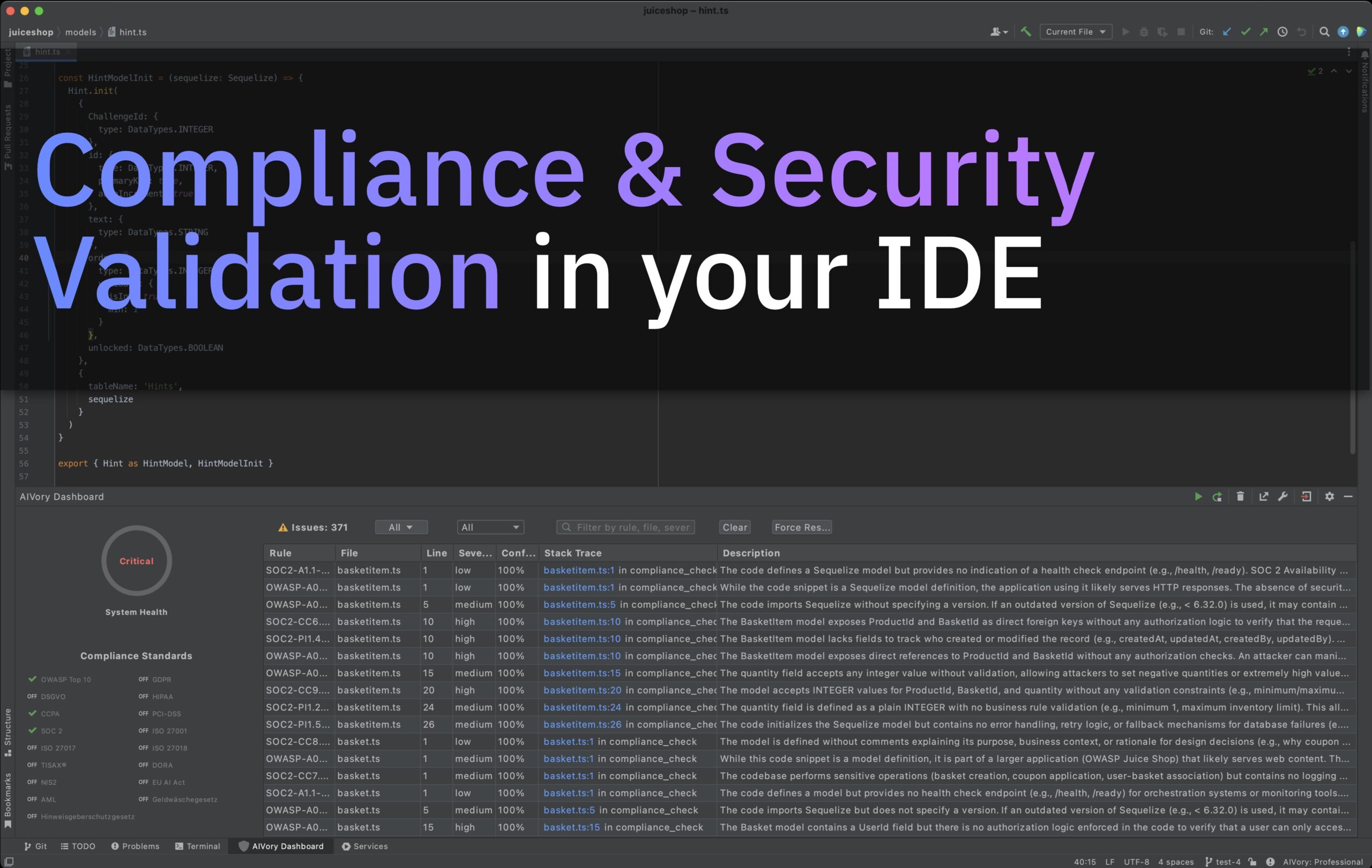
Launched in December 2025 and available as a JetBrains IDE plugin with support for multiple AI coding assistants, AIVory Guard acts as a real-time compliance officer for your AI-generated code. It ensures you don’t have to sacrifice security for speed by scanning for OWASP, GDPR, SOC2, HIPAA, PCI-DSS, and other critical violations directly in your development environment. The tool detects violations as you write code, achieving 30-50x reduction in remediation costs compared to post-production fixes through early intervention during development.
Key Features
AIVory Guard packs a powerful suite of features designed specifically for modern, AI-assisted workflows:
- Real-Time IDE Scanning with Immediate Feedback: Get instantaneous feedback and flag compliance issues directly within your Integrated Development Environment (IDE) as you or AI assistants write code. The system highlights violations inline with visual indicators, messages, and suggested fixes appearing in real-time without interrupting your workflow. Sub-second scanning enables continuous checking while typing.
- Comprehensive Compliance Standards Coverage: Scan your code against a robust library of 18+ compliance standards and security frameworks. The free version covers OWASP Top 10 including injection flaws, broken authentication, sensitive data exposure, XML external entities, broken access control, security misconfiguration, cross-site scripting (XSS), insecure deserialization, using components with known vulnerabilities, and insufficient logging and monitoring. Paid tiers unlock enterprise standards including GDPR (Article 32 requirements), SOC2 trust principles, HIPAA technical safeguards, PCI-DSS requirement 6, and industry-specific frameworks.
- AI-Generated Code Pattern Detection: This tool is uniquely engineered to identify patterns and potential vulnerabilities common specifically in AI-generated code—a critical capability that general-purpose scanners lack. The system recognizes distinctive characteristics of LLM output including common hallucinations, typical error patterns, and security anti-patterns that appear in machine-generated code with higher frequency than human-written code. Proprietary fingerprinting technology identifies violations specific to AI generation.
- MCP Agent Integration for Broader Coverage: For teams needing comprehensive coverage beyond IDE boundaries, AIVory Guard can be deployed via an MCP (Model Context Protocol) agent, enabling real-time scanning within your CI/CD pipelines, pre-commit hooks, and directly within AI coding assistant systems. Integration with Claude Code, GitHub Copilot CLI, Windsurf Cascade, and other MCP-compatible AI tools enables compliance checking before code generation completes.
- Multi-Language Support \& Broad IDE Compatibility: Support across 20+ programming languages (JavaScript, Python, Java, Go, Ruby, TypeScript, C#, C++, and more) with native plugins for JetBrains IDEs (IntelliJ IDEA, PyCharm, WebStorm, GoLand, RubyMine), VS Code, Cursor, and CLI tools for CI/CD integration. Setup typically requires under 30 seconds with automatic configuration detection.
- One-Click Contextual Remediation Suggestions: Each violation displays inline fix suggestions tailored to the specific context—for example, environment variable substitution for hardcoded secrets, data masking patterns for PII exposure, or secure API usage corrections. Developers apply one-click solutions directly within their IDE, eliminating context-switching to documentation or external security guides.
- Compliance Dashboard \& Audit Trail: Cloud-based dashboards (optional) provide team-level compliance visibility, historical violation tracking, trend analysis, and audit-ready reports for certification processes. Detailed audit trails show who wrote the code, what violations were detected, when they were fixed, and evidence of remediation for compliance documentation.
- Flexible Pricing \& Free Tier with Full OWASP Coverage: The free plan provides unlimited OWASP Top 10 scanning across all supported IDEs, making foundational security scanning accessible to individual developers and small teams. Paid Premium plans unlock the full 18+ compliance frameworks, priority support, team dashboards, and advanced features. Early pricing during launch phase with standard tiers TBD post-launch.
How It Works
Integrating AIVory Guard into your process is remarkably straightforward. It’s designed to work seamlessly in the background without disrupting your workflow:
Stage 1: Install \& Configure
The tool integrates directly into your development environment as an IDE plugin (JetBrains, VS Code, Cursor) or through the MCP agent for AI assistants. Installation requires under 30 seconds with automatic configuration detection for most environments. No complex setup, build steps, or external dependencies needed.
Stage 2: Code Generation \& Real-Time Scanning
As you or your AI assistant (like GitHub Copilot or Claude Code) generates code, AIVory Guard instantly scans it in real-time. The system immediately detects and highlights violations with visual indicators, inline messages, and suggested fixes appearing directly in your editor as you type or immediately after code generation.
Stage 3: Cross-Reference Against Compliance Standards
The tool cross-references your code against its database of 18+ compliance standards and security frameworks, flagging potential violations and “invisible liabilities” in real-time. This proactive approach ensures that compliance issues are caught and fixed at the earliest possible stage—long before deployment, code review, or security audits when remediation costs explode.
Stage 4: Apply One-Click Fixes
Review suggested fixes and apply contextually appropriate solutions with a single click. Remediation suggestions account for the specific violation, code context, and selected programming language, eliminating generic advice that requires manual translation.
Stage 5: Compliance Verification \& Deployment
Optional cloud dashboard provides team-level compliance verification, audit trails, and reports demonstrating compliance adherence for certifications or regulatory audits. Deploy with confidence that code has passed automated compliance validation before merge or deployment.
Use Cases
This tool is invaluable for any developer or organization leveraging AI for code generation:
Validating AI Assistant Output:
- Instantly verify that code snippets and functions generated by GitHub Copilot, Claude Code, or ChatGPT are secure and adhere to company compliance policies
- Catch hallucinations and insecure patterns before they enter the codebase
- Maintain security standards even when using fast AI-assisted development
Enterprise Software Development:
- Empower development teams to use AI assistants while maintaining strict adherence to enterprise-level compliance standards like SOC2, HIPAA, and PCI-DSS
- Reduce security review bottlenecks by catching issues during development rather than post-deployment
- Maintain compliance during rapid feature development without slowing innovation
Automated Security Audits \& Compliance:
- Integrate the MCP agent into your CI/CD pipeline to automate compliance checks as part of your build and deployment process
- Generate audit reports demonstrating compliance adherence for security certifications and regulatory requirements
- Prevent non-compliant code from reaching production through automated gates
GDPR \& Privacy Compliance:
- Proactively identify code that might mishandle personally identifiable information (PII), preventing costly data breaches and regulatory fines
- Flag hardcoded personal data, insecure logging of sensitive information, and compliance violations specific to data protection regulations
- Maintain continuous compliance during development without manual review bottlenecks
Healthcare \& Financial Sector Governance:
- Ensure HIPAA technical safeguards are maintained in healthcare software development
- Validate PCI-DSS requirement compliance in payment processing code generated with AI assistance
- Maintain audit trails documenting compliance throughout development
Pros \& Cons
Like any tool, AIVory Guard has its unique strengths and some considerations to keep in mind:
Advantages
- Bridges a Critical Gap: It masterfully connects the world of “fast AI code” with the non-negotiable requirements of “safe enterprise code,” addressing a gap that general-purpose SAST tools miss entirely. AI-generated code patterns differ fundamentally from human-written code, requiring specialized detection.
- Free Tier Availability with Full OWASP Coverage: The free plan provides complete OWASP Top 10 scanning (covering the most critical security vulnerabilities) with unlimited scans, making it incredibly easy for individual developers and small teams to get started with foundational security scanning at zero cost.
- Purpose-Built for AI-Assisted Development: Its specific focus on AI-generated code patterns, integration with AI coding assistants via MCP, and compliance frameworks critical to enterprises gives it a meaningful edge over generic static analysis tools designed for human-written code decades ago.
- Real-Time Feedback During Development: Scanning occurs as code is written rather than post-commit, enabling sub-100ms remediation cost interventions instead of post-production fixes requiring 30-50x more effort and cost to remediate.
- 30-50x Reduction in Remediation Costs: Early intervention during development reduces remediation costs compared to fixing violations discovered during security reviews, compliance audits, or production incidents.
- Seamless AI Tool Integration: Direct integration with GitHub Copilot CLI, Claude Code, Cursor, and other MCP-compatible systems enables compliance checking before code generation completes—a unique capability unavailable in traditional CI/CD scanning.
Disadvantages
- Paid Unlock for Full Enterprise Compliance: Access to the most critical enterprise standards like SOC2, GDPR, HIPAA, and PCI-DSS requires upgrading to a paid version, limiting enterprise adoption for cash-constrained organizations initially.
- Adds a Step to the Workflow: While designed to be seamless, it is an additional tool that teams must adopt, integrate, and configure, requiring organizational change management and developer training despite the simplified setup process.
- Specialized Focus Limits Scope: The platform’s specialization in AI-generated code compliance means it doesn’t address code quality issues, performance analysis, architectural concerns, or general software quality metrics that teams may need from comprehensive platforms.
- Early-Stage Product: Launched in December 2025, the platform is relatively new with unknown production SLA guarantees, potential feature evolution, and less battle-tested across diverse enterprise environments compared to 15+ year-old competitors.
- Limited to Code-Level Analysis: The tool cannot detect runtime vulnerabilities, configuration issues in deployed systems, or infrastructure security problems—requiring integration with broader AppSec platforms for comprehensive security coverage.
How Does It Compare?
AIVory Guard vs. Snyk
Snyk is a mature developer-focused security platform specializing in open-source dependency scanning (SCA) and container security with broad SAST capabilities.
Core Focus:
- AIVory Guard: Compliance scanning specifically optimized for AI-generated code patterns with real-time IDE integration
- Snyk: Comprehensive application security including SAST, SCA (open-source), container scanning, IaC security, and license compliance
AI-Generated Code Specialization:
- AIVory Guard: Purpose-built detection of AI code patterns; specialized fingerprinting for LLM-generated vulnerability patterns
- Snyk: General-purpose SAST; no specific optimization for AI-generated code characteristics
Compliance Framework Coverage:
- AIVory Guard: 18+ standards with deep coverage of OWASP, GDPR, HIPAA, PCI-DSS, SOC2, and regulatory frameworks
- Snyk: Security focus with some compliance context; lighter on specific regulatory framework rules
Real-Time Feedback:
- AIVory Guard: Sub-second IDE integration with continuous scanning as code is written
- Snyk: Primary scanning in CI/CD; IDE plugin available but less optimized for write-time feedback
Pricing Model:
- AIVory Guard: Free OWASP; Premium for enterprise standards; TBD standard pricing post-launch
- Snyk: Freemium with free tier limited to open-source scanning; paid tiers from \$50/month+ depending on usage
When to Choose AIVory Guard: For teams using AI coding assistants needing real-time compliance validation and specific regulatory framework coverage during development.
When to Choose Snyk: For comprehensive application security including open-source dependency scanning, container security, and infrastructure-as-code scanning requiring broader coverage.
AIVory Guard vs. SonarQube
SonarQube is an industry-standard code quality and security platform emphasizing comprehensive SAST, code smells detection, and technical debt analysis.
Primary Focus:
- AIVory Guard: Compliance scanning with AI-generated code specialization
- SonarQube: Code quality assurance and SAST security with broader code health metrics
Code Quality vs. Compliance:
- AIVory Guard: Regulatory compliance and security patterns specific to AI code
- SonarQube: Code smells, duplications, maintainability, technical debt, plus SAST security
Compliance Frameworks:
- AIVory Guard: Deep coverage of GDPR, HIPAA, PCI-DSS, SOC2, and regulatory standards
- SonarQube: Security focus with limited specific compliance framework rules
AI-Generated Code Detection:
- AIVory Guard: Specialized detection of AI-generated code patterns and LLM hallucinations
- SonarQube: Generic analysis; no specialization for AI-generated code characteristics
Language Support:
- AIVory Guard: 20+ languages with focus on popular development languages
- SonarQube: 30+ languages; more comprehensive language ecosystem
Integration Model:
- AIVory Guard: Real-time IDE integration with MCP support for AI assistants
- SonarQube: CI/CD-first with IDE plugins secondary to server-based architecture
When to Choose AIVory Guard: For compliance-focused teams using AI coding assistants requiring real-time regulatory validation during development.
When to Choose SonarQube: For comprehensive code quality, technical debt management, and when code maintainability and design issues matter as much as security compliance.
AIVory Guard vs. Checkmarx / Fortify
Checkmarx and Fortify are enterprise-grade SAST solutions with comprehensive vulnerability detection and deep code analysis.
Enterprise Grade Features:
- AIVory Guard: Compliance-first with simpler enterprise adoption path
- Checkmarx/Fortify: Mature enterprise platforms with extensive customization
Depth of Analysis:
- AIVory Guard: Optimized for real-time feedback; complimentary to deeper analysis
- Checkmarx/Fortify: Deep symbolic execution and data-flow analysis finding obscure vulnerabilities
Compliance Frameworks:
- AIVory Guard: Regulatory compliance specialization with GDPR, HIPAA, PCI-DSS deep coverage
- Checkmarx/Fortify: Security focus with compliance context but not regulatory framework specialization
Setup \& Overhead:
- AIVory Guard: Under 30 seconds setup; lightweight integration
- Checkmarx/Fortify: Complex enterprise deployment requiring specialized security teams; weeks to full integration
Real-Time Development Feedback:
- AIVory Guard: Continuous write-time scanning in IDE
- Checkmarx/Fortify: Primarily batch scanning in CI/CD pipelines; not optimized for real-time feedback
When to Choose AIVory Guard: For rapid adoption, AI-assisted development workflows, and real-time compliance validation with minimal setup friction.
When to Choose Checkmarx/Fortify: For comprehensive vulnerability detection requiring deep code analysis, extensive enterprise customization, and when finding every possible vulnerability matters.
AIVory Guard vs. Semgrep
Semgrep is a lightweight, rule-based static analysis tool emphasizing ease of customization and fast scanning across multiple languages.
Rule Customization:
- AIVory Guard: Pre-built compliance framework rules; limited custom rule creation (enterprise only)
- Semgrep: Highly customizable open-source rules with community contribution model
Ease of Use:
- AIVory Guard: Minimal setup; IDE integration and usage out-of-the-box
- Semgrep: Simple setup but requires rule understanding for full configuration
Scanning Speed:
- AIVory Guard: Sub-second real-time IDE scanning
- Semgrep: Fast scanning (seconds to minutes depending on codebase size)
AI-Generated Code Focus:
- AIVory Guard: Purpose-built specialization for AI code patterns
- Semgrep: General-purpose; no AI-specific optimizations
Compliance Framework Coverage:
- AIVory Guard: Deep coverage of regulatory compliance standards (GDPR, HIPAA, PCI-DSS)
- Semgrep: Security focus with limited specific compliance framework rules
Cost Model:
- AIVory Guard: Free OWASP; paid for enterprise standards
- Semgrep: Free open-source; managed hosting and support tiers available
When to Choose AIVory Guard: For regulatory compliance validation, AI-generated code scanning, and real-time IDE feedback without complex configuration.
When to Choose Semgrep: For highly customizable rules, fast lightweight scanning, and when community-driven open-source approach is preferred.
AIVory Guard vs. CodeQL
CodeQL is GitHub’s advanced code analysis engine using structured queries for deep semantic analysis of code.
Analysis Depth:
- AIVory Guard: Compliance pattern matching; real-time feedback optimized
- CodeQL: Deep semantic analysis using database queries; thorough but slower
Learning Curve:
- AIVory Guard: Intuitive; no learning required for developers
- CodeQL: Steep learning curve; requires understanding CodeQL query language for customization
Performance:
- AIVory Guard: Sub-second real-time scanning during development
- CodeQL: Database creation and query execution takes minutes for large codebases
Compliance Focus:
- AIVory Guard: Regulatory compliance frameworks (GDPR, HIPAA, PCI-DSS) integrated
- CodeQL: Generic security patterns; compliance framework coverage varies
AI-Generated Code:
- AIVory Guard: Specialized detection of AI-generated code patterns
- CodeQL: No specialization; treats all code identically
Integration:
- AIVory Guard: Direct IDE plugin and MCP agent for AI assistants
- CodeQL: Primarily GitHub/CI integration; IDE support secondary
When to Choose AIVory Guard: For real-time compliance validation, AI code specialization, and minimal operational overhead.
When to Choose CodeQL: When deep semantic analysis is required, you need advanced custom queries, and are comfortable managing CodeQL databases and query language.
AIVory Guard vs. Traditional SAST Tools (Legacy)
Legacy SAST tools like traditional static analyzers emphasize comprehensive vulnerability detection through complex code analysis.
Real-Time Feedback:
- AIVory Guard: Sub-second write-time scanning with immediate developer feedback
- Legacy Tools: Batch scanning in CI/CD; feedback delayed to commit/push stage
AI Code Specialization:
- AIVory Guard: Purpose-built for AI-generated code patterns and LLM hallucinations
- Legacy Tools: No specialization; designed for human-written code analysis
Compliance Frameworks:
- AIVory Guard: Regulatory framework specialization (GDPR, HIPAA, PCI-DSS)
- Legacy Tools: Generic security; limited compliance framework coverage
Developer Experience:
- AIVory Guard: Minimal friction; IDE integration with one-click fixes
- Legacy Tools: Complex setup, false positive tuning, and remediation workflows
Cost Structure:
- AIVory Guard: Free OWASP tier; paid tiers for enterprise compliance
- Legacy Tools: Expensive enterprise licensing models
When to Choose AIVory Guard: For modern AI-assisted development, compliance requirements, and when developer experience and speed matter.
When to Choose Legacy Tools: For comprehensive vulnerability detection on large enterprise codebases where depth of analysis and historical acceptance are priorities.
Final Thoughts
In an era where AI is becoming a standard part of the development toolkit, AIVory Guard addresses a crucial and growing need that existing tools overlook. It elegantly solves the tension between moving fast with AI assistants and staying compliant with regulatory requirements by providing real-time, intelligent scanning that understands the nuances of AI-generated code.
The December 2025 launch positions AIVory Guard uniquely in the code security landscape: not as a replacement for comprehensive SAST tools like Snyk or SonarQube, but as a specialized solution addressing the gap between “speed with AI” and “compliance with confidence.” The 30-50x reduction in remediation costs by catching violations during development rather than post-production demonstrates genuine value proposition aligned with regulatory compliance trends.
By providing real-time, AI-specialized scanning through IDE integration, MCP agent support, and 18+ compliance framework coverage, it empowers developers and organizations to innovate confidently using AI tools without sacrificing security or regulatory adherence. The free OWASP tier removes barriers to adoption, while premium compliance standards unlock enterprise-scale deployments.
If your team is using AI to write code and operates in regulated industries (fintech, healthcare, SaaS with compliance requirements), AIVory Guard isn’t just a helpful tool—it’s an essential safeguard for stopping problems before they start. You no longer have to choose between speed and compliance; now, you can finally have both.
The tool particularly excels for:
- Development teams using GitHub Copilot, Claude Code, or other AI assistants in regulated industries
- Organizations needing GDPR, HIPAA, PCI-DSS, or SOC2 compliance during development
- Security-conscious startups wanting compliance validation without enterprise complexity
- Enterprises accelerating feature velocity with AI while maintaining governance standards
- Teams reducing security review bottlenecks through automated compliance validation
For teams requiring comprehensive code quality analysis, extensive open-source dependency scanning, or deep vulnerability detection across all code types, established platforms like Snyk or SonarQube remain valuable components of a broader AppSec strategy. But for the specific intersection of “AI-assisted development” and “regulatory compliance,” AIVory Guard represents a genuinely novel solution addressing a gap that legacy tools cannot fill.