
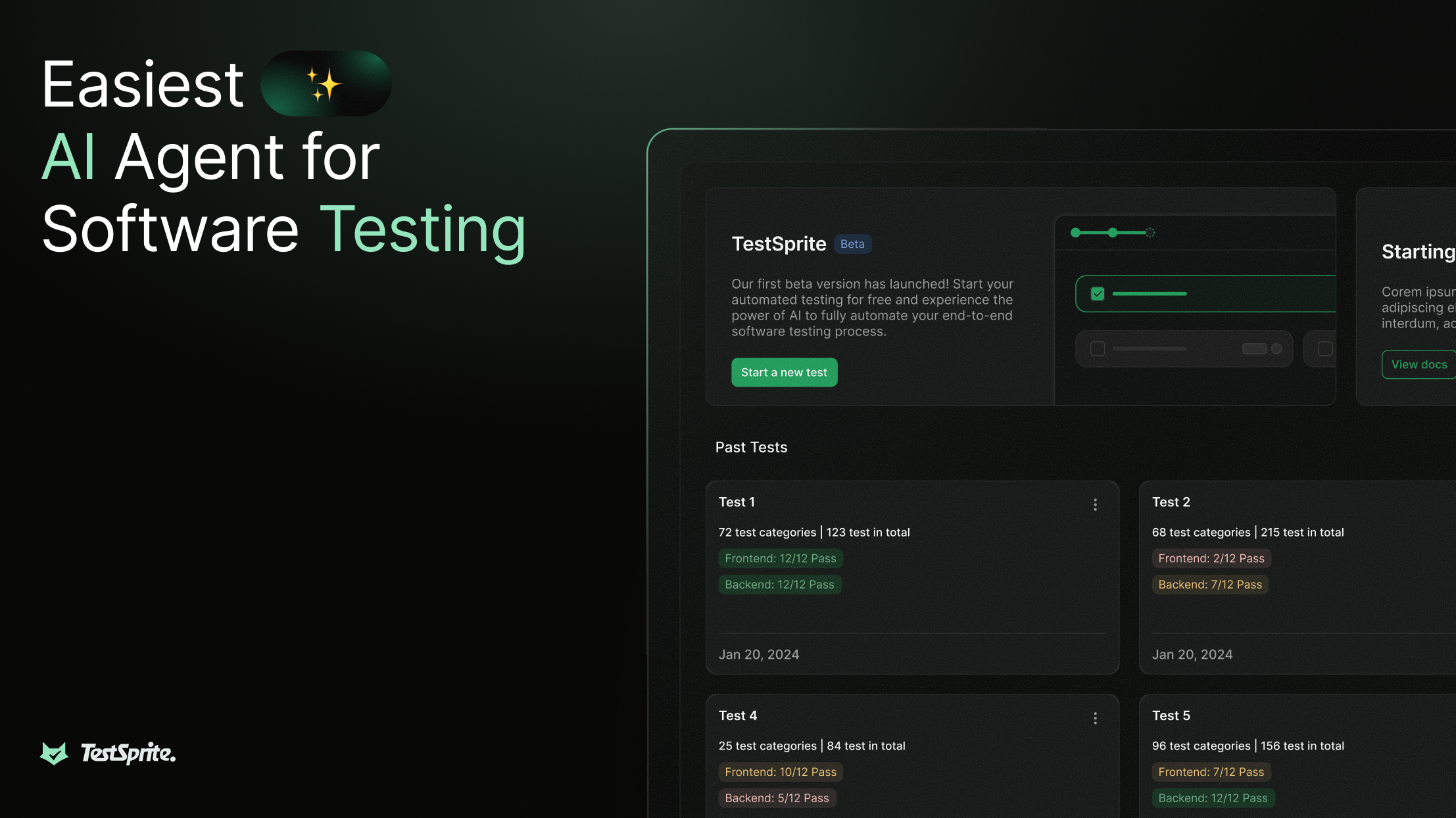

You changed the code — did anything break? TestSprite is an agentic testing tool that writes end-to-end tests, runs them on your app after every change, and tells you exactly what broke. Works from the CLI, your IDE via MCP, CI, or the browser. Open-source CLI, free tier included.
www.testsprite.com
Table of Contents
TestSprite: Comprehensive Research Report
Description Rewrite
TestSprite is an AI-powered autonomous software testing platform that automates the entire testing process for both frontend and backend systems. The platform examines test objects and natural-language documentation to construct and execute comprehensive test plans, including scenario creation, test case generation, coding, execution, analysis, and reporting. Designed for resource-limited teams needing confidence in their software, TestSprite helps developers save time and deliver high-quality products faster.Deep Service Report
TestSprite positions itself as the “first AI Testing Engineer” that fully automates the software testing workflow from end to end. The platform leverages artificial intelligence to handle tasks that traditionally require specialized test engineers, addressing the growing challenge of testing increasingly complex software with limited resources. The system operates by analyzing the test object (such as an API or UI) along with any available documentation. It then autonomously creates test plans, generates appropriate test cases, writes testing code, executes the tests, analyzes results, and produces comprehensive reports. This end-to-end automation eliminates the manual steps typically involved in testing. Currently, TestSprite offers two main testing capabilities:- Backend API Testing: Comprehensive testing for REST APIs, including authentication handling, boundary testing, error handling, and functionality verification
- Frontend UI Testing: Automated testing of user interfaces, ensuring visual elements, user flows, and interactions work correctly
Country
TestSprite is based in Seattle, Washington, United States.Pros \& Cons
Pros:
- Fully automated end-to-end testing process
- Supports both backend API and frontend UI testing
- High scalability for complex test scenarios
- Cost-effective compared to manual testing methods
- User-friendly interface with simple onboarding
- Minimal maintenance requirements
- Comprehensive test case generation including edge cases
- Effective at detecting hard-to-find issues
- Reduces time to market for software products
Cons:
- Some advertised features (AI Agents/Model Testing) still marked as “coming soon”
- Limited user interface customization options
- As a relatively new platform (founded 2023), lacks the established track record of more mature testing tools
Pricing
Specific pricing information isn’t publicly available in the reviewed sources. The TestSprite website features a “Start Free Trial Now” button, indicating a free trial option exists. Additionally, LinkedIn posts mention that “early registrants will gain exclusive access to our limited free community version,” suggesting a freemium model with paid tiers for more advanced features or higher usage volumes.Competitor Comparison
| Feature | TestSprite | Other AI Testing Tools | Manual Testing |
|---|---|---|---|
| Automation Level | Fully Automated | Semi-Automated | Manual |
| Test Case Generation | Auto-Detects \& Generates All | Human-Assisted \& Partial | Manual Creation |
| Speed \& Efficiency | High | Moderate | Low |
| Scalability | Highly Scalable | Limited | Low |
| Cost | Cost-Effective | Variable | High |
| Ease of Use | User-Friendly | Moderate | Complex |
| Maintenance | Minimal | Moderate | High |
Team Members
- Yunhao Jiao – Founder \& CEO
- Shawnie Shan – Founding Member
- Rui Li – Co-founder and CTO
- Malcolm Yang – Developer of ML \& Smart Contract
- Mia Wang – UX Designer
- Ken Oestreich – Product-Market Fit for B2B Products
Team Members About
- Yunhao Jiao: Yale University graduate with a Master’s degree in Computer Science and former Senior Software Development Engineer at Amazon with five years of experience. He has been involved in NLP research since 2015 and was lead author of a paper presented at WWW2018. Prior to founding TestSprite, he worked at Amazon Business and Amazon Web Services (AWS). He also contributed to a Chinese High School AI textbook and has prior entrepreneurial experience.
- Shawnie Shan: Yale University graduate with a Master of Public Health in Biostatistics. Her previous experience includes roles at Alibaba Group as a Business Operator, EXL as a Healthcare Analyst/Assistant Manager, and Yale University School of Medicine as a Machine Learning Data Scientist. She also worked as a Data Scientist at Rutgers School of Arts and Sciences and holds SAS certifications.
- Rui Li: Co-founder and CTO of TestSprite. Detailed background information not available in the reviewed sources.
- Malcolm Yang: Developer specializing in Machine Learning and Smart Contracts. Appears in testimonials as a co-founder of a company using TestSprite.
- Mia Wang: UX Designer for TestSprite. Detailed background information not available in the reviewed sources.
- Ken Oestreich: Product-Market Fit specialist for B2B Products. Detailed background information not available in the reviewed sources.
Team Members SNS Links
Company Website: https://www.testsprite.com/ Yunhao Jiao: LinkedIn – https://www.linkedin.com/in/yunhaojiao Shawnie Shan: LinkedIn – https://www.linkedin.com/in/xiangyishan Company LinkedIn: https://www.linkedin.com/company/testspriteFinal Thoughts
TestSprite presents a compelling solution for small and growing development teams looking to streamline their testing processes. While it may require some initial investment in terms of learning and configuration, the potential time savings and improved code quality make it a worthwhile consideration. As the tool continues to mature, its robustness and accuracy are likely to improve, further solidifying its position as a valuable asset in the software development lifecycle.
You changed the code — did anything break? TestSprite is an agentic testing tool that writes end-to-end tests, runs them on your app after every change, and tells you exactly what broke. Works from the CLI, your IDE via MCP, CI, or the browser. Open-source CLI, free tier included.
www.testsprite.com