
Table of Contents
New Nörm
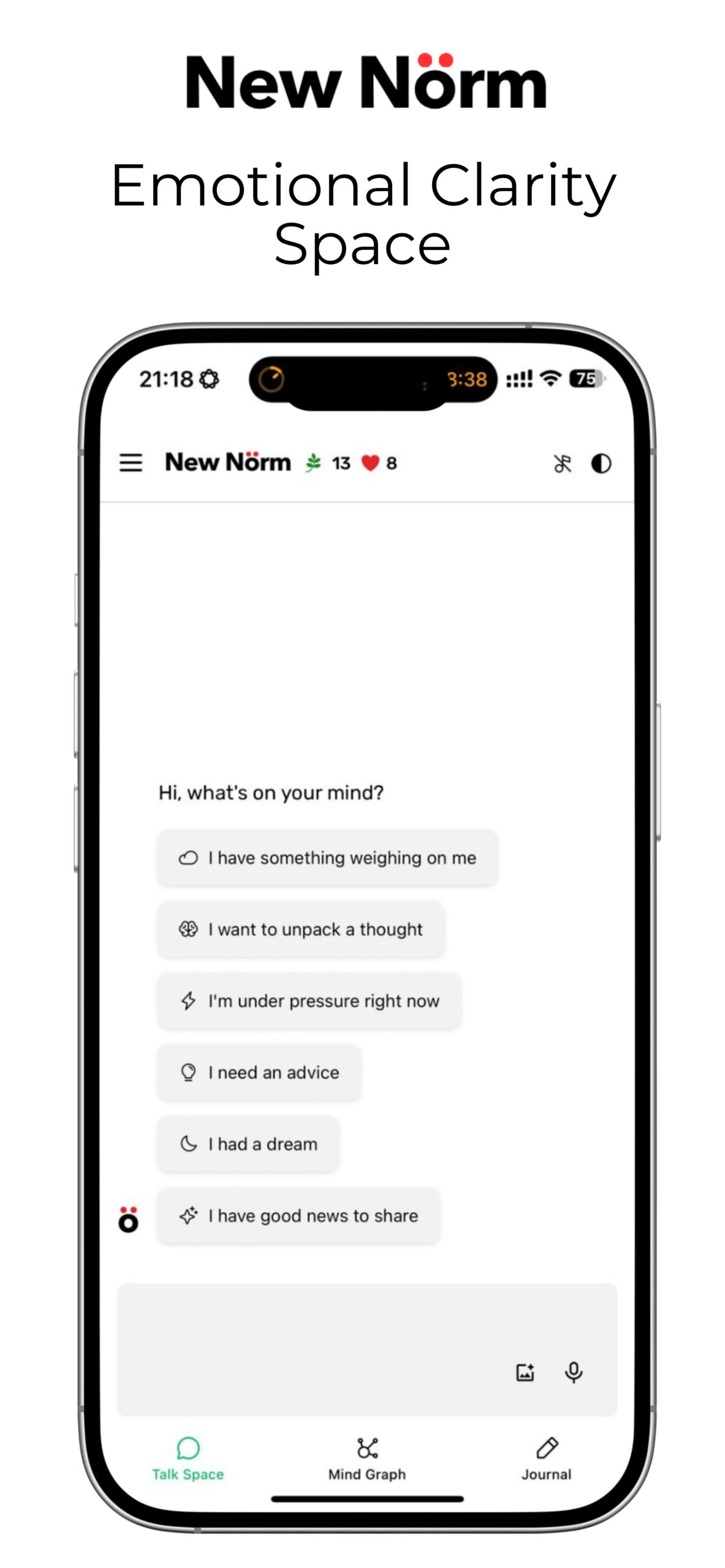
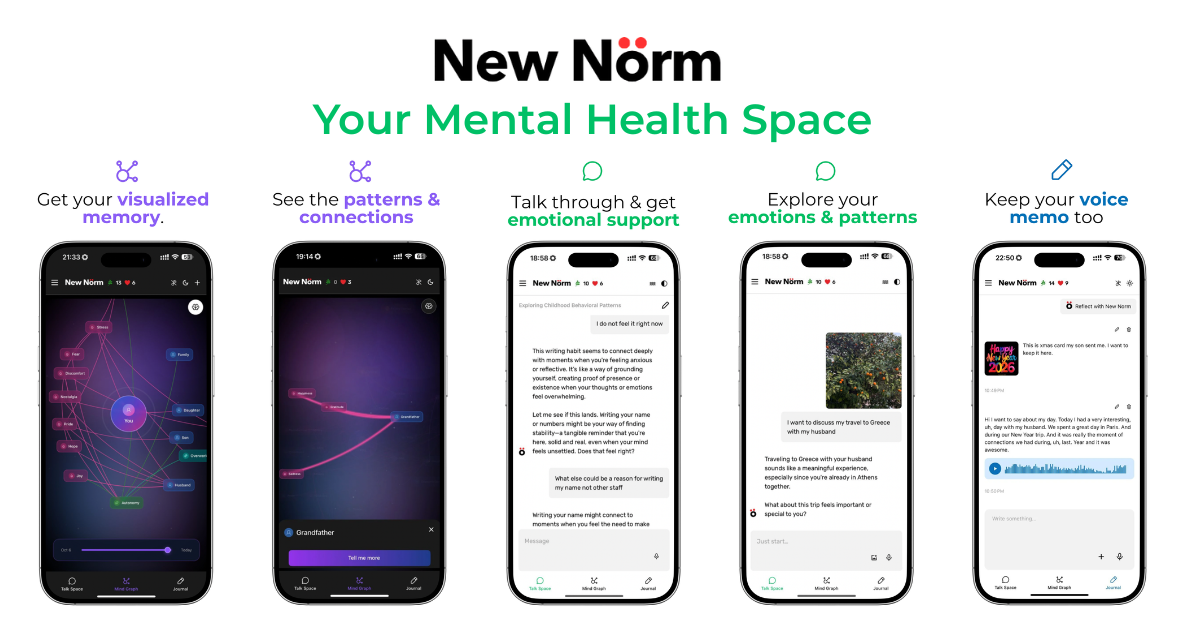
New Nörm is a “personal mind cloud” that transforms fragmented thoughts into a connected visual memory system. Unlike linear journaling apps, it creates a dynamic “Mind Graph” where every conversation, voice note, and handwritten entry is linked, helping users visualize patterns in their thinking and emotional state over time.
What It Does
New Nörm acts as a structured thinking space that combines the freedom of a blank page with the guidance of an AI therapist. Whether you speak, type, or upload photos of handwritten notes, the AI analyzes the content to build a continuous visual map of your mind.
Instead of entries disappearing into a chronological feed, they become nodes in an evolving network. The AI remembers context from weeks or months ago, proactively connecting new stresses to old patterns (e.g., “This anxiety about work resembles what you felt before your last project launch”). This turns self-reflection from a passive logging activity into an active discovery process.
Core Features
Continuous Mind Graph: Visualizes thoughts as interconnected nodes rather than a list. Click on a topic to see every related thought, emotion, or event from your past entries.
Multimodal Input: Accepts voice conversations, text, and images. Uniquely, it can analyze uploaded handwriting, digitizing and connecting your offline scribbles to your digital mind map.
Active AI Guidance: The AI doesn’t just listen; it asks structured, therapeutic follow-up questions to help you drill down into the “why” behind your emotions.
Pattern Recognition: Proactively identifies recurring themes, triggers, and behavioral loops across your history, alerting you to connections you might have missed.
Privacy-First Design: Positioned as a private space for “emotional clarity,” creating a separation between your social data and your inner world.
How It Works
- Capture: Open the app and start talking about your day, type a quick thought, or snap a picture of your journal.
- Process: The AI analyzes the input, tags emotions, and identifies key entities (people, projects, feelings).
- Map: It places this new entry onto your Mind Graph, drawing lines to related past entries.
- Reflect: The AI responds with a summary and a probing question (e.g., “You mentioned feeling stuck. Is this related to the feedback you received last Tuesday?”).
Ideal Use Cases
Deep Self-Discovery: Users who want to understand why they feel a certain way, not just track that they feel it.
Hybrid Journalers: People who prefer writing by hand but want the searchability and insights of digital tools.
Therapy Homework: Preparing for therapy sessions by reviewing visualized patterns of the week’s emotional highs and lows.
Strengths and Considerations
Strengths: The visual “Mind Graph” offers a completely unique way to navigate memory, superior to standard calendar views. Seamless integration of handwriting bridges the analog-digital divide. The AI’s memory is persistent and context-aware, making it feel like a continuous conversation rather than isolated sessions.
Considerations: The non-linear, visual interface can be overwhelming for users who prefer simple, chronological logs. Detailed analysis may require a subscription as the platform matures. AI interpretation of abstract handwritten notes may occasionally require manual correction.
Pricing
Free Tier: Access to basic journaling, mind mapping, and limited AI interactions.
Premium: Subscription plans (pricing varies by region) unlock unlimited voice conversations, advanced handwriting analysis, and deeper historical pattern recognition.
How Does It Compare?
Rosebud AI: The leader in “journaling as conversation.” Rosebud excels at structured, chat-based guidance and goal setting but uses a more traditional timeline interface compared to New Nörm’s visual map. Best for users seeking a text-based AI coach.
Day One: The gold standard for traditional digital journaling. It focuses on media richness (location, weather, photos) and chronology. While it has introduced AI features, it remains a “log” rather than an “analyst.” Best for memory keeping and archiving life events.
Apple Journal: A lightweight, OS-integrated option for iPhone users. It uses on-device machine learning to suggest moments to write about (like workouts or photos) but lacks deep conversational AI or cross-entry pattern recognition. Best for casual users wanting low-friction entry.
Hume AI (EVI): An “Empathic Voice Interface” that focuses heavily on detecting vocal emotion (tone, pitch, prosody). While New Nörm analyzes the content of what you say, Hume analyzes how you say it. Best for users who want an AI that responds to their emotional tone in real-time.
Reflection.app: Focuses on guided journals and monthly reviews with a clean, minimal interface. It bridges the gap between a paper journal and an app but is less aggressive with AI intervention than New Nörm.
Final Thoughts
New Nörm stands out in the crowded mental wellness market by reimagining the interface of memory. By moving away from the “timeline” and toward the “network,” it better mimics how the human brain actually works—associatively rather than chronologically. For visual thinkers and those who feel their current journaling habit is a “write-only” memory hole, New Nörm provides a way to actually interact with and learn from their past thoughts.