
Table of Contents
Polyglotta
Type: AI Multilingual Agent & Translator
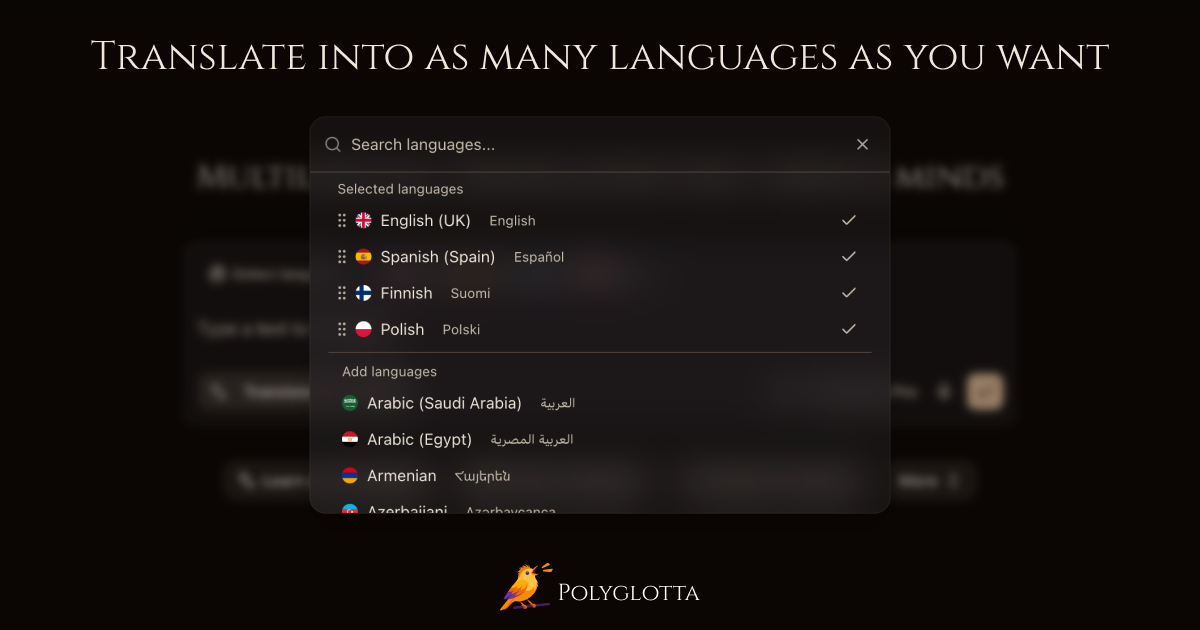
Polyglotta is a specialized AI agent designed for the “multilingual mind”—people who live, work, or learn across multiple languages simultaneously. Unlike standard translators that focus on simple A-to-B conversion, Polyglotta serves as an interactive language partner. It uniquely combines side-by-side translations with an AI conversation agent, allowing users to compare nuances across 70+ languages instantly while practicing fluency through natural dialogue.
Key Features
- Multilingual Context Switching: View translations for a single phrase in multiple languages side-by-side to understand nuanced differences in expression and structure.
- AI Conversation Partner: Practice real-time dialogue with an AI agent that corrects your grammar and suggests better phrasing as you chat.
- Immersion Mode: Designed to help you “think” in your target language by reducing reliance on your native tongue and offering context-aware suggestions.
- Audio Pronunciation: High-quality AI voice output for listening practice, bridging the gap between reading and speaking.
Use Cases
- Polyglot Studies: Comparing how a specific idiom is expressed across French, Spanish, and Italian simultaneously.
- Real-time Practice: engaging in a text or voice conversation without the pressure of a human partner.
- Cross-Cultural Communication: Drafting messages where nuance is critical by seeing multiple translation options at once.
- Vocabulary Expansion: Learning words in context rather than through isolated flashcards.
Pros & Cons
- Pros: Excellent for spotting patterns across related languages; less pressure than human exchange apps; combines translation utility with active learning.
- Cons: May be “overkill” for users who just want a quick, single translation; lacks the gamified “streak” retention mechanics of casual apps like Duolingo.
Pricing
Freemium
Core features are available for free. A “Pro” subscription is available for advanced AI models, unlimited translations, and premium voice features.
How Does It Compare?
Polyglotta sits in a unique middle ground between a utility translator and a learning app. Here is how it compares to the market leaders:
- vs. DeepL / Google Translate: While DeepL is the gold standard for accuracy in a single language pair, it is purely a utility tool. Polyglotta differentiates itself by displaying multiple languages at once (side-by-side) and adding an educational layer with AI corrections, making it better for study.
- vs. Duolingo: Duolingo is a structured, gamified course for beginners. Polyglotta is an unstructured tool for intermediate+ learners who want to use the language naturally without following a rigid skill tree or collecting points.
- vs. HelloTalk / Tandem: These apps rely on finding a human partner, which can be awkward or require scheduling. Polyglotta provides an always-available AI partner, eliminating the anxiety of making mistakes in front of a real person and removing scheduling conflicts.
- vs. ChatGPT (Standard Mode): You can ask ChatGPT to translate or chat, but Polyglotta wraps this capability in a purpose-built UI optimized for language learners (e.g., instant audio, saved vocabulary, and comparison views) that a general-purpose chatbot interface lacks.
Final Thoughts
Polyglotta solves a specific problem for the “serious” language learner who has outgrown gamified apps but isn’t ready for full immersion with native speakers. By treating translation as a learning opportunity rather than just a utility, it offers a valuable workspace for polyglots to refine their skills. It is particularly powerful for those learning multiple languages from the same family (e.g., Romance languages) simultaneously, as the side-by-side view highlights patterns that accelerate acquisition.