
Table of Contents
Hexis Cloud — Investment Assessment
Category: Enterprise agent context, skills, tools, and governance
Stage: Early-stage; Bevel founded in 2024, Hexis Cloud launched October 2026
Founders: Ali Raza (CEO), Razvan Radulescu (CTO/co-founder), Juan Viera Garcia (CPO/co-founder)
HQ: Munich, Germany; operated by Bevelites GmbH
Funding: No public equity round identified; Bevel lists EXIST among supporters, grant details not verified
Business Model: Free hosted tier up to 3 people; Team at €10/person/month; custom Enterprise; free self-hosted Apache-2.0 edition; related AI implementation services
Product Hunt Launch Date: 2026/10/12 (spreadsheet display value)
Report Date: 2026/10/15
| Metric | Assessment |
|---|---|
| Venture Potential | 64 / 100 |
| Unicorn Path | Conditional |
| Valuation Attractiveness | Not assessable |
| Evidence Confidence | 56 / 100 |
| Final Decision | DD |
Executive Summary
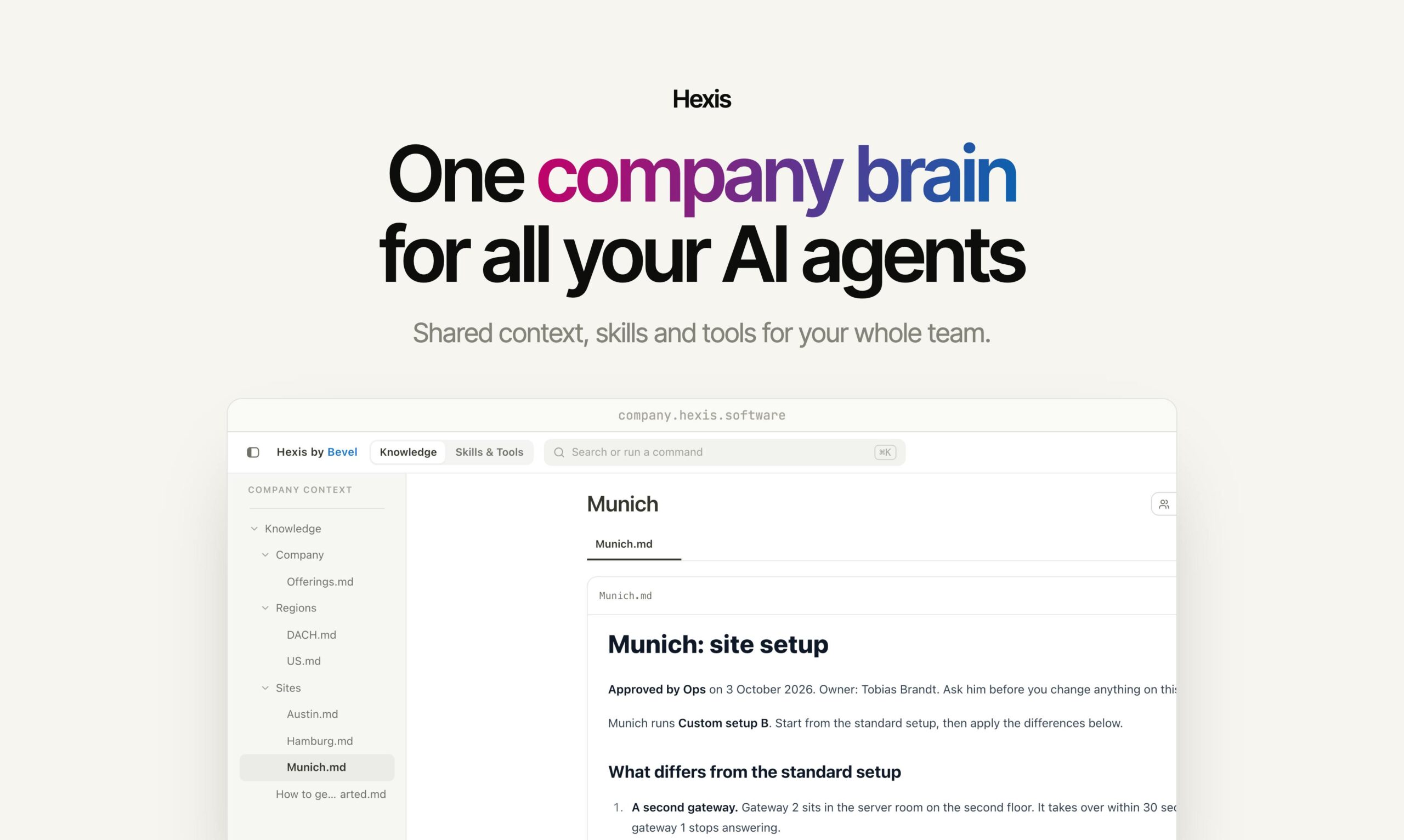
Hexis Cloud is Bevel’s hosted version of Hexis, an open-source product for sharing approved company context, reusable agent skills, and connected tools. It targets organizations where agent instructions, knowledge, and permissions are scattered across personal prompts, Git repositories, and vendor-specific settings. The product offers page ownership and approval, version history, fine-grained access, and one MCP gateway for multiple agent clients.
Its likely buyer is an organization deploying agents across departments and needing nontechnical staff to maintain shared procedures while security teams enforce access. Hosted setup addresses a pain users raised after Hexis’s open-source launch. The current offer is free for up to three people, then €10 per seat monthly, with custom Enterprise terms and a free self-hosted edition. Enterprise contracts will need to monetize managed operations, support, and security beyond this low entry price.
Signals are promising but early: the August Hexis launch reached #3 Product of the Day with 181 points; the October Cloud launch showed #7 with 126 points. GitHub showed 114 stars and 15 forks at review time. Bevel lists enterprise customers and publishes product testimonials, including Hexis feedback from osapiens. However, Bevel also sells AI implementation services, and public sources do not separate Cloud subscriptions from consulting, pilots, or self-hosted use.
The decision is DD, not Invest. The product addresses real governance needs and has a coherent open-source-to-hosted path. Verify paid SaaS traction, retention, software margins, and repeatable implementation before investing. The key question is whether customer-owned Git and vendor permissions work across many clients without turning each sale into a bespoke integration project.
Product Overview
Hexis stores shared context and skills as versioned material, assigns owners and reviewers, and exposes approved content and tools through a gateway. Team members can suggest a skill change in a browser; its owner approves it before agents receive it. The product describes per-file and per-tool access and explicit skill versions that agents can pin. The Cloud offering reduces setup work; the Apache-2.0 open-source edition can be self-hosted. See Hexis Cloud and the Hexis repository.
The free self-hosted core supports adoption and trust, but makes cloud value depend on managed hosting, collaboration, uptime, support, and enterprise controls rather than exclusive software access.
Founder and Team Assessment
Bevel identifies Ali Raza as CEO, Razvan Radulescu as CTO/co-founder, and Juan Viera Garcia as CPO/co-founder. The team built Hexis and the Universal Tool Calling Protocol; Bevel reports its CodeMode library has over 1,500 stars and 45,000 downloads. This shows technical experience, though not commercial traction. The Munich GmbH was established in 2024. Current headcount, ownership, founder commitment, and financing runway are not public.
Market Opportunity
The initial market is mid-market and enterprise organizations standardizing agents across departments, especially where internal knowledge is sensitive and permissions differ. An illustrative, unsourced scenario is 10,000 organizations paying €50,000 annually for an agent governance layer, or €500 million in potential yearly revenue. This assumes real enterprise budgets for a separate layer; the €10 seat price alone requires much greater volume.
The need grows as teams use multiple agents, but large customers may prefer governance included in existing search, collaboration, or cloud platforms. Hexis is strongest where nontechnical owners need to edit skills and IT needs a shared, auditable permission model.
Traction and Growth Signals
Product Hunt lists the October Cloud launch at #7 with 126 points and the August open-source launch at #3 with 181 points. The repository showed 114 stars and 15 forks. In launch discussion, users asked how central skill changes interact with older branches; co-founder Ali Raza said skills have explicit versions that agents can pin. This is a relevant product response, not proof of scaled use.
Bevel lists teams at Unite, Workpath, EGYM, osapiens, BEO, and others and publishes customer testimonials. These are company-reported references, and may reflect Bevel’s broader services work rather than paid Cloud seats. No public ARR, paid-seat count, recurring versus services mix, renewal rate, or gross margin was found. Launch rankings, logos, and repository activity do not establish product-market fit.
Competitive Position
Alternatives include internal Git and Markdown workflows, enterprise knowledge systems, agent builders, and MCP gateways. Glean advertises permission-aware agent governance and MCP access to enterprise context; Dust combines company context, reusable skills, connected tools, permissions, logs, and analytics; Microsoft Copilot Studio offers environment, connector, and agent governance. Those platforms bring existing distribution and may bundle similar controls. See Glean, Dust, and Microsoft Copilot Studio guidance.
Hexis may win through Git-backed context, human approval, file-level access, and portability across agent runtimes. UTCP and open-source development help technical credibility, but the protocol is not a moat. If Microsoft, Glean, or a leading agent platform offers versioned skills and per-file permissions, why retain Hexis as a separate layer? Bevel must prove cross-runtime neutrality, lower integration effort, and retention customers cannot get from bundled tools.
Business Model and Economics
The hosted product is free for up to three users, then €10 per seat per month; Enterprise offers custom terms and support. Self-hosted Hexis is free and Apache-2.0. Bevel also describes forward-deployed AI services. The free funnel may attract developers, but conversion depends on the value of managed operations. Services can bring customer access and revenue, while obscuring software margins and consuming engineering capacity.
Diligence should separate Hexis subscriptions from services, measure OSS/free-to-paid conversion and seat expansion, and calculate hosting, integration, security, and support costs by customer. Enterprise pricing is not public. Test whether repeatable product deployments can replace bespoke implementation effort.
Unicorn Path
At a hypothetical 10x ARR multiple, a €1 billion valuation implies €100 million ARR. At €120 annual revenue per Team seat, that requires about 833,333 paid seat-years; at €50,000 average Enterprise contracts, 2,000 customers. These are scenarios, not forecasts; current revenue and customer count are unknown.
A credible path requires repeatable enterprise deployment, expansion to company-wide use, strong retention, and high software margins. Services may open accounts, but the valuation case depends on converting delivery into reusable product.
Valuation Assessment
No public financing round, valuation, securities terms, or verified recurring revenue was identified. Valuation attractiveness is not assessable. Confirm the cap table, grant support, SaaS/services mix, renewal cohorts, margins, and deployment burden before evaluating terms.
Key Risks
- Services dependence: Customer references may not represent recurring Hexis Cloud use.
- Platform bundling: Glean, Microsoft, and agent vendors can add similar controls.
- Open-source conversion: Customers can self-host the core for free.
- Integration burden: Enterprise Git, identity, MCP, and data systems differ.
- Permission errors: A flaw could expose sensitive company information.
- Version fragmentation: Pinned skills may create inconsistent agent behavior.
- Enterprise readiness: Audits, uptime, and support capacity need verification.
- Services economics: Bespoke work may limit margin and product velocity.
- Unverified traction: Launches and testimonials do not prove paid retention.
- Emerging category: Buyers may consolidate governance into tools they already use.
Final Assessment
| Dimension | Score | Rationale |
|---|---|---|
| Market | 15 / 20 | Important emerging need; budgets and timing uncertain. |
| Traction | 11 / 20 | Launch, OSS use, and references; SaaS metrics unavailable. |
| Team | 12 / 15 | Strong technical signals; capacity and financing unknown. |
| Product | 8 / 10 | Coherent cross-agent context, skills, and access workflow. |
| Distribution | 8 / 15 | OSS and services create entry points; repeatable sales unknown. |
| Business economics | 5 / 10 | Clear seat pricing; services mix and margins unverified. |
| Defensibility | 5 / 10 | Git ownership and access help; platforms can bundle controls. |
| Total Venture Potential | 64 / 100 | Worth formal diligence if software adoption is distinct from services. |
Evidence confidence: 56 / 100. Product, price, legal company, repository, customer testimonials, and team roles have public sources. ARR, paid seats, renewal, margins, financing, and SaaS adoption by customer remain unknown. Final Decision: DD. Upgrade toward Invest if recurring Hexis revenue grows with strong retention, repeatable secure deployments, and attractive software margins. Downgrade to Watch or Pass if value depends mainly on custom services, enterprise sales do not convert, or platforms make the separate layer unnecessary.
Diligence Questions
- What are Hexis Cloud ARR, paid seats, active workspaces, and growth, excluding consulting?
- How many listed organizations use Cloud in production, self-host, or only buy services?
- What are free-to-paid conversion, 90/180-day retention, net revenue retention, and seat expansion?
- What are ACV, sales cycle, implementation hours, renewals, and customer concentration?
- What margins remain after hosting, integrations, security reviews, support, and deployment?
- What access-control testing, audits, certifications, incident response, and uptime history exist?
- How are conflicting skill versions handled across agents, workspaces, repositories, and branches?
- What share of customers adopts Hexis without Bevel engineers?
- What grants or other funding has Bevel received, and what are cap table and runway?
- What protects retention as Glean, Microsoft, and agent vendors add governance features?