
Table of Contents
Remix Investment Report
Category: Developer/design collaboration tooling — AI-assisted product experimentation on production codebases
Company Stage: Pre-seed (bootstrapped or undisclosed; no funding announcement found)
Founder or Founders: Hesham Ghandour (solo founder, per LinkedIn) linkedin
Headquarters: San Francisco Bay Area (founder location; company HQ not formally disclosed) linkedin
Funding: Not publicly disclosed; no round, investor, or grant announcements were found
Business Model: Seat-based SaaS — Free plan, Teams at $29/seat/month, higher tier at $99/seat/month remix
Product Hunt Launch Date: August 10, 2026 launly
Report Date: August 13, 2026
| Investment Metric | Assessment |
|---|---|
| Venture Potential | 45/100 |
| Unicorn Path | Conditional |
| Valuation Attractiveness | Not Assessable |
| Evidence Confidence | 45/100 |
| Final Decision | Watch |
Executive Summary
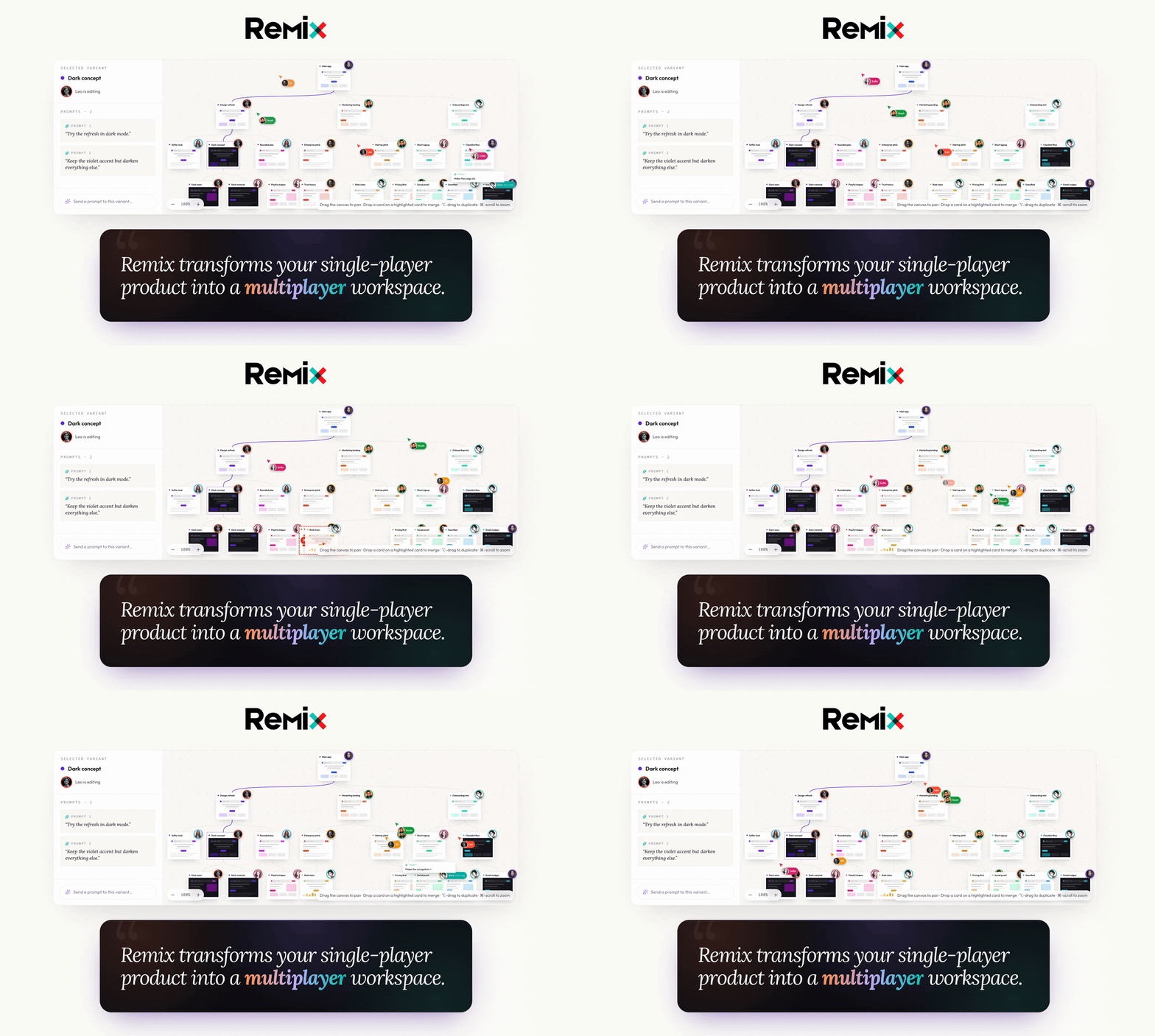
Remix is a desktop tool that lets non-engineers — designers, PMs, marketers, sales reps — spin up a sandboxed, live copy of a company’s actual production app, modify it by prompting AI coding tools, and submit the result to engineering as a reviewable pull request with the full prompt history attached. The pitch is “Figma, but on your production app”: experimentation on the real codebase rather than a throwaway prototype. It launched on Product Hunt on August 10, 2026, drawing roughly 127 votes and 6 comments — a modest, mid-table launch. launly
The company serves software teams where product ideas queue behind engineering backlogs. The strongest positive signal is the founder: Hesham Ghandour is a verified repeat Y Combinator founder — co-founder and CTO of open-banking infrastructure company Dapi (YC W20, backed by YC, VentureSouq, BECO Capital and others) and later co-founder/CTO of Tasker AI — with a credible technical track record. linkedin
The central concern is that Remix is a three-day-old product with no disclosed revenue, users, or funding, entering a space where the natural owners — Vercel (v0), Figma, GitHub — already control adjacent workflow layers and could bundle equivalent functionality. The “prompt history as review artifact” concept is genuinely differentiated, but differentiation is not yet a moat. nimbalyst
Final decision: Watch. The wedge is novel and the founder is real, but there is no commercial evidence yet. Specific upgrade milestones are listed below.
Product Overview
The customer problem: in most software companies, only engineers can touch the product, so ideas from designers, PMs, support, and sales die in backlogs. Remix connects to a repo once; invited teammates then get a live, isolated VM sandbox of the real app in about a minute, edit it through the AI tools they already use (Claude Code, Cursor), share a live link, and send a “Remix request” to engineering. remix
The distinctive mechanic is reviewability: engineers see every prompt, agent response, and file diff — “the story, not just the diff” — plus guardrail checks (security, secrets, dependency, route permissions) before anything merges to GitHub. Variants can be compared side by side and merged by dragging one card onto another. Sandboxes default to project-level backend configuration, with per-remix overrides — a flexibility the founder defended openly in launch comments, though one commenter flagged the lack of role-based enforcement as an enterprise concern. remix
Pricing is seat-based: a free tier (with a $5 one-time cloud credit), Teams at $29/seat/month, and a $99/seat/month tier. The product replaces Figma prototypes, throwaway v0/Lovable mockups, and “can engineering just mock this up” tickets. remix
Founder and Team Assessment
Hesham Ghandour’s identity and history are independently verifiable. He co-founded Dapi (YC W20), a payment-initiation and open-banking API company that raised from Y Combinator, Pioneer Capital, Endure Capital, VentureSouq, Class 5 Global, and BECO Capital, and expanded across MENA and into Mexico; he served as co-founder/CTO until April 2024. He then co-founded Tasker AI (April 2024 – November 2025), an AI task-automation product that appears to have wound down — a failure, but a relevant one in agentic tooling. Earlier ventures include an Egyptian peer-to-peer payments app. linkedin
Remix began in January 2026. No co-founder, employees, hiring activity, or legal entity details are public; the evidence pattern suggests a solo founder or very small team, making key-person risk near-total. Technical capability is well-evidenced; commercial capability is mixed — Dapi scaled with him as CTO, not CEO, and Tasker AI did not survive. linkedin
Founder Assessment: Verified, technically strong repeat-YC founder; unproven as a solo commercial leader, with one prior shutdown.
Market Opportunity
The narrow initial customer is a product or design lead at a software company with 20–2,000 employees, where non-engineers outnumber engineers roughly 5:1 and AI coding tools are already adopted. A bottom-up frame: roughly 50,000–100,000 such companies globally; capturing 20 paid seats per company at a blended ~$35/seat/month (~$8,400/year per company) implies a serviceable market of perhaps $400–800M ARR — meaningful but not obviously venture-scale, and entirely dependent on a new category (“non-engineers contribute production code”) actually forming.
Willingness to pay is unproven: the free tier and $29 entry point suggest a bottoms-up motion, but no customer count or conversion data exists. Adjacent expansion — sales-demo customization, marketing landing variants, experimentation/analytics — could raise seat counts and ACVs. Timing is genuinely favorable: Claude Code and Cursor adoption creates the exact skill base Remix rides on. The realistic market can support a strong SaaS business; venture scale requires category creation, not just capture. remix
Traction and Growth Signals
All available traction is launch attention: approximately 127 votes and 6 comments on launch day, ~144 product followers, and a mid-table daily ranking (around #13). Comment quality is a mild positive — technically literate questions about sandbox data isolation, answered in depth. There is no disclosed revenue, customer count, usage data, GitHub presence, or hiring activity, and no press coverage beyond launch directories. The product is three days old; sustained momentum is unknowable. launly
Most important missing metrics: number of teams connecting repos, weekly active remixes per team, free-to-paid conversion, and engineering approval rates (the workflow’s core health metric).
Traction Assessment: A modest launch with substantive early engagement; commercially unverified.
Competitive Position
Direct competitors are the prompt-to-app builders — v0 (Vercel), Lovable, Bolt.new, Replit Agent — plus design-to-code tools like Figma Make and Builder.io, which Product Hunt itself lists as alternatives alongside Codesphere. Indirect competitors are preview environments (Vercel previews), cloud dev environments (GitHub Codespaces, CodeSandbox), and simply giving non-engineers Cursor access. The manual alternative is the status quo backlog. nimbalyst
Remix’s differentiation is real: it operates on the actual production codebase rather than generating a new app, and it makes prompt history the review artifact — a governance layer none of the prompt-to-app tools offer. However, switching costs are low, there is no proprietary data or network effect yet, and the platform-replication question has no comfortable answer: GitHub (Copilot + Codespaces + PRs) or Vercel (v0 + previews + Git) could assemble this workflow natively within six months, and both own the surrounding rails. Remix’s defense would be speed, neutrality across editors, and the review-story UX — necessary but not sufficient. remix
Defensibility Assessment: Low
Business Model and Economics
The model is conventional seat-based SaaS: free tier, $29 and $99 per seat per month. Estimated annual revenue per seat is roughly $350–$1,200 depending on tier mix; a 20-seat team is worth ~$7K–$10K per year at the Teams tier. remix
Cost structure has one notable variable: each remix is its own cloud VM sandbox, so COGS scales with usage, not seats — the $5 one-time cloud credit on the free plan confirms sandbox compute is a real cost line. AI inference costs are partly externalized because Remix works inside the user’s own Claude Code/Cursor setup, which is economically smart. Gross margin should be SaaS-acceptable if sandbox runtime is short-lived, but this is an assumption requiring verification. Expansion revenue comes from seat growth across product, design, marketing, and sales; enterprise potential exists in the guardrails/permissions layer, though launch comments already surfaced a role-based-access gap. remix
Unicorn Path
Assume an 8x forward-revenue multiple, standard for high-growth B2B SaaS. Required revenue for $1B: $1B ÷ 8 = $125M ARR. At a blended $40/seat/month (~$480/seat/year), that implies roughly 260,000 paying seats — on the order of 10,000–15,000 customer companies at 15–25 seats each. That is category-king territory in a category that does not yet exist.
The path is therefore conditional: it requires (1) the “everyone ships code” workflow to become standard practice, (2) Remix to survive bundling by GitHub/Vercel/Figma, (3) expansion from teams to enterprise with the $99 tier and compliance guardrails carrying ACVs upward, and (4) repeatable bottoms-up distribution beyond launch spikes. If the category forms and Remix leads it, the math works; both are unproven.
Unicorn Path: Conditional
Valuation Assessment
No funding history, investors, round terms, or valuation are publicly disclosed for Remix; the company appears to be approximately seven months old and possibly bootstrapped. No revenue or customer data exists to anchor a multiple. linkedin
Valuation Attractiveness: Not Assessable. Assessment would require current MRR, seat growth, free-to-paid conversion, sandbox COGS and gross margin, engineering approval/merge rates, burn, runway, and any proposed round terms or SAFE cap. No valuation range is offered; pricing a three-day-old launch would be false precision.
Key Risks
- Platform replication: GitHub or Vercel can bundle sandboxed variant workflows natively.
- Unproven willingness to pay: non-engineers may not actually want repo-level responsibility.
- Category risk: the entire thesis depends on a workflow that may remain niche.
- Solo-founder key-person risk; no visible team. linkedin
- Governance gaps: commenters already identified missing role-based sandbox controls — an enterprise blocker. producthunt
- Sandbox compute costs scaling faster than seat revenue if usage is heavy. remix
- Security surface: giving non-engineers live app copies raises data-exposure concerns that could slow adoption.
- Distribution: dev-tool launches are noisy; no evident organic loop beyond shared live links.
- Founder continuity risk given the recent Tasker AI shutdown. linkedin
Final Assessment
Venture Potential: 45/100
| Category | Score |
|---|---|
| Market Size and Expansion Potential | 11/20 |
| Traction and Growth Evidence | 3/20 |
| Founder and Team | 10/15 |
| Product Strength | 7/10 |
| Distribution Potential | 6/15 |
| Business Model and Economics | 5/10 |
| Defensibility | 3/10 |
| Total | 45/100 |
The strongest element is the founder-product pairing — a verified repeat-YC builder attacking a real workflow gap with a genuinely fresh mechanic. The weakest are the absence of any commercial evidence and low structural defensibility against the platforms that own the surrounding rails.
Evidence Confidence: 45/100
Verified: product existence and positioning (official site), pricing tiers (official pricing page), launch date and approximate launch performance, founder identity and prior companies (LinkedIn corroborated by press coverage of Dapi). Company-reported: product capabilities and guardrail behavior. Unavailable: revenue, users, team size, funding, legal entity, retention, and margins. No material source conflicts were found. remix
Final Decision: Watch
Remix is a promising, well-conceived product from a credible founder, but it is three days post-launch with zero disclosed commercial traction and a defensibility question it cannot yet answer. That profile fits Watch: worth tracking, not yet worth diligence. The venture case hinges on whether the prompt-history review workflow becomes a habit inside real engineering orgs.
Upgrade Conditions
- 50+ paying teams within six months, with verified revenue approaching $500K ARR
- Evidence of weekly habitual use (remixes created and merged per team per week)
- Free-to-paid conversion above 5% and seat expansion within accounts
- Role-based permissions and enterprise guardrails shipped, closing the governance gap
- A distribution channel beyond Product Hunt (e.g., Claude Code/Cursor community adoption)
- A disclosed seed round from credible dev-tool investors
Downgrade Conditions
- GitHub, Vercel, or Figma shipping a native equivalent
- Launch traffic decaying with no paying-customer announcements by ~Q1 2027
- Evidence of sandbox security or data-leak incidents
- Founder taking on a parallel project or the product going quiet
Questions for Further Diligence
- How many teams have connected a repository, and how many are paying today?
- What is the weekly rate of remixes created, shared, and approved per active team?
- What percentage of Remix requests do engineers actually merge, and how long does review take?
- What are current MRR, free-to-paid conversion, and seat expansion within accounts?
- What is the per-remix VM cost, and what gross margin results at the $29 tier under realistic usage?
- Who besides the founder works on the company, and is he full-time?
- Is there a registered entity, and has any capital been raised or is a round planned — on what terms?
- How do you answer the sandbox-governance concern raised on Product Hunt (role-based backend targeting, audit visibility)?
- What prevents GitHub or Vercel from shipping this workflow natively, and what is the 12-month differentiation plan?
- What happened at Tasker AI, and what did you change in your approach as a result?
- Which AI coding tools does Remix depend on, and what happens if their pricing or APIs change?
- What does the enterprise tier add beyond seats, and have any design partners committed?
Sources
- Product Hunt — Remix product page producthunt
- Official website — remix.one remix
- Official pricing page — remix.one/pricing remix
- Hesham Ghandour — LinkedIn profile linkedin
- Hesham Ghandour — LinkedIn launch post linkedin
- crunch.id — launch-day domain listing (launch date, website)
- Launly — Remix launch stats (127 votes, 6 comments — secondary source) launly
- FinTech Futures — Dapi (YC W20) press release naming Ghandour as co-founder/CTO and listing investors fintechfutures
- Product Hunt — Remix alternatives (competitor set) producthunt
- Nimbalyst — AI mockup/builder tool landscape (v0, Lovable, Bolt, Figma Make — secondary source) nimbalyst