
Table of Contents
Nina by Antalpha Investment Report
Category: AI-powered crypto intelligence, trading workflow, and wallet-security software
Company Stage: Public growth-stage fintech; Nina is an early-stage product
Founder or Founders: Moore Xin Jin, founder and CEO of Antalpha
Headquarters: Singapore; Cayman Islands holding company
Funding: Nasdaq IPO in May 2025; approximately $49.3 million gross proceeds before any overallotment
Business Model: Nina is currently free; Antalpha primarily earns technology-financing and technology-platform fees from digital-asset lending
Product Hunt Launch Date: September 8, 2026
Report Date: September 10, 2026
| Investment Metric | Assessment |
|---|---|
| Venture Potential | 65/100 |
| Unicorn Path | Conditional |
| Valuation Attractiveness | Fair |
| Evidence Confidence | 76/100 |
| Final Decision | Watch |
Executive Summary
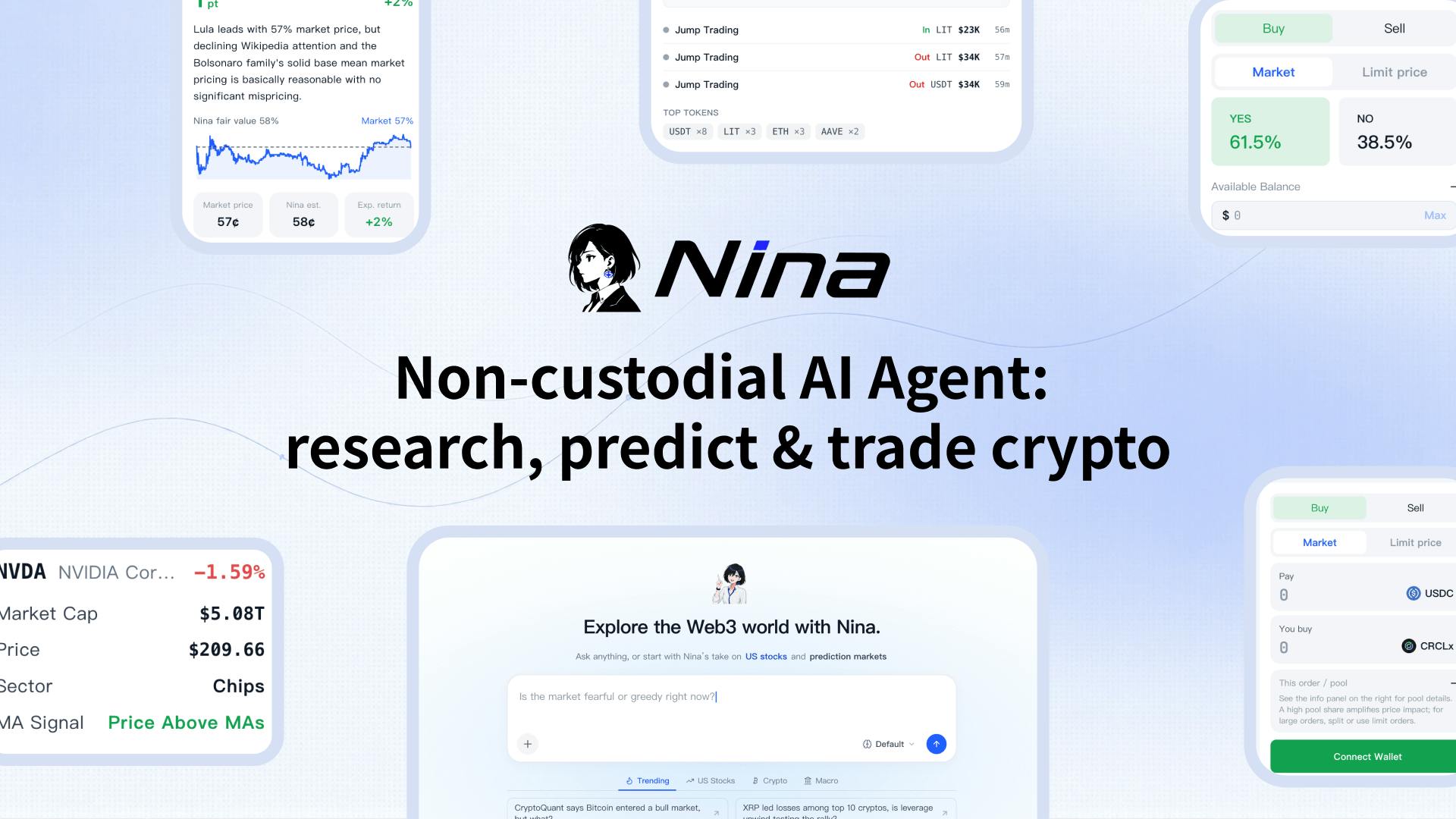
Nina is a conversational Web3 assistant for crypto research, on-chain analysis, transaction preparation, prediction markets, and wallet-risk checks. It aggregates market and blockchain data, presents conclusions with source and freshness indicators, and can draft transactions while leaving final authorization with the user’s own wallet. Antalpha describes this as a non-custodial model: Nina prepares an action, but the user signs it (official website; Product Hunt).
The product is more credible than the typical Product Hunt crypto application because it is backed by a Nasdaq-listed operating company. Antalpha generated $79.7 million of revenue in 2025, up 68%, and $18.5 million of net income attributable to Antalpha. Its core Antalpha Prime business facilitated $2.58 billion of loans at year-end 2025 (FY2025 results). Antalpha therefore has financial, technical, compliance, and industry resources that most early-stage AI products lack.
Nina itself remains commercially unvalidated. Antalpha reported “several thousand” registered users in August 2026 and said more than half completed at least one core interaction. That is useful activation evidence, but it does not establish retention, transaction volume, revenue, or willingness to pay (Q2 2026 results). Google Play showed only 100+ downloads, while the U.S. App Store displayed one rating; these storefront metrics are too small to establish consumer-market momentum (Google Play; App Store).
The strongest investment signal is company quality: Antalpha has an experienced founder, an established institutional crypto-financing platform, audited public disclosures, data-provider relationships, and the capacity to finance Nina’s development. The principal concern is the gap between that company foundation and Nina’s actual economics. Nina is free, its retention is undisclosed, and much of its functionality competes directly with Nansen, DeBank, Dune, exchanges, wallets, and general-purpose AI products.
The decision is Watch. Antalpha warrants monitoring, but Nina has not yet demonstrated that it can become a material, defensible revenue engine. A move to formal due diligence would require evidence of sustained engagement, monetization, reliable transaction execution, and incremental revenue attributable to Nina.
Product Overview
Nina addresses the fragmented workflow faced by active crypto users: checking token prices, on-chain flows, wallet positions, exchange liquidity, contract risk, prediction markets, and news across multiple applications.
Its principal functions include:
- Natural-language crypto and market research;
- Smart-money and on-chain activity analysis;
- CEX and DEX price and route comparison;
- Slippage calculation and transaction drafting;
- Prediction-market analysis;
- Token, wallet, honeypot, approval, phishing, and rug-pull checks;
- A “Sentinel” monitoring and alerting function;
- MCP access for using Nina’s capabilities through other AI clients.
Antalpha says Nina covers more than 50 chains and includes more than 100 MCP skills. These are company-reported capabilities, not independently audited performance figures (official website).
A notable product-quality feature is the “trust state” attached to answers. Nina labels responses according to whether supporting data is current, delayed, partial, insufficient, or unverified. The company identifies sources including Hyperliquid, Binance, OKX, Nansen, DeBank, GoPlus, Moralis, DefiLlama, FMP, and web search (How Nina Works). This is more suitable for financial decisions than an opaque chatbot answer, although the accuracy of source orchestration and transaction preparation has not been independently benchmarked.
The product is available on the web, iOS, and Android. It is free at present, although Google Play identifies in-app purchases without disclosing a complete paid plan. No verified subscription pricing or transaction-fee schedule was found.
Product Quality: Strong concept and thoughtful trust design, but real-world accuracy, reliability, and transaction safety remain insufficiently tested publicly.
Founder and Team Assessment
Antalpha’s founder and CEO is Moore Xin Jin. The company states that he previously worked in crypto-mining equipment and services and served as general manager of Diansuan Information Technology and Chichuang Technology. Management credits him with growing Antalpha to more than $1.6 billion in assets under management before the IPO (management page).
CFO Paul Guanning Liang previously held CFO roles at Appotronics and Yangtze Optical Fibre and Cable and is a fellow of the Association of Chartered Certified Accountants (management page). This provides public-company finance and governance capability.
Antalpha reported 113 full-time employees at December 31, 2025, up from 96 a year earlier. Forty-nine were based in Hong Kong (2025 Form 20-F). However, the number assigned specifically to Nina, the identity of Nina’s product leader, and the AI team’s model-development credentials are not publicly disclosed.
The company has demonstrated institutional sales, credit underwriting, risk management, product delivery, and public-market execution. Its founder-market fit is strongest in Bitcoin mining finance rather than consumer AI distribution.
Founder Assessment: Strong crypto-finance and operating capability, but Nina-specific AI leadership and consumer-product distribution remain unverified.
Market Opportunity
Nina’s initial target segment is active crypto traders and investors who use multiple data, wallet, exchange, and research products. This segment has a meaningful willingness to pay for timely information: Nansen, for example, advertises a Pro plan at $49 per month when billed annually or $69 monthly (Nansen pricing).
A bottom-up scenario—not a verified market estimate—is:
- 250,000 global paying power users;
- $240–$600 annual revenue per user;
- Implied annual market of $60–$150 million.
A broader outcome could come from institutional licenses, exchange integrations, MCP/API usage, transaction-routing fees, or enterprise wallet-security products. For example, 5,000 institutional clients at a hypothetical $20,000 annual contract value would generate $100 million of annual revenue. Neither that pricing nor customer demand has been established.
Timing is favorable because AI interfaces are becoming a distribution layer for financial data and execution. However, the same trend lowers barriers for incumbent analytics vendors, exchanges, and wallets to add conversational interfaces.
The realistic market is large enough for venture-scale revenue, but only if Nina develops beyond a free assistant into a trusted research-and-execution platform.
Traction and Growth Signals
Antalpha’s August 2026 earnings release provides the most useful Nina-specific evidence:
- Several thousand registered users across web and mobile;
- More than half completed at least one core interaction;
- Expanded availability on iOS and Android;
- Continued workflow development during Q2 2026 (Q2 results).
Product Hunt showed 184 followers around launch. This indicates early attention only and is not included as substantive evidence of product-market fit (Product Hunt makers page).
Storefront evidence is limited. Google Play showed 100+ downloads, and the U.S. App Store showed a 5.0 rating based on only one rating. Both stores showed a recent version update, suggesting active development, but the samples are commercially immaterial (Google Play; App Store).
At company level, Antalpha’s financial picture has weakened since 2025. Q2 2026 revenue fell 28% year over year to $12.2 million, and loan TVL fell 34% to $1.35 billion. Antalpha recorded a $12.5 million attributable net loss, substantially affected by fair-value losses on tokenized-gold holdings. Nina did not report revenue (Q2 results).
Traction Assessment: Nina has credible early activation, but monetization, retention, and sustained growth are not verified.
Competitive Position
Direct competitors include Nansen AI, which combines labeled-wallet intelligence, token analysis, and execution, and DeBank, which provides multi-chain portfolio and wallet information (Nansen; DeBank). Dune is an indirect competitor for sophisticated on-chain analysis and distributes normalized blockchain datasets through dashboards, APIs, and MCP (Dune).
Free and bundled alternatives include:
- Exchange research and order-routing interfaces;
- Wallet-integrated token and security data;
- General AI tools combined with public market-data plugins;
- Direct use of DeFi dashboards, blockchain explorers, and prediction markets.
Nina’s current advantages are non-custodial transaction preparation, source-level transparency, integration of Antalpha’s crypto-finance expertise, and a single conversational interface across multiple workflows. Antalpha also has the capital and existing institutional relationships to build enterprise distribution.
Switching costs are currently low. Users do not appear to accumulate proprietary portfolios, workflows, or collaborative data that would make leaving difficult. Network effects are unproven, and Nina depends on third-party market, blockchain, and AI providers.
There is also a disclosure inconsistency. The App Store says Nina is powered by Antalpha’s “own AI model,” while Antalpha’s privacy policy says prompts may be processed by Google Gemini, Moonshot/Kimi, and DeepSeek. The product explanation separately says it intentionally does not name the underlying model (App Store; privacy policy; How Nina Works). This may reflect an orchestration layer over third-party models, but the wording should be clarified.
If the largest platform in this market launched the same feature within six months, why would customers continue using this product? The credible answer would be better cross-venue routing, proprietary institutional data, superior risk controls, and demonstrably more reliable answers. Those advantages are plausible but not yet proven.
Defensibility Assessment: Medium-Low
Business Model and Economics
Nina currently costs $0 per month. There is no disclosed Nina revenue, paid conversion rate, transaction take rate, or enterprise pricing.
Potential monetization channels include:
- Consumer or professional subscriptions;
- Premium data and alerts;
- API or MCP usage fees;
- Institutional licenses;
- Transaction-routing or referral revenue;
- Cross-selling Antalpha Prime financing products.
Gross margins could be attractive for subscriptions, but Nina incurs model-inference, market-data, blockchain-node, security, cloud, and customer-support costs. The privacy policy confirms reliance on external AI providers and numerous connected services, making gross margin sensitive to query intensity and vendor pricing (privacy policy).
Antalpha’s existing business is not pure SaaS. In Q2 2026, funding costs equaled 68% of technology-financing fees, while technology-platform fees were more asset-light. Nina could improve the revenue mix if it becomes a paid software product, but that has not happened yet (Q2 results).
Unicorn Path
For Nina as a high-growth software and transaction platform, an 8× revenue multiple is a reasonable analytical assumption, provided it establishes recurring revenue, strong retention, and healthy gross margins.
Required annual revenue = $1 billion ÷ 8 = approximately $125 million.
Illustrative paths include:
- At $240 annual revenue per user: approximately 521,000 paying users;
- At $600 annually: approximately 208,000 paying users;
- At $20,000 institutional ACV: approximately 6,250 customers.
Antalpha as a consolidated company could merit a lower multiple because its principal business includes capital-intensive financing. At a 5× revenue multiple, it would require approximately $200 million in annual revenue, compared with $79.7 million in 2025.
Required strategic changes include paid plans, verified recurring engagement, broader exchange and wallet integrations, enterprise compliance features, international licensing, proprietary data, and repeatable acquisition beyond crypto-launch communities.
Unicorn Path: Conditional
Valuation Assessment
Antalpha sold 3.85 million shares at $12.80 in its May 2025 IPO, generating approximately $49.3 million of gross proceeds. Tether subscribed for 1.95 million shares, representing approximately half of the offering (IPO announcement; SEC prospectus).
As of September 8, 2026, third-party market data placed the shares near $3.42 and market capitalization near $90 million (StockTitan). That is approximately 1.1× 2025 revenue and below June 2026 attributable shareholders’ equity of $112.1 million. However, the balance sheet contains substantial loan, collateral, related-party, and digital-asset positions, making a simple book-value comparison inadequate.
The valuation appears inexpensive on headline revenue and book-value measures but reflects declining Q2 revenue, crypto exposure, funding concentration, related-party complexity, and volatile tokenized-gold marks.
Valuation Attractiveness: Fair
Key Risks
- Nina has no disclosed revenue, retention, or paid conversion.
- Q2 2026 group revenue and loan TVL declined materially.
- Nansen, exchanges, wallets, and data platforms can replicate conversational features.
- Financial or transaction errors could cause user losses and reputational damage.
- Digital-asset regulation may constrain trading, prediction, wallet, or data functions.
- Dependence on third-party models and data providers can pressure margins and reliability.
- Antalpha remains exposed to Bitcoin mining, Bitmain, and concentrated funding relationships.
- Tokenized-gold holdings introduce earnings and balance-sheet volatility.
- Nina’s non-custodial design reduces but does not eliminate transaction-security risk.
- Public disclosures regarding proprietary versus third-party AI models require clarification.
Final Assessment
Venture Potential: 65/100
| Category | Score |
|---|---|
| Market Size and Expansion Potential | 17/20 |
| Traction and Growth Evidence | 8/20 |
| Founder and Team | 13/15 |
| Product Strength | 8/10 |
| Distribution Potential | 9/15 |
| Business Model and Economics | 5/10 |
| Defensibility | 5/10 |
| Total | 65/100 |
The strongest elements are Antalpha’s operating team, institutional crypto infrastructure, existing revenue base, and Nina’s integrated research-to-transaction workflow. The weakest are Nina-specific monetization, retention, distribution, and defensibility.
Evidence Confidence: 76/100
Company identity, leadership, headquarters, public listing, financial results, employee count, and IPO terms are supported by SEC filings and official disclosures. Nina’s features and user count are company-reported. Retention, paid users, Nina revenue, usage frequency, unit economics, and product-specific staffing remain unavailable. The conflicting model-provider descriptions also reduce confidence.
Final Decision: Watch
Antalpha is a substantive company, but Nina is still an experimental growth vector rather than a proven commercial business. Its early registered-user count supports continued monitoring, not investment based specifically on Nina. The group valuation is not obviously expensive, but exposure to crypto financing and digital assets means the investment thesis cannot rest on the AI product alone.
Upgrade Conditions
- More than 25,000 monthly active Nina users with sustained growth;
- Verified 90-day retention above 40% for activated users;
- Launch of paid plans with measurable conversion;
- At least $1 million of Nina annualized recurring or transaction revenue;
- Demonstrated positive contribution margin after inference and data costs;
- Independent evidence of transaction accuracy and security;
- Enterprise or exchange distribution partnerships;
- Recovery in Antalpha’s core revenue and loan TVL.
Downgrade Conditions
- Nina usage falls after launch or remains below several thousand active users;
- Paid conversion proves negligible;
- Material transaction, wallet, or data-security incident;
- Regulatory restrictions limit trading or prediction-market functionality;
- Continued contraction in Antalpha Prime;
- Further material losses from digital-asset holdings;
- Loss of critical data, funding, or ecosystem partners;
- Misleading disclosure regarding AI models, performance, or users.
Questions for Further Diligence
- What are Nina’s registered users, MAU, WAU, and daily query volumes?
- What are 30-, 90-, and 180-day retention rates by acquisition cohort?
- How many users have drafted and successfully completed transactions?
- What subscription, transaction, API, or institutional monetization is planned?
- What is inference and data-provider cost per active user?
- Which data and routing capabilities are proprietary rather than licensed?
- How are transaction drafts tested, audited, and insured against errors?
- How many employees work full-time on Nina?
- How does “Antalpha’s own AI model” reconcile with the use of Gemini, Kimi, and DeepSeek?
- What portion of Nina users originates from Antalpha’s institutional network versus paid or launch-driven acquisition?
- What regulatory analysis supports Nina’s trading and prediction-market functionality by jurisdiction?
- What financial milestones must Nina meet before Antalpha increases or reduces investment?