
Table of Contents
Prized Investment Report
Category: AI internal-tool builder / cloud developer infrastructure
Company Stage: Accelerator / pre-seed
Founder or Founders: Hudson Griffith and Marinos Eliades
Headquarters: San Francisco, California, United States
Funding: Y Combinator Summer 2026; other financing not publicly disclosed
Business Model: Unclear for the launched internal-tool product; current website sells usage-credit cloud development boxes
Product Hunt Launch Date: 2026/08/20
Report Date: August 26, 2026
| Investment Metric | Assessment |
|---|---|
| Venture Potential | 58/100 |
| Unicorn Path | Conditional |
| Valuation Attractiveness | Not Assessable |
| Evidence Confidence | 56/100 |
| Final Decision | Watch |
Executive Summary
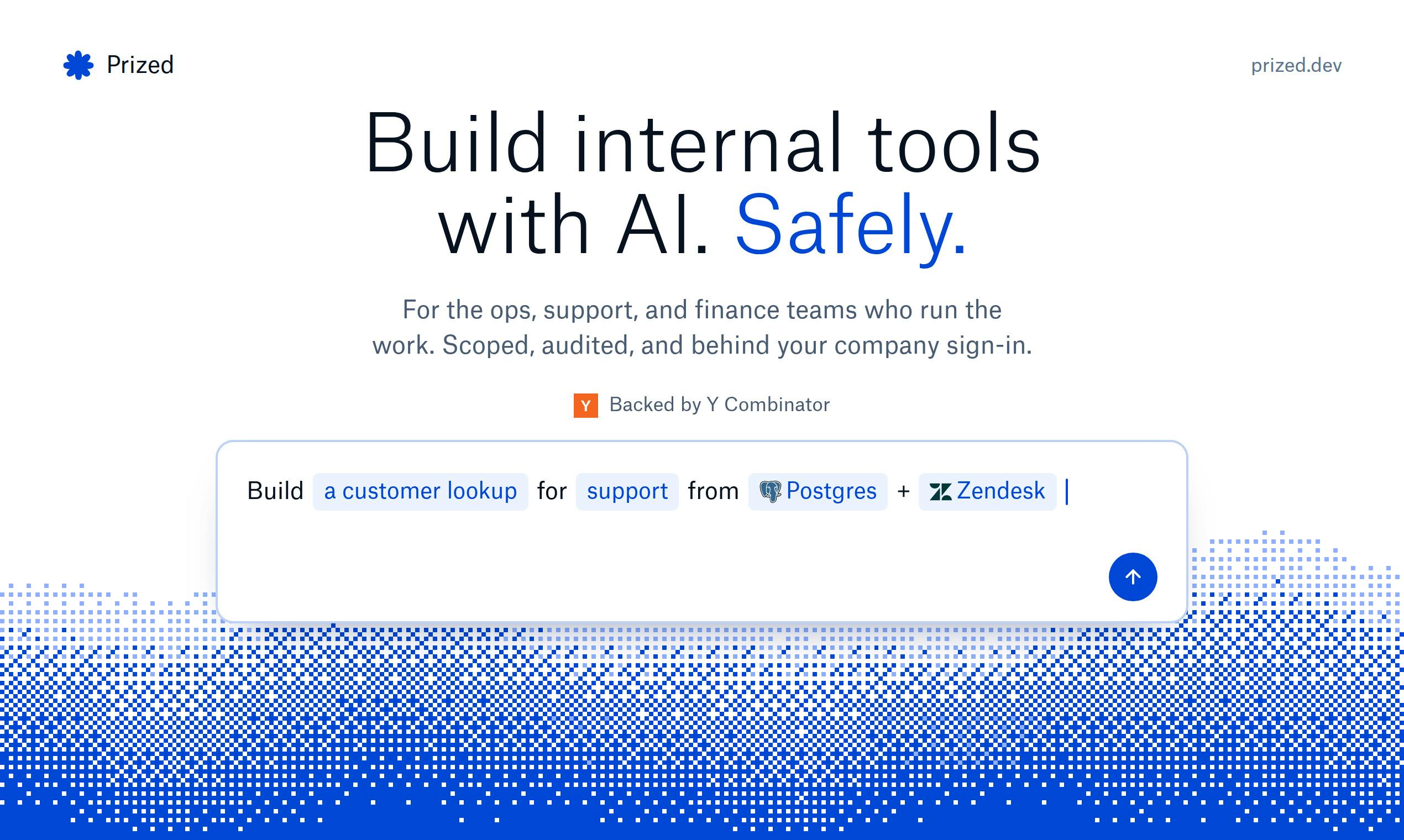
The Product Hunt listing identifies Prized as an AI builder that lets operations, support, and finance employees create secure internal tools over approved company data. It emphasizes least-privilege access, audited data use, controlled outbound traffic, and deployment behind corporate sign-in. The buyer is an IT leader governing employee-built applications.
The concept is timely. Non-engineers increasingly use coding agents to create operational software, while generic app builders often leave data permissions and auditability to the builder. Prized’s strongest potential advantage is enforcing security in the infrastructure rather than relying on generated application code.
The founders have strong technical credentials for a two-person company. Hudson Griffith was the first engineer at Gander, later acquired by Archer Aviation, and then worked at Suno. Marinos Eliades also worked at Gander and studied computer science and mechanical engineering at Stanford. Prized is listed in Y Combinator’s Summer 2026 batch.
However, the product identity is inconsistent. The Product Hunt page and YC profile describe a governed internal-tool builder. On the report date, prized.dev instead markets a persistent cloud development box with local file sync, port mirroring, agent sessions, and usage-credit pricing. The launched product is therefore unavailable or difficult to verify through its official site.
The final decision is Watch. Product uncertainty, no verified revenue or retention, and crowded markets make diligence premature despite a credible team.
Product Overview
The Product Hunt product addresses shadow software: employees who understand a workflow build internal apps with Claude Code or Cursor but connect directly to company data without proper permissions, auditing, credential controls, or administrative visibility. Prized was presented as a sandbox in which company data is pre-connected and scoped; tools deploy behind company authentication.
Launch features include per-tool data roles, brokered credentials, controlled egress, audit logs, and approval for destructive changes. Maker comments describe isolated AWS sandboxes, inherited user permissions, and VPC connectivity. The alternative is spreadsheets, scripts, engineering tickets, or platforms such as Retool, Airtable, Appsmith, Superblocks, Power Apps, and Lovable.
The current site instead sells Mac-linked Linux development boxes with sync, mirrored ports, persistent sessions, snapshots, and preinstalled agents. Pricing uses $10–$1,000 monthly credits with hourly metering. Internal-tool pricing is unavailable.
Founder and Team Assessment
YC identifies CEO Hudson Griffith as a former first engineer at Gander who owned core architecture and built AI voice and document agents; after Gander’s acquisition by Archer Aviation, he worked on full-stack products at Suno. Marinos Eliades studied at Stanford, worked at Gander, co-founded onboarding product Loophole, and served in Cyprus’s National Guard.
Their prior collaboration reduces co-founder risk, but a two-person team cannot easily cover product, security, infrastructure, sales, and support. The launch named Avoca and Onyx Odds as users without disclosing paid status, value, or retention. The website mismatch could reflect a routing error or pivot and requires direct confirmation.
Founder Assessment: Strong technical and collaborative history, but commercial focus and product commitment are not yet demonstrated.
Market Opportunity
The narrow internal-tools segment is technology companies with 50–1,000 employees, operational app backlogs, and strict data access. An illustrative 25,000 customers at $24,000 annual value yields a $600 million initial market; enterprise expansion could enlarge it. These are estimates. A $2,000 monthly contract is plausible if it replaces engineering work, but security review slows adoption.
For cloud boxes, 100,000 developers at $100 monthly average spend would produce $120 million ARR. Both markets can support scale, but serving both would fragment a two-person team.
Traction and Growth Signals
Product Hunt showed 159 points, a number-six daily rank, and 167 followers when observed. These measure launch interest, not product-market fit. The maker stated that Avoca, Onyx Odds, and other teams used the internal-tool product, but customer count, paid status, and outcomes were not disclosed.
YC acceptance is a positive selection and financing signal. YC’s standard deal is $500,000: $125,000 for 7% plus $375,000 on an uncapped MFN SAFE. Because company-specific closing details and additional financing are not public, this should not be treated as a complete cap-table record.
The current site documents a functioning cloud box, but active users, revenue, uptime, utilization, reviews, and retention are unknown.
Traction Assessment: Very early product activity with no verified commercial traction and significant product-identity uncertainty.
Competitive Position
For governed internal tools, direct competitors include Retool, Superblocks, Appsmith, ToolJet, Airtable, and Power Apps. AI app builders and coding agents are indirect competitors; spreadsheets and engineering tickets are manual alternatives. Existing platforms can bundle permissions, audit logs, and AI generation.
Prized’s proposed differentiation is infrastructure-enforced least privilege, credential brokering, governed egress, and builder accessibility. Security depth could become durable through integrations, policy data, and enterprise trust, but none is yet verified at scale. Switching costs might grow through a library of tools and connectors.
For cloud boxes, competitors include GitHub Codespaces, Coder, Gitpod, Daytona, exe.dev, raw cloud VMs, and local Macs. Two-way sync, localhost mirroring, persistent sessions, and flat monthly credits are useful but replicable. Prized itself compares against several incumbents.
If the largest platform launched the same feature within six months, customers would stay only for superior governance and integration in the internal-tool product, or a better local experience and economics in the cloud-box product. Neither advantage has sufficient customer evidence.
Defensibility Assessment: Low
Business Model and Economics
The launched product’s pricing and contract structure are unknown. A likely B2B subscription could charge by workspace, builder, connector, tool, or usage, with enterprise expansion through SSO, audit, policy, and VPC deployment. Costs would include model inference, sandboxes, databases, connector maintenance, support, and security compliance.
Cloud-box credits range from $10 to $1,000 monthly; a Small box is $100 always awake or an estimated $48 for eight-hour days. Compute, disk, networking, snapshots, and support make margins utilization-sensitive.
Neither model discloses margin, CAC, conversion, expansion, or churn. Product-level contribution margins and one coherent revenue model are prerequisites.
Unicorn Path
Assume an 8x ARR multiple for a high-growth software platform with security value, or a lower multiple if revenue is primarily infrastructure resale. A $1 billion valuation therefore requires roughly $125 million ARR.
For internal tools, 4,167 customers at $30,000 ACV would reach that level. For cloud boxes, 104,167 customers at $100 monthly average revenue would be required. Both routes demand repeatable distribution, strong retention, international scale, reliable infrastructure, and a larger team.
The prerequisite is focus, a narrow retained customer, and compounding integrations or workflow data.
Unicorn Path: Conditional
Valuation Assessment
YC participation implies its standard investment economics, but Prized’s other SAFE terms, current raise, valuation cap, ownership, and cash position are not public. No revenue or retention exists for a comparable-company multiple. Product quality or launch votes cannot determine price.
Valuation Attractiveness: Not Assessable
Needed information includes signed financing documents, cap table, option pool, current SAFE cap, round size, ARR, growth, gross margin by product, burn, runway, retention, and investor rights.
Key Risks
- Product identity and focus: Official sources currently describe different businesses.
- No commercial proof: Revenue, paid customers, retention, and usage are undisclosed.
- Two-person execution: Product, security, sales, and infrastructure scope exceeds current capacity.
- Crowded markets: Both internal tools and cloud development have well-funded incumbents.
- Low defensibility: Core features can be bundled by larger platforms.
- Security liability: Production data, credentials, generated code, and sandbox isolation create high stakes.
- Infrastructure margins: Cloud-box economics may resemble resale more than SaaS.
- Enterprise sales friction: Security review and connectors can lengthen onboarding.
- Platform dependence: AWS, Mac integration, Git providers, and AI-agent vendors affect cost and reliability.
- Financing opacity: Current price and dilution are unknown.
Final Assessment
Venture Potential: 58/100
| Category | Score |
|---|---|
| Market Size and Expansion Potential | 16/20 |
| Traction and Growth Evidence | 7/20 |
| Founder and Team | 13/15 |
| Product Strength | 6/10 |
| Distribution Potential | 7/15 |
| Business Model and Economics | 4/10 |
| Defensibility | 5/10 |
| Total | 58/100 |
The technical team is strongest; product inconsistency, absent commercial evidence, and weak defensibility are weakest.
Evidence Confidence: 56/100
Founder backgrounds, YC batch, launch description, Product Hunt activity, and current cloud-box pricing are verifiable. Named users are founder-reported. Market size, ACV, and customer requirements are estimates. Revenue, retention, funding documents, product continuity, margins, and customer outcomes are unavailable.
Final Decision: Watch
The company is too early and ambiguous for DD. Monitor until one stable product shows paid use.
Upgrade Conditions
- Public and investor-verified clarity on the active product and roadmap.
- At least $500,000 ARR or 20 paying B2B customers in one product.
- Strong three- and six-month retention with expanding usage.
- Documented security architecture and successful customer reviews.
- Gross margin above 70% for software or a credible path above 50% for infrastructure.
- A defensible distribution or proprietary-data advantage.
Downgrade Conditions
- Continued rapid pivots without retained customers.
- Material security, isolation, credential, or data-access incident.
- Weak paid conversion or high early churn.
- Infrastructure costs prevent positive contribution margin.
- A major platform bundles the differentiated workflow.
Questions for Further Diligence
- Which product is active today, and why do Product Hunt, YC, and the official site differ?
- How many paid and active customers does each product have?
- What are current MRR, monthly growth, and three-month cohort retention?
- Did Avoca and Onyx Odds pay, deploy in production, and continue using Prized?
- What is gross margin after model, cloud, storage, and support costs?
- What security reviews, penetration tests, certifications, and incident controls exist?
- Which product-level usage behavior predicts renewal or expansion?
- How will two founders cover enterprise sales and infrastructure reliability?
- What intellectual property or data compounds into durable advantage?
- What are burn, runway, ownership, SAFE obligations, and current round terms?
- What milestone would cause another pivot, and how is focus decided?
- Why will customers remain if Retool, GitHub, or a cloud provider bundles the feature?