
Table of Contents
AINA Investment Report
Category: AI recruiting platform and career-coaching software
Company Stage: Seed-stage
Founder or Founders: Natallia Mikhnovets; other co-founder(s) not publicly identified
Headquarters: Limassol, Cyprus, according to company and press descriptions; legal operator registered in Dubai, UAE
Funding: $1 million seed funding from an undisclosed private angel investor
Business Model: Employer-paid B2B SaaS; free candidate career and job-search tools
Product Hunt Launch Date: September 18, 2026
Report Date: September 21, 2026
| Investment Metric | Assessment |
|---|---|
| Venture Potential | 60/100 |
| Unicorn Path | Conditional |
| Valuation Attractiveness | Not Assessable |
| Evidence Confidence | 54/100 |
| Final Decision | Watch |
Executive Summary
AINA is an AI-native recruiting platform serving both employers and job candidates. Employers can create roles, source and score candidates, conduct asynchronous AI interviews, manage applicants and analyze hiring funnels. Candidates receive free profile-building, job matching, résumé feedback, interview practice and an avatar-based AI career coach (official website; candidate platform).
The product is broader than a single-purpose interview bot. Its strongest proposition is consolidating an applicant-tracking system, sourcing, screening, interviews and candidate coaching into one workflow. The listed entry price of $49 per month is materially below established recruiting platforms, potentially supporting bottom-up adoption but raising questions about revenue per customer and support-adjusted gross margin (AINA employer plan).
The strongest investment signal is evidence that AINA existed before its Product Hunt launch and has processed meaningful recruitment activity. The current website reports more than 100 employer teams, 12,000 interviews and 45,000 candidates scored. A January 2026 funding announcement confirms a $1 million seed round, while Product Hunt generated 475 upvotes, 191 comments and a #2 Product of the Day ranking (official website; FinSMEs; launch record).
The principal concern is not product usefulness but commercial and evidentiary quality. Current revenue, paying-customer count, retention, gross margin and acquisition costs are undisclosed. Public operating figures also conflict: January press coverage cited more than 2,000 interviews and over 300 positions filled, while the current homepage reports 12,000 interviews but only 200-plus roles filled. Different definitions may explain this, but the discrepancy requires reconciliation.
AINA may become a meaningful HR software company, particularly if it develops enterprise pricing and a compliance advantage in European hiring. However, the present $49-per-month entry model, low switching costs, intense platform competition and regulatory exposure make a billion-dollar outcome conditional. The appropriate decision is Watch until financial traction, customer retention and the accuracy of operating claims are verified.
Product Overview
AINA addresses two related problems. Employers must process large applicant volumes without consuming excessive recruiter time, while candidates often lack personalized guidance on positioning, role selection and interview performance.
For employers, AINA converts a role description or voice brief into candidate criteria, sources and ranks applicants, runs asynchronous interviews and presents explainable scores. It also provides applicant tracking, communication history, offers and hiring analytics. Final hiring decisions remain with the employer, according to AINA’s legal documentation (employer platform; terms).
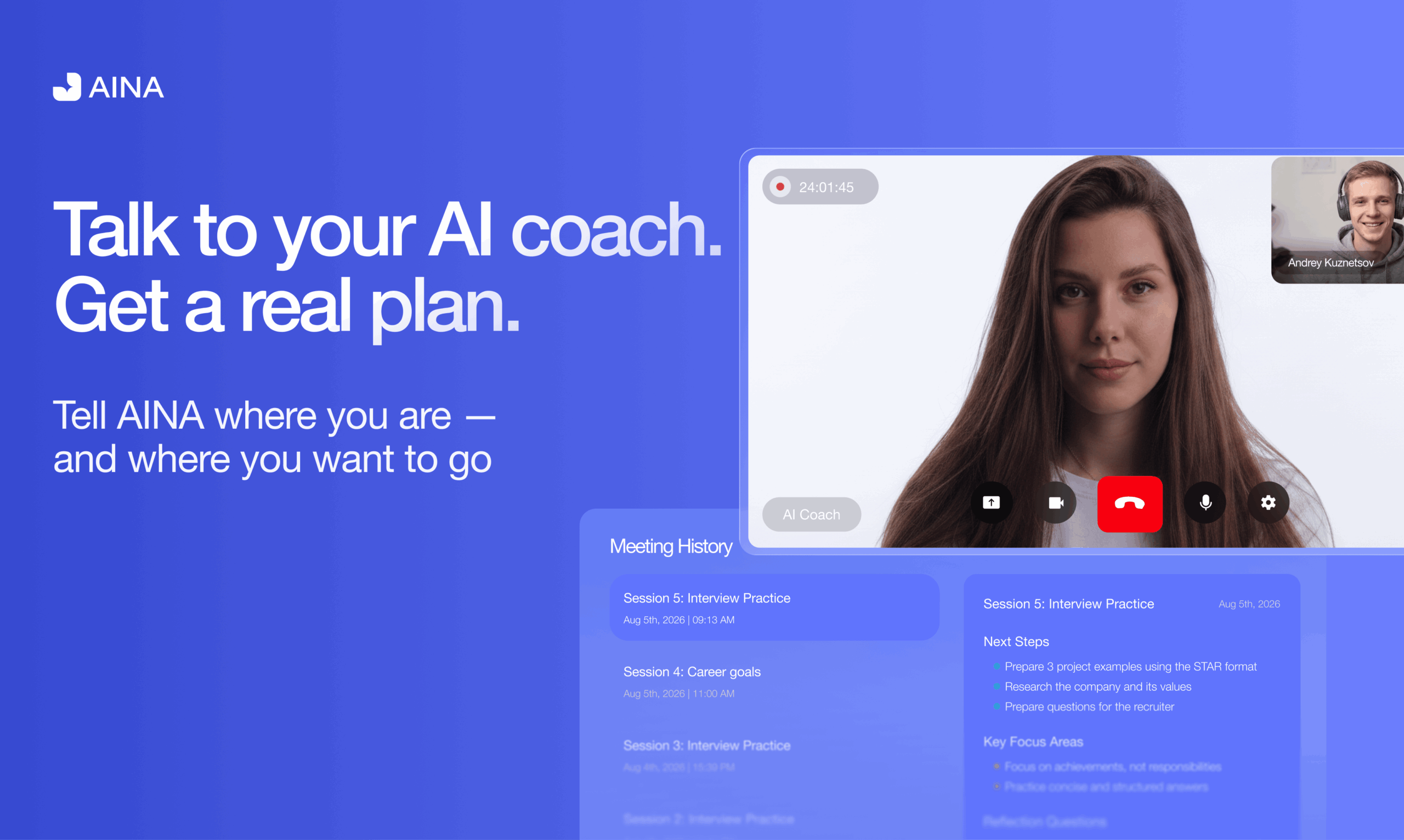
Candidates can upload a résumé or LinkedIn profile, build a reusable professional profile, receive job recommendations, practice interviews and speak with an AI career coach. Candidate access is currently free (Product Hunt launch announcement).
Employer pricing starts at $49 per month, with a free starting option. The public page does not disclose usage limits, interview allowances, higher tiers or enterprise pricing. AINA is browser-based; no verified native App Store or Google Play product associated with this recruiting platform was found.
The product replaces combinations of an ATS, job boards, LinkedIn Recruiter, interview-recording tools, scheduling products, spreadsheets and manual candidate review. Its breadth is attractive, although replacing established systems requires reliability, integrations, security and compliance—not merely better AI demonstrations.
Product Quality: Promising end-to-end workflow and unusually low entry price, but product reliability and assessment validity are not independently established.
Founder and Team Assessment
Natallia Mikhnovets is identified as AINA’s co-founder and CEO by the company, LinkedIn and funding coverage. She states that she has more than ten years of experience around recruitment, HR technology and operations (Product Hunt; LinkedIn; Tech.eu).
This background suggests relevant founder-market fit. However, detailed prior employers, operating achievements and previous exits were not sufficiently verified through primary sources. Although Mikhnovets describes herself as a co-founder, no other co-founder was reliably identified.
LinkedIn categorizes AINA as an 11–50-employee company, but an exact headcount and functional breakdown are not publicly verified. A product-marketing job listing provides a limited hiring signal, but current open positions and hiring velocity are unclear.
The platform’s legal operator is TECH DUCK L.L.C.-FZ, registered in Dubai. This differs from AINA’s marketing description as Cyprus-headquartered and “EU-native.” The structure may be legitimate, but diligence should establish where employees, intellectual property, contracting entities and data-processing responsibilities actually sit (privacy policy).
Founder Assessment: Relevant recruiting and operations experience, but the full founding team, technical leadership and prior execution record remain insufficiently verified.
Market Opportunity
AINA’s narrow initial segment is European technology companies—from seed-stage startups through mid-market businesses—that hire approximately 5–200 employees annually and need sourcing, screening and interviewing automation. The company specifically emphasizes software, mobile, gaming and fintech employers (company positioning).
A bottom-up analyst scenario illustrates the opportunity:
- 25,000–100,000 potentially addressable growth companies across Europe and adjacent markets;
- $600–$15,000 in annual revenue per employer, depending on whether AINA remains a low-cost tool or develops multi-seat and enterprise plans;
- Implied serviceable annual revenue pool of approximately $15 million–$1.5 billion.
This is an analytical range, not a verified market estimate. It is highly sensitive to customer qualification and achievable contract value. At the current $588 annual entry price, the immediate software revenue pool is modest even with broad adoption. Venture-scale economics require higher tiers, usage pricing or materially larger customers.
Adjacent opportunities include staffing agencies, high-volume frontline recruitment, internal mobility, skills assessment, onboarding and candidate-paid coaching. International expansion is possible, although privacy and employment regulations vary by jurisdiction.
Traction and Growth Signals
AINA’s current website reports:
- More than 100 employer teams;
- More than 200 roles filled;
- More than 12,000 interviews conducted;
- More than 45,000 candidates scored (official website).
These are company-reported and unaudited. January 2026 coverage stated that AINA had conducted more than 2,000 interviews and helped fill more than 300 positions (Tech.eu). A later company page cited 50 corporate clients, 2,000 interviews and 300 positions. The increase from 50 to 100-plus employer teams and 2,000 to 12,000 interviews would be encouraging if definitions are consistent. The decline from 300 “positions filled” to 200-plus “roles filled” is unexplained and reduces confidence.
The Product Hunt launch received 475 upvotes, 191 comments, three reviews and a #2 daily ranking. The reviews were positive, including one employer review praising AI interviews and affordability, but three reviews are not sufficient to establish satisfaction or retention (Product Hunt reviews; Hunted.Space).
The company raised $1 million from an undisclosed private angel investor in January 2026. No current revenue, paying-customer count, growth rate, customer concentration or renewal data were found.
Traction Assessment: Meaningful reported product usage, but commercially unverified and affected by inconsistent cumulative metrics.
Competitive Position
Direct competitors include HireVue, Eightfold AI, Paradox and specialist AI screening products. Broader recruiting-platform competitors include Greenhouse, Ashby and Workable. LinkedIn is a significant platform threat because its Hiring Assistant can combine recruiting automation with proprietary professional-network data (LinkedIn Hiring Assistant).
AINA’s differentiation is the combination of low-cost employer software, AI interviews, explainable candidate scoring and a free candidate-side coach. Candidate participation could eventually produce differentiated matching data or a two-sided network.
That network effect is not yet demonstrated. Candidates can use generic AI assistants for interview preparation, while employers can select from numerous ATS and assessment platforms. Switching costs are low until AINA becomes the employer’s system of record and accumulates substantial workflow history.
If the largest platform launched the same feature within six months, why would customers continue using AINA? Potential reasons are lower pricing, faster onboarding, European compliance and a better candidate experience. None is currently strong enough to prevent replication: larger platforms can bundle AI, and regulatory compliance must be independently demonstrated rather than asserted.
Defensibility Assessment: Low
Business Model and Economics
The current model appears to subsidize candidates while charging employers. The public employer plan starts at $49 monthly, implying a minimum annual contract value of $588. Pricing for higher volumes or enterprise accounts is not disclosed.
At that price, payment-processing and cloud costs should be manageable, but video-avatar sessions, résumé analysis, sourcing, transcription and interview scoring create inference and data costs. Customer support, assessment customization and employer onboarding may be more significant than model inference.
The candidate product could improve employer acquisition by creating a proprietary talent pool. However, free coaching also generates costs without direct revenue. Unit economics depend on whether candidate engagement produces employer conversions, better fill rates or defensible data.
No reliable public information was found on gross margin, support cost, AI cost per interview, acquisition cost, expansion revenue or retention.
Unicorn Path
An 8× ARR multiple is assumed for a scaled HR SaaS business. This is less aggressive than the highest AI-software multiples because recruiting is cyclical, regulated and highly competitive.
Required ARR = $1 billion ÷ 8 = approximately $125 million.
That would require approximately:
- 212,600 employers at the $588 annual entry price;
- 20,800 employers at a $6,000 blended ACV;
- 8,300 employers at a $15,000 blended ACV; or
- 2,500 enterprise customers at $50,000 annually.
The current entry model cannot credibly support a unicorn without dramatic customer volume. A more credible route requires multi-seat plans, usage-based interview fees, enterprise contracts, integrations, international distribution and meaningful revenue per employer.
AINA would also need independently validated assessment accuracy, robust bias monitoring, strong retention and proof that its candidate network improves employer outcomes. Recruitment AI is classified as a sensitive or high-risk application under the EU’s regulatory framework, increasing both compliance cost and the potential value of a genuine compliance advantage (European Commission).
Unicorn Path: Conditional
Valuation Assessment
AINA raised $1 million in seed funding from an undisclosed private angel investor. The round’s valuation, security type, ownership sold and investor rights were not disclosed (FinSMEs).
No current fundraising status, verified ARR or comparable financing data sufficient to price the company were found.
Valuation Attractiveness: Not Assessable
Assessment requires current ARR, revenue growth, paying-customer count, retention, gross margin, burn, runway, cap table, round size, valuation or SAFE cap, liquidation preferences and investor ownership.
Key Risks
- Unverified commercial traction: Employer usage is reported, but revenue and paying-customer data are absent.
- Conflicting operating metrics: Public counts of roles or positions filled are inconsistent.
- Insufficient contract value: The $49 monthly plan is unlikely to support venture-scale revenue without substantial upselling.
- Regulatory exposure: AI-assisted candidate scoring creates GDPR, employment-discrimination and EU AI Act obligations.
- Weak defensibility: Established ATS, assessment and professional-network platforms can bundle similar functionality.
- Assessment validity: No independent evidence was found validating scoring accuracy, bias performance or quality-of-hire predictions.
- Legal-entity ambiguity: Cyprus positioning and a Dubai operating entity require clarification.
- Two-sided focus risk: Building employer infrastructure and a free consumer career platform may dilute a small team.
- Data-provider dependency: OpenAI, Google, AWS, Telegram and external professional networks influence cost, reliability and privacy.
- Hiring-cycle exposure: Recruitment software demand may weaken when customers reduce headcount growth.
Final Assessment
Venture Potential: 60/100
| Category | Score |
|---|---|
| Market Size and Expansion Potential | 15/20 |
| Traction and Growth Evidence | 10/20 |
| Founder and Team | 9/15 |
| Product Strength | 8/10 |
| Distribution Potential | 8/15 |
| Business Model and Economics | 6/10 |
| Defensibility | 4/10 |
| Total | 60/100 |
The strongest elements are product breadth, low-friction pricing and reported recruitment activity. The weakest are unverified economics, low current ACV, limited defensibility and incomplete team evidence.
Evidence Confidence: 54/100
Funding, legal operator, founder identity, public pricing and product availability are reasonably verified. Customer, interview and candidate metrics are company-reported. Market sizing and future ACV scenarios are analyst assumptions. Revenue, retention, gross margin, CAC, burn, runway, valuation and current financing status remain unknown.
Final Decision: Watch
AINA is more than a Product Hunt prototype, but the evidence does not yet justify formal investment diligence. The product could become a viable HR SaaS business; the venture case depends on proving paid retention, enterprise expansion and regulatory-grade assessment quality.
Upgrade Conditions
- Verify at least $500,000–$1 million ARR with sustained growth.
- Demonstrate 50 or more paying employer customers and strong cohort retention.
- Reconcile all interview, customer and role-fill metrics.
- Show gross margin above 70% after AI, video, data and support costs.
- Establish a blended ACV materially above the $588 entry tier.
- Provide independent bias, accuracy and compliance testing.
- Demonstrate repeatable employer acquisition beyond founder relationships and Product Hunt.
Downgrade Conditions
- Weak conversion from free or $49 accounts to higher-value plans.
- High employer churn after one hiring cycle.
- Adverse regulatory findings or discrimination claims.
- Material security or candidate-data incidents.
- Replication by LinkedIn or major ATS platforms without differentiated retention.
- Misleading traction, compliance or partnership claims.
Questions for Further Diligence
- What are current ARR, MRR and monthly revenue growth?
- How many of the 100-plus employer teams are paying, active and renewed customers?
- What are employer retention rates at 90, 180 and 365 days?
- How do the reported 200-plus roles filled reconcile with the earlier 300-plus positions figure?
- What are average and median annual contract values by customer segment?
- What are gross margin and AI, video, sourcing and data costs per interview?
- What percentage of free candidates become active applicants or generate employer value?
- What independent testing supports AINA’s candidate-scoring accuracy and absence of unlawful bias?
- Who are the other co-founders and technical leaders, and what is the full-time team structure?
- Which entity owns the intellectual property, contracts with customers and received the seed investment?
- What are current burn, cash balance and runway?
- What are the cap table, current valuation, proposed round terms and investor rights?
Sources
- AINA on Product Hunt
- Product Hunt launch statistics
- Official AINA employer website
- AINA employer pricing
- AINA candidate platform
- AINA funding coverage — FinSMEs
- AINA funding and operating claims — Tech.eu
- AINA privacy policy and legal operator
- European Commission AI Act overview
- LinkedIn Hiring Assistant