
Table of Contents
Nimbia Investment Report
Category: AI customer onboarding, digital adoption, and browser agents
Company Stage: Pre-seed / early commercial
Founder or Founders: Joris Machielse; Eelke Hermens is listed as CTO, but co-founder status is not explicitly confirmed
Headquarters: Amsterdam, Netherlands
Funding: Amount not publicly disclosed; the company says it is backed by operators from Booking.com, OpenAI, Google, and Flexport, but investor identities and financing terms are not disclosed
Business Model: Custom-priced B2B SaaS, apparently based on call volume, products covered, and integrations
Product Hunt Launch Date: August 25, 2026
Report Date: August 28, 2026
| Investment Metric | Assessment |
|---|---|
| Venture Potential | 63/100 |
| Unicorn Path | Conditional |
| Valuation Attractiveness | Not Assessable |
| Evidence Confidence | 49/100 |
| Final Decision | Watch |
Executive Summary
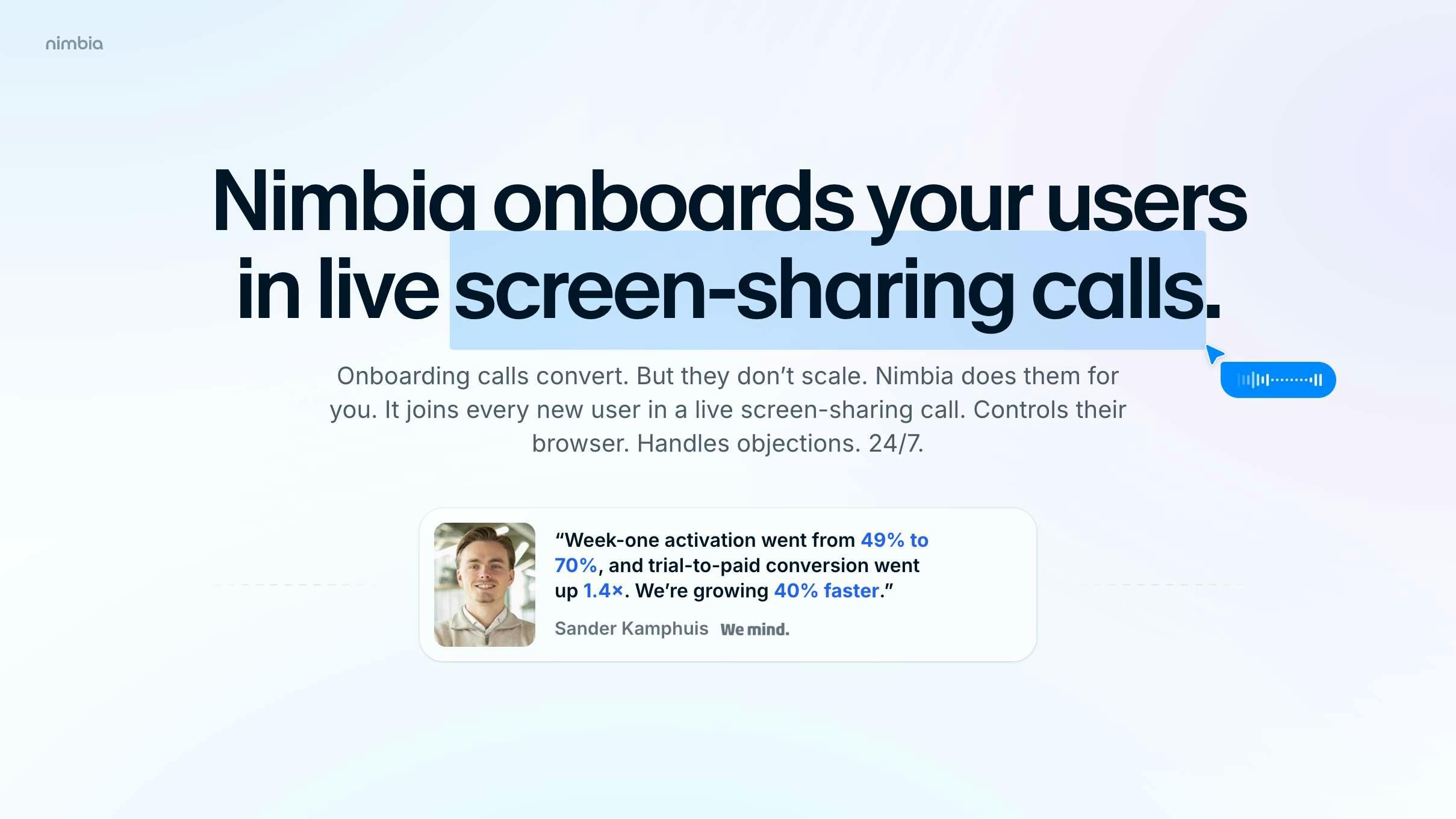
Nimbia provides AI-led onboarding calls for software users. Its agent communicates through real-time voice, observes the user’s screen, and can click, type, and navigate inside the customer’s browser. The proposition is to replicate a founder or customer-success manager’s screen-sharing session for every new user, without requiring scheduling or additional support headcount (official website).
The product addresses a real problem for self-service SaaS companies: personalized onboarding can improve activation but is expensive to provide to low-value or geographically distributed users. Nimbia is more ambitious than a conventional tooltip tour or support chatbot because it attempts to act directly inside the product while responding to questions.
The strongest positive signal is a company-reported randomized test with WeMind. Nimbia says week-one activation was 68% in the Nimbia group versus 45% for the incumbent onboarding product, while trial-to-paid conversion was 1.4 times higher. After full deployment, the company reports activation of 70%, compared with 49% before Nimbia. The case study is unusually transparent about its methodology, but it covers one customer, does not disclose sample size or absolute conversion, and has not been independently audited (WeMind case study).
The most important concern is the lack of commercial validation. Pricing is private, and no reliable public information was found for revenue, paying customers, active end users, customer retention, gross margin, funding amount, or valuation. Nimbia’s ability to control customers’ browsers also creates a high security and reliability threshold that the current public materials do not fully address.
The final decision is Watch. Nimbia has an interesting product, credible founder-market fit, and an initial outcome-based customer reference. It requires multiple retained paying customers, auditable conversion evidence, enterprise security controls, and demonstrated unit economics before formal investment diligence is warranted.
Product Overview
Nimbia targets SaaS companies whose new users struggle to reach an activation milestone. Existing workflows typically involve founder-led calls, customer-success meetings, recorded videos, documentation, chatbots, or static product tours.
Customers train Nimbia using recorded calls, documentation, or access to a test account. They then install a JavaScript snippet in their application. New users can receive a live voice session in which Nimbia answers questions and controls the browser to demonstrate or complete onboarding steps (official website, founder-onboarding page).
The principal customer benefit is immediate, individualized onboarding across time zones without one human employee per call. The agent also produces conversation data that could support sales qualification, customer-success follow-up, and product feedback.
Nimbia says it integrates with Slack, Intercom, HubSpot, Salesforce, and Segment. Public technical documentation for these integrations was not found, so their depth should be verified. The product is web-based; no mobile applications or browser-extension marketplace listings were identified.
Pricing is customized according to call volume, products covered, and integrations. There is a signup option, but no public free plan, trial duration, per-minute price, or minimum contract value (pricing page).
The company’s public privacy policy covers ordinary personal and website-usage data, but does not explain in sufficient detail how screen content, call recordings, transcripts, credentials, or model-provider data are processed and retained (privacy policy).
Product Quality Assessment: Technically differentiated and potentially valuable, but reliability, authorization controls, analytical accuracy, and deployment friction are not independently established.
Founder and Team Assessment
Joris Machielse is identified as founder and CEO. His public profile shows more than two decades of software experience, including founding Record Once, a SaaS training-video product, and Sellscope, a B2B lead-generation and sales-coaching business. That history creates direct founder-market fit with onboarding, training content, and B2B software sales (LinkedIn).
Nimbia’s official about page lists Eelke Hermens as CTO and Anies Rayyes as founding engineer. Hermens’ public profile describes more than 15 years of CTO, engineering-leadership, software-architecture, and machine-learning experience. Rayyes’ background could not be independently verified beyond Nimbia’s website (Nimbia about page, Hermens profile).
The operating company is identified as Hyper Labs B.V., with Dutch Chamber of Commerce number 96939109. The publicly listed team therefore appears to contain three people, although contractors or undisclosed employees may exist. No active job listings were identified.
The team combines relevant engineering and onboarding experience, but a three-person organization faces substantial demands across real-time AI infrastructure, security, integrations, sales, customer configuration, and support. There is also material founder and key-engineer concentration.
Founder Assessment: Strong founder-market fit and relevant technical experience, but commercial scaling and enterprise execution remain unproven.
Market Opportunity
The narrow initial segment is B2B software companies with self-service trials, a definable activation milestone, and enough signup volume to justify automated one-to-one onboarding. Nimbia is less appropriate for simple consumer applications, products without trials, or software where browser control creates unacceptable compliance risk.
No reliable public count exists for companies meeting all these conditions. An illustrative bottom-up scenario is:
- 20,000–50,000 potentially suitable software products worldwide;
- $12,000–$48,000 annual contract value, depending on call volume and integrations;
- resulting addressable revenue of approximately $240 million–$2.4 billion annually.
This is an analyst scenario, not a verified market estimate. The lower end can support a meaningful software company but not necessarily a unicorn. The upper end requires international distribution, enterprise adoption, and considerably broader deployment than publicly demonstrated.
Expansion opportunities include employee training, customer support, implementation, sales demonstrations, feature adoption, renewal intervention, product research, and customer-success automation. Moving from new-user onboarding into a persistent agent across the customer lifecycle would materially enlarge contract values.
Market timing is favorable because multimodal models, real-time voice, and browser automation have recently become capable enough to combine in a single workflow. The same technology shift, however, makes entry easier for established competitors.
Traction and Growth Signals
Nimbia’s strongest disclosed evidence is the WeMind case study. The company reports a month-long randomized A/B test, with:
- 68% week-one activation for Nimbia versus 45% for the previous onboarding product;
- 1.4 times higher trial-to-paid conversion;
- 80% of sessions occurring outside business hours;
- post-deployment activation of 70%, compared with 49% before deployment.
Nimbia explicitly notes that it is not publishing raw conversion rates or absolute participant counts and that marketing activity was not frozen. Consequently, the statistical significance and revenue impact cannot be independently assessed (case study).
The website includes two additional testimonials, but does not identify corresponding contract values, implementation dates, or retention. It is unclear whether these organizations are paying customers, design partners, or trial deployments.
Nimbia launched on Product Hunt on August 25, 2026 and ranked fifth with approximately 97 points in a contemporaneous Product Hunt search snapshot (Product Hunt, awards page). This indicates early interest but has minimal weight in the investment score.
No public GitHub organization, independent software reviews, app-store metrics, revenue data, active-session volume, or sustained post-launch growth metrics were found.
Traction Assessment: Encouraging single-customer performance evidence, but commercially unverified and insufficiently diversified.
Competitive Position
Direct competitors include Appcues, Userpilot, Pendo, WalkMe, Chameleon, and other digital-adoption platforms. Indirect competitors include Intercom, Zendesk, knowledge-base chatbots, interactive-demo products such as Supademo and Navattic, recorded Loom videos, customer-success employees, and founder-led Zoom calls.
Nimbia’s differentiation is combining real-time voice, visual understanding, and browser control. Static product tours generally provide predefined instructions; Nimbia attempts to understand the live interface and adapt to questions. If reliable, this should produce a more personal and effective onboarding experience.
Nevertheless, the surrounding market is well funded and strategically important. Userpilot’s published plans begin at $299 per month and include engagement, analytics, and surveys, while Pendo and Appcues offer broad product-adoption platforms with enterprise integrations and security controls (Userpilot pricing, Pendo pricing, Appcues pricing). SAP’s approximately $1.5 billion acquisition of WalkMe validates the value of digital adoption at scale (SAP announcement).
If Pendo, WalkMe, Intercom, or Appcues launched equivalent live browser-control onboarding, customers would remain with Nimbia only if it delivered materially higher activation, faster implementation, safer actions, or specialized workflows. Proprietary data could develop from onboarding conversations and successful action sequences, but no network effect or durable data advantage is yet demonstrated.
Defensibility Assessment: Low
Business Model and Economics
Nimbia appears to use a usage-sensitive B2B SaaS model. Pricing depends on call volume, number of products, and integrations, suggesting a subscription with usage tiers or committed capacity.
Comparable onboarding tools charge hundreds to thousands of dollars monthly, supporting potential annual contracts in the low-to-mid five figures. However, Nimbia’s actual ACV is unknown.
Variable costs may be significant. Each session can require streaming speech recognition, text-to-speech, multimodal inference, reasoning, browser execution, recording, storage, and monitoring. Sessions reportedly last approximately two to ten minutes. Gross margin depends on price per call, average duration, model costs, error-recovery rates, and the amount of human configuration and review required.
If Nimbia charges substantially less than the incremental conversion value it produces, pricing power could be attractive. Conversely, bespoke setup for each customer could turn the business into a service-heavy operation. No evidence is available regarding implementation hours, contribution margin, support load, or customer acquisition cost.
Unicorn Path
Assuming a 10× ARR multiple for a fast-growing, high-gross-margin AI SaaS company:
Required ARR = $1 billion ÷ 10 = $100 million.
At a hypothetical $24,000 ACV, Nimbia would need approximately 4,200 customers. At $60,000 ACV, it would need approximately 1,700 customers. These figures are analyst scenarios because Nimbia does not publish pricing.
Reaching $100 million ARR exclusively through startup onboarding would be difficult. A credible path requires expansion into enterprise training, implementation, support, feature adoption, and customer-success automation; strong retention; high automation; and enterprise-grade security. It would also require reliable multilingual performance and a repeatable distribution model beyond founder-led sales.
Unicorn Path: Conditional
Valuation Assessment
No reliable public information was found regarding total funding, named investors, SAFE terms, valuation, burn, runway, or current fundraising. The company only states that it is backed by operators from several technology companies.
Pendo’s historical $2.6 billion financing valuation and SAP’s $1.5 billion WalkMe acquisition demonstrate that product adoption can produce large outcomes, but both businesses had far broader product suites and commercial scale than Nimbia (Pendo announcement, SAP announcement).
Valuation Attractiveness: Not Assessable
Required information includes ARR, growth, gross margin, retention, customer concentration, burn, runway, round size, SAFE cap or post-money valuation, cap table, and investor rights.
Key Risks
- Insufficient commercial validation: Only one detailed customer outcome is public.
- Security and authorization: Browser control could expose sensitive data or execute unintended actions.
- Incumbent replication: Major digital-adoption and support platforms can bundle similar capabilities.
- Unit economics: Real-time voice, vision, and browser inference may create high variable costs.
- Services intensity: Training and tuning an agent for each product may limit scalability.
- Reliability: UI changes, ambiguous requests, hallucinations, and latency can disrupt onboarding.
- Customer concentration: Current revenue may depend heavily on a small number of early deployments.
- Privacy compliance: Public disclosures do not adequately address session recordings, screen data, credentials, or subprocessors.
- Small team: Three publicly listed team members create operational and key-person dependency.
Final Assessment
Venture Potential: 63/100
| Category | Score |
|---|---|
| Market Size and Expansion Potential | 16/20 |
| Traction and Growth Evidence | 8/20 |
| Founder and Team | 12/15 |
| Product Strength | 8/10 |
| Distribution Potential | 8/15 |
| Business Model and Economics | 6/10 |
| Defensibility | 5/10 |
| Total | 63/100 |
The strongest elements are founder-market fit, technical differentiation, and the measurable outcome reported by one customer. The weakest are limited commercial evidence, undisclosed economics, security maturity, and weak demonstrated defensibility.
Evidence Confidence: 49/100
The product, legal entity, core team, custom pricing structure, and one customer case are publicly documented. Performance metrics, integrations, and investor backing are company-reported. Revenue, funding, customer count, retention, gross margin, security certifications, valuation, burn, and runway are unavailable.
Final Decision: Watch
Nimbia is promising but too early for formal diligence based solely on public evidence. The company should be monitored until it demonstrates multiple retained paying customers, repeatable deployment, enterprise security, and viable per-call economics.
Upgrade Conditions
- At least 10–20 paying customers across multiple SaaS categories.
- $500,000 or more in annualized recurring revenue with sustained growth.
- Verified six-month customer retention above 80%.
- Multiple controlled tests demonstrating statistically credible activation or conversion improvements.
- Gross margin above 70% after voice, model, browser, storage, and support costs.
- SOC 2 roadmap, comprehensive DPA, subprocessor disclosure, and action-level permission controls.
- Evidence of repeatable acquisition beyond founder relationships and Product Hunt.
Downgrade Conditions
- WeMind’s reported lift does not replicate across other customers.
- High error or session-abandonment rates.
- Significant manual tuning makes deployments services-heavy.
- Major incumbents release equivalent functionality.
- Gross margin remains below software norms.
- A security incident involves screen content, credentials, or unintended browser actions.
- Founders or key engineers cease full-time involvement.
Questions for Further Diligence
- What are current ARR, MRR, monthly growth, and paying-customer count?
- What were the sample sizes and confidence intervals in the WeMind experiment?
- What are 30-, 90-, and 180-day customer retention and usage retention?
- What is the average contract value and pricing metric—calls, minutes, users, or outcomes?
- What is gross margin per session after all model, voice, browser, and storage costs?
- How many engineering or support hours are required to deploy each customer?
- What percentage of sessions complete successfully without human intervention?
- How are permissions, credentials, destructive actions, and sensitive screen data protected?
- Which model, voice, hosting, and analytics subprocessors receive customer data?
- What are the primary acquisition channels, CAC, and expected payback period?
- What are current burn, runway, team responsibilities, and hiring plans?
- What funding has been raised, and what are the cap table, valuation, and current round terms?