
Table of Contents
CoolPlugz Investment Report
Category: AI developer tools; coding-agent orchestration; MCP infrastructure
Company Stage: Pre-seed / newly launched
Founder or Founders: Tasos Valtinos
Headquarters: Not publicly disclosed; founder is based in Barcelona, Spain
Funding: No completed funding round publicly disclosed
Business Model: Individual and enterprise B2B SaaS
Product Hunt Launch Date: August 25, 2026
Report Date: August 28, 2026
| Investment Metric | Assessment |
|---|---|
| Venture Potential | 49/100 |
| Unicorn Path | Conditional |
| Valuation Attractiveness | Not Assessable |
| Evidence Confidence | 48/100 |
| Final Decision | Watch |
Executive Summary
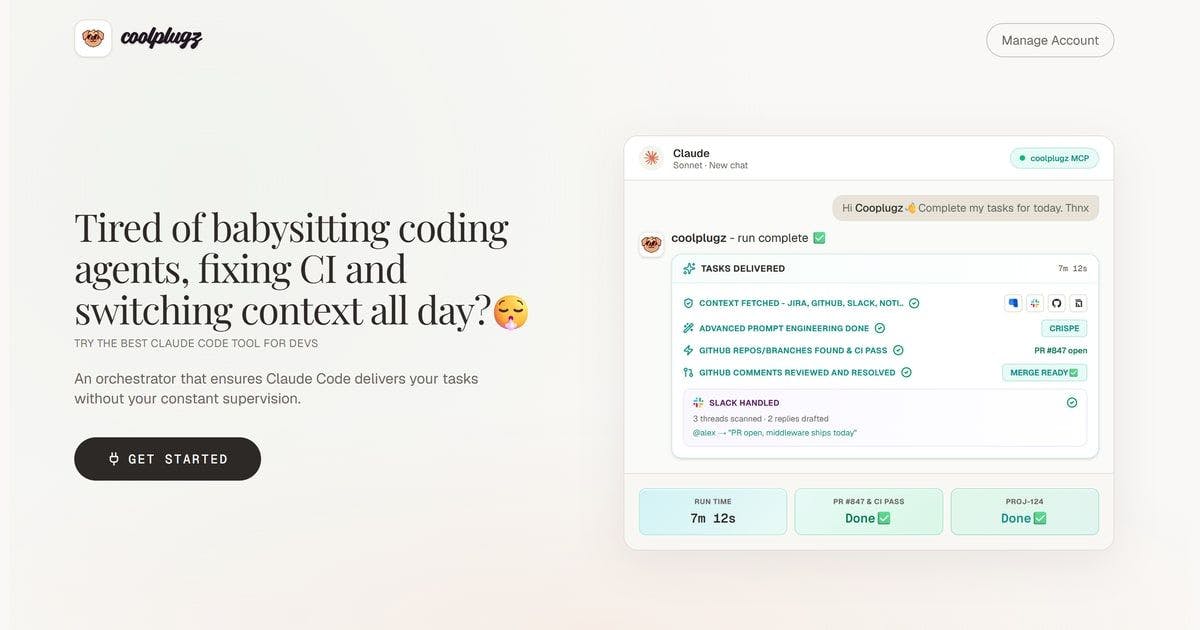
CoolPlugz is an orchestration layer for Claude Code that gathers development context from Jira, GitHub, Slack, and Notion, then guides the coding agent through implementation and verification workflows. Its objective is to reduce repetitive prompting, context switching, and manual supervision when developers turn backlog tickets into pull requests. The product is delivered as a Claude plugin and MCP service rather than as a standalone coding model (official website; Terms of Service).
The product addresses a recognizable problem. Coding agents can generate code, but developers still need to assemble context, enforce repository conventions, monitor CI, resolve review comments, and decide whether output is acceptable. CoolPlugz attempts to codify that workflow and keep it persistent across tasks. Its narrow focus may provide a better experience than manually combining several generic MCP connectors.
The strongest investment signal is the founder’s technical and product-building background. Tasos Valtinos has held engineering leadership roles, including CTO at EMURGO Labs, and has built several previous products. He also reports prior founder experience with Mapped, which reached approximately 1,800 users; these career and product claims are presented on his public profile but have not been independently audited (LinkedIn).
The most important concern is that CoolPlugz currently resembles a highly replicable workflow layer around Claude Code. Anthropic, GitHub, Cursor, Cognition, Atlassian, or an open-source MCP project could bundle similar context retrieval and task orchestration. GitHub Copilot already supports coding agents, pull-request creation, custom instructions, MCP integration, and third-party project-management initiation (GitHub Copilot plans). CoolPlugz has not publicly demonstrated proprietary technology, durable distribution, meaningful switching costs, or enterprise-grade security.
Commercial validation is extremely early. The founder reported roughly 300 launch-day “users,” later clarified that more than 1,000 people had visited and approximately ten had paid. This is useful initial paid-conversion evidence, but it is self-reported, launch-driven, and too small to establish retention or product-market fit (founder Reddit discussion). The appropriate decision is Watch, pending evidence of sustained usage, recurring revenue, retention, enterprise adoption, and a defensible product advantage.
Product Overview
CoolPlugz targets developers and small engineering teams using Claude Code alongside Jira, GitHub, Slack, and Notion. The existing workflow requires users to copy ticket requirements, repository context, team discussions, CI output, and review comments into repeated agent sessions. CoolPlugz instead retrieves authorized context and applies persistent orchestration instructions.
The product’s core workflow is:
- Gather relevant context from connected workplace tools.
- Guide Claude Code through planning and implementation.
- Check CI status, review comments, and task requirements.
- Allow the developer to approve or reject the resulting work.
- Re-run the workflow without reconstructing all context.
The company says Claude Code executes in the developer’s environment while CoolPlugz supplies orchestration, context, and workflows. It claims integrations with Jira, GitHub, Notion, and Slack and markets persistent task execution, customizable instructions, PR workflows, and developer-insight reports (official website; product guide).
Pricing consists of a seven-day free trial with no payment card, a Pro plan at $147 per year, and custom Enterprise pricing. The Enterprise plan advertises multi-seat licensing, CI/CD and automated QA support, organization-wide onboarding, SSO, security options, and service-level agreements (pricing page).
Product quality appears promising for a newly launched tool, particularly because it focuses on the operational gaps surrounding a coding agent rather than attempting to build another model. However, no independent benchmark was found validating the website’s implied productivity improvement, verification quality, or ability to deliver production-ready code. The Terms explicitly state that AI output may be inaccurate and remains the user’s responsibility to review (Terms).
Founder and Team Assessment
The identifiable maker is Tasos Valtinos, who introduces himself as the CoolPlugz maker on Product Hunt and identifies CoolPlugz in his X biography (Product Hunt; X profile).
Valtinos’s public profile shows experience in full-stack development, data engineering, Web3, and engineering leadership. Listed positions include CTO at EMURGO Labs, technical lead at Consensys, founding engineer at ChatWise and ViDi, and founder/CEO/CTO of Mapped (LinkedIn). This supports strong technical founder-market fit for a developer-tool product.
Commercial capability is less established. Previous launches demonstrate familiarity with Product Hunt and founder-led distribution, but no verified exit, institutional financing, or scaled SaaS revenue was found. The founder described himself as a solopreneur who had been doing client development work, and his LinkedIn profile did not clearly identify CoolPlugz as his primary full-time role. Founder commitment therefore requires verification.
No additional CoolPlugz employees, co-founders, or active job listings were reliably identified. The apparent solo-founder structure creates substantial key-person risk across product development, integrations, security, customer support, and sales.
Founder Assessment: Strong technical and product-building experience, but full-time commitment, enterprise-selling capability, and team depth remain unverified.
Market Opportunity
The initial customer is a professional developer or small engineering team already using Claude Code and several of Jira, GitHub, Slack, and Notion. This is narrower than the overall software-developer market because a customer must use the relevant stack, trust an external orchestration service with sensitive context, and experience enough workflow friction to pay for another tool.
A reasonable bottom-up scenario is:
- Potential individual and small-team buyers: 100,000–500,000
- Current annual price: $147
- Illustrative addressable annual revenue: approximately $15 million–$74 million
This is an analyst scenario, not a verified market count. It deliberately excludes the much larger population of developers who do not use Claude Code, do not use the supported integrations, or would prefer bundled functionality.
Enterprise expansion could materially enlarge the market. If CoolPlugz supported multiple coding agents, centralized policies, audit logs, security controls, workflow analytics, and organization-specific verification, it could sell into engineering organizations at an assumed $300–$1,200 per seat annually. Neither enterprise pricing nor willingness to pay has yet been validated.
Market timing is favorable because coding agents are becoming embedded in existing development platforms. It is also dangerous: Claude includes MCP connectors, while Cursor’s team product includes shared context, agents, automations, MCPs, skills, SSO, and usage analytics (Claude pricing; Cursor pricing). The market is large enough for a venture outcome, but CoolPlugz must own a valuable orchestration layer rather than remain a replaceable Claude add-on.
Traction and Growth Signals
CoolPlugz launched on Product Hunt on August 25, 2026. Third-party launch archives report approximately 129–134 votes, while the founder said it finished at rank seven; another archive displays a lower final daily position. Because Product Hunt data and snapshots conflict, these figures should be treated as approximate (Product Hunt; Launly; founder launch post).
The founder reported:
- Approximately 300 initial users or visitors
- More than 1,000 website visitors after launch
- Initially seven and later approximately ten paid users
- No paid marketing expenditure
- A meeting requested by an early-stage VC
These are founder-reported launch observations, not independently verified operating metrics. The changing description of “users” versus visitors materially limits their usefulness. Ten reported purchases nevertheless indicate some willingness to pay at the current price.
No reliable public data was found for MRR, ARR, active usage, task completion, renewal, churn, cohort retention, enterprise customers, GitHub adoption, or post-launch organic growth. A scheduled investor conversation is not evidence of funding.
Product Hunt attention is evidence of initial developer interest, not proof of product-market fit.
Traction Assessment: Encouraging launch conversion, but commercially unverified and dominated by a single Product Hunt event.
Competitive Position
Direct and adjacent competitors include Claude Code’s native workflows, GitHub Copilot coding agents, Cursor, Devin, OpenHands, and numerous MCP-based orchestration tools. Manual alternatives include repository instruction files, Claude skills, custom MCP servers, scripts, CI automation, and copying context directly into coding agents.
CoolPlugz’s current advantages are its focused workflow, low annual price, and preconfigured integration of multiple context sources. At $147 annually, it is inexpensive relative to the time of a professional developer. However, it is an additional cost on top of Claude, which starts at $17 per month annually for individual Pro access, while competing platforms increasingly bundle orchestration features (Claude pricing).
Switching costs appear low. The integrations rely on third-party APIs, and workflow instructions can potentially be recreated through prompts, skills, repository rules, or alternative MCP servers. No proprietary dataset, network effect, exclusive integration, or patented technology was identified.
If the largest platform launched the same feature within six months, why would customers continue using CoolPlugz? The credible answer would need to be superior cross-platform orchestration, demonstrably better task-completion rates, accumulated organization-specific workflow knowledge, and vendor neutrality. None of those advantages has yet been proven.
Defensibility Assessment: Low
Business Model and Economics
The individual plan generates $147 of annual recurring revenue per subscriber before discounts, refunds, Stripe fees, support, and infrastructure. Because Claude performs the core coding work in the user’s environment, CoolPlugz may avoid some of the model-inference burden borne by full-stack AI products. Its variable costs should instead center on hosted MCP infrastructure, integration API calls, authentication, storage, monitoring, and customer support. Actual gross margin is not disclosed.
The annual-only price can improve upfront cash collection and reduce monthly churn mechanics, but it may also constrain revenue per customer. Enterprise contracts are therefore essential if the company seeks venture-scale revenue.
Security could lengthen enterprise sales cycles. The service accesses potentially sensitive Jira tasks, source-control information, pull requests, Slack messages, and related metadata. The privacy policy describes general safeguards and Stripe billing but does not disclose SOC 2 certification, detailed retention periods, encryption specifications, subprocessors, or independent penetration testing (Privacy Policy).
The acquisition model is presently founder-led content, Product Hunt, Reddit, search-oriented guides, and referrals. Its repeatability and customer-acquisition cost are unknown.
Unicorn Path
An 8× ARR multiple is used for a hypothetical scaled, high-growth developer SaaS company. This would require approximately:
$1 billion ÷ 8 = $125 million ARR
At the current $147 annual Pro price:
$125 million ÷ $147 ≈ 850,000 paying subscribers
Alternatively, at an illustrative enterprise revenue of $600 per seat annually, CoolPlugz would need approximately 208,000 paid enterprise seats. These calculations exclude discounts and assume the company maintains strong SaaS gross margins and growth.
Reaching this scale would require CoolPlugz to:
- Expand beyond Claude Code into a vendor-neutral agent orchestration platform
- Win engineering-team and enterprise deployments
- Build security, audit, administration, and compliance capabilities
- Demonstrate measurably better delivery quality
- Create organization-specific workflow data and switching costs
- Establish scalable distribution beyond launch communities
- Build a larger product, security, sales, and support organization
The individual-product model alone is unlikely to sustain a $1 billion outcome. An enterprise control plane for multiple coding agents could, but that is a materially broader company than the product presently evidenced.
Unicorn Path: Conditional
Valuation Assessment
No completed financing, institutional investors, SAFE cap, post-money valuation, or active round terms were found. The founder reported that a VC requested a meeting, but this does not constitute funding.
Valuation Attractiveness: Not Assessable
A responsible assessment requires current ARR, paid cohorts, growth, renewal data, gross margin, burn, runway, round size, SAFE or equity terms, capitalization table, and liquidation preferences. Product quality and Product Hunt ranking are insufficient bases for a valuation range.
Key Risks
- Platform replication: Anthropic, GitHub, Cursor, or Atlassian can bundle similar orchestration.
- Unverified retention: Launch purchases may not translate into sustained use or annual renewal.
- Low switching costs: Workflows can be reproduced with MCP servers, prompts, and repository instructions.
- Founder commitment: CoolPlugz’s status as the founder’s full-time focus is unclear.
- Enterprise security: Access to source code and internal communications creates a high trust threshold.
- Single-platform dependency: The current positioning is closely tied to Claude Code and Anthropic’s product direction.
- Limited revenue per individual: The $147 annual price requires very large customer volume.
- Solo-founder capacity: Integration maintenance, support, security, and enterprise sales may exceed current capacity.
- Unproven verification quality: No independent benchmark demonstrates higher task-completion or defect performance.
Final Assessment
Venture Potential: 49/100
| Category | Score |
|---|---|
| Market Size and Expansion Potential | 14/20 |
| Traction and Growth Evidence | 7/20 |
| Founder and Team | 10/15 |
| Product Strength | 7/10 |
| Distribution Potential | 5/15 |
| Business Model and Economics | 4/10 |
| Defensibility | 2/10 |
| Total | 49/100 |
The strongest elements are founder-product fit, clear developer pain, low-friction pricing, and potential enterprise expansion. The weakest are defensibility, sustained traction, team depth, security maturity, and dependence on rapidly evolving platforms.
Evidence Confidence: 48/100
Product functionality, pricing, legal terms, founder identity, and founder career history are reasonably documented. User and payment figures are founder-reported. Revenue, retention, active usage, funding, team size, gross margin, valuation, burn, and enterprise traction remain unavailable.
Final Decision: Watch
CoolPlugz is too early for formal diligence based solely on public evidence. It has a useful product and a credible technical founder, but the current evidence supports a small paid developer utility more strongly than a defensible venture-scale company. The decision could move to DD if initial paid users become retained customers and enterprise demand validates a broader orchestration platform.
Upgrade Conditions
- At least $250,000–$500,000 ARR with sustained monthly growth
- More than 500 paying users or several verified team deployments
- Strong six-month retention and annual renewal intent
- Verified reduction in task cycle time or developer supervision
- Enterprise security roadmap, including SOC 2 and documented subprocessors
- Support for multiple coding agents rather than Claude alone
- Gross margin above 75%
- Repeatable acquisition outside Product Hunt and founder communities
- Evidence of organization-specific data or workflow switching costs
Downgrade Conditions
- Launch customers fail to remain active
- Paid conversion or renewal proves weak
- Anthropic or GitHub bundles equivalent orchestration
- Enterprise buyers reject the product on security grounds
- Integration maintenance produces excessive support costs
- The founder remains part-time or stops active development
- Productivity claims cannot be reproduced
- Material privacy, credential, or source-code security incidents occur
Questions for Further Diligence
- What are current MRR, cash collections, refunds, and total paying subscribers?
- How many launch purchasers remain active after 30, 90, and 180 days?
- How is an “active user” defined, and how many tasks are completed per active user?
- What percentage of runs produce an accepted pull request without substantial manual correction?
- Does CoolPlugz re-poll source tickets, specs, and linked PRs mid-run to detect staleness (e.g., a closed ticket or updated spec), or does it only re-check context at the next task pickup? If mid-run detection exists, how are diffs surfaced to the agent, and does the agent re-plan automatically or defer to the developer?
- What customer data is stored, for how long, and which subprocessors can access it?
- What are gross margin and infrastructure cost per active subscriber?
- Which acquisition channels have produced customers after the Product Hunt launch?
- Is CoolPlugz the founder’s full-time occupation, and who else contributes to the product?
- What prevents Anthropic, GitHub, or Cursor from reproducing the workflow?
- What enterprise pilots, security reviews, or paid team contracts exist?
- What is the current legal capitalization, and has outside capital been accepted?
- What are the proposed round size, valuation or SAFE cap, runway, and hiring plan?