
Table of Contents
Wondering Canvas Investment Report
Category: Consumer AI learning — personalized micro-learning app (parent product, “Duolingo for learning anything”) with a parallel visual AI-exploration canvas
Company Stage: Pre-seed; Y Combinator Summer 2026 batch; public launch of the main app July 30, 2026, Canvas feature launched August 27, 2026
Founder or Founders: Cheng-Wei Hu (CEO; previously Google NotebookLM) and Angelica Kosasih (CTO; previously Meta); both Cornell Tech MS ’22, building together 5+ years ycombinator
Headquarters: San Francisco, California; two employees ycombinator
Funding: Y Combinator’s standard $500,000 investment (S26 batch); no other round disclosed ycombinator
Business Model: Freemium consumer subscription — free tier plus Wondering Pro at $14.99/month or $107.99/year (iOS in-app) apps.apple
Product Hunt Launch Date: Main app August 4, 2026 (first launch); Canvas August 27, 2026 (second launch) launly
Report Date: August 30, 2026
| Investment Metric | Assessment |
|---|---|
| Venture Potential | 54/100 |
| Unicorn Path | Conditional |
| Valuation Attractiveness | Not Assessable |
| Evidence Confidence | 50/100 |
| Final Decision | Watch |
Executive Summary
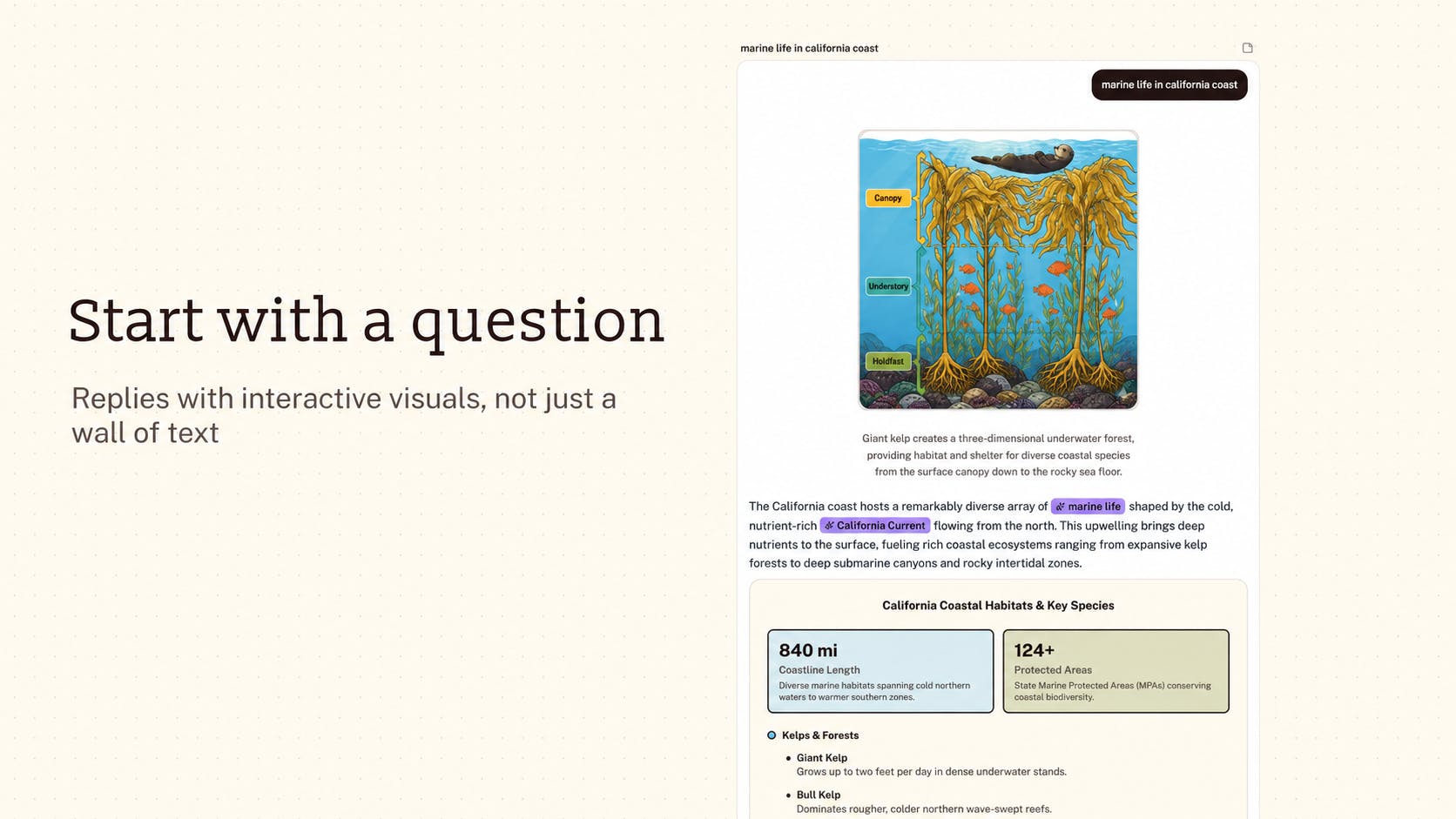
Wondering is a consumer learning app that generates a personalized, structured path of roughly three-minute lessons on any topic — with interactive diagrams, course podcasts, exercises, streaks, and an AI tutor chat. Wondering Canvas, the subject of this report, extends the product into a visual workspace: users ask a question, receive diagram-based explanations instead of text walls, and spin any key term or sentence into a parallel chat thread, keeping explorations organized on one canvas. apps.apple
The company is a two-person YC S26 startup in San Francisco, founded in 2026 by Cheng-Wei Hu (ex-NotebookLM) and Angelica Kosasih (ex-Meta), who have built together for five years. Founder-market fit is unusually direct: the CEO previously worked on Google’s flagship AI learning product, and the CTO brings engineering depth from Meta. ycombinator
The strongest positive signals are product velocity and founder quality: within one month of public launch the team shipped a second, technically distinct surface (Canvas), won #1 Product of the Day on Product Hunt with the main app, and engaged critics substantively in launch comments. YC backing provides capital and network. launly
The most important concern is structural: the core value proposition — AI-generated personalized lessons and visual explanations — is being commoditized by the largest players in consumer AI. Duolingo made its AI tutoring free for all users in January 2026, ChatGPT offers canvas-style workspaces, and Google NotebookLM is the founder’s own former product and could absorb this functionality at zero price. No revenue, user, retention, or conversion data is publicly available, and the US App Store listing shows no visible ratings yet. ycombinator
The decision is Watch: a credible founding team with an early, well-executed product in a proven category, but one month of public life, no commercial evidence, low defensibility, and an unassessable valuation do not yet justify formal diligence.
Product Overview
Problem: Self-directed learning is unstructured. Adults who want to understand a new domain — for work, study, or curiosity — face either dense primary sources or fragmented video/content browsing; generic AI chat gives answers but shallow retention, and learning is rarely linear, while chat threads are. producthunt
How it works: Users enter a topic, link, PDF, or goal; AI generates a structured roadmap of bite-sized lessons with visuals, then supports learning via podcasts, interactive exercises, knowledge cards, streaks, and friend streaks. Canvas adds a parallel exploration layer: each question opens a thread rendered with interactive diagrams; any term or sentence can spin off into its own thread carrying context; suggested next questions highlight “what you don’t know you don’t know”; related threads group into one canvas, with highlighting and notes. apps.apple
Target users: Curious adult learners, students, and professionals upskilling, primarily English-speaking markets; the founders also invite organizations that want to teach with the platform. ycombinator
Pricing: Free to start; Wondering Pro at $14.99/month or $107.99/year, including unlimited daily lessons, AI chats, and podcasts, capped at 15 course creations per month, subject to “abuse and reliability guardrails”. apps.apple
Platforms: iOS app (Wondering Labs, Inc., live since roughly March 2026) and desktop web; Canvas is part of the web product. apps.apple
Primary benefit: Comprehension that sticks — complex topics decomposed into a personalized, delightful path. Replaces: unstructured ChatGPT sessions, YouTube browsing, and course platforms for self-directed learning.
Founder and Team Assessment
Both founders are independently verified through YC, LinkedIn, and Cornell’s startup directory: Cheng-Wei Hu (CEO, previously Google NotebookLM) and Angelica Kosasih (CTO, previously Meta software engineering), Cornell Tech graduates who have built together for over five years. The team is exactly two people, based in San Francisco, active and responsive — the founder spent launch day answering technical criticism in PH comments and disclosed the roadmap (summaries, canvas-to-course conversion). ycombinator
Founder-market fit is excellent on the product side: NotebookLM experience maps directly onto AI-assisted understanding. Commercial capability is untested — no prior exits or operating experience at scale is verifiable. Key-person risk is maximal: two founders constitute the entire company. ycombinator
Founder Assessment: Strong, directly relevant technical-founder pairing with high credibility; commercial scaling ability and durability are entirely unproven.
Market Opportunity
The initial segment is English-speaking adult self-learners using AI to master non-language topics — professionals upskilling, students supplementing coursework, and curious hobbyists. Willingness to pay is proven in the category: Duolingo, the model’s explicit reference point, converted gamified micro-learning into roughly ten million paying subscribers at $84–168/year tiers. Wondering prices Pro at $108/year, between Duolingo’s Super and Max tiers. apps.apple
Bottom-up: capturing even 150,000 paying learners at ~$100/year yields ~$15M ARR — a strong seed-stage outcome but far from venture-scale. The category ceiling supports much more (Duolingo’s scale), but that ceiling is defended by incumbents with free AI features. Expansion paths mentioned by the founders include organizations teaching with Wondering — a B2B/B2B2C direction that would raise contract values. Timing is favorable: generative AI now makes per-user course generation economically plausible, and demand for AI tutors is rising. The realistic addressable market supports a meaningful business; whether it supports a venture-scale one depends on execution against free alternatives. ycombinator
Traction and Growth Signals
Available evidence: the main app reached #1 Product of the Day on Product Hunt (August 4, 2026) with #22 weekly ranking and 18 tracked comments, per a third-party tracker whose vote count for the page appears unreliable (reported zero alongside a #1 daily rank). The product page has 690 followers; Canvas launched August 27 with substantive technical engagement, including a sharp critique of branching-canvas design that the founder answered directly. Independent mentions include a LinkedIn recommendation describing it as “Duolingo but for everything” and directory listings updated August 2026. launly
Missing metrics: everything commercial. No user counts, downloads, paying subscribers, revenue, retention, conversion, or ratings data are public; the App Store listing currently shows no visible ratings. YC acceptance is a selection signal, not traction. apps.apple
Traction Assessment: Early launch attention and credible product velocity, but commercially unverified.
Competitive Position
Direct competitors: Duolingo (gamified micro-learning with free AI tutoring since January 2026), Khan Academy’s Khanmigo (free AI tutor), Brilliant (interactive STEM), and a wave of AI learning apps. For Canvas specifically: OpenAI’s ChatGPT Canvas, Google NotebookLM, Claude Artifacts, Heptabase, and fresh entrants like Eureka and Nimo all occupy the visual-AI-thinking space. Free alternatives: ChatGPT itself, NotebookLM, YouTube. launly
Differentiation is UX craft: diagram-first explanations, parallel thread management with context inheritance, streak-based habit mechanics, and the course-conversion loop from canvas explorations. Pricing sits mid-market. There are no network effects, no proprietary data, and low switching costs. producthunt
The platform question is decisive: if OpenAI or Google (whose NotebookLM the CEO helped build) shipped equivalent visual parallel exploration tomorrow — they are one release away from it — Wondering’s remaining answer would be focus, delight, and learning-specific structure. That is a real but narrow answer.
Defensibility Assessment: Low
Business Model and Economics
Revenue is a freemium consumer subscription: $14.99/month or $107.99/year via the App Store, with Apple taking 15–30%. The economics hinge on AI generation costs: each active learner consumes course generation, lesson rendering, TTS podcasts, and chat — with the Pro tier’s 15-course monthly cap and explicit “abuse and reliability guardrails” signaling that the team already manages per-user cost ceilings. A heavy learner could plausibly cost more in inference than their subscription; a light user is high-margin. Whether usage growth outruns inference cost is the central question, and it is unverifiable publicly. apps.apple
Consumer risks: high churn typical of micro-learning apps, App Store dependency and fees, paid acquisition costs in a crowded category, and usage frequency that depends on habit formation. Expansion revenue potential exists via organizational accounts, but it is undeveloped. ycombinator
Unicorn Path
Assume an 8–10x ARR multiple, appropriate for high-growth consumer subscription businesses (Duolingo, the closest comp, trades in that band). A $1 billion valuation requires roughly $100–125M ARR. At an effective $80–100/year net of discounts and churn on iOS, that implies approximately 1.0–1.5 million paying subscribers — about one-tenth of Duolingo’s payer base, achievable in category terms but not against incumbents giving AI tutoring away free. nibble-app
Strategic changes required: establishing a defensible niche where free general assistants underperform (structured professional upskilling, certification-adjacent learning), expanding to team and organizational subscriptions, and building retention mechanics strong enough to sustain multi-year subscriptions. Under the current pure-B2C model against free incumbents, this outcome is not credible without that expansion. ycombinator
Unicorn Path: Conditional
Valuation Assessment
Valuation Attractiveness: Not Assessable. The only disclosed financing is Y Combinator’s standard $500,000 investment; no seed round, SAFE terms, post-money valuation, or revenue data exists publicly. Consumer learning apps span enormous valuation dispersion, and comparable financings at this stage are priced on narrative rather than metrics. Assessment would require: paying-subscriber count, ARR and growth, retention cohorts, gross margin after inference costs, and the terms of any post-YC round. ycombinator
Key Risks
- Free-feature absorption — Duolingo made AI tutoring free in January 2026; ChatGPT and NotebookLM are one release from replicating visual parallel exploration nibble-app
- No commercial validation — one month post-launch; no users, revenue, or retention data; no visible App Store ratings apps.apple
- AI content accuracy — AI-generated courses on complex topics risk errors that undermine trust in an education product
- Unit economics — per-user generation costs versus a $15/month price; course caps and guardrails signal cost pressure apps.apple
- Two-person key-person risk — the founders are the entire team ycombinator
- Consumer churn — habit-dependent micro-learning apps historically suffer steep drop-off
- Crowded canvas category — Canvas competes with ChatGPT Canvas, Artifacts, NotebookLM, and multiple funded startups producthunt
- Brand collision — “Wondering” is shared with an established UK user-research platform (a secondary article already confused the two), and “Canvas” collides with OpenAI’s Canvas and Instructure’s Canvas LMS toolwise
Final Assessment
Venture Potential: 54/100
| Category | Score |
|---|---|
| Market Size and Expansion Potential | 14/20 |
| Traction and Growth Evidence | 6/20 |
| Founder and Team | 11/15 |
| Product Strength | 7/10 |
| Distribution Potential | 8/15 |
| Business Model and Economics | 5/10 |
| Defensibility | 3/10 |
| Total | 54/100 |
Strongest elements: exceptional founder-market fit, proven category demand, and visible product velocity. Weakest: defensibility against platforms that can ship the same feature free, zero commercial evidence, and uncertain unit economics in a per-user generation-cost business.
Evidence Confidence: 50/100
Verified: founders, backgrounds, team size, entity (Wondering Labs, Inc.), headquarters, YC S26 affiliation and standard investment, pricing, platforms, launch dates, and PH results. Company-reported: all product claims and engagement. One secondary source misidentifies the company as the unrelated UK user-research platform; primary sources (YC, App Store, PH) resolve the identity. Unavailable: revenue, users, retention, conversion, burn, and valuation. ycombinator
Final Decision: Watch
Wondering is exactly the kind of company worth monitoring: a focused, technically credible founding team with direct domain experience, YC backing, and a well-executed product in a proven category. But it is one month past public launch with no commercial evidence, no defensibility against free incumbent features, and no valuation data. The framework’s DD bar — credible early traction — is not yet met.
Upgrade Conditions
- Disclosed paying subscribers and ARR trajectory over two consecutive quarters
- 30/90-day retention above consumer-learning benchmarks
- Evidence of a defensible niche (e.g., professional upskilling) where free assistants demonstrably underperform
- Signed organizational accounts validating the B2B direction
- A seed round with disclosed terms that can be assessed against traction
- Visible App Store ratings at scale with positive review substance
Downgrade Conditions
- Duolingo, OpenAI, or Google shipping equivalent structured learning or parallel-canvas features free
- Weak free-to-Pro conversion or high early churn once data emerges
- AI-accuracy failures that damage trust in an education context
- Either founder stepping back or the product going quiet post-launch
- Growth stalling beyond Product Hunt-driven acquisition spikes
Questions for Further Diligence
- What are current paying-subscriber count and MRR/ARR since the July 30 launch?
- How many registered users and 30-day actives, and what is the D30/D90 retention curve?
- What is free-to-Pro conversion, and which topics convert best?
- What percentage of generated courses are actually completed?
- What is the fully loaded inference and generation cost per active learner per month versus ARPU?
- What prompted the 15-course monthly cap and the “abuse and reliability guardrails”?
- What are Canvas engagement metrics — canvases created, threads per canvas, return visits?
- How is content accuracy validated for complex topics like the analytic philosophy example?
- What is the acquisition mix (organic, PH, App Store, paid), and what is CAC on iOS?
- What are the plans and status for organizational/team accounts?
- Is a seed round in progress, and on what terms?
- How does the team respond strategically if NotebookLM or ChatGPT ships parallel visual learning?
Sources
- Product Hunt — Wondering Canvas producthunt
- Y Combinator — Wondering company page ycombinator
- App Store — Wondering: Learn Anything apps.apple
- Wondering — official website wondering
- Cheng-Wei Hu — LinkedIn linkedin
- Angelica Kosasih — LinkedIn linkedin
- Launch announcement — LinkedIn linkedin
- Launly — launch metrics launly
- Duolingo Max pricing reference (secondary) nibble-app
- Cornell BigRed AI — Wondering profile bigredai
- Y Combinator — funding model ycombinator
- Toolwise — Canvas coverage (secondary; contains company misidentification) toolwise