
Table of Contents
Ayven — Investment Assessment
Category: AI workflow automation; team coordination; B2B SaaS
Company Stage: Early-stage software product; launched publicly in October 2026; financing stage undisclosed
Founder(s): Howard Chen (founder; no other founders publicly identified)
Headquarters: London, United Kingdom (Alknoma states “Made in London”; its registered office is in London)
Funding: No public funding round identified in reviewed sources
Business Model: Team subscriptions, usage credits, and custom enterprise plans
Product Hunt Launch Date: 2026/10/11
Report Date: 2026/10/14
Executive Summary
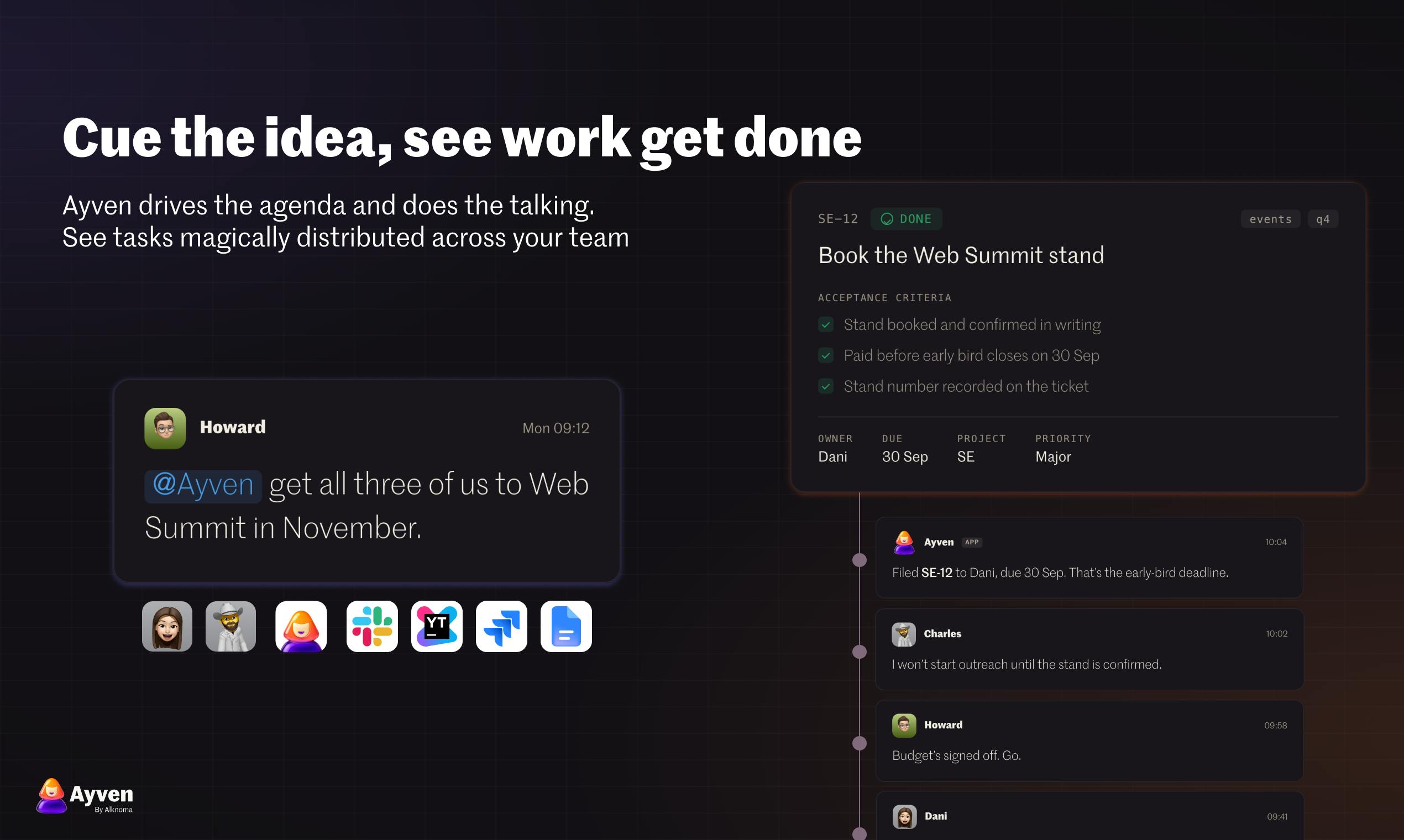
Ayven, built by Alknoma Ltd, is an AI coordination agent for Slack and Microsoft Teams. It converts requests into owned, dated work, asks colleagues for missing information, follows up over time, and checks connected trackers before work is counted complete. It targets the handoffs left to people by chatbots and project boards. Ayven overview
Its distinctive idea is persistence: responsibility and next steps remain active after a conversation ends. It connects Slack or Teams to Jira, YouTrack, Asana, GitHub, Notion, and document storage. Ticket and document edits require approval by default, while messages and comments can be automatic. Customer value remains unverified. Ayven documentation
Ayven offers a free tier, Standard at $179/month billed annually ($199 monthly), Premium at $358/month annually ($398 monthly), credit packs, and custom enterprise plans. Plans cover whole teams. Pricing supports a SaaS model, but paid-customer count, revenue, retention, and cost per run are undisclosed. Ayven pricing
Alknoma Ltd was incorporated in England and Wales in November 2024; it identifies Howard Chen as founder. No financing or independent growth metrics were found. Product Hunt showed 154 points and a #7 rank when reviewed. The maker reports thousands of weekly runs without a customer denominator. These signals do not prove adoption or willingness to pay. Companies House Product Hunt
The key question is whether Ayven can build a trusted coordination layer before incumbents bundle similar agents. Safety, integrations, security, and usage economics need validation. Public evidence supports Watch, not an investment commitment.
Product Overview
Ayven works in Slack, Microsoft Teams, a web app, and API. It assigns owners and deadlines, pursues missing answers, updates Jira, YouTrack, or Asana tickets, and tracks longer-running “missions” until the linked work is done. It also offers research and document drafting. Ayven documentation
Ticket and document edits wait for approval unless a team enables auto-approval; messages and comments may be automatic. Ayven claims an audit log, no training on customer data, and SOC 2 Type II certification. Verify the current audit report and data flows. Ayven documentation
Founder and Team Assessment
Alknoma identifies Howard Chen as founder. His Product Hunt launch note says Ayven grew from the problem that agents stop when users stop prompting. Company materials consistently focus on persistent work and team handoffs, supporting founder-market fit at the problem-definition level. Alknoma Product Hunt
Technical and commercial track records, team depth, enterprise sales capacity, financing, and customer references are not publicly clear. These gaps matter for a product maintaining many integrations and handling sensitive data.
Founder Assessment: The founder shows a focused view of workflow coordination, but the team’s ability to deliver, sell, and secure an enterprise-grade agent remains unverified.
Market Opportunity
Ayven targets product, operations, and engineering teams coordinating work across chat, documents, and ticketing systems. It sells team subscriptions, with enterprise options. No reliable market-size estimate for this specific category was found.
At the $179 Standard annual-billing price, one team account represents $2,148 ARR; 10,000 accounts imply $21.48 million ARR and 50,000 imply $107.4 million, before discounts, churn, and costs. These are scenarios, not forecasts or TAM. Premium and enterprise mix could raise revenue per account, but is unknown. Pricing
Buyers can also use process changes or built-in automation; Ayven must show that cross-system follow-through saves enough time to justify another vendor.
Traction and Growth Signals
On October 14, Product Hunt showed 154 points and a #7 rank. The maker says an internal agenda became a populated board and reports thousands of weekly runs. These self-reported signals do not establish external customers, payment, quality, or retention. Product Hunt
Public plans and documentation show a marketable product, but no customer list, revenue, activation, churn, or case studies were found. Earlier company material describes design-partner outreach, not verified adoption. Alknoma blog
Traction Assessment: Product availability and launch activity are positive early signals, but external adoption, retention, and monetization remain unproven.
Competitive Position
Ayven differentiates through a persistent loop: track waits across days or weeks, ask the right colleague, and verify the board before closing work. Cross-platform support may suit teams unwilling to standardize on one suite; approval gates limit unreviewed changes. Ayven documentation
Incumbents are direct competitors. Asana AI Studio automates workflows in Asana; Atlassian Rovo agents act in Jira and Confluence; Slack offers agents and workflow automation. They have distribution, enterprise relationships, and native workflow context. Asana Atlassian Slack
Cross-platform reach may differentiate Ayven, but increases integration and permission complexity. Trust and persistent workflow state become a moat only with reliable use on important work.
If the largest platform in this market launched the same feature within six months, why would customers continue using this product?
The best answer is that Ayven coordinates across multiple vendors and maintains work state beyond a single chat or tracker. That answer must be proven through superior follow-through, reliable integrations, and measurable customer outcomes.
Defensibility Assessment: Low. The product has a clear workflow concept, but the feature set is replicable and no durable data, distribution, or retention advantage is public.
Business Model and Economics
Pricing is team-based: Free includes 500 monthly credits; Standard costs $179/month annually or $199 month-to-month; Premium costs $358 annualized or $398 month-to-month. Enterprise is custom. Credit packs cost $40/500 or $100/2,000; each completed run uses one credit on free and credit-pack plans. Pricing
The model supports recurring and expansion revenue. But inference, retries, integrations, and monitoring make cost per account uncertain. Ayven must show that retention and revenue cover support, hosting, model, and sales costs; whole-team pricing may undercharge large or heavy users.
Unicorn Path
At an illustrative 8x ARR, a $1 billion enterprise value requires $125 million ARR. At $2,148 Standard ARR per team, that is about 58,200 Standard-equivalent accounts; at 5x, $200 million ARR or 93,100 accounts. This sensitivity excludes other plans, discounts, churn, and costs.
Scale requires repeatable sales, retention, safe execution, and attractive usage economics despite platform competition. None is established publicly.
Unicorn Path: Conditional. The recurring team SaaS model can support venture scale in theory, but the required account scale and platform competition make execution uncertain.
Valuation Assessment
No public priced financing, valuation, or ownership terms were identified. The company’s pricing shows a potential product revenue model, not equity value. Without financing terms, ARR, growth, retention, and gross-margin data, entry valuation cannot be judged.
Valuation Attractiveness: Not Assessable.
Key Risks
- Bundling: Collaboration and project platforms can add similar agents.
- Adoption: Launch attention and reported runs do not prove paid use.
- Integration fragility: API or permission changes can break workflows.
- Reliability: Stale context or missed follow-ups can harm execution.
- Action safety: Automatic messages can confuse; approvals must be auditable.
- Security: Data and SOC 2 claims need independent evidence and data-flow review.
- Cost to serve: Agent runs and monitoring may erode margins.
- Pricing fit: Flat team plans may undercharge heavy users.
- Capacity: Team depth, runway, and financing plans are unknown.
Final Assessment
| Metric | Assessment |
|---|---|
| Venture Potential | 66/100 |
| Unicorn Path | Conditional |
| Valuation Attractiveness | Not Assessable |
| Evidence Confidence | 60/100 |
| Final Decision | Watch |
Evidence Confidence: 60/100. Product features, pricing, registration, and founder identity are documented. Adoption, revenue, retention, security, and margins are uncertain because metrics are private and usage claims are self-reported.
Final Decision: Watch. Revisit after paid growth, retention, workflow quality, and cost per run are disclosed. Upgrade on customer proof and sound unit economics; downgrade for reliability or security failures or effective platform bundling.
Due-Diligence Questions
- How many active workspaces and paying teams use Ayven?
- What are ARR, growth, retention, and churn by plan?
- What are activation and 30-, 90-, and 180-day retention rates?
- What are mission success and escalation rates?
- What is inference and tool cost per completed run?
- Which customers can verify measurable time savings?
- What data is retained and which vendors process it?
- Can Alknoma provide its SOC 2 report and penetration-test results?
- How does the team maintain its integrations?
- What are financing history, runway, hiring plan, and acquisition channel?
Sources
- Ayven product overview — features, integrations, and control claims.
- Ayven pricing — tiers and credit packs.
- Product Hunt — launch signals and founder statement.
- Alknoma and Companies House — founder and registration.
- Competitor sources: Asana, Atlassian, Slack.
- Alknoma blog — product history.
Conclusion
Ayven addresses a real coordination problem with persistent, cross-tool follow-through. Its live SaaS product merits attention, but adoption, economics, and defensibility remain unproven. Maintain Watch pending customer and retention evidence.