
Table of Contents
Onset MCP Investment Report
Category: Developer tools / product communication (changelog and release notes SaaS with an MCP server)
Company Stage: Bootstrapped micro-SaaS (apparent solo founder, post-relaunch)
Founder or Founders: Sonny T. (Sonny Toma-era projects published under “Sonny T.”; operates under OneClick Labs) — founder-reported
Headquarters: New York, NY, USA
Funding: Not publicly disclosed; no evidence of external investment found
Business Model: SaaS subscription (freemium)
Product Hunt Launch Date: September 2, 2026 (seventh launch from Onset.io)
Report Date: September 5, 2026
| Investment Metric | Assessment |
|---|---|
| Venture Potential | 37/100 |
| Unicorn Path | Improbable |
| Valuation Attractiveness | Not Assessable |
| Evidence Confidence | 50/100 |
| Final Decision | Pass |
Executive Summary
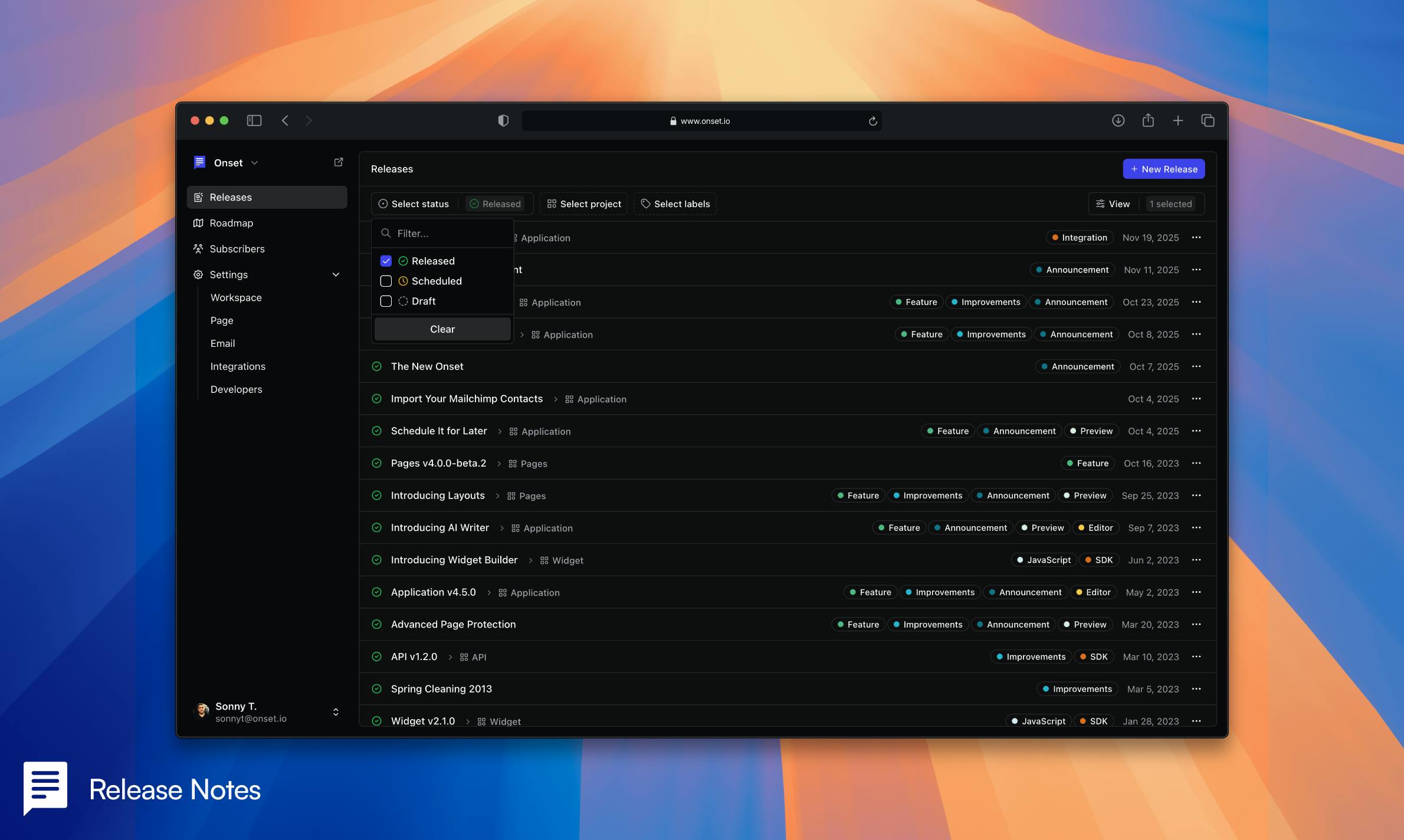
Onset MCP is a Model Context Protocol (MCP) server that lets AI coding assistants such as Claude and Cursor draft, schedule, and publish release notes directly to a branded Onset changelog page, without leaving the editor. It is a feature of Onset, a release-notes and changelog SaaS aimed at small software teams that stop publishing product updates because writing changelogs is the last chore of every release. producthunt
The underlying company appears to be a one-person operation in New York, founded around 2018–2019, run by Sonny T., an experienced software engineer who previously built Ugly Email (a browser extension with 100,000+ weekly users) and sold a WordPress theme marketplace, and who currently holds a full-time Staff Software Engineer role at Intuit. Onset itself was paused around 2023, rebuilt as “The New Onset” in October 2025, and relaunched on Product Hunt in November 2025, making the September 2026 MCP launch its seventh Product Hunt appearance. producthunt
The strongest positive signal is founder-market fit: a technically credible, product-literate builder iterating quickly in a workflow (agent-assisted release communication) that is genuinely emerging. The product is real, documented, and usable on a free tier. onset
The most important concern is structural: this is a low-ACV product ($24–$48/month) in a small, crowded changelog category (Beamer, AnnounceKit, Headway, LaunchNotes, Olvy, Canny, ProductLift, ReleaseNotes.io) where the core capability — an agent writing release notes — is trivially replicable by every incumbent and by the platforms themselves. productbridge
There is no public evidence of revenue, paying customers, retention, or funding. The company is best understood as a promising niche or lifestyle business rather than a venture-scale candidate. Final decision: Pass, with clear conditions under which it could be reconsidered.
Product Overview
The customer problem is well defined: teams ship work and never announce it, because writing the changelog is the last step and it slips. Onset’s answer is a hosted changelog with subscriber notifications, plus an MCP server that lets the AI agent that wrote the code also write and publish the release notes. producthunt
Core workflow: point Claude, Cursor, or any MCP client at the Onset workspace; the agent reads releases and roadmap data, drafts notes, and publishes to the public page after human review. The MCP server never touches GitHub directly — the agent already has the repo open in the editor. Onset also offers native GitHub, Linear, and Jira integrations, an embeddable widget, REST API, SDK, and email notifications. producthunt
Pricing (verified on the official pricing page): Free Forever ($0, unlimited releases, 1,000 subscribers, 1 teammate, custom domain); Team at $24/month; Business at $48/month, with 30-day paid trials. A third-party directory reports annual billing at $288/year (Team) and $576/year (Business) — a secondary source, not independently verified [-source pricing page; see pricing link in Sources]. techshark
The product replaces manual changelogs, GitHub Releases, or heavier changelog suites. It is functional and available today; documentation is live and the free plan works with the MCP server. producthunt
Founder and Team Assessment
Founder identity is verified through his personal site and Product Hunt presence: “Sonny,” a New York City software engineer and founder of OneClick Labs. His verified-track-record projects include Ugly Email (Chrome/Firefox extension, 100,000+ weekly users, #1 on Product Hunt, covered by The New York Times, WIRED, and Bloomberg) and ThemeWizz (marketplace, acquired). He was Senior Director of Engineering at Simulmedia and is currently a Staff Software Engineer at Intuit (since July 2024). sonnyt
Two material observations:
- His own site lists “Founder at Onset, Feb 2019 — Apr 2023,” suggesting the original Onset was wound down or paused, with the current product being a 2025 rebuild. The relaunch history (October 2025 rebuild, November 2025 Product Hunt relaunch, seven total launches) is consistent with a solo founder searching for traction. producthunt
- The concurrent full-time Intuit role implies Onset is, at most, a part-time commitment. LinkedIn shows 1–10 employees and roughly 23 followers, consistent with a single founder. linkedin
No other team members, advisors, or investors could be verified. No funding announcement, investor, or Crunchbase-listed round was found.
Founder Assessment: Strong technical execution and credible product craft, but solo, apparently part-time, with no demonstrated commercial scaling of a B2B SaaS business.
Market Opportunity
The initial customer is narrow: small SaaS and developer-tool teams (roughly 1–20 people) that use Claude, Cursor, or similar agents and want automated customer-facing release notes. Willingness to pay exists but is modest — the entire category prices between $19 and $99/month, with enterprise tools like LaunchNotes at $249–$299/month. productbridge
A rough bottom-up estimate (analyst assumption, not verified data): assume 50,000–100,000 plausible target teams globally, 3–5% reachable and converting at typical SMB SaaS rates, at $288–$576/year. That implies a realistic ceiling of roughly $5–20 million ARR for the category leader. Even the most generous framing — every SaaS team on earth needing changelogs — is a few-hundred-million-dollar category, dominated by incumbents with larger feature sets.
Adjacent expansion (roadmaps, feedback, in-app engagement) moves Onset into direct competition with Beamer, Canny, and Productboard, i.e., away from its wedge. The timing point in its favor is real: MCP became the de facto agent-integration standard after Anthropic open-sourced it in November 2024, and “agent publishes the changelog” is a well-timed use case. media.defense
The realistic addressable market is unlikely to support venture-scale revenue on its own.
Traction and Growth Signals
Verified signals:
- Product Hunt: ~100 upvotes, 11 comments, #15 daily ranking for the Onset MCP launch on September 2, 2026; 174 product followers; seventh launch overall. producthunt
- Comment engagement on the launch was substantive (questions about tone control, GitHub PR integration, templates), and the founder answered all of them in detail — a sign of genuine maker involvement. producthunt
- Product activity is real and continuous: a documented API and SDK, MCP server, integration changes, and public release notes through 2025–2026. releases.onset
Missing metrics: revenue, ARR, paying customers, user counts, retention, website traffic, app-store or marketplace performance, and hiring. Seven Product Hunt launches over multiple years without disclosed commercial traction is itself a signal: repeated launches are a distribution tactic, not evidence of compounding growth. Product Hunt votes have very limited weight here.
Traction Assessment: Genuine product activity and community goodwill, but commercially unverified.
Competitive Position
Direct competitors: Beamer ($49/mo), AnnounceKit ($49–79/mo), Headway ($29/mo), LaunchNotes ($249+/mo, enterprise), Olvy, ProductLift, ReleaseNotes.io, Changelogfy, Canny, Featurebase. Free/manual alternatives: GitHub Releases, static-site changelogs, or simply asking the agent to write notes into a markdown file — which costs nothing. productbridge
Onset’s differentiation is the MCP-native workflow: the agent writes the code and publishes the announcement in the same session. That is a genuine convenience edge today. However, defensibility is weak. Every incumbent changelog vendor can ship an MCP server in weeks; several competitors already market AI-drafted release notes (Olvy, ProductLift). The platforms themselves (GitHub, Linear, Jira, Vercel, Cursor) could bundle changelog publishing natively. Switching costs are minimal — the asset is a public page and a subscriber list, both portable. producthunt
The critical question — “if the largest platform in this market launched the same feature within six months, why would customers stay?” — has no strong answer. Distribution advantage, proprietary data, and network effects are absent.
Defensibility Assessment: Low.
Business Model and Economics
The model is standard freemium SaaS with a generous free tier (unlimited releases, 1,000 subscribers, custom domain) [-pricing]. At $288–$576/year, annual contract value is very low, so the business requires either very high volume or upward price expansion (SSO, EU data residency, and enterprise security are roadmap items, suggesting a future enterprise tier). techshark
Gross margin is presumably high (hosted pages and email; the MCP server itself carries no inference cost — the user’s own model client does the drafting, which is actually a favorable cost structure). Not verified: subscriber email-delivery costs, free-to-paid conversion, churn, and support load.
The economics that matter are unanswerable from public data: no customer counts, no conversion, no retention. What is visible is the price ceiling of the category — sub-$600/year ACV — which makes venture economics arithmetically difficult regardless of execution.
Unicorn Path
Assume a 6–8x revenue multiple (reasonable for a growing SMB SaaS; comparable category tools trade or raise well below peak SaaS multiples). Required revenue for a $1 billion valuation: roughly $125–170 million ARR.
At the current blended price of ~$300–600/year, that implies roughly 250,000–500,000 paying teams — a multiple of the entire realistic category, and far beyond what incumbents with years of head start have achieved. Reaching that scale would require: a strategic transformation into a broader product-communication or customer-engagement platform (competing head-on with Beamer/Canny-class companies), enterprise contracts with much higher ACVs, international expansion, and full-time founder commitment with external capital. None of these is currently visible.
Unicorn Path: Improbable.
Valuation Assessment
No funding history, investors, rounds, SAFE caps, or valuations are publicly disclosed. No comparable financings for a changelog micro-SaaS of this size were found. Revenue is unknown, so no revenue-multiple framework can be applied responsibly.
“Valuation Attractiveness: Not Assessable.” To assess it, the following would be required: current ARR, revenue growth, retention, burn, runway, round size or SAFE cap, post-money valuation, and investor ownership.
Key Risks
- Category size: the changelog market likely caps out well below venture-scale revenue.
- Founder commitment: the founder appears to hold a full-time Intuit role; key-person risk is total.
- Defensibility: the MCP workflow is trivially replicable by incumbents and platforms.
- Low ACV: $288–$576/year requires enormous customer volume for meaningful revenue.
- Traction opacity: seven launches, no disclosed revenue, users, or retention — the 2019–2023 pause suggests prior inability to reach escape velocity. sonnyt
- Competitive pricing pressure: free alternatives (GitHub Releases, agent-written static changelogs) sit directly beneath the paid tier.
- Solo-operator capacity: no hiring, no team, no investor support visible.
- Platform dependency: value is contingent on Cursor/Claude-style agent workflows remaining open to third-party MCP servers.
Final Assessment
Venture Potential: 37/100
| Category | Score |
|---|---|
| Market Size and Expansion Potential | 8/20 |
| Traction and Growth Evidence | 4/20 |
| Founder and Team | 7/15 |
| Product Strength | 6/10 |
| Distribution Potential | 5/15 |
| Business Model and Economics | 5/10 |
| Defensibility | 2/10 |
| Total | 37/100 |
Strongest elements: founder-market fit and product timing. Weakest: market ceiling, defensibility, and absence of commercial evidence.
Evidence Confidence: 50/100
Verified: founder identity and background, headquarters, pricing, product existence and activity, launch history. Company-reported: positioning and free-tier terms. Unknown: revenue, users, retention, funding, valuation, team beyond the founder. Product and team evidence is solid; commercial evidence is entirely absent.
Final Decision: Pass
Onset MCP is a well-built, well-timed product by a credible technical founder, but it operates in a small category, at low price points, with minimal defensibility, no disclosed commercial traction, and an apparently part-time solo founder. It fits a bootstrapped/niche profile, not a venture-fundable one. This is not a judgment of product quality, which appears good.
Upgrade Conditions
- Demonstrated traction: e.g., $500K–$1M ARR with disclosed growth and retention.
- Full-time founder commitment (departure from Intuit) or a credible team build-out.
- Evidence of expansion beyond changelogs into a larger, defensible workflow with materially higher ACV.
- Verifiable distribution that does not depend on repeated Product Hunt launches.
Downgrade Conditions
- Product dormancy or another pause, as occurred in 2023.
- Incumbent MCP launches (Beamer, Linear, GitHub) eroding the differentiation.
- No movement on paid conversion after the free-tier MCP distribution.
Questions for Further Diligence
- What is current MRR/ARR and monthly growth since the October 2025 relaunch?
- How many paying customers, and what is free-to-paid conversion?
- What are 30/90/180-day retention and logo churn on paid plans?
- Is Onset full-time for you, and what is your commitment split with your Intuit role?
- What did the 2019–2023 version of Onset achieve in users and revenue before the pause?
- What are gross margin and monthly infrastructure/email-delivery costs at current scale?
- What is the acquisition mix beyond Product Hunt, and what is observed CAC?
- How many workspaces actively use the MCP server, and at what publish frequency?
- What is the roadmap for enterprise features (SSO, EU residency) and target ACV?
- Have you raised any capital, and on what terms?
- How do you respond if GitHub or Linear ships native AI changelog publishing?
- What is the subscriber email list worth — i.e., does distribution via your customers’ audiences create any compounding advantage?
Sources
- Product Hunt — Onset.io / Onset MCP producthunt
- Onset official website onset
- Onset pricing page techshark
- Onset documentation docs.onset
- Founder site (Sonny T.) sonnyt
- Onset LinkedIn company page linkedin
- “The New Onset” rebuild release, Oct 2025 releases.onset
- Onset Product Hunt relaunch note, Nov 2025 releases.onset
- Hunted.space launch stats hunted
- Onset features page (MCP, API, SDK) onset
- Competitor landscape — ProductBridge productbridge
- Competitor landscape — ProductLift productlift
- TechShark Onset review (secondary source for billing details) techshark