
Table of Contents
- Live Captions by Subanana Investment Report
Live Captions by Subanana Investment Report
Category: AI speech-to-text, multilingual live captioning, transcription, and translation
Company Stage: Seed-stage operating company; exact financing stage not independently verified
Founder or Founders: Kevin Wong and Hinnes Lung founded Datax; Aric Fung publicly describes himself as Subanana co-founder and growth lead
Headquarters: Hong Kong
Funding: Amount not publicly disclosed; Datax appears in Alibaba Entrepreneurs Fund’s portfolio with a 2020 investment
Business Model: Freemium subscription SaaS, usage allowances, and custom enterprise/private-deployment contracts
Product Hunt Launch Date: September 10, 2026
Report Date: September 13, 2026
| Investment Metric | Assessment |
|---|---|
| Venture Potential | 65/100 |
| Unicorn Path | Conditional |
| Valuation Attractiveness | Not Assessable |
| Evidence Confidence | 55/100 |
| Final Decision | Watch |
Executive Summary
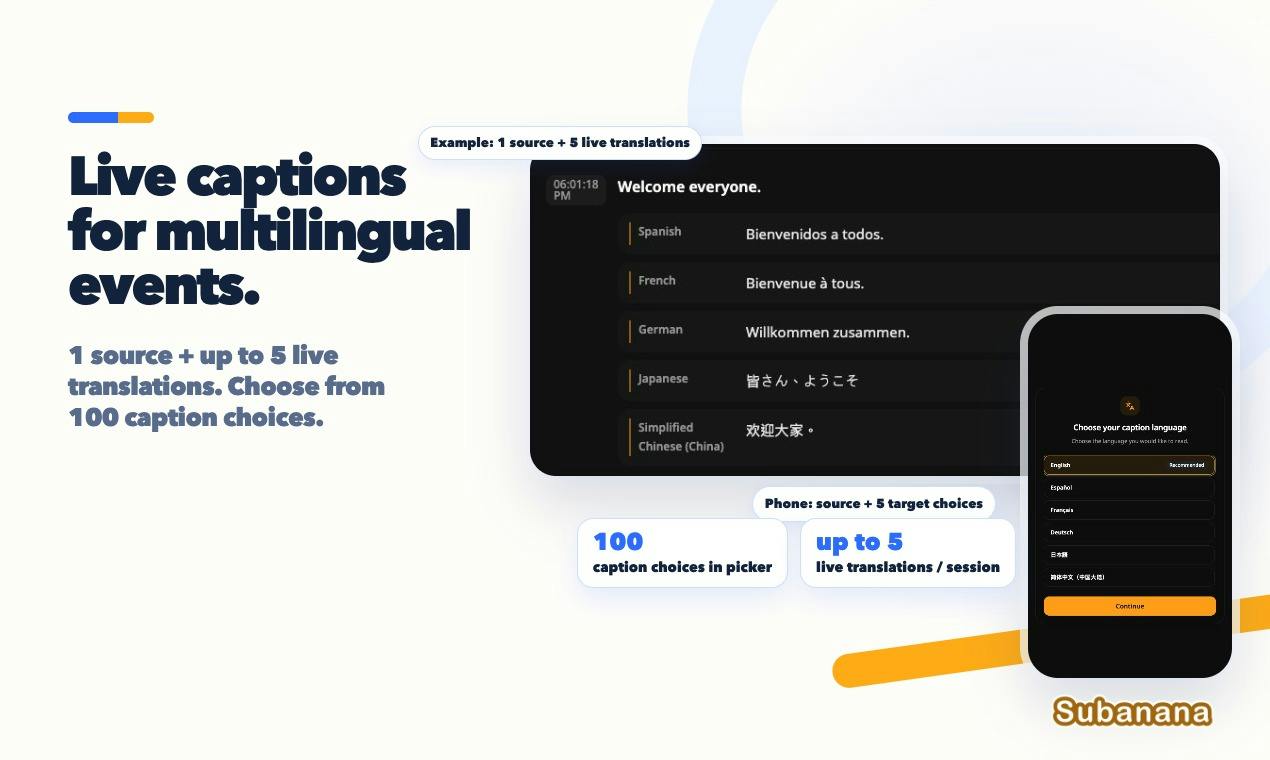
Live Captions by Subanana provides real-time captions and translations for conferences, classrooms, religious services, webinars, and hybrid broadcasts. A speaker starts an event, audience members scan a QR code, and each attendee can follow captions on their own device. Captions can also appear on a projector or be sent to production software such as OBS or vMix. The product supports the speaker’s original language and up to five translated languages (official product page).
The product is part of a broader Subanana workspace offering uploaded-file transcription, subtitles, translation, meeting recording, summaries, and interview-research workflows across more than 95 languages. Its initial differentiation is handling Cantonese, code-switching, and other multilingual audio that general-purpose transcription products may process inconsistently. Subanana says it selects speech models by language rather than relying on one model for every input, although its claimed 98% average word accuracy has not been independently validated (official website).
The strongest positive investment signal is that Subanana is not simply a Product Hunt prototype. Its owner, Datax Limited, has operated since 2017, and Subanana reports more than 200,000 users. Datax’s website also references historical media coverage stating that approximately 700 enterprises, media companies, and creators used Subanana. These are company-reported or company-republished figures; current activity, paid conversion, and revenue are not disclosed (Datax; Subanana).
The central investment concern is monetization. The self-service plans are inexpensive, while Live Captions is restricted to the $50-per-month Max plan. At those price levels, the company would need hundreds of thousands of paid accounts to support a unicorn valuation unless it develops a much larger enterprise business. Revenue, retention, paid customers, gross margin, and customer acquisition costs are all unknown.
The underlying company has a credible technical history and an identifiable regional wedge, but the new live-caption product remains commercially unvalidated. Privacy-policy inconsistencies and the absence of independently verified customer metrics further limit conviction. Final Decision: Watch.
Product Overview
Subanana addresses the difficulty and cost of making spoken content accessible across languages. Traditional alternatives include professional interpreters, human captioners, separate translation feeds, or built-in captions from meeting platforms. These can be expensive, platform-specific, or inaccurate when speakers alternate between languages.
For live events, Subanana captures microphone audio and produces captions in the source language plus as many as five translation languages. Audience members access the feed through a link or QR code without installing software. Event operators can display two languages on a large screen, provide individual-language views on audience phones, or output a caption layer to broadcast software. The service includes pausing, event archiving, downloadable transcripts, microphone selection, customizable display modes, and caption history (Live Captions).
Live Captions is available on the Max plan. Other users receive a one-time five-minute trial. According to the published pricing and support documentation:
| Plan | Annualized Price | Included Transcription |
|---|---|---|
| Free | $0 | 15 minutes per project |
| Lite | $108 | 720 minutes/year |
| Pro | $216 | 2,160 minutes/year |
| Max | $600 | 7,200 minutes/year |
| Team/Enterprise | Custom | Custom |
Sources: pricing page and usage documentation.
The platform is primarily web-based. A Chrome extension records Google Meet, Microsoft Teams, and Zoom sessions locally before users choose whether to upload them. The extension was updated on September 10, 2026, but the Chrome listing does not disclose a meaningful public user or review count (Chrome Web Store). No verified first-party iOS or Android Subanana app listing was found.
Product-quality assessment: The workflow is coherent, inexpensive, and more flexible for physical events than captions built into a single meeting platform. Accuracy, latency under event conditions, and resilience to noisy rooms remain insufficiently independently tested.
Founder and Team Assessment
Datax was founded in 2017 at the University of Hong Kong by Kevin Wong and Hinnes Lung. Wong is identified as CEO and Lung as CTO. Their initial business focused on data labeling and commercial AI solutions before expanding into OCR, computer vision, and multilingual speech recognition (HKU Business School).
Hong Kong Science and Technology Parks reports that Datax received workspace and researcher support and that Subanana emerged from the company’s speech and language work. It also describes Hong Kong and Cantonese localization as the company’s original market wedge (HKSTP profile).
Aric Fung publicly identifies himself as a Subanana co-founder responsible for growth. Public sources do not make clear whether he is a legal co-founder of Datax, a later co-founder of the Subanana product line, or an employee with a co-founder title. LinkedIn places both Subanana and Datax in the 11–50 employee range, but exact full-time headcount and allocation between product and custom-services work are not publicly disclosed.
The team has relevant experience delivering speech recognition and other applied-AI projects, including work referenced for Hong Kong government departments. However, no previous exit was found, and the balance between recurring SaaS revenue and project-based AI services is unknown.
Founder Assessment: Strong applied-AI and regional language experience, but SaaS scaling and international commercial execution remain unproven.
Market Opportunity
The narrow initial customers are organizers of multilingual events, universities, houses of worship, webinar producers, and Hong Kong organizations that need accurate Cantonese/English code-switching. The economic buyer is likely an event organizer, operations team, accessibility lead, educational institution, or communications department.
Willingness to pay is established by professional interpretation and enterprise captioning services. For comparison, Wordly offers AI captions and translation for meetings and events, with packages starting around $1,500, while KUDO sells AI and human interpretation through event and annual plans (Wordly pricing; KUDO pricing). Subanana’s $600 annual Max plan is therefore inexpensive, but it may also leave substantial willingness to pay uncaptured.
No reliable public count of the narrowly addressable event organizers or multilingual institutions was found. Illustrative, not forecast, revenue scenarios are:
- 10,000 Max subscribers × $600 annually = $6 million ARR.
- 25,000 organizations × $2,000 blended annual spend = $50 million ARR.
- 10,000 enterprise accounts × $10,000 ACV = $100 million ARR.
The last two scenarios require a significant enterprise sales motion, multi-seat administration, stronger compliance, higher usage allowances, integrations, and service-level guarantees. Adjacent expansion opportunities include meeting intelligence, media localization, accessibility compliance, transcription APIs, private deployments, and Asia-Pacific language infrastructure.
The realistic market can support a venture-scale business, but Subanana must become more than a low-priced captioning subscription. The larger opportunity is a multilingual speech-workflow platform for organizations.
Traction and Growth Signals
Available signals include:
- Subanana reports 200,000-plus users, but does not define registered, active, or paying users (official website).
- Datax republishes historical media reporting that approximately 700 enterprises, media companies, and creators used the software; contract status and current activity are unknown (Datax).
- Historical reporting cited by Datax stated that 13,000 people used an early version over six months to generate subtitles for more than 9,000 videos. This is evidence of early use, not current retention.
- The company reports that median processing time for a one-hour meeting improved from 26.8 minutes in July 2025 to 4.9 minutes in July 2026. The measurements are company-produced and exclude failed jobs (performance update).
- The Product Hunt page showed approximately 173 points. Search results conflict on placement: the daily leaderboard lists the product at approximately fifth, while the awards page labels it “Launch of the Day.” Product Hunt attention is not evidence of paid adoption (Product Hunt; awards).
- Datax appears in Alibaba Entrepreneurs Fund’s portfolio, with an investment year of 2020 and a listed seed fundraising stage; the investment amount is not disclosed (portfolio entry).
There is no public ARR, revenue growth, paid-customer count, live-event volume, caption minutes processed, retention, conversion, or customer concentration data.
Traction Assessment: Evidence of a functioning, established product and substantial claimed free usage, but commercial traction remains unverified.
Competitive Position
Direct event-caption competitors include Wordly, KUDO, Interprefy, and other AI interpretation platforms. Adjacent competitors include Notta, Otter, Fireflies, Descript, Happy Scribe, and Rev. Built-in alternatives include translated captions in Zoom, Microsoft Teams, and Google Meet (Zoom support; Microsoft Teams; Google Meet).
Subanana’s current advantages are:
- Cantonese and mixed-language positioning;
- model routing by language;
- audience access through QR codes;
- physical-event and broadcast-display support;
- a broader workspace spanning live, recorded, meeting, and subtitle workflows;
- substantially lower entry pricing than specialist enterprise-event vendors.
Switching costs are low for one-off events. Saved glossaries, archives, workflows, and organization settings could create moderate workflow retention, but there is no proven network effect or proprietary data advantage. The company may improve models using de-identified individual-account data, subject to opt-out, but the scale and defensibility of this dataset are unknown.
If the largest platform launched the same feature within six months, why would customers stay? The credible answer is superior Cantonese/code-switching accuracy, platform independence, public-display workflows, and lower pricing. If independent benchmarks do not validate the accuracy advantage, that answer weakens considerably.
Defensibility Assessment: Low.
Business Model and Economics
Subanana combines individual subscriptions with custom Team and Enterprise pricing. At the annual allowances, implied subscription revenue per included hour falls from approximately $9 on Lite to $6 on Pro and $5 on Max. Actual gross margin depends on model-provider fees, translation calls, storage, audio processing, failed-job retries, and support.
The company acknowledges that retries may route unsuccessful segments through another model without charging the customer again. This can improve quality but raises variable costs. Subanana also states that transcription represents only about 20% of processing time, with media preparation, cue generation, and preview rendering comprising much of the pipeline. That engineering investment may improve performance but does not establish attractive unit economics.
The free tier and low-cost subscriptions support product-led acquisition. Enterprise deployments could provide higher ACV and better retention, but likely require sales, onboarding, security reviews, data residency, and support. Gross margin, cloud cost per minute, payment-processing expense, acquisition cost, and support burden are not disclosed.
Unicorn Path
Assume an 8× ARR multiple, appropriate only for a growing subscription-software company with strong retention and software-like gross margins.
Required ARR = $1 billion ÷ 8 = $125 million.
At current pricing, that would require approximately:
- 208,000 Max subscribers at $600 annually;
- 694,000 subscribers at a hypothetical $180 blended annual revenue; or
- 12,500 enterprise customers at $10,000 ACV;
- 2,500 enterprise customers at $50,000 ACV.
The self-service paths appear unrealistic without global mass-market distribution and low churn. The enterprise scenarios are more credible but require a strategic transition: stronger security credentials, organization controls, APIs, integrations, regional hosting, sales capacity, and proof that multilingual accuracy materially exceeds bundled alternatives.
The company would also need expansion beyond Hong Kong, deeper positioning in regulated and multilingual institutions, and higher contract values than its current self-service plans.
Unicorn Path: Conditional.
Valuation Assessment
Datax is listed as a 2020 portfolio investment by Alibaba Entrepreneurs Fund. Cyberport and HKSTP support are also referenced, but the nature and amount of that support are not fully disclosed. No reliable round size, valuation, SAFE cap, ownership, or current fundraising terms were found.
Valuation Attractiveness: Not Assessable.
Assessment requires current ARR, growth, gross margin, retention, burn, runway, round size, post-money valuation, cap table, investor rights, and the division of revenue between Subanana SaaS and Datax services.
Key Risks
- Commercial opacity: Claimed users are not separated into active, free, and paying cohorts.
- Low current ACV: $600 annual Max pricing requires very large subscriber volume.
- Bundling risk: Zoom, Teams, and Google Meet already provide translated captions.
- Weak defensibility: Model APIs and speech-processing infrastructure are broadly available.
- Accuracy claim risk: The reported 98% accuracy lacks an independent methodology or benchmark.
- Privacy inconsistency: Current privacy terms say newly created individual accounts may have de-identified content used for training unless they opt out, while a help article says uploaded content is not used for training (privacy policy; help article).
- Sensitive-data exposure: The privacy policy says PostHog session recordings may capture displayed transcripts and subtitles for up to 90 days.
- Regional concentration: Evidence of adoption is concentrated in Hong Kong.
- Services distraction: Datax’s custom AI work may compete with product development for management attention.
- Enterprise-readiness gap: Public documentation does not establish SOC 2, ISO 27001, or comparable certification.
Final Assessment
Venture Potential: 65/100
| Category | Score |
|---|---|
| Market Size and Expansion Potential | 14/20 |
| Traction and Growth Evidence | 11/20 |
| Founder and Team | 12/15 |
| Product Strength | 8/10 |
| Distribution Potential | 9/15 |
| Business Model and Economics | 7/10 |
| Defensibility | 4/10 |
| Total | 65/100 |
The strongest elements are the experienced applied-AI team, established product history, regional language specialization, and coherent expansion across speech workflows. The weakest are low self-service ACV, unverified commercial traction, low switching costs, and strong bundled competition.
Evidence Confidence: 55/100
Verified information includes the legal owner, product functionality, pricing, product documentation, founder identities, Chrome extension, and historical institutional support. User counts, accuracy, processing performance, and enterprise usage are company-reported. Revenue, retention, paid customers, margins, funding amount, valuation, burn, and runway remain unavailable. The conflict in data-training disclosures also reduces confidence.
Final Decision: Watch
Subanana merits continued monitoring but not yet formal investment diligence. Its existing user claim and founder experience are stronger than those of a typical launch-stage product, yet there is insufficient evidence that usage converts into a scalable, defensible SaaS business. A credible venture case depends on enterprise adoption and higher ACV rather than the current low-priced consumer plans.
Upgrade Conditions
- Verified ARR of at least $1 million with strong recurring growth.
- Disclosure of paying-customer count and conversion from the 200,000 claimed users.
- At least 70% six-month paid retention.
- Multiple referenceable event, university, government, or enterprise contracts.
- Demonstrated gross margin above 70% after speech and translation costs.
- Independent benchmarks confirming superior Cantonese and code-switching accuracy.
- Repeatable acquisition outside Hong Kong and Product Hunt.
- Clear, consistent training-data policies and recognized security certification.
Downgrade Conditions
- Claimed users prove predominantly inactive or promotional.
- Weak Max-plan conversion or high annual renewal churn.
- Enterprise contracts remain primarily custom services rather than recurring software.
- Bundled platform captions reach comparable Cantonese accuracy.
- Inference and translation costs prevent attractive gross margins.
- Material privacy, consent, or event-recording complaints.
- Declining product-release activity or reduced founder commitment.
Questions for Further Diligence
- How many of the claimed 200,000 users were active in the last 30 and 90 days?
- What are current ARR, MRR, monthly growth, and paid-account count?
- What percentage of revenue comes from Subanana subscriptions versus Datax services?
- What are free-to-paid conversion and 30-, 90-, and 180-day retention?
- How many customers use Live Captions repeatedly after their first event?
- What are gross margins and model, translation, storage, and processing costs per live hour?
- How many enterprise customers pay more than $10,000 annually?
- What independent tests support the 98% accuracy claim?
- Why do the privacy policy and help center give different answers on model training?
- What are current burn, runway, headcount, and founder time allocation?
- What funding has Datax raised, and what are the current cap table and financing terms?
- What is the roadmap for APIs, enterprise integrations, compliance certifications, and international distribution?