
Table of Contents
- AI Observability by OpenObserve Investment Report
AI Observability by OpenObserve Investment Report
Category: Open-source observability infrastructure / AI and LLM observability
Company Stage: Series A
Founder or Founders: Prabhat Sharma
Headquarters: San Francisco Bay Area; public sources differ between San Francisco and Menlo Park, California
Funding: $10 million Series A; an earlier seed round is confirmed, but its amount is not publicly disclosed
Business Model: Open-source core, usage-based managed cloud, and enterprise subscriptions/support
Product Hunt Launch Date: September 10, 2026
Report Date: September 13, 2026
| Investment Metric | Assessment |
|---|---|
| Venture Potential | 78/100 |
| Unicorn Path | Plausible |
| Valuation Attractiveness | Not Assessable |
| Evidence Confidence | 68/100 |
| Final Decision | DD |
Executive Summary
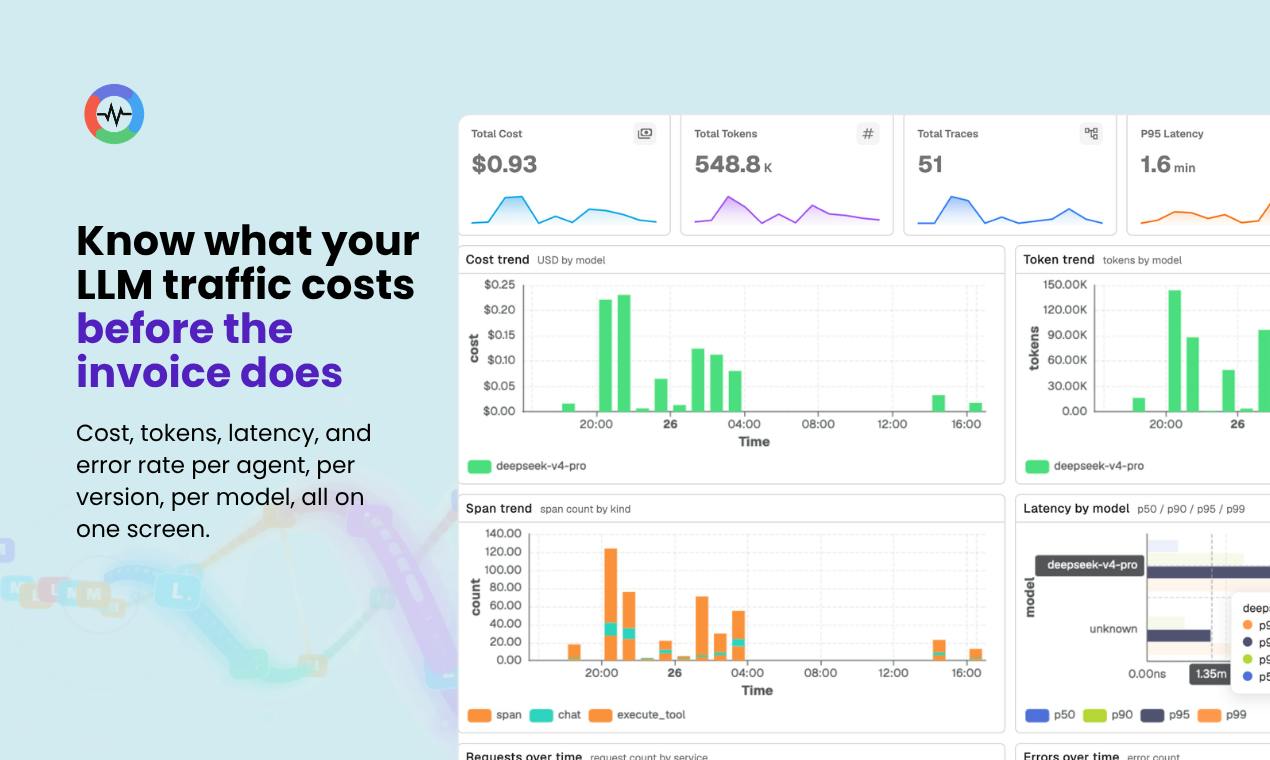
OpenObserve is an open-source observability platform covering logs, metrics, traces, real-user monitoring, alerting, incident management, and AI/LLM observability. Its newly launched AI product traces model calls, tools, agent handoffs, sessions, token costs, and evaluations while correlating them with application and infrastructure telemetry in the same system (AI Observability).
The product addresses a real infrastructure problem: AI teams frequently use one tool for LLM traces and evaluations and separate platforms for application, database, and infrastructure telemetry. OpenObserve’s strongest differentiation is not simply LLM tracing; it is the ability to connect an agent failure with the underlying API, database, Kubernetes, or infrastructure event through OpenTelemetry-compatible traces.
The strongest investment signal is sustained open-source and production adoption beyond Product Hunt. As of September 2026, the official GitHub repository showed approximately 21,700 stars and 1,070 forks, while the company reports more than 9,000 active deployments and approximately 5 PB of daily data processing (GitHub; company overview). The $10 million Series A was led by existing seed investors Nexus Venture Partners and Dell Technologies Capital, providing external validation of the technical team and enterprise opportunity (funding announcement).
The principal concern is the lack of disclosed commercial metrics. Active deployments primarily measure open-source usage and cannot be equated with paying customers. ARR, revenue growth, cloud-versus-self-hosted mix, retention, gross margin, customer concentration, and sales efficiency are not publicly disclosed. OpenObserve is also competing against larger full-stack platforms and well-adopted specialist AI-observability products.
The product appears venture-backable and the market clearly supports large outcomes, but an investment cannot be recommended without commercial and financing data. Final Decision: DD.
Product Overview
OpenObserve serves DevOps, SRE, platform-engineering, and AI-engineering teams that need to collect and analyze high-volume telemetry without operating several separate databases and monitoring interfaces.
The AI Observability product captures LLM and tool calls as OpenTelemetry spans. It reconstructs multi-agent runs, groups traces into conversations, attributes token cost, supports versioned evaluators, and connects AI activity to logs, metrics, databases, Kubernetes, and other application traces. Customers can self-host the product or use OpenObserve Cloud; evaluations can use customer-controlled model-provider keys (product page).
The broader platform includes logs, metrics, traces, dashboards, RUM, session replay, error tracking, alerts, SLOs, pipelines, incident management, and synthetic monitoring. Version 1.0, released September 11, 2026, added general-availability AI observability, annotation queues, datasets, experiments, a playground, agent/service graphs, and related evaluation workflows (release notes).
Managed-cloud pricing starts at $0.50 per GB ingested plus $0.01 per GB queried, with 30-day retention for non-metric data and 15 months for metrics. Enterprise pricing is custom and adds deployment flexibility, longer retention, BYOB storage, RBAC, SSO, audit trails, AI capabilities, support, and SLAs (pricing). The open-source core uses the AGPL-3.0 license.
Product-quality assessment: Technically broad and relevant, with credible release activity and an attractive cost-oriented architecture. Product Hunt reviews are directionally positive on efficiency and support but report weaker UI and trace navigation; the small review sample is not representative evidence of customer satisfaction (Product Hunt).
Founder and Team Assessment
Founder and CEO Prabhat Sharma has strong founder-market fit. His public profile shows roughly five years at AWS in solutions-architecture roles, including container and Kubernetes specialization, following infrastructure and technology-management roles at Accenture, HSBC, and other financial-services companies (founder profile). Dell Technologies Capital independently highlights his prior AWS experience and work with enterprise cloud environments (investor assessment).
LinkedIn lists 36 associated employees and a company-size band of 11–50, while the company describes the team as globally distributed (LinkedIn; About). The Series A announcement also names Shani Shoham as chief revenue officer, indicating an effort to build a formal go-to-market organization.
No previous founder exit was found. Exact headcount, executive ownership, employee retention, and engineering concentration are not publicly disclosed.
Founder Assessment: Strong technical and enterprise-infrastructure fit; repeatable commercial execution remains to be verified.
Market Opportunity
The initial segment is engineering organizations operating cloud-native applications or production AI agents with enough telemetry volume to make incumbent observability pricing material. These customers may pay from thousands to hundreds of thousands of dollars annually depending on ingestion, retention, support, and compliance requirements.
The market is demonstrably large. Datadog reported $3.43 billion of FY2025 revenue and 4,310 customers with at least $100,000 of ARR (Datadog results). Grafana Labs reported more than $400 million ARR and over 7,000 customers in September 2025 (Grafana Labs). These figures establish that open and commercial observability platforms can support venture-scale revenue.
A defensible count of OpenObserve’s potential customers is not publicly available. A practical bottom-up route to $100 million-plus ARR could be:
- 10,000 customers at $12,500 average ARR;
- 2,500 mid-market customers at $50,000 average ARR; or
- 500 large enterprises at $250,000 average ARR.
These are analyst scenarios, not forecasts. Expansion opportunities include AI evaluation, incident response, synthetic monitoring, security analytics, longer data retention, and managed deployments across additional regions.
Traction and Growth Signals
Verified or observable signals include:
- Approximately 21,762 GitHub stars and 1,076 forks as of the report date, with code pushed on September 13, 2026 (GitHub API).
- Version 1.0 contained 295 open-source commits since the prior release and listed 29 contributors (release notes).
- The company reports 9,000-plus active deployments and 5 PB processed daily; these remain company-reported rather than independently audited metrics (About).
- Dell Technologies Capital states that OpenObserve is used by a Fortune 10 enterprise, multinational financial institutions, and thousands of production teams (investor page).
- Public customer stories include Uno.ai, DevZero, Stonal, Evereve, and Jidu, with reported migration and cost-saving outcomes (customer stories).
- The Product Hunt launch reached approximately 300 points and ranked second for September 10. This demonstrates launch interest, not product-market fit (Product Hunt).
- Active hiring includes sales roles, consistent with use of Series A proceeds to expand go-to-market operations (careers).
Missing metrics include ARR, paid-customer count, cloud ingestion growth, conversion from open source to paid, gross and net revenue retention, churn, pipeline conversion, and customer concentration.
Traction Assessment: Strong developer and deployment adoption, but commercially under-disclosed.
Competitive Position
Direct competitors include Datadog, Grafana Cloud, Elastic, New Relic, Splunk, SigNoz, and Dash0. AI-specific competitors include Langfuse, Arize Phoenix, Braintrust, LangSmith, and incumbent LLM-observability modules. Datadog already offers agent traces, evaluations, datasets, experiments, and correlation with infrastructure and RUM (Datadog Agent Observability). Langfuse claims more than 100 integrations and substantial production adoption, making it a serious specialist competitor (Langfuse).
OpenObserve’s advantages are its unified telemetry store, S3-native architecture, self-hosting, open-source distribution, OpenTelemetry compatibility, and transparent ingestion pricing. Switching costs rise after customers centralize dashboards, retention policies, alerts, and incident workflows, but OpenTelemetry also makes data portable and therefore reduces lock-in.
If a major platform launched the same feature within six months, customers would continue using OpenObserve primarily for cost, self-hosting, data control, and full-stack correlation. That is credible, but not unassailable: Datadog and Grafana already offer comparable platform breadth, and SigNoz prices logs and traces at $0.30/GB versus OpenObserve’s listed $0.50/GB before retention differences (SigNoz pricing).
Defensibility Assessment: Medium.
Business Model and Economics
The model combines free self-hosted software with managed-cloud usage charges and enterprise contracts. This supports efficient developer-led acquisition while preserving monetization through hosting, support, security, governance, and operational convenience.
Potential gross margins should resemble infrastructure SaaS rather than lightweight application SaaS because storage, query compute, data transfer, and customer support scale with telemetry volume. The S3/Parquet architecture could create a structural cost advantage, but audited cost-of-revenue and gross-margin data are unavailable. Customer-provided evaluator keys may limit OpenObserve’s direct AI-inference exposure.
A key commercial risk is that aggressive cost positioning could constrain gross profit unless storage and compute efficiency are as strong in production as claimed. Sales-assisted enterprise deployments may also require significant migration and support resources.
Unicorn Path
For a growing observability infrastructure company, an illustrative 8× ARR multiple is reasonable but not guaranteed; it assumes strong growth, retention, and software-like gross margins. At that multiple:
Required ARR = $1 billion ÷ 8 = approximately $125 million.
This could require approximately 2,500 customers at $50,000 ARR or 500 large enterprises at $250,000 ARR. Grafana’s reported $400 million ARR demonstrates that an open-source observability company can exceed this threshold, but OpenObserve’s current paid scale is unknown.
Reaching it would require converting open-source deployments into cloud or enterprise contracts, establishing repeatable enterprise sales, maintaining strong net retention through telemetry expansion, and proving that AI observability increases contract value rather than remaining a bundled feature.
Unicorn Path: Plausible.
Valuation Assessment
The company raised a $10 million Series A led by Nexus Venture Partners and Dell Technologies Capital in April 2026. Both investors also participated in an earlier seed round, whose size was not disclosed in the primary sources reviewed (announcement).
The Series A post-money valuation, ARR, round terms, ownership, and current fundraising status are not publicly disclosed.
Valuation Attractiveness: Not Assessable.
Assessment requires current ARR, growth, gross margin, retention, burn, runway, round valuation, liquidation preferences, and fully diluted ownership.
Key Risks
- Commercial conversion risk: 9,000 deployments may include mostly non-paying self-hosted users.
- Incumbent competition: Datadog, Grafana, and Elastic can bundle AI observability into existing enterprise contracts.
- Specialist competition: Langfuse and other AI-native tools may remain stronger in prompt management, experimentation, and developer workflows.
- Unverified economics: Storage efficiency claims do not establish cloud gross margin or support costs.
- Limited lock-in: OpenTelemetry and open standards simplify both adoption and switching.
- Enterprise sales execution: The company is expanding GTM after being primarily developer-led.
- Security exposure: Observability stores prompts, source code, credentials, and operational telemetry; a breach would be material. OpenObserve reports SOC 2 Type II certification and security controls, but independent audit materials were not reviewed (security).
- Founder/key-person concentration: Public evidence identifies one founder; broader executive and succession depth is unclear.
Final Assessment
Venture Potential: 78/100
| Category | Score |
|---|---|
| Market Size and Expansion Potential | 19/20 |
| Traction and Growth Evidence | 14/20 |
| Founder and Team | 13/15 |
| Product Strength | 9/10 |
| Distribution Potential | 12/15 |
| Business Model and Economics | 6/10 |
| Defensibility | 5/10 |
| Total | 78/100 |
The strongest elements are a large proven market, credible technical founder, substantial open-source adoption, and a product that spans traditional and AI observability. The weakest are undisclosed commercial performance, unknown unit economics, and competition from both incumbents and AI-native specialists.
Evidence Confidence: 68/100
Product functionality, pricing, GitHub activity, founder identity, funding, and several customer references are verifiable. Deployment volume and daily ingestion are company-reported. ARR, paid customers, growth, retention, margins, burn, runway, valuation, and round terms remain unavailable. Headquarters disclosures also vary between San Francisco and Menlo Park.
Final Decision: DD
OpenObserve has enough technical adoption, market credibility, founder-market fit, and product depth to warrant formal diligence. It does not qualify for “Invest” because valuation, commercial traction, retention, economics, and financing terms are unknown.
Upgrade Conditions
- Verified ARR above $5 million with strong year-over-year growth.
- Evidence that a meaningful share of active deployments convert to paid contracts.
- Gross margin above 70% after storage, query compute, and support.
- Net revenue retention above 120% or similarly strong cohort expansion.
- Multiple referenceable six-figure enterprise customers.
- Repeatable sales economics and limited customer concentration.
- Evidence that AI observability drives new revenue or material expansion.
Downgrade Conditions
- Minimal conversion from self-hosted adoption to paid usage.
- Cloud gross margins materially below infrastructure-software norms.
- High churn after initial cost-driven migrations.
- AI functionality remains a parity feature rather than a purchasing driver.
- Material security incident or misleading deployment/customer claims.
- Enterprise pipeline requires excessive professional services.
Questions for Further Diligence
- What are current ARR, monthly growth, and cloud-versus-enterprise revenue mix?
- How many of the 9,000-plus deployments are active paid customers?
- What are gross retention and net revenue retention by cohort?
- What percentage of customers adopt AI observability, and how does it affect ACV?
- What are gross margins after storage, query compute, support, and data transfer?
- What is the conversion rate from open-source deployment to paid cloud or enterprise?
- What are median and top-decile ACVs, sales cycles, and customer acquisition costs?
- How concentrated is revenue among the ten largest customers?
- Which AI-observability capabilities win against Datadog and Langfuse in competitive trials?
- What are burn, runway, current headcount, and hiring plan?
- What are the fully diluted cap table, Series A valuation, and liquidation preferences?
- Which security certifications have completed third-party audits, and can reports be provided?