
Table of Contents
ChatGPT Space — Venture Investment Report
Prepared: 8 October 2026 | Product owner: OpenAI | Decision: Pass
Snapshot
| Metric | Assessment |
|---|---|
| Product | Shared home for editable Pages, files and collaborative work inside ChatGPT |
| Core capabilities | Create/edit Pages with ChatGPT, organize content into Spaces, share access, co-edit, comment and use connected tools |
| Availability | Pro, Business and Enterprise; create/edit on web and desktop, read/share on mobile |
| Launch limits | Collaborative slides and spreadsheets are listed as coming soon; mobile editing is unavailable at launch |
| Monetization | Bundled with paid ChatGPT plans; no standalone Space price or revenue disclosed |
| Strategic role | Increase ChatGPT’s value as a persistent workspace for people and AI |
| Investable company | None; this is an OpenAI feature |
| Final Decision | Pass |
Executive view
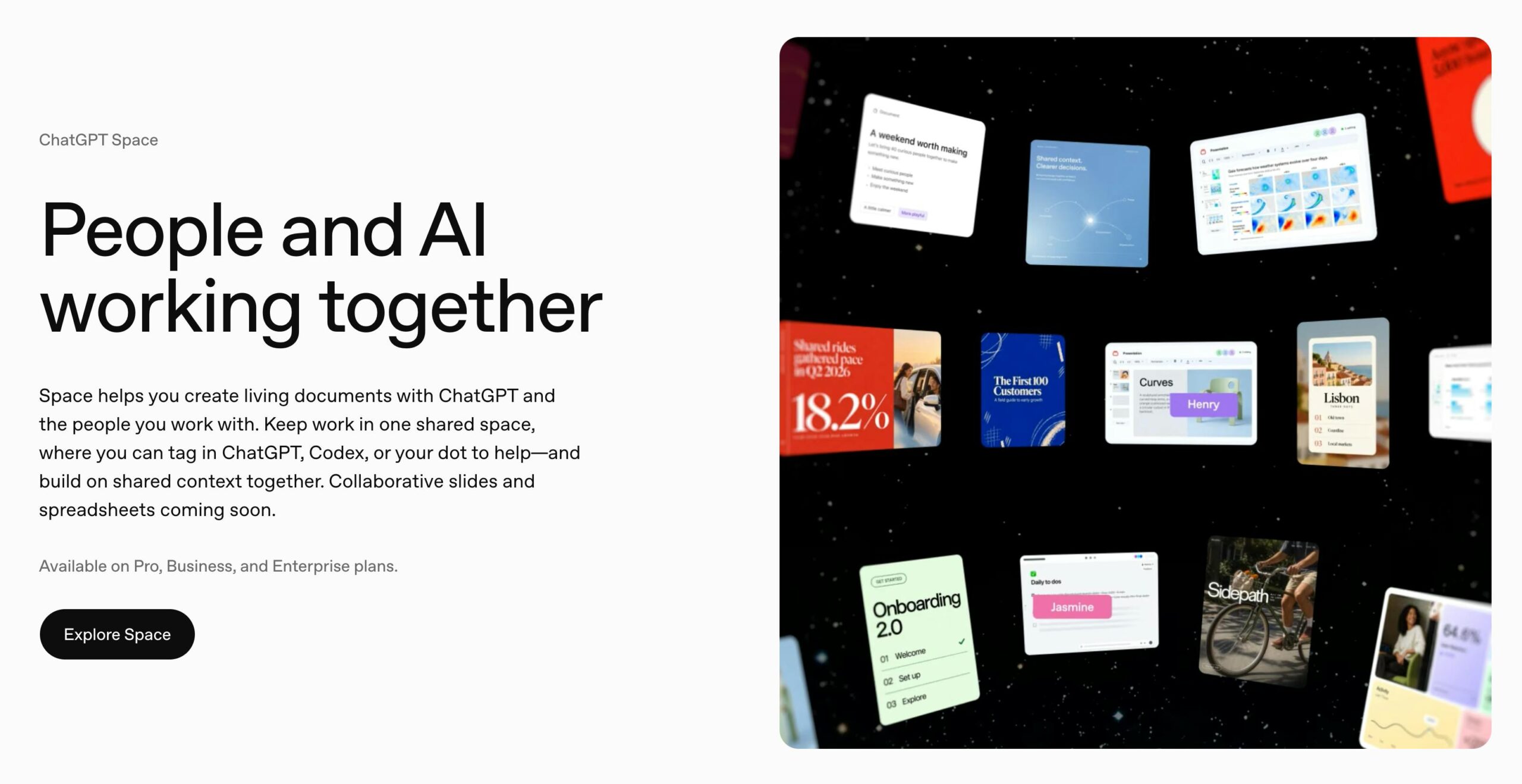
ChatGPT Space is a shared home for pages, uploaded files and related work inside ChatGPT. Users can ask ChatGPT to create or edit a page, organize pages and files into named spaces, and share work with individuals or teams. Collaborators can edit the same page in real time, comment on passages, and ask their own ChatGPT to work with shared content. The product page also describes bringing ChatGPT, Codex or a dot into the work.
This moves ChatGPT from a conversation interface toward a persistent work surface. Teams often need an editable artifact they can organize, revise and share after AI has helped produce it. Space keeps that artifact and its AI assistance in one environment. If teams return to shared pages repeatedly, the feature could increase paid-plan usage and reinforce ChatGPT subscriptions.
Official documentation says Space is available to Pro, Business and Enterprise users. Create/edit works on web and desktop; mobile supports finding, reading and sharing, but not editing at launch. Collaborative slides and spreadsheets are still listed as coming soon. Space does not replace Projects, which continue to organize project chats, files and instructions. The current product is a shared page and file workspace, not yet a complete replacement for every document suite.
Recommendation: Pass as a venture investment target. Space is an OpenAI feature, not an independent company or financing opportunity. Its commercial value belongs within OpenAI’s subscription and retention strategy. Public materials do not isolate Space adoption, paid conversion, retention lift or incremental revenue from the rest of ChatGPT.
Product and customer value
A Page is an editable document that can start blank or draw on notes, a conversation or uploaded context. Users can revise it directly or ask ChatGPT to change a section, compare proposals, summarize files or build charts and interactive tools. A Space groups related Pages, files and folders; nested Pages can keep a summary and supporting material together. Teams can share view/edit access, comment and collaborate in real time.
This combines a knowledge container with an AI editor. A team can turn a conversation into a project brief, meeting notes, research summary or launch update, then continue working on the same artifact. Each collaborator can use their own ChatGPT on shared content without gaining access to others’ private chats or Memory. The product page also describes using connected sources such as Google Drive and Slack. Source-file permissions remain separate from permissions on the shared Page.
The clearest value is for teams that repeatedly turn conversations, files and research into shared deliverables. Space reduces the handoff between asking AI for help and maintaining a document colleagues can review. It may also make useful AI work easier to find than relying on chat history alone.
Important limits remain. Mobile is currently a read-and-share surface. Collaborative slides and spreadsheets are not available at launch according to the Help Center. Existing Projects remain separate, so users may need to decide whether work belongs in a Project, a Space or both. Users are also advised to verify facts, calculations and sources before sharing AI-created content.
Market and strategic position
The opportunity sits across team collaboration, knowledge management and document creation, with AI inside the work rather than as a separate step. Space enters a category where organizations already maintain shared documents, project workspaces and files. Its advantage is distribution: ChatGPT can create or update an artifact in the same product where users already ask questions and upload context.
Space can be strategically important without a separate price. If teams store work in ChatGPT, share it with colleagues and return to update it, the feature may increase paid-plan usage and reduce switching. Business and Enterprise availability ties it to organizational purchases. This is a plausible strategic benefit, not a published financial result.
The product must compete with established systems for documents and team projects as well as other AI-assisted workspaces. Its distinction is the combination of ChatGPT context and shared editable Pages, not storage alone. It must become reliable enough for users to trust it as a working copy while preserving clear links to source files and permissions.
Monetization, distribution and evidence
Space is included with Pro, Business and Enterprise access; the official materials reviewed do not list a separate Space price. Its financial contribution is therefore indirect in public evidence: subscription acquisition, plan upgrades, retention, seat expansion or increased usage. OpenAI has not published Space-specific user counts, activity, paid conversion, retention uplift, document volume or revenue.
The key commercial question is whether Space activates new team use and improves renewal or expansion. For Business and Enterprise, workspace sharing settings apply, which can reduce procurement friction but also means the feature competes for attention with existing systems of record. A user may create a page in ChatGPT but continue to keep final work elsewhere.
Product maturity is still developing. The Help Center lists collaborative slides and spreadsheets as coming soon, says automatic page updates are unavailable at launch, and notes that Space is not yet available for certain data-residency regions. Users can ask ChatGPT to update a page with an automation, but still return to review the result. These gaps create roadmap potential while limiting current product-level adoption evidence.
Privacy, governance and execution
Pages can contain material from chats, uploads, connected services or personal context. OpenAI’s Help Center says uploaded files follow the Page’s permissions, while links to separately stored files retain their original permissions. If ChatGPT copies or summarizes source information onto a shared Page, everyone with Page access can read that content even if they cannot open the original source. Users need to review content and access settings before sharing.
Memory and training settings can differ across collaborators. OpenAI says Business and Enterprise data is not used for training by default. For individual accounts, each collaborator’s own settings apply; shared content may be used for training through another person’s interaction if that person’s setting allows it. This matters for teams mixing personal and organization accounts. Enterprise administrators may need to enable sharing, and access can be inherited from parent pages or a Space.
Deletion and access changes also need clear handling. The Help Center says deleting a parent Page moves its subpages to Trash, including subpages owned by other people. Moving a Page can change access through its new parent. These are manageable product issues, but mistakes could expose content or disrupt workflows.
Key risks
- No separate investible entity: Space is an OpenAI feature with no separate equity or cap table.
- Attribution gap: Space-specific adoption, retention, upgrades and revenue are not public.
- Feature maturity: Collaborative slides and spreadsheets, mobile editing and automatic updates are limited or forthcoming.
- Permission complexity: Pages, parent spaces, subpages, uploads and linked source files have distinct access rules.
- Training-setting mismatch: Shared content may be handled under collaborators’ individual settings.
- Crowded workflow category: Teams already use established systems for documents, project work and shared files.
- Quality responsibility: AI-created content can contain errors; users must verify it before sharing.
- Bundled economics: Space’s contribution to subscription demand is not separately measurable in public materials.
Investment scorecard
| Dimension | Score | Rationale |
|---|---|---|
| Customer problem | 4/5 | Teams need durable shared artifacts after AI-assisted work |
| Product integration | 4/5 | Pages and AI editing sit inside ChatGPT |
| Market potential | 4/5 | Broad collaboration and knowledge-work category |
| Product maturity | 3/5 | Useful core, with mobile and collaborative file-format gaps |
| Differentiation | 3/5 | ChatGPT context is valuable; sharing and pages are familiar behaviors |
| Commercial evidence | 2/5 | Included in paid plans, but Space-specific use and revenue are undisclosed |
| Governance readiness | 3/5 | Controls are documented; permission and training interactions add complexity |
| Investibility | 0/5 | OpenAI product with no separate financing vehicle |
| Overall | 2.9/5 | Pass as a direct VC target; strategically relevant OpenAI feature |
Diligence questions
- How many Pro, Business and Enterprise users create or edit a Page each week?
- What share of Spaces are shared with another person or team, and how often do collaborators return?
- Does Space improve paid-plan conversion, seat expansion, engagement or renewal?
- Which workflows drive repeat use: meeting follow-up, research, planning, file analysis or other work?
- What is the roadmap for collaborative slides, spreadsheets and mobile editing?
- How do users distinguish Space from Projects, chats and other saved-content areas?
- What permission checks prevent copied source material from reaching a wider audience than intended?
- How does the product explain Memory and training behavior when collaborators have different settings?
- What are the rates of accidental oversharing, access-removal requests, restore events and Page-related support cases?
- Which integrations and file types produce retained use, and where do permission boundaries create friction?
- How does Space perform in workspaces where administrators initially restrict sharing?
- Which metrics would show improved team outcomes rather than simply more content stored in ChatGPT?
Sources
- OpenAI Help Center, Space availability, features and controls: https://help.openai.com/en/articles/20001549-getting-started-with-space-in-chatgpt
- Official ChatGPT Space product page: https://chatgpt.com/features/space
- OpenAI DevDay 2026 recap: https://openai.com/index/devday-2026-recap/
- OpenAI ChatGPT plan comparison: https://openai.com/business/pricing/
Conclusion: Space is a coherent extension of ChatGPT into shared, persistent work. It could deepen paid-plan value if teams create and revisit useful Pages, but OpenAI has not published Space-specific adoption or financial results, and several collaboration capabilities remain forthcoming. It is not an independent venture investment target; assess it as part of OpenAI’s broader product strategy.