
Table of Contents
Spira Maxima — Venture Investment Report
Prepared: 8 October 2026 | Company: Spira Lab Inc. | Decision: Watch
Snapshot
| Metric | Assessment |
|---|---|
| Product | Creates finished vertical social videos from scripts, images, voice samples or existing footage |
| Output | Presenter, B-roll, motion graphics, captions and music in one generation; up to 90 seconds |
| Target users | Creators, founders, service businesses, e-commerce brands and marketing teams |
| Product Hunt | Maxima launch ranked #1 of the day with 446 points; launch-week snapshot |
| Pricing | $0.15 per finished-video second after launch promotion; 50% first-month discount |
| Parent plans | Creator listed at $15/month and Growth at $59/month monthly; annual options also shown |
| Traction | No product-level paid usage, retention or revenue disclosed |
| Company | Spira Lab Inc.; founder Long Ma reports prior work across social and creative products |
| Final Decision | Watch |
Executive view
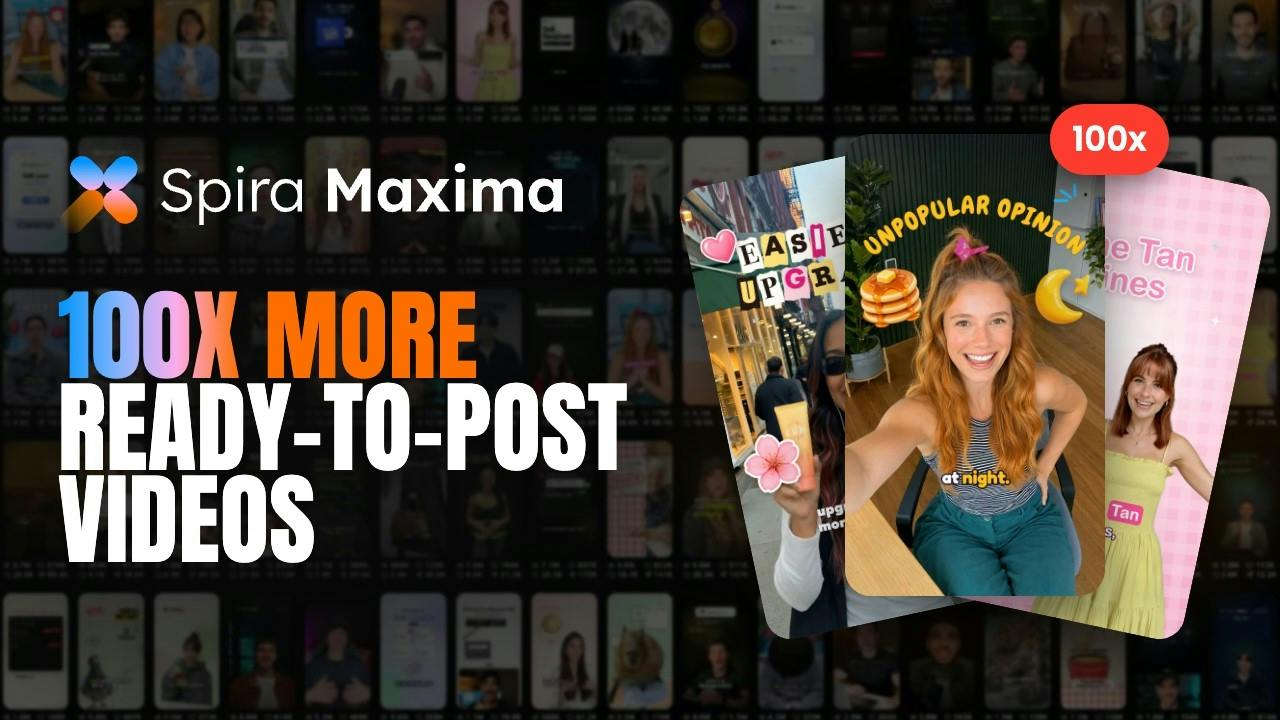
Spira Maxima turns a script into a finished vertical social video. Users can start with text, product or presenter images, an optional voice sample, or an existing recording. The product combines a presenter, B-roll, motion graphics, captions and music, then returns an MP4 intended for TikTok, Reels and Shorts. The company says it can produce up to 90 seconds in one generation, reducing assembly work after using a standalone avatar or video model.
The product targets a real bottleneck: small brands and creators need a steady supply of short-form content, while scripting, filming, editing, captioning and publishing take time. Maxima’s promise is a complete draft that needs little or no editing. If quality is consistent and costs stay low, it could increase content volume for small marketing teams and service businesses.
Product Hunt listed the Maxima launch at #1 of the day with 446 points. Spira’s broader site reports company-level reach and case studies, but these do not prove Maxima conversion, repeat usage or revenue. The product does have clear public pricing at $0.15 per finished second after its launch promotion. This makes willingness to pay easier to test than a waitlist-only product, though generation costs and margins are not public.
Recommendation: Watch. The team reports relevant experience and the product is packaged around an output marketers can publish. Before investing, verify retention, rework rates, cost per finished second, use of faces and voices, content rights and customer performance after publishing.
Product and customer value
Maxima’s differentiator is the complete post, rather than a raw clip. A user can provide a script and product images or start from a recording, then receive a video with subtitles, music and visual treatment. The company says its model is tuned with social trend and performance signals. If that consistently reduces production steps, Maxima can compete on time-to-publish and cost per usable post, not only realism or model benchmarks.
Documented limits vary by plan: Free supports up to 20 seconds and 400 script characters, Creator up to 60 seconds and 1,200 characters, and Growth up to 90 seconds and 1,800 characters. The output is vertical 9:16 MP4 with a caption and hashtags. Video editing, native MCP and CLI integrations, and API access are listed as in development. Until editing and integrations ship, users who need revisions or automated production may still move work into other tools.
Market and competition
The market includes creator video tools, avatar presenters, generative video models, editing suites and social publishing platforms. More products are producing short videos, which puts pressure on price and makes model quality alone a weak moat. Maxima’s positioning is that several production elements arrive together, reducing work between idea and publishable post.
This could help founders, service businesses and e-commerce teams that need frequent explainers, product pitches or ads without production staff. A stronger long-term position would connect generation to brand voice, channel planning, campaign workflow and performance data, then improve the next post using actual outcomes. Spira’s wider social automation suite could support that loop, but marketing material alone does not prove that Maxima users achieve better performance.
Distribution may come from Spira’s existing users and its publishing features. That would help if customers already connect accounts and schedule posts in the platform. Diligence should separate Maxima active users and video revenue from broader company impressions, followers and case studies.
Traction and business model
At research time the Product Hunt launch had a #1 daily rank and 446 points. Spira has launched other products there, so engagement may reflect an existing audience as well as interest in Maxima. It is a top-of-funnel signal, not evidence of repeat generation or paid conversion.
The Maxima page prices finished video at $0.15 per second, with a 50% launch discount for the first month. At the non-promotional rate, a 30-second video is $4.50 before plan or credit treatment. The page says the exact price appears before generation. Spira’s main pricing page lists Creator at $15/month and Growth at $59/month on monthly billing, with an annual Growth option shown at $39/month billed yearly. Confirm how Maxima’s per-second price interacts with subscription credits.
Usage pricing tracks customer value but exposes margin to model, rendering and retries. Request realized price per second, generation cost, failed jobs, credit use, refunds and the share of exports used without substantial editing. Measure weekly active creators, videos exported, repeat generation, conversion and social outcomes by cohort. Public sources reviewed disclose none of these for Maxima.
Team, execution and content rights
Spira Lab Inc. operates the broader product. Its site identifies Long Ma as founder and describes more than ten years building social and creative products, including work connected with Meta, TikTok, CapCut and Creatify. Treat these as company-presented credentials and verify roles, dates, founding team, ownership, funding and who leads Maxima’s model and distribution.
Spira’s Terms of Service deserve close diligence for a product built on users’ faces, voices and brand material. The terms say users retain ownership of uploads but grant Spira a broad license to use, host, adapt and promote them in connection with the service. They also say user content, inputs and outputs may be used to train or improve AI models. For Free-plan generations, outputs and associated inputs may be public by default and used in galleries or marketing; private generation may be offered on paid plans. These terms may affect trust, especially for unreleased products, client assets, voice samples and likenesses.
The terms require users to hold rights to submitted material and say social posts require user preview and approval. Verify consent and deletion controls for face and voice clones, how deletion interacts with training, paid-plan privacy protections, and the process for rights disputes. AI-generated ads also face platform policies, disclosure requirements and brand-safety risks.
Key risks
- Output quality: “Ready to post” needs proof through export-without-edit rates and campaign outcomes.
- Commoditization: Better generative video and avatar models could pressure pricing.
- Unit economics: Generation, rendering, retries and support costs are not public.
- Content rights and privacy: Terms permit training on user content; free outputs and inputs may be public by default.
- Platform dependence: Changes to social network rules or APIs can affect publishing and distribution.
- Attribution: Parent-company impressions and case studies may not reflect Maxima users.
- Pricing clarity: Interaction between per-second charges, subscription credits and plan limits should be explicit.
- Authenticity and safety: Face/voice cloning and synthetic advertising increase consent and brand-safety requirements.
Investment scorecard
| Dimension | Score | Rationale |
|---|---|---|
| Problem severity | 4/5 | Consistent short-form production is labor intensive |
| Product differentiation | 4/5 | Combines presenter, B-roll, captions, music and graphics |
| Team | 4/5 | Founder reports relevant social and creative product experience |
| Market potential | 4/5 | Broad creator and small-business demand in a crowded market |
| Traction | 3/5 | Strong launch attention and prior Spira presence; Maxima usage unknown |
| Business model | 3/5 | Clear per-second price and subscriptions; credit interaction and margins unknown |
| Defensibility | 2/5 | Trend signals and workflow could help but are not proven as a moat |
| Trust and rights | 2/5 | Training and public-by-default free outputs need careful controls |
| Overall | 3.3/5 | Watch; validate repeat use, margins and rights protections |
Diligence questions
- How many unique users have generated a Maxima video, and how many return weekly or monthly?
- What are paid conversion, revenue, repeat purchase and retention for Maxima separately from other Spira products?
- What share of videos is exported as-is, and how much editing or regeneration does a typical post require?
- What is gross margin per finished second after inference, rendering, failures, retries and support?
- How do per-second charges interact with Creator/Growth subscriptions and included credits?
- What independent customer data supports better reach, engagement, leads or sales from Maxima videos?
- How were trend and performance signals obtained, and what rights or licenses apply?
- Can users opt out of training and public galleries, including under free trials and promotional credits?
- How are consent, verification and deletion handled for a user’s face, voice, client footage and product images?
- What are the full founding team’s roles, funding and runway, and roadmap for editing, integrations and API access?
Sources
- Product Hunt, Spira Maxima launch and maker discussion: https://www.producthunt.com/products/spira-ai
- Official Spira Maxima product page and pricing: https://spira.ai/spira-maxima
- Official Spira pricing and plan limits: https://spira.ai/pricing
- Spira Lab Inc. website and founder claims: https://spira.ai/
- Spira Terms of Service, user content, training and free-plan visibility: https://spira.ai/terms-of-service
Conclusion: Maxima is a credible attempt to sell a finished social post rather than another isolated clip generator, with transparent usage pricing and a founder who reports relevant experience. The venture case depends on repeat generation, low cost per usable video and measurable customer results. The current terms around training and free-plan outputs could limit adoption unless users understand and trust the controls. Keep it on the watchlist pending product-level retention, margins and rights safeguards.