
Table of Contents
FetchSandbox MCP Investment Report
Category: Developer tools, API testing, agent infrastructure
Company Stage: Very early / pre-seed; not independently verified
Founder or Founders: Raj Nagulapalle and Pratibha Sharma
Headquarters: Not publicly disclosed
Funding: Not publicly disclosed
Business Model: Freemium usage-based SaaS with custom enterprise contracts
Product Hunt Launch Date: August 23, 2026
Report Date: August 26, 2026
| Investment Metric | Assessment |
|---|---|
| Venture Potential | 55/100 |
| Unicorn Path | Conditional |
| Valuation Attractiveness | Not Assessable |
| Evidence Confidence | 52/100 |
| Final Decision | Watch |
Executive Summary
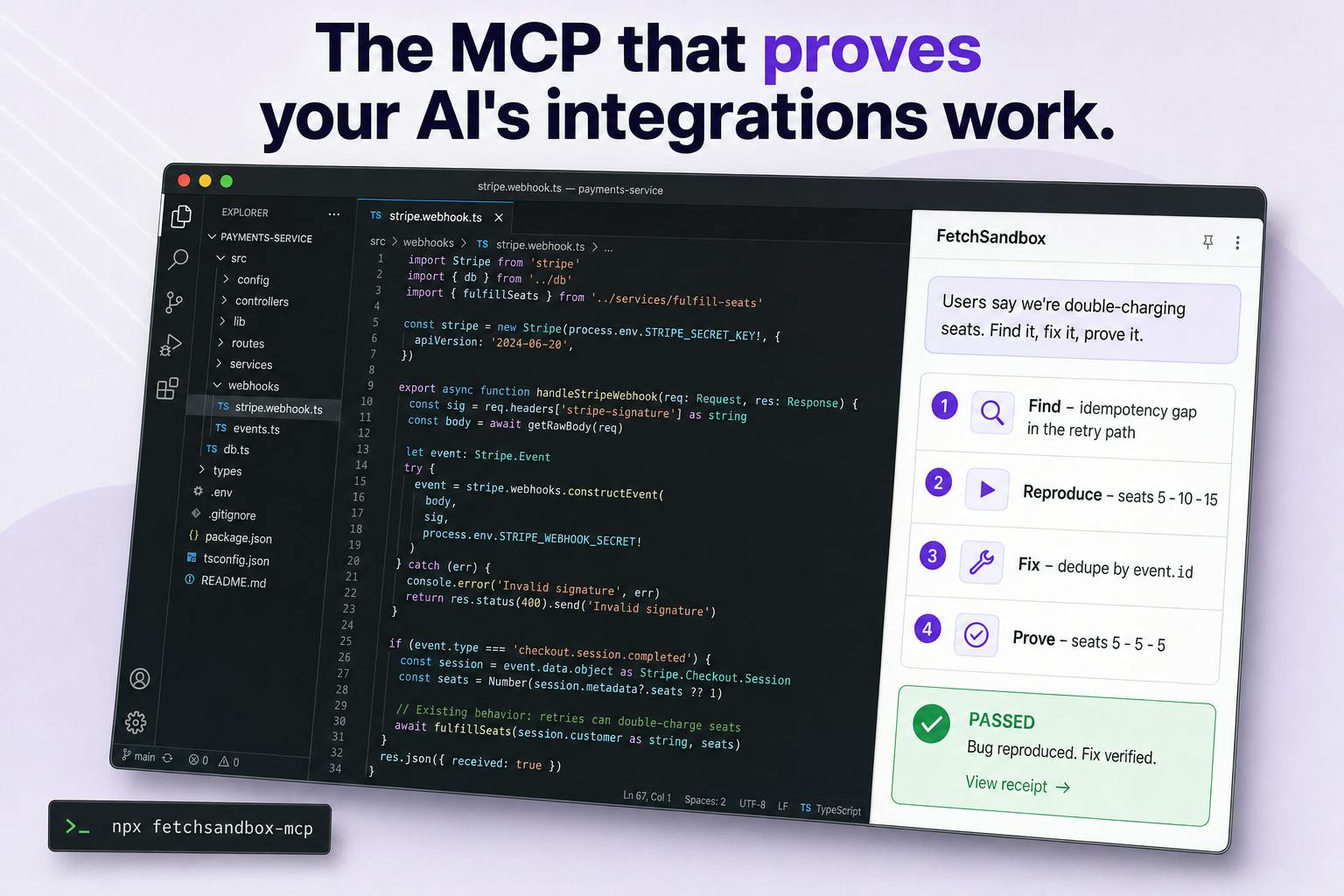
FetchSandbox MCP gives AI coding agents isolated, stateful environments in which to test third-party API integrations. Instead of checking only whether an API returns a successful response, it simulates workflows involving state changes, webhooks, retries, failures, and asynchronous events. The MCP server integrates with tools including Claude Code, Cursor, Codex, Cline, and Windsurf through a small configuration change (installation guide).
The initial customer is a developer or small engineering team using AI-generated code to integrate services such as Stripe, GitHub, Twilio, OpenAI, or Paddle. The product addresses a real problem: agents can generate syntactically plausible integration code without proving that the complete workflow will behave correctly in production.
Product quality appears promising. The hosted sandbox engine is combined with an MIT-licensed MCP server and CLI, which lowers adoption friction. The product’s emphasis on reproducible failure scenarios and shareable test receipts is more differentiated than another API documentation or simple mock-response tool.
The strongest investment signal is founder-market fit. Raj Nagulapalle reports more than 15 years of engineering experience, including API and payment infrastructure roles at PayPal and engineering leadership at Meta. Pratibha Sharma reports product-management experience at Meta and Amazon Lab126. The technical and product backgrounds are relevant, although current roles and full-time commitment require confirmation through diligence.
The primary concern is insufficient commercial evidence. Revenue, paying customers, retention, daily active sessions, enterprise contracts, gross margin, and financing terms are not public. The $5 monthly Pro price also creates a difficult standalone venture equation unless FetchSandbox converts into a higher-value enterprise testing, service-virtualization, and agent-governance platform. Final decision: Watch pending evidence of paid retention and enterprise willingness to pay.
Product Overview
AI coding agents can read OpenAPI specifications and generate integration code, but they may invent fields, misuse identifiers, or test only happy-path responses. FetchSandbox converts an OpenAPI specification into a stateful, schema-validated environment that an agent can invoke directly from its IDE.
The product supports curated workflows for commonly used APIs and automatically inferred workflows for other OpenAPI specifications. Runs can test multi-step behavior, including resource creation, state transitions, webhook delivery, retries, authentication, and failure handling. Each run can produce a shareable receipt showing the requests, responses, and validation results (MCP repository).
The official pricing page offers:
- Free: 1,000 runs per month, bundled APIs, MCP/CLI access, and OpenAPI imports.
- Pro: $5 per month for 10,000 runs, private integrations, webhook replay, history, and support; additional 10,000-run blocks cost $5.
- Enterprise: Custom pricing with unlimited runs, private API onboarding, SSO/SAML, audit logs, private storage, SLA, and VPC/on-premises options (pricing).
The hosted engine is proprietary, while the MCP and CLI packages are MIT-licensed. The principal alternatives are testing a provider’s real sandbox, writing mocks manually, running Postman collections, or operating open-source service-virtualization software.
Product quality: Strong early implementation and low-friction workflow, but reliability across APIs and complex failure modes has not been independently benchmarked.
Founder and Team Assessment
Raj Nagulapalle is identified as a co-founder on Product Hunt and describes building FetchSandbox and a related agent-runtime project called Phalanx. His LinkedIn profile reports experience at Meta, PayPal, eHealth, Cisco, and IBM. The PayPal experience is particularly relevant because it included merchant integration, REST services, sandbox quality, and developer tooling.
Pratibha Sharma is identified as a FetchSandbox maker on Product Hunt and as co-founder in LinkedIn search results. Her LinkedIn profile reports product-management experience at Meta, Amazon Lab126, and Refdash.
These backgrounds indicate strong technical and product capability. No previous founder exit was verified. Team size, legal employment status, founder equity, and full-time commitment are not publicly disclosed. Raj’s profile contains overlapping entries for Meta and his startup work, while Pratibha’s public profile describes a generic startup rather than consistently naming FetchSandbox. This may reflect stale profile data, but it should be resolved in diligence.
No reliable job listings or broader employee roster were found. The company therefore appears highly dependent on its founders.
Founder Assessment: Strong technical founder-market fit and complementary product experience, but commitment, team structure, and prior startup outcomes remain unverified.
Market Opportunity
The initial customer segment is small software teams using AI coding assistants to build integrations with external APIs. GitHub reported more than 180 million developers in 2025 and substantial growth in agent-assisted software development (GitHub Octoverse).
Postman’s survey of over 5,700 API professionals found that 89% used AI, 81% performed API testing, and 69% spent at least ten hours per week on API-related work. However, only 10% used MCP regularly, demonstrating both favorable timing and early-standard risk (2025 State of the API).
A narrow bottom-up scenario illustrates the current pricing limitation:
100,000 paying Pro users × $60 annual price = $6 million ARR.
Reaching $100 million ARR at the current Pro price would require approximately 1.67 million paying accounts. That is possible mathematically but unlikely given the specialist use case and extensive free alternatives.
A more credible expansion path is enterprise service virtualization. Under an analyst-assumed enterprise ACV of $10,000–$25,000—not a disclosed FetchSandbox price—4,000–10,000 enterprise customers would generate $100 million ARR. That would require SOC 2-grade security, private deployments, CI/CD integration, team controls, broad protocol coverage, and enterprise sales.
The market can support a venture-scale company, as illustrated by Postman’s historically disclosed $5.6 billion financing valuation. However, FetchSandbox must expand beyond inexpensive individual subscriptions into a material enterprise platform.
Traction and Growth Signals
FetchSandbox MCP ranked #2 Product of the Day on August 23, 2026 (Product Hunt leaderboard). The official website also displays a prior #3 Product of the Day badge for FetchSandbox. These are launch-attention signals, not evidence of retention or revenue.
The company reports approximately 3,200 monthly website visitors, 3,100 npm downloads, and 67 live APIs on its homepage. These are company-reported figures. The precise API count is inconsistent: pricing materials say “50+,” the homepage reports 67, and launch copy says “70+.” The difference may reflect rapid catalog updates, but no single verified count is used.
The npm public API recorded 1,006 downloads for fetchsandbox-mcp between July 26 and August 24, 2026 (npm downloads endpoint). Downloads include repeat installations, CI activity, and automatic updates; they are not equivalent to unique or active users.
The public MCP repository was created in May 2026 and had zero stars and zero forks when checked, despite the website’s higher npm-download claim. The organization also provides a playground with deliberately broken integrations, demonstrating product activity but limited community pull.
Revenue, paying customers, free-to-paid conversion, cohorts, enterprise pilots, and customer references are not publicly disclosed.
Traction Assessment: Functional product with early launch and package activity, but commercially unverified.
Competitive Position
Direct competitors include WireMock, Mockoon, Microcks, Postman mock servers, Stoplight Prism, MockServer, and cloud service-virtualization products. Free alternatives include provider sandboxes, local mocks, test containers, OpenAPI-generated stubs, and custom fixtures.
FetchSandbox differentiates through an agent-native workflow: the coding agent can reproduce a failure, modify code, rerun the scenario, and return a receipt without leaving the IDE. Curated stateful workflows and webhook verification are more useful than static mock responses.
The competitive threat is substantial. WireMock already markets stateful API simulation, failure modes, agent skills, and a native MCP server. Postman offers API testing, cloud mocks, webhooks, AI capabilities, enterprise controls, and an established distribution network; its paid plans start at $9 for Solo and $19 per user for Team (Postman pricing). Mockoon offers local-first open-source mocking and a $100-per-month team plan (Mockoon pricing).
Switching costs are currently low. The MCP and CLI are open source, curated workflows can potentially be reproduced, and no proprietary data advantage or network effect has been demonstrated.
If the largest platform launched the same feature within six months, why would customers continue using FetchSandbox? The credible answer would need to be superior workflow fidelity, broader curated coverage, faster failure reproduction, and integration-specific memory. Those advantages are asserted but not independently proven.
Defensibility Assessment: Low
Business Model and Economics
The business is a freemium, usage-based developer SaaS product. At $5 per month, self-serve Pro revenue will have low payment-processing efficiency and limited capacity to fund support. Its purpose may be adoption rather than monetization.
Infrastructure costs include sandbox compute, storage, workflow execution, webhook delivery, telemetry, public receipt hosting, and support. AI inference costs may be modest if the customer’s IDE supplies the model, but any server-side workflow generation or diagnosis would add model expense. Unit costs per run and gross margin are unknown.
The open-source MCP and CLI can drive adoption, while the proprietary hosted engine captures revenue. The risk is that users reproduce enough functionality locally or choose established open-source products. Expansion revenue must therefore come from private APIs, higher run volumes, organizational environments, auditability, VPC deployment, and support.
The crucial economic metrics are paid conversion, run-level contribution margin, enterprise ACV, net revenue retention, and whether usage grows faster than infrastructure expense.
Unicorn Path
Assuming a 10× ARR multiple for a rapidly growing, high-margin developer-infrastructure SaaS company:
Required ARR = $1 billion ÷ 10 = $100 million.
At the published $60 annual Pro price:
Required Pro customers = $100 million ÷ $60 ≈ 1.67 million.
That is improbable under the current individual plan. Using an assumed $10,000–$25,000 enterprise ACV would require approximately 4,000–10,000 customers. The enterprise route is more credible but requires a major product and go-to-market expansion.
FetchSandbox would need to become a testing and governance layer for every AI-generated API integration, add CI/CD and pull-request enforcement, support more protocols, deliver private deployment, establish security certifications, and build proprietary failure/workflow data.
Unicorn Path: Conditional
Valuation Assessment
No reliable public information was found regarding funding, investors, SAFE caps, valuation, current fundraising, cap table, or secondary transactions. The founders appear to describe the business as pre-seed in community posts, but this is not independent evidence of financing.
Postman’s $5.6 billion Series D valuation demonstrates that API tooling can produce a large outcome, while WireMock’s disclosed $6.5 million seed round illustrates investor interest in service virtualization. Neither is sufficient to value FetchSandbox without revenue and financing terms.
Valuation Attractiveness: Not Assessable
Required information includes ARR, growth, paid users, gross margin, retention, burn, runway, round size, SAFE cap or post-money valuation, dilution, liquidation preferences, and current investor commitments.
Key Risks
- No verified commercial traction: Revenue, customers, conversion, and retention are unknown.
- Low pricing: $60 annual Pro revenue creates an unfavorable path to venture scale.
- Powerful incumbents: WireMock and Postman already possess overlapping agent and simulation capabilities.
- Low switching costs: MCP configuration and OpenAPI workflows are portable.
- Enterprise readiness: No public security, compliance, uptime, or data-processing documentation was found.
- Founder dependency: Product, sales, and support appear concentrated in a very small team.
- Catalog maintenance: Curated API behavior can become outdated as providers change.
- MCP-standard risk: Regular MCP adoption remains early and alternative agent interfaces may emerge.
- Usage economics: Sandbox execution and support costs may exceed revenue from low-priced plans.
- Evidence inconsistencies: Public API-count and founder-employment information is not fully consistent.
Final Assessment
Venture Potential: 55/100
| Category | Score |
|---|---|
| Market Size and Expansion Potential | 15/20 |
| Traction and Growth Evidence | 7/20 |
| Founder and Team | 11/15 |
| Product Strength | 8/10 |
| Distribution Potential | 7/15 |
| Business Model and Economics | 4/10 |
| Defensibility | 3/10 |
| Total | 55/100 |
The strongest elements are founder-market fit, timely positioning, and a useful agent-native workflow. The weakest are unverified traction, low self-serve pricing, limited defensibility, and the absence of demonstrated enterprise economics.
Evidence Confidence: 52/100
Product functionality, pricing, npm activity, GitHub repositories, and founder profiles are publicly observable. Website traffic, catalog size, and testimonials are company-reported. Revenue, retention, legal entity, team size, financing, and unit economics remain unavailable.
Final Decision: Watch
FetchSandbox is interesting but too early for formal diligence based solely on available evidence. Product quality is ahead of commercial validation, and the unicorn path depends on an unproven enterprise transition.
Upgrade Conditions
- At least $250,000–$500,000 ARR with sustained monthly growth.
- More than 100 paying teams or several credible enterprise pilots.
- Six-month paid-logo retention above 70%.
- Verified gross margin above 70%.
- Repeatable acquisition beyond Product Hunt and founder outreach.
- Security documentation, private deployment, and CI/CD enforcement.
- Evidence that curated workflows catch materially more bugs than WireMock, Postman, or local mocks.
Downgrade Conditions
- Launch-driven usage falls without sustained active sessions.
- Free-to-paid conversion remains negligible.
- WireMock or Postman matches the workflow-receipt experience.
- Infrastructure expense rises faster than usage revenue.
- API scenarios become stale or produce unreliable results.
- Material privacy, credential-handling, or security issues emerge.
- Founders remain part-time or split focus across unrelated products.
Questions for Further Diligence
- What are current MRR, paying accounts, and monthly revenue growth?
- How many monthly active developers and active organizations use the hosted engine?
- What are free-to-paid conversion and 30-, 90-, and 180-day retention?
- How many npm downloads represent unique active installations?
- What is gross margin per 10,000 runs, including compute and webhook costs?
- What enterprise pilots, contracts, ACVs, and sales cycles exist?
- How does bug-detection performance compare with WireMock and Postman?
- How are private OpenAPI specifications, payloads, and receipts secured and retained?
- Are both founders full-time, and how are product, engineering, and sales responsibilities divided?
- What are current burn, runway, legal entity, and cap table?
- What valuation and terms are being sought in the pre-seed round?
- Which proprietary data or workflow assets can create durable defensibility?