
Table of Contents
Overview
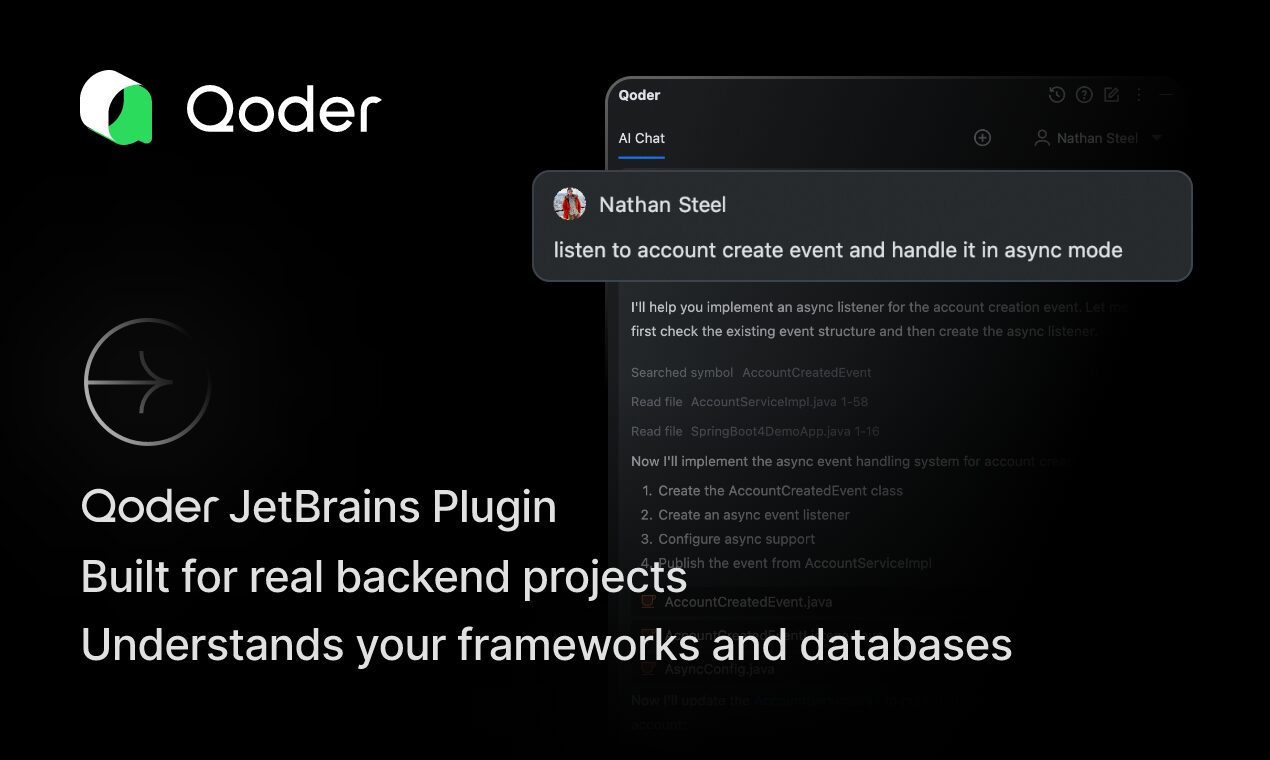
In the world of AI-powered coding assistants, most tools focus on generating snippets and completing lines of code. But what about understanding the vast, intricate architecture of a massive backend system? This is where Qoder, a revolutionary “Agentic” plugin for JetBrains IDEs developed by Alibaba Cloud, steps in.
Unlike standard copilots, Qoder is designed to comprehend your codebase’s very foundation—generating a “Repo Wiki” that maps Spring Bean graphs and database schemas. It brings the power of autonomous AI agents directly into IntelliJ IDEA, providing an unparalleled level of context for developers working on complex, enterprise-scale Java and Go projects.
Key Features
So, what makes Qoder such a powerful ally for backend developers? Its strength lies in its “Agentic” workflow and deep architectural indexing.
- Deep Architectural Analysis (Repo Wiki): Qoder doesn’t just read your code; it indexes it into a comprehensive “Repo Wiki.” It identifies project-wide dependencies, Spring Bean relationships, and API hierarchies to understand how your system works, not just what the syntax looks like.
- Quest Mode (Agentic Coding): Go beyond chat. With “Quest Mode,” you can delegate complex, multi-step tasks—like “Refactor this module to use the new payment API”—and Qoder will plan, execute, and test the changes autonomously while you watch.
- Framework Semantic Understanding: This tool speaks the language of enterprise frameworks. It deeply comprehends the semantics of technologies like Spring Boot and MyBatis, ensuring suggestions are architecturally sound rather than just syntactically valid.
- Massive Scale Handling: Working on a monolithic application with over 100,000 files? Qoder is built on the same tech stack used at Alibaba, designed specifically to index and navigate enormous enterprise monorepos without performance degradation.
- MCP Integration: Qoder supports the Model Context Protocol (MCP), allowing you to connect external data sources and tools (like database terminals or documentation fetchers) directly into the AI’s context window.
How It Works
This level of intelligence is grounded in a sophisticated indexing process called Context Engineering. Once installed, the Qoder plugin performs a deep scan of your codebase to build a Repo Wiki—a structured knowledge base of your application’s logic.
Unlike a simple vector search, this graph maps critical relationships: which Controller calls which Service, how database tables relate to entities, and where specific Beans are injected. When you code or use Quest Mode, Qoder queries this internal graph in real-time. This allows it to “reason” about your project structure, ensuring that when you ask for a refactor, it knows exactly which downstream files will be affected, much like a senior engineer would.
Use Cases
Qoder shines in scenarios where deep context is critical for success.
- Refactoring Legacy Monoliths: Safely untangle aging Java/Spring codebases. Qoder can trace hidden dependencies across thousands of files, making modernization less risky.
- Agentic Bug Fixing: Delegate a bug report to Qoder in Quest Mode. It can analyze the stack trace, traverse the call graph, reproduce the issue, and propose a fix autonomously.
- Navigating Dependency Injection: Stop guessing which bean to inject. Qoder visualizes the Spring context, suggesting the correct components based on the actual bean graph.
- Onboarding New Developers: The “Repo Wiki” acts as an interactive documentation layer, helping new hires ask questions like “How does the checkout flow work?” and getting answers linked directly to the relevant code paths.
Pros \& Cons
Like any specialized tool, Qoder has a distinct set of strengths and limitations.
Advantages
- Enterprise-Grade Scale: One of the few AI tools proven to handle massive monorepos (100k+ files) effectively.
- Agentic Capabilities: “Quest Mode” brings autonomous coding (similar to Cursor’s Composer) directly into the JetBrains ecosystem.
- Framework Specialization: Superior understanding of backend frameworks (Java/Spring, Go) compared to generalist models.
Disadvantages
- Resource Intensive: The deep indexing and “Repo Wiki” generation can be resource-heavy on larger projects during the initial setup.
- Backend Bias: While it supports many languages, its deepest architectural features are heavily optimized for backend technologies (Java, Go, Python) rather than frontend frameworks.
- JetBrains Focused: Currently, the full plugin experience is exclusive to JetBrains IDEs, leaving VS Code users with a different feature set.
How Does It Compare?
Qoder enters a competitive market, but it carves out a specific niche for enterprise backend developers. Here is how it stacks up:
- Vs. GitHub Copilot:
- Copilot is a “Generalist” focused on speed and autocompletion across all languages. It excels at snippets and boilerplate.
- Qoder is a “Specialist” for backend architecture. It excels at understanding relationships (e.g., A depends on B) and performing multi-step agentic tasks that Copilot often struggles to coordinate across many files.
- Vs. Cursor:
- Cursor is an independent editor (forked from VS Code) and is currently the gold standard for “Agentic” coding.
- Qoder brings that same “Agentic” power (via Quest Mode) inside IntelliJ IDEA. For developers who refuse to leave the JetBrains ecosystem for VS Code, Qoder is the closest equivalent to the Cursor experience.
- Vs. JetBrains AI Assistant:
- JetBrains AI is deeply integrated but functions primarily as a chat assistant and documentation helper.
- Qoder goes further with Quest Mode, allowing for autonomous task execution rather than just chat. Additionally, Qoder’s “Repo Wiki” provides a more transparent view of the project’s architecture than JetBrains’ internal indexing.
Final Thoughts
Qoder isn’t trying to be just another autocomplete tool. By combining Alibaba’s enterprise-scale handling with the agentic power of Quest Mode, it positions itself as an indispensable “AI Architect” for backend developers. If you are working on complex, framework-heavy applications within IntelliJ IDEA and have been envious of the “Agentic” features in Cursor, Qoder is the plugin that finally bridges that gap. It transforms your IDE from a text editor into an intelligent, autonomous partner.