
Table of Contents
- 1752vc Pitch Deck Analyzer Investment Report
1752vc Pitch Deck Analyzer Investment Report
Category: AI fundraising and pitch-deck analysis
Company Stage: Public launch; commercial stage not verified
Founder or Founders: Built and operated by 1752VC; no separate product company or founder publicly disclosed
Headquarters: Los Angeles/Santa Monica, California, United States
Funding: Product-level funding not publicly disclosed
Business Model: Free founder tool, paid analysis credits, and lead generation for 1752VC’s investment and accelerator programs
Product Hunt Launch Date: August 29, 2026
Report Date: September 1, 2026
| Investment Metric | Assessment |
|---|---|
| Venture Potential | 45/100 |
| Unicorn Path | Conditional |
| Valuation Attractiveness | Not Assessable |
| Evidence Confidence | 52/100 |
| Final Decision | Pass |
Executive Summary
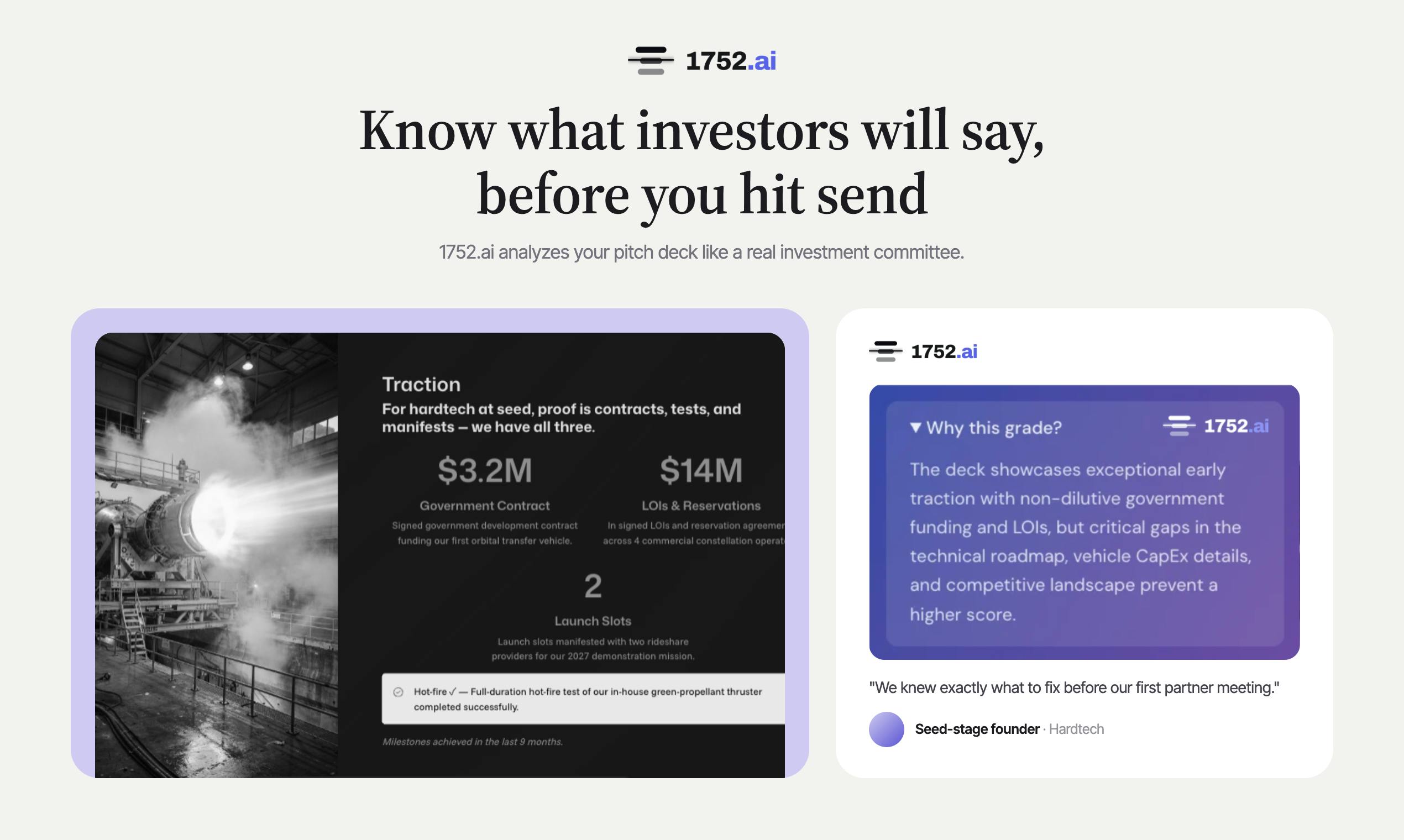
1752vc Pitch Deck Analyzer reviews uploaded PDF pitch decks and produces slide-level feedback intended to approximate an investor’s screening process. The product claims to evaluate more than 3,000 attributes using a multimodal retrieval system grounded in over 25,000 decks and associated investor decisions. It checks narrative cohesion, missing evidence, internal contradictions, and financing logic rather than focusing primarily on visual design (official product site).
The product addresses a real but episodic problem: founders receive little useful feedback when investors reject their decks. Its strongest product signal is the operator’s access to proprietary deal-flow data. 1752VC says it evaluates more than 4,000 startups annually, while the product’s launch team reported approximately 2,000 decks processed during alpha (Product Hunt). If the historical data are clean, appropriately permissioned, and demonstrably predictive, they could improve product quality beyond generic large-language-model feedback.
Company quality is stronger than the standalone venture case. 1752VC has an identifiable investment, operating, and technical team, including General Partner Lucas Pols, Venture Partner Taissa Maleh, and Senior AI Engineer Grace Cupat (team page). A regulatory filing also verifies the existence of Pegasus Angel Accelerator Fund I, although that fund is legally and economically distinct from the analyzer product (SEC filing).
The principal concern is that the analyzer presently appears to be a deal-sourcing and founder-acquisition asset for a venture firm, not a standalone venture-scale software company. The official site describes it as free because it helps 1752VC identify companies more efficiently; the terms contemplate credit purchases but disclose no public price. Revenue, retention, paid conversion, recurring usage, customer-acquisition economics, and product-level funding are all unknown.
The product may be valuable and strategically useful without supporting an independent billion-dollar outcome. A credible venture path would require expansion into a recurring fundraising operating system or B2B deal-screening platform for funds, accelerators, universities, and startup programs. Final decision: Pass as a standalone venture investment, while remaining open to reconsideration if the software becomes a separately financed B2B platform with verified recurring revenue.
Product Overview
Founders upload a PDF of up to 30 slides and 25 MB. The system analyzes each slide, identifies severe and lower-priority issues, tests claims across slides for contradictions, and returns an overall “fundability” assessment. The company says files are encrypted in transit and at rest and that the analysis runs in minutes (official product site).
The target user is an early-stage founder preparing to contact investors. The primary benefit is faster, more candid feedback than founders typically receive from friends, mentors, or investors who decline without explanation. It replaces manual deck reviews, generic templates, consultant feedback, and prompting a general-purpose AI assistant.
Pricing is not fully transparent. The homepage says the product is free and requires no credit card; the terms state that free accounts receive three analyses and that paid credit packs are non-refundable. Product Hunt offered five free reviews during launch. No public price for additional credits was found (terms; Product Hunt).
The product is web-based; no verified mobile app or public API was found. Product quality appears promising, but independent testing of scoring accuracy, consistency, or correlation with fundraising outcomes is unavailable.
Founder and Team Assessment
The analyzer is not presented as an independently incorporated startup. It is operated by 1752VC, which LinkedIn describes as a privately held venture-capital organization founded in 2023 with a listed company-size range of 2–10 employees, although LinkedIn also associates substantially more profiles with the organization; these figures should not be treated as verified headcount (LinkedIn company page).
Lucas Pols has relevant venture and distribution experience, including leadership at 1752VC and prior roles at Tech Coast Angels. Taissa Maleh brings institutional-finance, founder, accelerator, and portfolio-support experience. The official team page identifies Grace Cupat as Senior AI Engineer, with software and AI/RAG experience (team page). Product Hunt lists Pols, Maleh, and Rohan Chaubey as launch makers (Product Hunt).
The team has strong founder access, investment-domain knowledge, and content distribution. However, no public evidence establishes a dedicated full-time product organization, standalone CEO, product-level cap table, or engineering team beyond the identified senior engineer. Key-person and organizational-priority risks are material because the parent firm also runs funds, accelerators, investor education, and media activities.
Founder Assessment: Strong investor-domain and distribution experience, but standalone software-company commitment and scaling capability remain unverified.
Market Opportunity
The narrow initial market is pre-seed and seed founders actively preparing institutional fundraising decks. Willingness to pay is constrained because fundraising is intermittent, many founders are pre-revenue, and free alternatives are abundant.
An illustrative bottom-up model—not a verified market estimate—is:
- 100,000–300,000 globally addressable founders per year
- $60–$200 annual expenditure per paying founder
- Implied annual consumer revenue pool: approximately $6 million–$60 million
That range could support a useful, profitable software business but is unlikely to support a unicorn on pitch-deck analysis alone.
The larger opportunity is institutional: VC funds, accelerators, angel groups, universities, banks, and innovation programs that need intake, scoring, diligence, benchmarking, and portfolio workflows. If 10,000–20,000 institutions paid $10,000–$30,000 annually, the theoretical B2B opportunity would be $100 million–$600 million. These are analyst assumptions, not verified demand. Moreover, PitchBob already markets white-label solutions starting at $99 per month, suggesting price competition at the lower end (PitchBob).
International expansion is technically straightforward, but investment criteria vary by geography, stage, sector, and investor strategy. The product would need region-specific data and outcome validation rather than simple translation.
Traction and Growth Signals
Product Hunt named the analyzer #1 Product of the Day on August 29, 2026. At review time, the page displayed 643 followers, ten reviews, and a 5.0 rating (Product Hunt awards; overview).
The launch team reported approximately 2,000 decks processed during alpha and roughly 100 additional submissions within the first hours of launch. These are company-reported figures and have not been independently audited (Product Hunt). A related Reddit launch post generated only limited engagement—three net votes and eight comments—so community evidence outside Product Hunt is thin (Reddit).
The official site presents testimonials from RxPost, Genloop, and Swif.ai, but these appear connected to 1752VC’s ecosystem and therefore are not equivalent to independent customer references (official site).
No reliable public evidence was found for revenue, paid customers, active-user retention, repeat analysis frequency, conversion, cohort behavior, traffic, enterprise contracts, or sustained post-launch momentum.
Traction Assessment: Strong launch attention and encouraging usage claims, but commercially unverified.
Competitive Position
Direct competitors include Slidebean’s free AI reviewer, Seed Angels’ free 34-criterion analyzer, SaaStr’s free fundability grader, and PitchBob’s broader founder copilot (Slidebean; Seed Angels; SaaStr; PitchBob). Indirect alternatives include mentors, accelerators, consultants, general-purpose AI assistants, and document-sharing products such as DocSend, which provides investor-engagement analytics rather than pre-send deck scoring (DocSend).
1752VC’s differentiation is its claimed dataset of 25,000 decks linked to investment decisions and its ongoing intake of thousands of startup applications. However, dataset provenance, outcome labels, representativeness, model performance, and predictive lift have not been independently validated.
Switching costs are low. A founder can upload the same deck to several free tools, and analysis is naturally episodic. There is no demonstrated network effect, workflow lock-in, or exclusive distribution contract.
If the largest platform in this market launched the same feature within six months, why would customers continue using this product? The best answer is superior feedback derived from proprietary, outcome-linked investor data. Until that superiority is measured and published, the answer remains insufficient.
Defensibility Assessment: Low
Business Model and Economics
The current model combines free usage, future or current credit-pack purchases, and deal-flow generation for 1752VC. The official site explicitly says the free service helps the firm identify and evaluate potential investments, while the terms permit paid analysis credits (official site; terms).
Gross-margin potential is probably software-like, but not assessable without inference cost per deck, cloud-storage cost, support burden, payment fees, and human-review incidence. Google Gemini, Firebase, Google Cloud, SendGrid, and Google authentication are disclosed service dependencies (privacy policy).
Privacy could affect conversion. Uploaded decks may contain financial, ownership, customer, and strategy information. The privacy policy permits internal investment review, model improvement, and indefinite retention; founders must contact the company to opt out of training use. Pitch content may remain in anonymized grounding data after account deletion (privacy policy). This supports data accumulation but may discourage sophisticated founders from uploading confidential information.
Unicorn Path
Assume a 10× ARR multiple, appropriate only for a high-growth, recurring software company with strong retention and margins. That implies:
Required ARR = $1 billion ÷ 10 = approximately $100 million
At an illustrative $100 annual net revenue per founder, the product would require one million paying founders annually. At $20 per analysis, it would require five million paid analyses per year. Given episodic fundraising behavior and free competition, that route is improbable.
A more credible path would be B2B software: at a hypothetical $20,000 annual contract value, the company would need approximately 5,000 institutional customers. It would also need recurring pipeline management, diligence collaboration, benchmarking, investor matching, API access, compliance controls, and measurable decision-quality improvements.
DocSend demonstrates that fundraising can be an entry point into a broader document workflow: Dropbox agreed to acquire it for $165 million when it had more than 17,000 customers, but DocSend served multiple industries and recurring document workflows—not only deck feedback (Dropbox announcement).
Unicorn Path: Conditional
Valuation Assessment
No product-level funding, SAFE cap, equity round, valuation, cap table, or current fundraising process was found. The SEC filing for Pegasus Angel Accelerator Fund I reports $912,000 sold to 44 investors as of December 2025, but this represents capital committed to an investment fund, not a valuation or financing round for 1752.ai (SEC filing).
The DocSend acquisition is strategically relevant but not a defensible valuation comparable because its product breadth, customer base, and recurring revenue profile were materially different.
Valuation Attractiveness: Not Assessable
Assessment would require product ARR, growth, gross margin, paid retention, infrastructure costs, burn, runway, ownership structure, financing instrument, valuation cap, liquidation preferences, and clarification of whether investors would own the software, the VC management company, or another entity.
Key Risks
- No verified commercial traction: Revenue, conversion, retention, and paying customers are undisclosed.
- Lead-generation product rather than standalone company: Strategic value to 1752VC may not translate into investable software equity.
- Low usage frequency: Founders may need deck analysis only during fundraising.
- Free and inexpensive competition: Comparable automated reviewers are already available at no cost.
- Unproven data advantage: Dataset size is company-reported; predictive accuracy is not independently demonstrated.
- Privacy and trust friction: Indefinite deck retention and internal investment review may deter high-quality submissions.
- Low switching costs: Founders can compare outputs across several tools.
- Platform dependency: The product relies on Google infrastructure and Gemini.
- Organizational focus: The team operates investment, accelerator, education, and media businesses alongside the software.
- Model liability and bias: Incorrect or overly standardized feedback could disadvantage unconventional companies or sectors.
Final Assessment
Venture Potential: 45/100
| Category | Score |
|---|---|
| Market Size and Expansion Potential | 9/20 |
| Traction and Growth Evidence | 6/20 |
| Founder and Team | 11/15 |
| Product Strength | 8/10 |
| Distribution Potential | 7/15 |
| Business Model and Economics | 2/10 |
| Defensibility | 2/10 |
| Total | 45/100 |
The strongest elements are team-domain fit, proprietary deal-flow access, and a clear customer problem. The weakest are recurring monetization, defensibility, retention evidence, and the absence of a separately investable software-company structure.
Evidence Confidence: 52/100
Verified information includes the functioning website, product terms, privacy practices, named team, Product Hunt award, and parent fund filing. Usage, dataset, application-volume, and customer-benefit figures are company-reported. Market and unicorn calculations are analyst scenarios. Revenue, retention, gross margin, burn, product ownership, cap table, and valuation remain unavailable.
Final Decision: Pass
The analyzer appears to be a potentially effective product and valuable acquisition funnel for 1752VC. It does not yet demonstrate the recurring revenue, independent corporate structure, defensibility, or market breadth required for a venture-scale software investment. The conditional unicorn path depends on becoming a broader institutional fundraising and investment-workflow platform.
Upgrade Conditions
- Establish a separate investable entity and disclose product ownership.
- Reach at least $1 million ARR with verified customer-level records.
- Demonstrate 70%+ gross margin after AI inference and support costs.
- Sign at least 25 paying institutional customers with meaningful ACV.
- Publish cohort retention and repeat-usage data.
- Validate scoring against subsequent investor meetings or financing outcomes.
- Show acquisition channels beyond 1752VC and Product Hunt.
- Introduce explicit opt-in data training and enterprise-grade retention controls.
Downgrade Conditions
- Alpha users fail to convert to paid credits or recurring plans.
- Usage falls materially after launch.
- A major fundraising platform bundles equivalent analysis for free.
- Inference or human-review costs prevent attractive margins.
- Security, confidentiality, or data-permission issues emerge.
- The team treats the product solely as a temporary deal-flow campaign.
- Company claims about data provenance or usage cannot be substantiated.
Questions for Further Diligence
- What are current MRR, paid credit sales, paying accounts, and monthly revenue growth?
- How many of the reported alpha submissions represent unique founders and unique companies?
- What are 30-, 90-, and 180-day repeat-analysis rates?
- What percentage of free users purchase additional credits, and at what effective annual revenue per account?
- What is the fully loaded inference, storage, payment, and support cost per analysis?
- How were the 25,000 decks obtained, and what permissions allow their use for model grounding?
- How are “investor decisions” labeled, and what out-of-sample tests demonstrate predictive accuracy?
- How many customers have subsequently secured investor meetings or financing, and how is causality evaluated?
- Are there signed institutional pilots with funds, accelerators, universities, or banks?
- Who owns the source code, dataset, and intellectual property—1752VC, the fund, or another legal entity?
- What are the current cap table, financing terms, valuation, burn, and runway for the product organization?
- What product capabilities will create recurring workflow ownership rather than one-time deck analysis?
Sources
- 1752vc Pitch Deck Analyzer — official website
- Product Hunt product page
- Product Hunt awards
- 1752.ai Terms of Service
- 1752.ai Privacy Policy
- 1752VC team
- SEC Form D/A — Pegasus Angel Accelerator Fund I
- Dropbox acquisition announcement for DocSend
- Slidebean AI Pitch Deck Reviewer
- PitchBob official website and pricing