
Table of Contents
Vidaya Investment Report
Category: Consumer digital health — AI longevity dashboard aggregating wearables, labs, DNA, and medical records
Company Stage: Bootstrapped/pre-seed (no funding found); product live since May 2026 under the prior name Vitality AI Health betalist
Founder or Founders: Kevin Amrelle (Founder & CEO); Duddu Venkata Ramana, Ph.D. (Co-Founder, Head of AI & Data Science) producthunt
Headquarters: North Charleston, South Carolina (per LinkedIn; CEO based in Charlotte, NC) linkedin
Funding: Not publicly disclosed; no round or investor announcements found. App Store seller is Kevin Amrelle personally, and the entity appears to be Vitality AI LLC apps.apple
Business Model: Consumer subscription — $9.99/month or $89/year, no free tier linkedin
Product Hunt Launch Date: Week of August 10, 2026 (rebrand relaunch; the product originally launched May 2026) betalist
Report Date: August 13, 2026
| Investment Metric | Assessment |
|---|---|
| Venture Potential | 37/100 |
| Unicorn Path | Improbable |
| Valuation Attractiveness | Not Assessable |
| Evidence Confidence | 40/100 |
| Final Decision | Pass |
Executive Summary
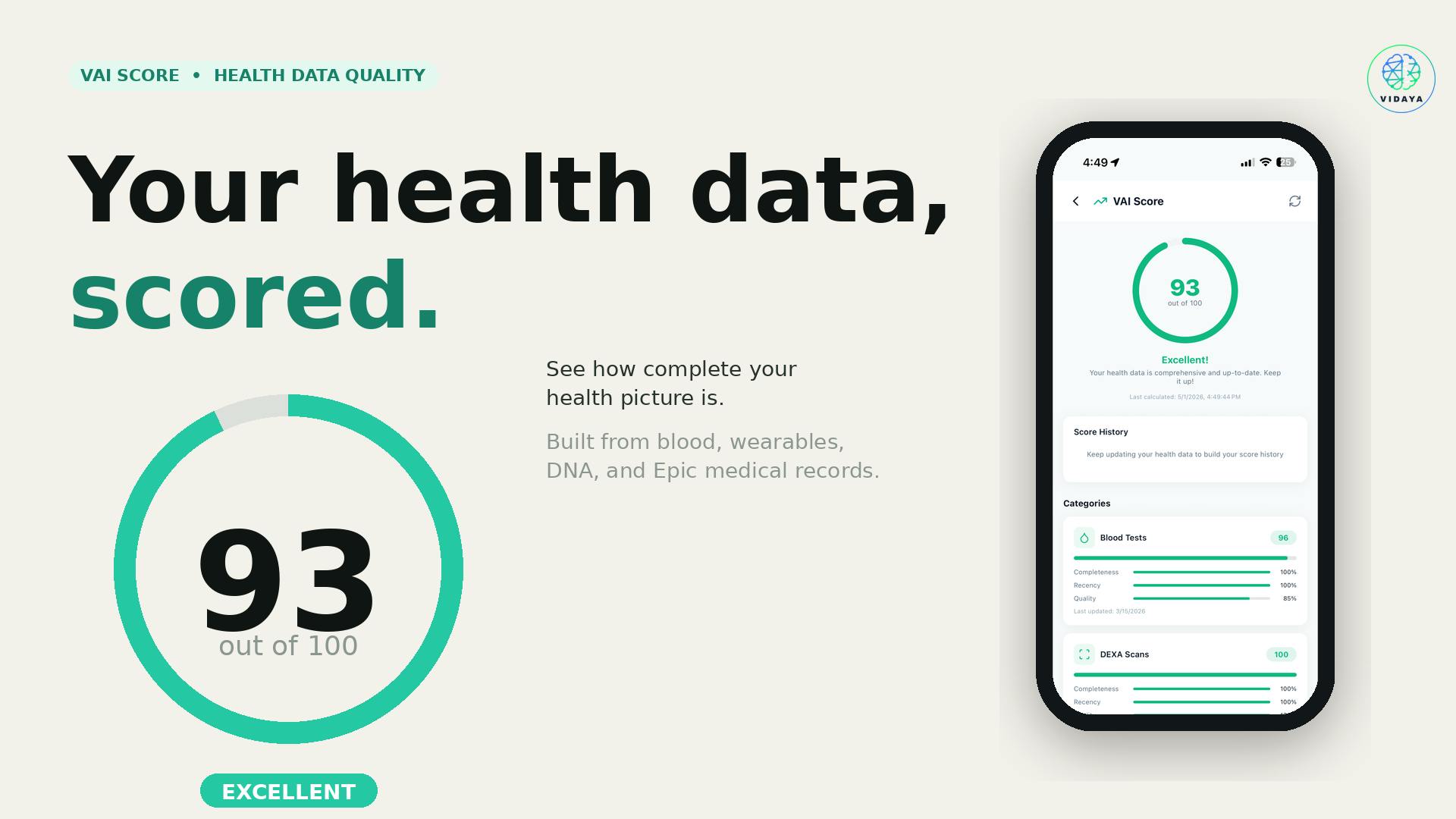
Vidaya is a consumer health app that aggregates data from 60+ sources — wearables (Garmin, Oura, Whoop, Fitbit, Apple Watch), lab providers (Quest, Labcorp), DNA services (23andMe, AncestryDNA), nutrition apps, and Epic medical records via SMART on FHIR — into a single dashboard with a “Healthspan Score” and an AI coach called Vaya that answers natural-language questions across the unified record. It is a rebrand of Vitality AI Health, which launched on iOS and Android in May 2026. betalist
The product targets quantified-self consumers frustrated by fragmented health data. The strongest positive signal is the founding team’s genuine ML pedigree: the CEO is an Executive Director of AI/ML at Wells Fargo credited with building the bank’s first end-to-end RAG solution, and the co-founder holds a PhD with a decade of enterprise analytics experience; their launch comments describe an unusually disciplined AI-safety evaluation stack (32-question stress suite, Arize AX observability, 100% production sampling). producthunt
The central concerns are traction and commitment. Three months after launch, the Google Play listing shows “5+” downloads and the App Store shows no visible rating count. The CEO’s Wells Fargo executive role is listed as current (September 2022–present) alongside multiple parallel ventures, raising material questions about full-time commitment. The company also rebranded after global insurer Vitality launched its own “Vitality AI” with Google in November 2025 — an obvious brand collision. linkedin
Final decision: Pass. This is a competently engineered product in a market dominated by heavily funded competitors, with near-zero verifiable traction and unresolved founder-commitment questions.
Product Overview
The customer problem is real: health data is scattered across a dozen silos that never interoperate. Vidaya’s answer is a longitudinal “system of record” for personal health, with trend lines per biomarker (7d–1y), a five-pillar Healthspan Score, a VAI completeness score, and Vaya Chat for cross-source questions. producthunt
Core features: 60+ integrations including Epic FHIR medical records; AI chat with two-tier model routing; safety monitoring with nine LLM-as-judge evaluators (company-reported; a May 15 audit claiming zero hallucinations across 32 stress questions is available “on request” — unverified). Platforms: iOS, Android, web. Pricing: $9.99/month or $89/year with no free tier; a launch-week discount cut the annual plan to $39. producthunt
The product replaces manual correlation across MyFitnessPal, Apple Health, lab PDFs, and wearable apps. It does not provide testing itself — it is an aggregation and interpretation layer, which matters competitively: the value depends entirely on data the user already has elsewhere.
Founder and Team Assessment
Kevin Amrelle’s identity and technical credentials are verified: Executive Director of AI/ML & Gen AI at Wells Fargo (listed September 2022–present), with public speaking on RAG evaluation alongside Wells Fargo’s model-risk leadership, plus a prior UNC Charlotte business-school board role. However, the same sources list concurrent roles — real-estate investor since 2014, founder of Startup Maker AI, and founder of HealthPriceTransparency.org (August 2025) — so full-time commitment to Vidaya is unverified and doubtful. Co-founder Duddu Venkata Ramana, Ph.D., brings a decade of enterprise analytics and ML experience (company-stated). A fractional vCISO, Denis Galkin, advises on healthcare security. producthunt
Team size is a red flag: LinkedIn claims 11–50 employees, but the App Store seller is the CEO personally, the company has 98 LinkedIn followers, and no hiring activity or employee profiles were found — the evidence is consistent with a 2–4 person team. Claims of HIPAA compliance “from day one” and a patent application on the correlation engine are company-reported and unverified. producthunt
Founder Assessment: Strong ML engineering credentials, but apparent part-time commitment, parallel ventures, and inflated team-size signals materially weaken the case.
Market Opportunity
The narrow initial customer is the affluent quantified-self/longevity enthusiast in the US who already owns a wearable and gets regular labs — perhaps 5–15 million Americans, of whom a small fraction pay for health-optimization software. At $89/year, capturing 100,000 subscribers yields ~$9M ARR: a good bootstrap business, not a venture outcome.
The market context is favorable — Function Health reached 100,000+ paying members at $499/year and a $2.5B valuation, proving willingness to pay for proactive health data. But Function’s wedge is proprietary lab testing (125+ biomarkers included in membership), not aggregation; Superpower ($42M raised) and InsideTracker occupy adjacent positions. Vidaya’s aggregation-only wedge sits underneath these players, monetizing a layer they increasingly bundle for free. Geographic expansion is constrained by the US-centric data plumbing (Epic, Quest, Labcorp). The realistic addressable market for a paid aggregation dashboard alone does not obviously support venture-scale revenue. fiercehealthcare
Traction and Growth Signals
Verifiable traction is effectively absent. The Google Play listing shows “5+” downloads; the App Store listing (version 1.0.6) displays no rating count; the Product Hunt relaunch drew 138 followers. A BetaList listing from May 2026 confirms the product has been live for roughly three months. No revenue, subscriber count, retention, or growth figures are disclosed anywhere. The company’s Instagram presence consists of team-introduction posts. betalist
The most important missing metrics: paying subscribers, monthly churn, Vaya usage frequency, and connection rates for the flagship Epic/labs integrations. Three months of near-invisible app-store performance is not launch noise — it is an early negative signal about organic pull.
Traction Assessment: Near-zero verifiable traction three months post-launch; commercially unproven.
Competitive Position
Direct competitors: Function Health ($350M raised, $2.5B valuation, 100,000+ members, proprietary labs + Medical Intelligence AI); Superpower ($42M raised, ~$199/year with 100+ biomarkers included); InsideTracker ($149–$699/year, established). Indirect competitors: wearable-native platforms (Whoop, Oura, Apple Health) adding AI coaching, Epic’s MyChart AI features, and free LLM health queries. Notably, global insurer Vitality launched “Vitality AI” with Google in November 2025 — the collision that likely forced this company’s rebrand. vitalitygroup
Vidaya’s differentiation is breadth of aggregation (60+ sources including Epic FHIR) at a lower price ($89/year vs. Function’s $499) — but it owns no proprietary data source, no testing supply, and no clinical relationship. Switching costs are modest (data lives at the sources, not in Vidaya). If Apple or Google shipped cross-source health AI natively — both are actively building here — there is no credible reason a mainstream user would pay Vidaya $89/year. The claimed patent application, if granted and meaningful, could help, but it is unverified. producthunt
Defensibility Assessment: Low
Business Model and Economics
The model is a straightforward consumer subscription: $9.99/month or $89/year, no free tier, sold through app stores (15–30% platform fees) and web. Estimated net revenue per annual subscriber is roughly $62–$76 after store fees. Variable costs include wearable-data normalization APIs (per-user monthly fees), FHIR infrastructure, LLM inference for Vaya (mitigated by two-tier routing), and the observability stack. Gross margins should be software-like (70%+) at scale, but the absence of a free tier means every subscriber must be acquired against funded competitors with celebrity investors and nine-figure war chests — paid acquisition in consumer health is expensive, and nothing suggests an organic loop. Retention is the make-or-break unknown: aggregation dashboards historically suffer engagement decay once novelty fades, and at $89/year a single churned cohort erases thin margins. None of these economics are disclosed; all require verification. producthunt
Unicorn Path
Assume a 5x forward-revenue multiple, appropriate for consumer subscription health (Function’s $2.5B on an estimated ~$50–100M revenue implies ~25–50x, but that premium reflects proprietary testing and hyper-growth Vidaya does not have). Required revenue: $1B ÷ 5 = $200M ARR. At $89/year gross (~$70 net), that requires roughly 2.2–2.9 million concurrent paying subscribers — more than 20x the member count Function Health has publicly claimed, achieved by an aggregation-only product with no proprietary supply, against Apple and Google as free bundlers. No realistic pricing increase or incremental feature set closes that gap; only a transformation into a testing/clinical-services provider (a different, capital-intensive company) would.
Unicorn Path: Improbable
Valuation Assessment
No funding rounds, investors, valuations, or revenue figures are publicly disclosed; the venture appears bootstrapped under Vitality AI LLC. There is no basis for a valuation range. contactout
Valuation Attractiveness: Not Assessable. Required inputs: current MRR and subscriber count, churn and cohort retention, CAC by channel, gross margin after store fees and data-API costs, burn and runway, cap table, and any proposed round terms. Comparable financings (Function at $2.5B, Superpower at $42M raised) describe companies with proprietary testing supply — not transferable to an aggregation layer. techcrunch
Key Risks
- Founder commitment: CEO’s Wells Fargo executive role and multiple parallel ventures appear current. linkedin
- Near-zero traction three months post-launch (5+ Play downloads; no visible App Store ratings). apps.apple
- Funded competition with proprietary wedges (Function, Superpower) and free platform bundlers (Apple, Google, Epic).
- No proprietary data or supply; aggregation is replicable and increasingly commoditized.
- Regulatory/clinical exposure: AI health guidance with unverified HIPAA and safety-audit claims. producthunt
- Brand fragility: already forced into one rebrand by the Vitality/Google collision. vitalitygroup
- Team-size misrepresentation risk (LinkedIn “11–50” vs. evidence of a very small team). linkedin
- No free tier constrains top-of-funnel in a CAC-heavy category.
- Corporate hygiene: app sold under the founder’s personal name; entity structure unclear. apps.apple
Final Assessment
Venture Potential: 37/100
| Category | Score |
|---|---|
| Market Size and Expansion Potential | 10/20 |
| Traction and Growth Evidence | 2/20 |
| Founder and Team | 7/15 |
| Product Strength | 6/10 |
| Distribution Potential | 4/15 |
| Business Model and Economics | 5/10 |
| Defensibility | 3/10 |
| Total | 37/100 |
The strongest element is genuine ML-engineering competence applied to a real fragmentation problem. The weakest are traction (near-zero after three months), defensibility (no proprietary data or supply), and founder commitment.
Evidence Confidence: 40/100
Verified: product existence and pricing (App Store/Play), founder identity and Wells Fargo role (multiple sources), rebrand history, launch timing. Company-reported and unverified: HIPAA compliance, patent application, safety-audit results, 60+ integrations. Conflicting: team size (LinkedIn’s 11–50 versus all other evidence) and the CEO’s employment status — both material, hence the reduced score. Unavailable: revenue, users, funding, retention, margins. betalist
Final Decision: Pass
Vidaya is a thoughtful product built by capable engineers, but it is not currently a venture investment: the aggregation layer it occupies is being commoditized by platforms and owned end-to-end by funded competitors, traction is negligible three months in, the unicorn math requires millions of subscribers with no credible acquisition engine, and the CEO’s full-time commitment is in question. This profile is better suited to a bootstrapped niche business. Reconsideration is possible under the conditions below.
Upgrade Conditions
- Verified 10,000+ paying subscribers with monthly churn under 4%
- CEO full-time on Vidaya with a clean entity and cap table
- A proprietary data wedge (e.g., exclusive lab pricing, employer or payer partnerships)
- Evidence that the safety/compliance claims (HIPAA audit, patent filing) are real and third-party validated
- Organic acquisition channel demonstrably beating paid CAC
Downgrade Conditions
- Continued flat app-store signals through Q4 2026
- Any misleading-claim findings (team size, compliance, audit results)
- Apple/Google/Epic shipping native cross-source health AI
- Founder disengagement or another rebrand/pivot
Questions for Further Diligence
- How many paying subscribers does Vidaya have today, and what were the last three months of net adds and churn?
- Is the CEO full-time on Vidaya? What is the status of the Wells Fargo role and the other ventures (Startup Maker AI, HealthPriceTransparency.org)?
- What is the legal entity, cap table, and has any outside capital been raised?
- What does the wearable-normalization API cost per connected user per month, and what is gross margin at $89/year after app-store fees?
- How many users have connected Epic/FHIR records, and what is weekly Vaya usage per active user?
- Can you share the May 15 safety audit and the HIPAA compliance documentation (BAA coverage, penetration tests)?
- What is the status and scope of the patent application?
- What is the actual team size, and who is full-time?
- What CAC are you seeing by channel, and what is the plan given no free tier?
- Why did the Vitality AI Health name change, and were there any trademark disputes with Vitality Group?
- What retention do 90-day cohorts show, and what drives re-engagement?
- What is the 18-month roadmap — does it include proprietary testing, employer channels, or payer partnerships?
Sources
- Product Hunt — Vidaya product page and founder comments producthunt
- Apple App Store — Vitality AI Health (pricing, seller, version history) apps.apple
- Google Play — Vitality AI Health (download count) play.google
- Vidaya official website vidaya
- Vidaya team page vidaya
- LinkedIn — Vidaya company page (HQ, size, pricing) linkedin
- LinkedIn — Kevin Amrelle profile linkedin
- ContactOut — Kevin Amrelle employment history (secondary source) contactout
- BetaList — Vitality AI Health May 2026 launch betalist
- Google Cloud press corner — Vitality and Google “Vitality AI” partnership (name collision) vitalitygroup
- TechCrunch — Function Health $298M Series B at $2.5B techcrunch
- Fierce Healthcare — Superpower $30M Series A; Function membership data fiercehealthcare