
Table of Contents
Tidy Investment Report
Category: macOS utility — system-wide grammar correction and AI-text “de-slopping” via on-device Apple Intelligence
Company Stage: Just-launched free utility; appears to be a solo side project
Founder or Founders: Not publicly disclosed — a solo maker posting under the product name “Tidy,” self-described as having built the tool for personal use; identity, background, and track record could not be verified producthunt
Headquarters: Not publicly disclosed
Funding: Not publicly disclosed; no evidence of external funding found
Business Model: Free; no paid tier or pricing page found producthunt
Product Hunt Launch Date: September 3, 2026 (ranked #8 on the daily leaderboard)
Report Date: September 6, 2026
> Disambiguation: This report covers the Tidy launched on Product Hunt in September 2026 — a Mac grammar-fixing utility running on Apple Intelligence. It is unrelated to other products named Tidy/Tidy, including Tidy Services Inc.’s cleaning-management app, Tidyme’s wardrobe app, and thetidy.app’s studio-management SaaS. producthunt
| Investment Metric | Assessment |
|---|---|
| Venture Potential | 28/100 |
| Unicorn Path | No Credible Path |
| Valuation Attractiveness | Not Assessable |
| Evidence Confidence | 22/100 |
| Final Decision | Pass |
Executive Summary
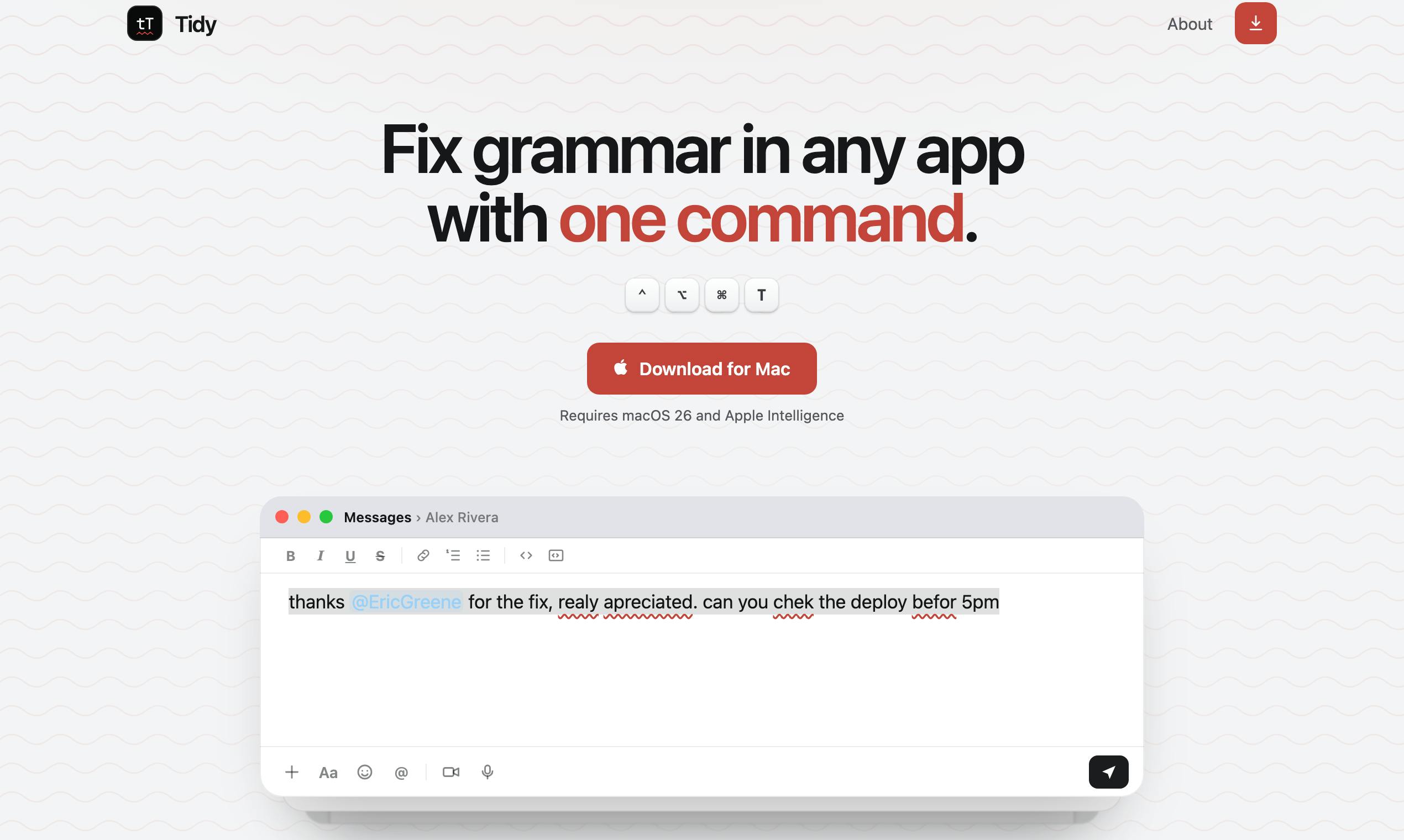
Tidy is a free Mac utility that fixes spelling and grammar in any application: the user selects text, presses a keyboard shortcut (⌃⌥⌘T), and the corrected text replaces the original in place. A second shortcut (⌃⌥⌘S) “de-slops” text that reads as machine-written, rewriting it back to plainer prose. It runs entirely on the Apple Intelligence model built into macOS — no cloud calls, no API keys, no account — and requires macOS 26 with Apple Intelligence enabled. producthunt
The target user is Mac owners who write constantly in apps where macOS spellcheck is inconsistent (the maker cites Slack, Gmail, Docs, Notes) and who value local processing. The product is thoughtfully scoped: @mentions, dates, and product-name capitalization are deliberately preserved, and it maintains the user’s own writing style rather than homogenizing it. producthunt
The strongest positive signal is product focus — a single, well-defined job done with a privacy guarantee and zero friction — plus an organic top-ten Product Hunt finish on a day with strong competition .
The most important investment concern is that the product is a thin layer over Apple’s own operating-system capabilities, in a category where Apple itself, Raycast, Grammarly, and dedicated tools already ship near-identical functionality for free. There is no disclosed business model, company, team, or founder identity. support.apple
This is a well-executed free utility, not a company. The venture case fails on market structure, monetization, and defensibility simultaneously. Final decision: Pass.
Product Overview
The customer problem: macOS system spellcheck works unevenly across apps (poorly in Slack, inconsistently in browsers), so heavy writers constantly send messages with typos, accidental caps-lock errors, and misspellings, and correct them after the fact. producthunt
How it works: Tidy registers two global keyboard shortcuts. Selecting text and pressing the first shortcut sends the text through the local Apple Intelligence model, which returns a corrected version that replaces the selection in place, across any Mac app. The second shortcut targets AI-generated-sounding prose — “em dashes, ‘delve’, listy rhythm” — and rewrites it to sound human, a feature commenters explicitly flagged as the most desirable part. The model runs on-device; nothing is uploaded; no API keys or accounts are required. producthunt
Core features: in-place grammar and spelling correction anywhere on macOS; de-slopping rewrite; context preservation for @mentions, dates/times, and product names; style preservation. Limitations: macOS 26 with Apple Intelligence required (excluding older Intel Macs); English-only at launch, with localization promised as a follow-up. producthunt
Pricing: free. Platform: macOS only; distribution appears to be via the linked website (which could not be independently verified in detail); no Mac App Store listing was confirmed during research. producthunt
The replaced workflow is per-app spellcheck, native macOS autocorrect, or copy-pasting text into a chatbot — all of which are free.
Founder and Team Assessment
The Product Hunt maker account posts under the name “Tidy” rather than a personal identity; the launch text is first-person (“I built this for myself”) and describes the product’s origin as a personal fix for editing two-thirds of one’s own Slack messages. No founder name, LinkedIn profile, GitHub repository, prior companies, or exits could be located. Team size appears to be one; there are no hiring signals, job listings, or company registration information. Full-time commitment is unknown and the framing suggests a self-directed project rather than a company-building effort. producthunt
The maker demonstrates credible technical capability: shipping a global-shortcut utility that integrates with Apple Intelligence and respects context boundaries is real macOS engineering, and comment replies show responsiveness and product judgment (preserving product-name capitalization, planning localization). producthunt
Founder Assessment: Evident solo technical execution and product taste, but the founder’s identity, background, commercial capability, and commitment are entirely unverified.
Market Opportunity
The initial segment is narrow: Mac users on macOS 26 with Apple Intelligence-compatible hardware who write frequently across apps and want in-place grammar correction. This is a subset of the Mac install base — newer Apple-silicon machines only — and the segment most likely to adopt such a tool (technical, heavy writers) is also the segment most aware of the free alternatives below.
Willingness to pay is structurally capped. Apple’s own Writing Tools — available anywhere you can type, including third-party apps — offer native Proofread with change tracking at no cost. Grammarly for Mac is free at the base tier. Raycast, a popular paid launcher, ships “Quick Fix,” which selects text, fixes spelling and grammar, and pastes the correction back in place with one hotkey — functionally identical to Tidy’s core loop. support.apple
Bottom-up: assume 10–20 million eligible Apple-Intelligence Macs, perhaps 5–10% of owners with the specific pain, and a hypothetical future one-time purchase of $15 (typical for such utilities). At a 1% purchase rate, that is roughly $1.5–3M in lifetime revenue — a strong indie outcome, not venture scale. Adjacent expansion (iOS, Windows, style memory, team features) is possible but each step deepens competition with platform vendors.
Traction and Growth Signals
Available evidence: a September 3, 2026 Product Hunt launch that ranked #8 for the day organically, on a leaderboard that included launches from World Labs, OpenAI-adjacent tools, and Google ; 120 followers and a 4.0 rating from one review at the time of research; a comment thread with engaged, substantive technical questions about the de-slop heuristics, style handling, and localization; a “Built With” page with 25 followers. producthunt
Not available: downloads, active users, revenue (none exists — the product is free), retention, website traffic, GitHub activity, press coverage, community discussion beyond Product Hunt, or any post-launch momentum data. The launch occurred three days before this report.
The most important missing metrics are downloads and sustained usage — for a free utility, even those would only establish popularity, not commercial viability, since no monetization exists.
Traction Assessment: Credible launch-week attention for a niche utility; no commercial traction exists to assess.
Competitive Position
- Platform vendor: Apple ships Writing Tools system-wide, including a native Proofread function in most apps and third-party websites, free with Apple Intelligence support.apple
- Direct functional competitors: Raycast’s Quick Fix does select-text → hotkey → in-place grammar correction, plus dozens of other AI commands; WunderType is a Mac menu-bar app that corrects selected text in any app via shortcut, supports local models and BYO API keys, and sells without a subscription; Grammarly for Mac operates across desktop apps with a free tier and $12/month Pro manual.raycast
- Free alternatives: Apple Writing Tools, free Raycast tier commands, macOS autocorrect, and pasting into any free chatbot support.apple
Current differentiation is real but minor: the dedicated de-slop shortcut is the one feature neither Apple nor Raycast markets as a first-class function, and the strict local/zero-setup posture is cleaner than Grammarly’s cloud approach. But Tidy runs on the exact same Apple Intelligence model Apple uses for its own Writing Tools — the moat is a keyboard shortcut and prompt tuning.
The six-month replication test: Apple already ships this. A user on macOS 26 can select text, right-click, and Proofread today. Tidy’s remaining advantages are speed of invocation and the de-slop feature. That is a settings change for Apple or a one-day extension for Raycast, whose Quick Fix already replicates the core mechanic. Switching costs are effectively zero for a free tool. support.apple
Defensibility Assessment: Low.
Business Model and Economics
There is no revenue model. The product is explicitly free, with no pricing page, paid tier, or disclosed monetization plans. Because inference runs on the user’s own device via Apple Intelligence, the maker’s marginal cost per user is near zero — the only costs are distribution and support. This is economically elegant for an indie project and generates no revenue. producthunt
If a paid tier were introduced, the realistic ceiling is a one-time purchase of $10–20, the convention for single-purpose Mac utilities in this category. Recurring subscription pricing would face immediate resistance against Apple’s free native alternative and Grammarly’s free tier. Free-to-paid conversion, churn, and CAC are not assessable because no paid product exists. AI inference costs are externalized to Apple — a genuine cost advantage, but one available to every macOS developer. support.apple
Unicorn Path
Assume an aggressive hypothetical: the maker converts to a $15 one-time-purchase utility with exceptional adoption. At a 10x revenue multiple (generous for consumer software), $100M ARR would require ~6.7 million annual purchases of a single-purpose grammar utility on macOS — implausible against free platform-native alternatives. A subscription pivot at $3/month would need ~2.8 million continuous subscribers in a market where the OS vendor bundles the feature free. No plausible combination of pricing, volume, or expansion within this product’s foreseeable scope reaches venture-scale revenue. support.apple
Unicorn Path: No Credible Path. Under the current free model there is no revenue at all, and the foreseeable pivot (paid Mac utility) is a lifestyle-business ceiling, not a venture outcome.
Valuation Assessment
No funding, investors, valuation, or fundraising activity is publicly disclosed. No legal entity was identified. The Product Hunt page gives no indication this is a fundable company rather than a personal project. producthunt
Valuation Attractiveness: Not Assessable. There is no revenue, no entity, and no financing to evaluate. Assessment would require, at minimum: incorporation details, any monetization with conversion data, user and retention metrics, and evidence the founder intends to build a company.
Key Risks
- Platform vendor replication — already realized: Apple’s native Writing Tools provide free system-wide proofreading support.apple
- No revenue model: free by design, with no disclosed monetization path producthunt
- Direct feature parity: Raycast Quick Fix performs the identical select-fix-replace loop; WunderType occupies the same niche with a proven paid model manual.raycast
- Anonymous, unverified founder: no identity, background, or commitment information producthunt
- Narrow platform window: requires macOS 26 plus Apple Intelligence, excluding older hardware producthunt
- Single-maintainer dependency: one anonymous individual; abandonment risk is high
- English-only launch with localization only promised producthunt
- Brand collision: multiple unrelated “Tidy” products exist across app stores and the web, fragmenting search and trademark space play.google
Final Assessment
Venture Potential: 28/100
| Category | Score |
|---|---|
| Market Size and Expansion Potential | 8/20 |
| Traction and Growth Evidence | 4/20 |
| Founder and Team | 4/15 |
| Product Strength | 6/10 |
| Distribution Potential | 4/15 |
| Business Model and Economics | 1/10 |
| Defensibility | 1/10 |
| Total | 28/100 |
The strongest element is product quality: a focused, privacy-preserving utility that solves a genuine annoyance and attracted organic top-ten launch attention. The weakest elements are the absent business model (1/10), near-zero defensibility against Apple and Raycast (1/10), and an unverified solo founder. The score falls in the weak-venture-case band (0–34). producthunt
Evidence Confidence: 22/100
Verified: the product exists, its features, platform requirements, launch date, and leaderboard placement. Unverified: founder identity and background, website details, download counts, any usage data. Unknown: entity, team, funding, revenue, costs, runway, roadmap beyond comment-thread promises. The maker’s anonymity is a material evidence gap that caps confidence in the 20–39 band. producthunt
Final Decision: Pass
Tidy is a genuinely useful, well-crafted free Mac utility — and it is not a venture investment on any dimension. It has no revenue model, no company structure that could be verified, no defensibility against the OS vendor that supplies its own AI engine, and direct free competitors performing the same function. Nothing here suggests fraud or broken fundamentals, so Hard Pass is inappropriate; the project simply operates at hobby/indie scale. Pass could be reconsidered only if the maker builds a genuine company around a differentiated product line.
Upgrade Conditions
- Founder identity, background, and full-time commitment becoming verifiable
- A paid product line with demonstrated willingness to pay against free alternatives
- Evidence of a durable wedge beyond the two shortcuts (e.g., proprietary style models, team features, cross-platform reach)
- Hundreds of thousands of sustained active users, not just launch-week installs
Downgrade Conditions
- Product abandonment or no updates after launch
- Apple extending native Writing Tools with a hotkey-driven, in-place fix (rendering the core value redundant) support.apple
- Evidence that usage collapses after launch week
- Discovery of misleading claims about the product’s capabilities or privacy posture
Questions for Further Diligence
- Who are you, and is Tidy a company, a side project, or a portfolio experiment? producthunt
- How many downloads and weekly active users since launch?
- Do you intend to monetize, and what is the pricing thesis against Apple’s free Writing Tools? support.apple
- What share of usage is the grammar shortcut versus the de-slop shortcut — which is the real product?
- How does the de-slop heuristic work, and can it be tuned per user without becoming a style model you’d have to run in the cloud?
- Is there a Mac App Store listing or direct distribution, and what are the installation numbers by channel?
- What happens to the product when Apple ships a native hotkey for in-place proofreading?
- Is localization (e.g., Brazilian Portuguese, requested in comments) actually resourced? producthunt
- Are there any trademark plans given the crowded “Tidy” namespace? play.google
- Is there any incorporation, funding, or team-building intent?
- How do you measure whether corrections are actually accepted versus reverted by users?
- What is the roadmap beyond the two shortcuts?
Sources
- Product Hunt — Tidy launch page
- Product Hunt — Best of September 3, 2026 leaderboard
- Product Hunt — Tidy “Built With” page
- Apple Support — Writing Tools with Apple Intelligence on Mac (native competitive context)
- Cult of Mac — Apple Intelligence Writing Tools overview (competitive context)
- Raycast Manual — AI Commands and Quick Fix (direct functional competitor)
- Raycast changelog — Quick Fix launch (direct functional competitor)
- Grammarly for Mac — official page (competitor pricing context)
- WunderType — Mac grammar-fix competitor analysis (secondary source)
- Tidy Services Inc. — unrelated “Tidy” product (disambiguation)