
Table of Contents
Tines 3B Investment Report
Category: Enterprise AI workflow orchestration, automation, and governance
Company Stage: Growth-stage / Series C; existing unicorn
Founder or Founders: Eoin Hinchy and Thomas Kinsella
Headquarters: Dublin, Ireland
Funding: $272 million raised; latest $125 million Series C
Business Model: Enterprise SaaS platform license, with a free exploration edition
Product Hunt Launch Date: August 11, 2026; official product announcement July 28, 2026
Report Date: August 14, 2026
| Investment Metric | Assessment |
|---|---|
| Venture Potential | 88/100 |
| Unicorn Path | Clear — already achieved at company level |
| Valuation Attractiveness | Fair at the February 2025 round; current terms unknown |
| Evidence Confidence | 82/100 |
| Final Decision | DD |
Executive Summary
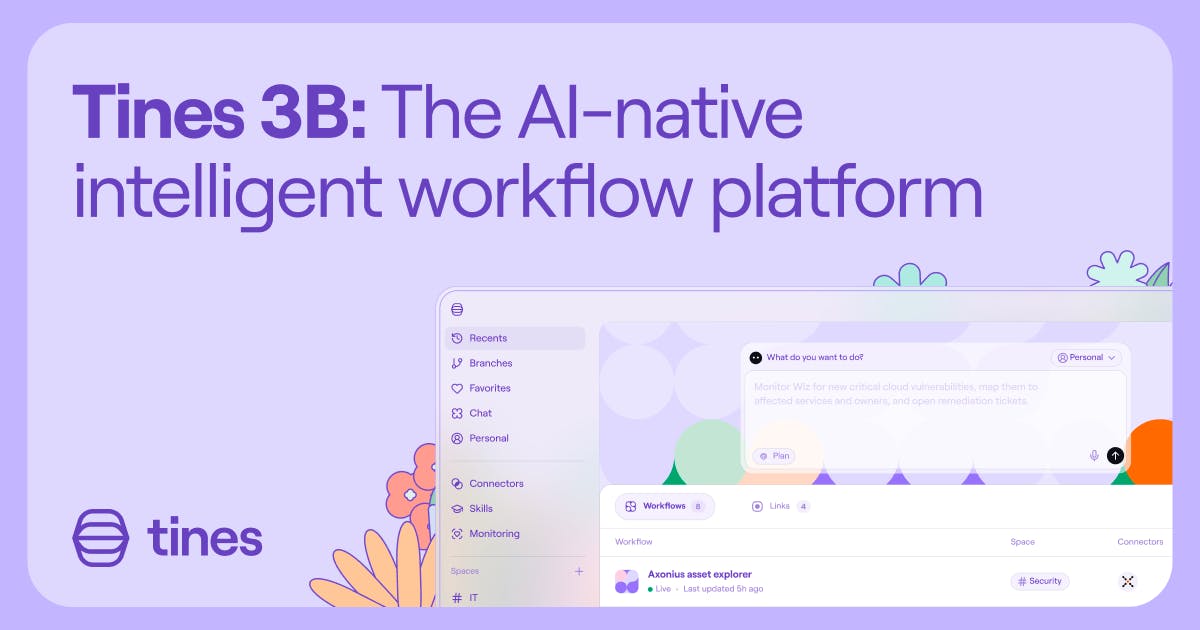
Tines 3B is an enterprise environment for creating, running, and governing AI-generated applications, agents, and automations. Employees can describe a workflow in natural language or work through coding assistants, while security and IT teams retain control over credentials, deployment, permissions, auditability, AI spending, and workflow dependencies. It extends Tines beyond its established security-automation product into horizontal enterprise workflow infrastructure.
Product quality appears strong. Workflows are code-first, support Git and branching, and execute in isolated sandboxes. Credentials are injected through a proxy rather than exposed to builders or AI models. The platform can connect through APIs or Model Context Protocol and can be deployed in cloud, hybrid, self-hosted, or on-premise environments (Tines 3B). This architecture addresses a substantive enterprise problem: controlling the proliferation of employee-built AI workflows without preventing experimentation.
Company quality is considerably more proven than product-specific traction. Tines reported that 2025 was its most successful year, with its enterprise customer base tripling and automated actions more than doubling. Its earlier platform was already executing more than one billion actions per week when the company announced its Series C. Irish statutory accounts reported revenue of $39.6 million for the year ended January 2025, up from $19.1 million, although the company remained loss-making (Irish Times; Series C announcement).
The strongest investment signal is Tines’ combination of established enterprise distribution, security credibility, rapid revenue growth, and relevant founder experience. The principal concern is that 3B enters a crowded horizontal automation market and represents a code-first architectural shift from Tines Stories. Product-specific revenue, retention, deployment breadth, and incremental gross margin are not publicly disclosed.
The appropriate decision is DD, not Invest. Tines is clearly a venture-scale company and has already crossed the unicorn threshold, but a new investor must verify current revenue, retention, gross margin, 3B adoption, and financing terms before judging whether the risk-adjusted entry price is attractive.
Product Overview
Organizations increasingly allow employees to use generative AI to build internal tools and automate work. This can create unsanctioned code, exposed credentials, duplicated applications, uncontrolled model spending, and poorly maintained dependencies. Tines calls this problem “wild code.”
Tines 3B provides a governed development and execution layer. Its principal capabilities include:
- Natural-language and code-first workflow creation;
- Compatibility with external coding agents such as Claude Code and Codex;
- Git integration, versioning, native branching, and workflow tests;
- Sandboxed execution, with each workflow step isolated;
- Credentials injected through a controlled proxy;
- Role-based access, spaces, skills, and connector permissions;
- Monitoring of AI spending, reliability, savings, access, and dependencies;
- Automated suggestions through “Autofix” and “Autotune”;
- Cloud, hybrid, self-hosted, and on-premise deployment.
The initial customer is an enterprise IT or security organization responsible for allowing finance, HR, revenue operations, legal, and other business teams to build AI workflows safely. The product replaces a combination of custom scripts, disconnected low-code tools, unmanaged AI applications, manual governance reviews, and traditional automation platforms.
Tines offers a free Explore edition with unlimited users, spaces, and connectors, but limits it to three live workflows and a one-time $50 AI allowance. Paid editions provide unlimited workflows, flexible deployment, and bring-your-own-model support. Enterprise prices are not published; Tines uses a platform-license model rather than selling features separately (pricing).
Product-quality assessment: Strong enterprise architecture and a credible customer problem, but product-specific reliability and adoption remain only partially demonstrated.
Founder and Team Assessment
Eoin Hinchy and Thomas Kinsella founded Tines in 2018 after more than a decade working as senior security practitioners. Their direct exposure to repetitive security operations led to the original Tines automation platform (company overview).
The founders have demonstrated both technical and commercial execution:
- Built a production automation platform handling more than one billion actions weekly;
- Expanded from security orchestration into IT and broader enterprise workflows;
- Raised capital from Goldman Sachs Alternatives, SoftBank Vision Fund 2, Accel, Felicis, Addition, Activant, and Blossom Capital;
- Grew reported annual revenue by more than 100% in the year ended January 2025;
- Built a team exceeding 400 people following an average headcount of 220 during that financial year.
The Irish Times reported that annual employee costs were $43 million and that the company continued hiring after its Series C. LinkedIn displays more than 600 profiles associated with Tines, although this is not equivalent to verified full-time headcount (LinkedIn).
The principal organizational risk is execution breadth. Tines must maintain Tines Stories for security and IT users while developing and commercializing the architecturally distinct Tines 3B platform.
Founder Assessment: Strong founder-market fit and demonstrated enterprise execution, with manageable but meaningful dual-platform execution risk.
Market Opportunity
The initial segment is medium-sized and large organizations with substantial SaaS estates, multiple AI initiatives, and centralized security or IT governance. Financial services, technology, healthcare, telecommunications, and regulated enterprises are especially relevant.
Eurostat reports roughly 33 million active EU enterprises, of which approximately 0.2% are large organizations with at least 250 employees—implying roughly 66,000 large EU businesses before considering the United States, Asia-Pacific, and smaller regulated companies (Eurostat). Only a subset will need a dedicated AI-governance and workflow platform, but the potential account base is large enough for enterprise SaaS scale.
Because Tines does not publish prices, the following is an analyst scenario rather than a company forecast:
- 20,000 addressable enterprise accounts;
- $50,000–$150,000 annual platform spend;
- Implied annual addressable revenue of $1–$3 billion.
Higher contract values could result from organization-wide adoption, self-hosting, support, more execution volume, or deployment across multiple departments. Expansion opportunities include finance operations, procurement, employee onboarding, compliance, customer support, developer workflows, and managed service providers.
The market is sufficiently large for venture-scale revenue. The more difficult question is whether Tines can establish itself as a horizontal control plane before Microsoft, ServiceNow, Workato, or other incumbents bundle equivalent governance.
Traction and Growth Signals
The strongest available traction relates to Tines overall:
- Revenue increased from $19.1 million to $39.6 million for the year ended January 2025.
- The company reported a $24.87 million pre-tax loss, versus $24.05 million previously.
- Tines said two-thirds of customers were using its AI features at the time of its Series C.
- The platform was executing more than one billion automated actions per week.
- Tines reported that its enterprise customer base tripled during 2025 and total automated actions more than doubled.
- Published customer logos include Coinbase, Databricks, Reddit, Snowflake, Dropbox, Canva, MongoDB, Sophos, McKesson, and Pinterest. Logo presence verifies a relationship but not contract size or current status (customers).
For 3B specifically, Tines states that design partners helped shape the product and that some had signed as paying customers. Fin is the only clearly named reference in launch materials. Internally, Tines reported more than 500 employee-built apps, agents, and automations going live during a three-week deployment; this is company-reported usage, not external customer adoption (3B announcement).
Tines 3B ranked first on Product Hunt on August 11, 2026. This represents launch awareness and has little weight in the traction score (Product Hunt awards).
Critical missing metrics include 3B ARR, active enterprise deployments, paid conversion, workflow retention, net revenue retention, and cross-sell from Tines Stories.
Traction Assessment: Strong and commercially verified at company level; early and insufficiently quantified for 3B specifically.
Competitive Position
Direct competitors include Workato, Tray.ai, n8n, Torq, Swimlane, Splunk SOAR, Palo Alto Cortex XSOAR, and Microsoft Power Automate. Broader alternatives include ServiceNow, UiPath, Retool, Zapier, cloud functions, internal scripts, and AI-agent platforms.
Tines’ advantages are:
- Security and IT credibility developed over eight years;
- Existing enterprise workflows and customer relationships;
- Flexible API/MCP integration rather than a closed connector catalogue;
- Isolation of workflow steps and controlled credential injection;
- Deployment flexibility for regulated customers;
- Governance spanning builders, models, applications, and automation.
Switching costs can become substantial once mission-critical workflows, credentials, audit policies, and departmental processes run through Tines. However, there is no clear network effect, and AI-generated code may reduce the effort required to migrate or rebuild workflows.
If Microsoft or ServiceNow launches a comparable feature, customers could still remain with Tines because it is vendor-neutral, supports heterogeneous technology stacks, and offers security-focused deployment controls. That answer is credible, but not conclusive: large platforms retain major bundling and distribution advantages.
Defensibility Assessment: Medium-high.
Business Model and Economics
Tines operates enterprise SaaS with a free product-led entry tier and custom paid platform licenses. Unlimited users can facilitate organization-wide adoption, while workflow volume, deployment requirements, support, and broader departmental usage may drive expansion.
The model should have attractive software gross-margin potential, but actual gross margin is not publicly disclosed. Principal variable costs include cloud execution, observability, storage, AI inference allowances, customer support, and deployment support for on-premise or hybrid customers. Bring-your-own-model functionality can reduce Tines’ direct inference exposure.
The $24.87 million pre-tax loss on $39.6 million of revenue shows that the company was still investing substantially ahead of revenue in FY2025. This is not automatically problematic after more than 100% growth, but sales efficiency, gross margin, and burn since the $125 million financing require verification.
Unicorn Path
For a rapidly growing enterprise workflow SaaS company, an illustrative 10× ARR multiple is reasonable, subject to strong growth, high retention, and software-like gross margins.
\[
\$1\text{ billion} \div 10 = \$100\text{ million ARR}
\]
At illustrative annual contract values:
- $50,000 ACV requires approximately 2,000 customers;
- $100,000 ACV requires approximately 1,000 customers;
- $250,000 ACV requires approximately 400 customers.
Tines was already valued at $1.125 billion in February 2025, so the valuation milestone has been achieved. However, its latest publicly available statutory revenue of $39.6 million was below the approximately $100 million level normally required to support a $1 billion valuation at 10× revenue. The round therefore priced in continued rapid growth.
To sustain and expand unicorn status, Tines must convert 3B from a design-partner product into a material revenue stream, maintain strong retention, and broaden adoption beyond security teams without losing its security differentiation.
Unicorn Path: Clear.
Valuation Assessment
Tines raised $125 million in a February 2025 Series C led by Goldman Sachs Alternatives, with SoftBank Vision Fund 2 and existing investors participating. The round valued the company at $1.125 billion and brought total funding to $272 million (Goldman Sachs).
Relative to FY2025 reported revenue, the round represented approximately:
\[
\$1.125B \div \$39.6M = 28.4\times trailing revenue
\]
That is a premium multiple, but the relevant revenue had more than doubled and the financing occurred shortly after the reporting period. Current ARR, growth, and new financing terms are unavailable, preventing an assessment of today’s entry price.
Valuation Attractiveness: Fair at the February 2025 round; current attractiveness is not assessable without updated terms.
Required information includes current ARR, growth, gross margin, net retention, burn, cash balance, cap table, liquidation preferences, and any proposed secondary or financing price.
Key Risks
- 3B adoption risk: Design-partner enthusiasm may not translate into broad paid deployment.
- Platform competition: Microsoft, ServiceNow, Workato, and cloud providers can bundle workflow governance.
- Architectural transition: Supporting both Stories and 3B could divide engineering and go-to-market resources.
- Valuation risk: The latest round implied a high trailing-revenue multiple.
- Profitability and burn: Losses remained substantial relative to reported revenue.
- Security exposure: A credential or workflow-execution breach would damage the core trust proposition.
- AI commoditization: Improved coding agents could let enterprises build governance internally.
- Long enterprise sales cycles: Organization-wide governance products require security, legal, and procurement approval.
- Unverified unit economics: Gross margin, CAC payback, and net retention are not publicly disclosed.
Final Assessment
Venture Potential: 88/100
| Category | Score |
|---|---|
| Market Size and Expansion Potential | 19/20 |
| Traction and Growth Evidence | 17/20 |
| Founder and Team | 15/15 |
| Product Strength | 9/10 |
| Distribution Potential | 14/15 |
| Business Model and Economics | 7/10 |
| Defensibility | 7/10 |
| Total | 88/100 |
The strongest elements are founder quality, revenue growth, enterprise references, and expansion into a strategically important governance layer. The weakest are missing unit economics, 3B-specific commercial evidence, and substantial platform competition.
Evidence Confidence: 82/100
Funding, valuation, founders, historical revenue, losses, pricing structure, product functionality, and security posture are supported by primary sources or statutory-account reporting. Customer-growth and usage metrics are company-reported. Current ARR, retention, margins, burn, 3B revenue, and current financing terms remain unavailable.
Final Decision: DD
Tines warrants formal due diligence because it is already a venture-scale company with credible product differentiation and strong company-level traction. An investment cannot be recommended without verifying whether current operating performance supports the post-unicorn entry price and whether 3B has genuine customer adoption beyond design partners.
Upgrade Conditions
- Verified current ARR above $75–100 million with continued strong growth;
- Net revenue retention above 120%;
- 3B generating material contracted ARR across multiple departments;
- Gross margin above 75%;
- Evidence of efficient CAC payback and declining burn relative to revenue;
- Multiple external customer references confirming production-scale 3B use.
Downgrade Conditions
- 3B remains primarily an internal or design-partner product;
- Revenue growth falls materially while losses remain elevated;
- Stories customers resist migration or cross-selling;
- Major platform vendors replicate and bundle governance capabilities;
- A material security incident affects credentials or workflow execution;
- New financing terms materially exceed operating fundamentals.
Questions for Further Diligence
- What are current ARR, year-over-year growth, and contracted backlog?
- How much ARR is attributable specifically to Tines 3B?
- How many external organizations run 3B workflows in production?
- What are gross and net revenue retention by customer cohort?
- What are average contract value and cross-sell rates from Stories to 3B?
- What percentage of 3B customers deploy across departments beyond IT or security?
- What are gross margin and AI/cloud cost per workflow execution?
- What are CAC payback, sales-cycle length, and sales efficiency?
- What are current monthly burn, cash balance, and runway?
- How will Tines allocate engineering resources between Stories and 3B?
- What security incidents or customer-data events have occurred?
- What are the current cap table, financing valuation, liquidation preferences, and secondary-sale terms?