
Table of Contents
Navigara Investment Report
Category: Engineering intelligence, AI ROI, and developer analytics
Company Stage: Seed
Founder or Founders: Jirka Bachel (Co-Founder & CEO) and Peter Malina (Co-Founder & CTPO)
Headquarters: San Francisco, California, with engineering in Prague
Funding: $2.5 million seed round led by Inovo.vc, with Rockaway Ventures and QQ Capital
Business Model: Per-developer SaaS, enterprise contracts, and paid engineering benchmarks
Product Hunt Launch Date: August 24, 2026
Report Date: August 27, 2026
| Investment Metric | Assessment |
|---|---|
| Venture Potential | 72/100 |
| Unicorn Path | Conditional |
| Valuation Attractiveness | Not Assessable |
| Evidence Confidence | 69/100 |
| Final Decision | DD |
Executive Summary
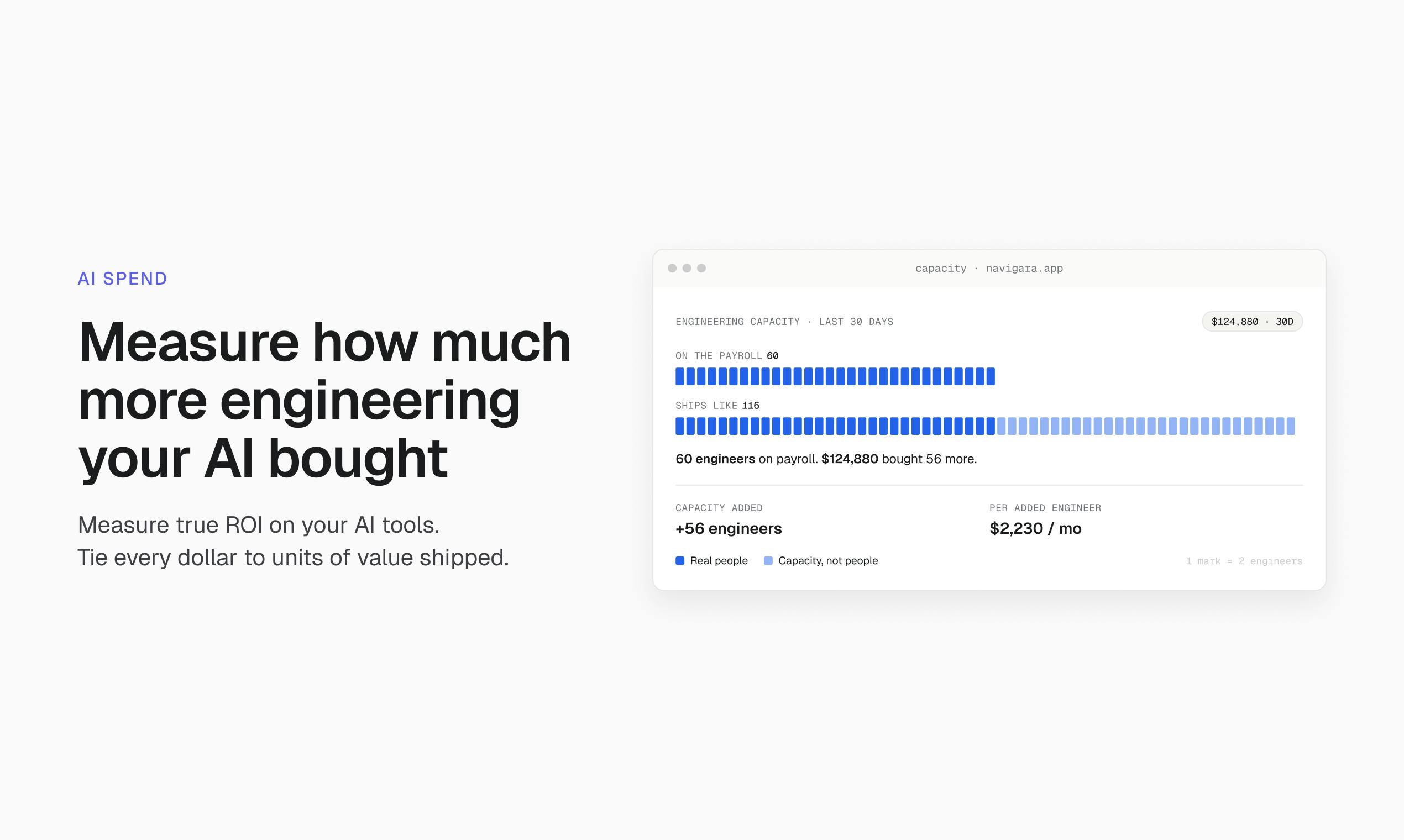
Navigara connects AI coding spend to roadmap outcomes. Its Engineering Throughput Value (ETV) analyzes Git work, classifies intent, and maps output to Jira or Linear priorities. It also offers process checks and model routing (official website; AI ROI product).
CTOs and CFOs often cannot distinguish more code activity from faster delivery of valuable work. Navigara’s strongest signals are public pricing, named customer logos, on-premises deployment, a public methodology, and a verified $2.5 million seed—not Product Hunt attention.
Founders Jirka Bachel and Peter Malina report relevant CTO and platform-engineering histories (about). The site displays Kiwi.com, ESET, FTMO, Finshape, Partners Banka, and others, and claims 200+ benchmark teams. Paid status, contract size, and retention require verification.
The central concern is measurement validity. A model-derived “value” score for code can influence management, compensation, and employment decisions. If it is inconsistent across languages, roles, repositories, or work types, customer trust and regulatory exposure could deteriorate. Existing engineering-intelligence vendors can also add AI ROI modules.
Final decision: DD. Navigara is seed-stage but sufficiently developed and commercially credible to justify founder meetings, customer calls, cohort data, methodology audit, and financing review. The valuation remains unassessable because current round valuation and revenue are not public.
Product Overview
Git activity, story points, and AI adoption do not show whether teams delivered valuable roadmap work. Navigara estimates code complexity and intent, compares a pre-AI baseline, and links output to roadmap priorities and spend (Product Hunt; methodology).
Features include performance, roadmap and cost reporting, CapEx/OpEx support, process checks, peer benchmarks, and model routing. Deployment can be cloud, cloud with an on-prem collector, or fully on-prem/air-gapped. The collector exports metadata and scores rather than source.
Pricing is public: a 14-day trial, Measure from $7 per developer monthly, Pro from $30, custom Enterprise, and a $4,500 benchmark credited toward Enterprise (pricing).
Target buyers are CTOs, VPs of Engineering, finance leaders, private-equity operating teams, and regulated enterprises. Alternatives include spreadsheets, DORA metrics, Jira dashboards, Git analytics, and engineering-intelligence platforms.
Founder and Team Assessment
Navigara describes Bachel as an 18-year technology leader who built the Seznam.cz browser, and Malina as a 15-year leader and former Kiwi.com Director of Engineering (about). Outcomes need independent references.
Malina joined as co-founder in 2025 as the product pivoted to engineering measurement. LinkedIn lists 13 employees and locations in San Francisco, Prague, and Delaware (LinkedIn); payroll and hiring plans are not public.
The team appears capable technically and commercially: it has raised institutional seed capital, built on-prem architecture, published research, and established US positioning. Key-person risk remains because the methodology and category narrative appear closely tied to the founders.
Founder Assessment: Strong founder-market fit with credible technical leadership; customer references and organizational depth still need verification.
Market Opportunity
The initial customer has 30–1,000 developers and material AI-tool spend. At Pro list price, 200 developers equal $72,000 ARR. An analyst scenario of 10,000 organizations at $75,000 ARR implies $750 million; these are assumptions, not verified demand.
Adjacent markets include engineering productivity, software capitalization, due diligence, AI governance, routing, and compliance. On-prem expands access to regulated enterprises.
The market can support a venture outcome, but customers must accept ETV as decision-grade rather than an experimental score. Navigara must avoid being perceived as employee surveillance or a narrow dashboard feature.
Traction and Growth Signals
Product Hunt shows 286 points, 640 followers, #4 daily rank, and one review—interest, not PMF. Stronger signals are the trial, prices, paid benchmark, deployment choices, research, and logos.
The company reports 200+ benchmark teams and ten logos. Its study covers 676 contributors across six open-source organizations and reports 116% year-over-year growth, explicitly as correlation rather than proof of AI causality (research).
A $2.5 million seed round led by Inovo.vc with Rockaway Ventures and QQ Capital is corroborated by investor and press sources (Rockaway; Vestbee). Revenue, customer count, logo contract status, growth, retention, usage, and pilot conversion are not public.
Traction Assessment: Credible early commercial and institutional signals, but financial traction remains unverified.
Competitive Position
Competitors include Jellyfish, LinearB, Swarmia, DX, Faros AI, Pluralsight Flow, Athenian, Waydev, Git analytics, DORA dashboards, and internal teams. Coding vendors can add ROI reporting.
Navigara combines ETV, pre-AI baselines, roadmap alignment, spend, process checks, and flexible deployment. Its research index may create benchmark data and authority; on-prem and audit reporting add switching costs.
However, ETV is both the moat and the risk. It needs defensible calibration, explainability, longitudinal comparability, and protection against gaming. Network effects are limited unless benchmark quality improves materially with more customers.
If the largest platform launched the same feature within six months, customers would remain only if Navigara’s cross-repository benchmarks and outcome methodology were more trusted, independent, and actionable than bundled analytics. That case is plausible but not proven.
Defensibility Assessment: Medium.
Business Model and Economics
Revenue comes from subscriptions, enterprise contracts, and $4,500 benchmarks. Pro yields $10,800 ARR for 30 developers and $72,000 for 200 at list price; enterprise services can raise ACV.
Cloud analytics can be high-margin, but per-diff LLM analysis, routing, on-prem support, and deployment add costs. Revenue must outgrow inference and services.
The free trial and benchmark create a measurable land motion; roadmap, finance, governance, and routing modules support expansion. Diligence should test trial conversion, sales-cycle length, discounting, CAC payback, gross margin by deployment, and customer concentration.
Unicorn Path
Assume a 10× ARR multiple for a high-growth enterprise analytics SaaS business with strong retention and 75%+ gross margin. A $1 billion valuation requires about $100 million ARR. At $72,000 average ACV, Navigara needs roughly 1,389 customers; at $150,000 enterprise ACV, 667 customers.
The path requires trusted ETV, repeatable US sales, strong retention, finance/governance expansion, and durable benchmark data. Seat pricing needs larger teams or enterprise premiums.
Unicorn Path: Conditional
Valuation Assessment
Verified funding is the $2.5 million seed led by Inovo.vc with Rockaway Ventures and QQ Capital. The pre-money valuation, post-money valuation, security type, ownership, and current fundraising terms are not public. Revenue is also unknown.
Valuation Attractiveness: Not Assessable
Assessment requires ARR, growth, gross margin, retention, burn, runway, cap table, option pool, seed terms, current raise, and liquidation preferences. A financing amount alone cannot establish attractiveness.
Key Risks
- ETV validity may vary across languages, roles, and architectures.
- No verified ARR, retention, customer count, or logo contract status.
- Developers may reject the product as surveillance or ranking software.
- Established engineering-intelligence vendors can copy AI ROI features.
- LLM analysis may be costly, inconsistent, or gameable.
- Repository access creates material security and privacy exposure.
- On-prem deployment may create services-heavy economics.
- Correlation may be presented by customers as causal AI productivity proof.
- Per-seat pricing may cap ACV without enterprise expansion.
- US expansion and a 13-person team may increase burn before repeatable sales.
Final Assessment
Venture Potential: 72/100
| Category | Score |
|---|---|
| Market Size and Expansion Potential | 17/20 |
| Traction and Growth Evidence | 12/20 |
| Founder and Team | 13/15 |
| Product Strength | 8/10 |
| Distribution Potential | 10/15 |
| Business Model and Economics | 7/10 |
| Defensibility | 5/10 |
| Total | 72/100 |
Founder fit, pricing, seed backing, customer signals, and a budget-linked problem are strong. Methodology risk and missing financial cohorts are the weakest elements.
Evidence Confidence: 69/100
Verified information includes pricing, product scope, founders, legal company identity, public research, LinkedIn team signals, and investor-confirmed seed financing. Customer logos, 200+ benchmark teams, compliance status, and some performance claims are company-reported. Market sizing and unicorn math are analyst assumptions. Revenue, retention, margins, burn, valuation, and terms remain unavailable.
Final Decision: DD
Navigara has credible founders, a differentiated product, public pricing, institutional backing, and early customer evidence. The 72/100 score and Conditional unicorn path justify formal diligence. Investment cannot be recommended until commercial cohorts, methodology, security, economics, and valuation are verified.
Upgrade Conditions
- Verified $1 million+ ARR with strong growth and at least 75% gross margin.
- Over 80% twelve-month gross revenue retention and over 110% net retention.
- Reference calls confirming decision-grade ROI and roadmap insights.
- Independent validation that ETV is consistent and difficult to game.
- Repeatable US acquisition with CAC payback below 18 months.
- Acceptable financing valuation, ownership, and investor terms.
Downgrade Conditions
- Customer references treat ETV as unreliable or harmful.
- Logo customers are unpaid or fail to renew.
- Enterprise deployments require excessive services.
- Security, employment-law, or privacy issues arise.
- Incumbents replicate the product and materially slow growth.
Questions for Further Diligence
- What are current ARR, monthly growth, paid customers, pilots, and logo contract status?
- What are 6- and 12-month gross retention and net revenue retention?
- How do ETV scores perform across languages, repositories, roles, and non-code work?
- What independent audits test bias, repeatability, explainability, and gaming?
- What are trial-to-paid and benchmark-to-enterprise conversion rates?
- What are ACV, sales cycle, discounts, CAC, and pipeline by geography?
- What gross margin is achieved for SaaS, collector, and full on-prem deployments?
- How are source code, employee data, access rights, and deletion handled?
- Which customer decisions changed because of Navigara, and with what verified outcome?
- What are burn, runway, cap table, seed terms, current valuation, and raise plans?
- How much of the $2.5 million remains, and which hiring milestones unlock new spend?
- Why will Navigara’s dataset or methodology outperform Jellyfish, LinearB, and Swarmia?