
Table of Contents
Murfy AI Investment Report
Category: AI research software; collaborative LaTeX editor
Company Stage: Seed-stage
Founder or Founders: Shounan An
Headquarters: Seongnam, Gyeonggi-do, South Korea
Funding: Company reports KRW 1.8 billion seed funding from Naver Z; later round details not publicly disclosed
Business Model: Freemium individual subscription plus institutional and enterprise licensing
Product Hunt Launch Date: August 30, 2026
Report Date: September 2, 2026
| Investment Metric | Assessment |
|---|---|
| Venture Potential | 70/100 |
| Unicorn Path | Conditional |
| Valuation Attractiveness | Not Assessable |
| Evidence Confidence | 64/100 |
| Final Decision | DD |
Executive Summary
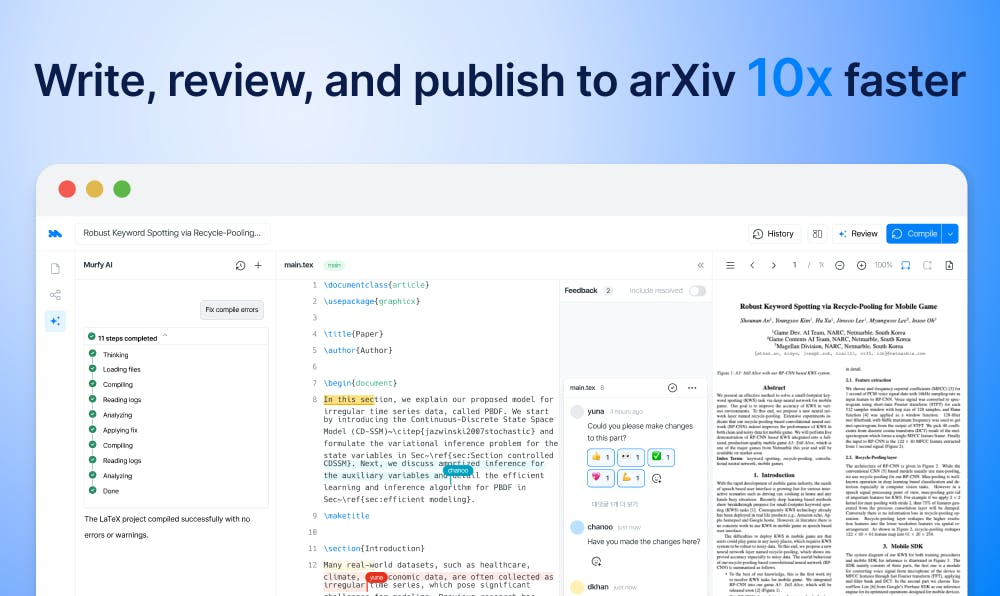
Murfy is an AI-native, browser-based LaTeX editor operated by South Korean company Murple Inc. It combines collaborative document editing with research-specific agents for drafting, paper review, citation verification, LaTeX error correction, revision, and Beamer-slide generation. It primarily targets graduate students, academic researchers, research laboratories, and institutional customers currently using Overleaf, desktop LaTeX tools, or general-purpose AI assistants (Murfy; Product Hunt).
The product is credible and addresses a recurring workflow rather than offering only a standalone AI-writing feature. Unlimited projects and collaborators on the free plan lower adoption friction, while document collaboration, templates, version history, and LaTeX compilation can create greater habitual use than a generic chatbot. The company also has relevant founder-market fit: founder Shounan An reports 15 years across industrial R&D roles and a publication record in AI-related conferences.
The strongest investment signal is company-reported usage: Murple states that Murfy has exceeded 180,000 cumulative users and reached 70,000 monthly active users. The founder separately reported users across more than 120 countries and 50–100% monthly growth in new sign-ups. These figures are meaningful if verified, but they remain unaudited company disclosures rather than independently confirmed commercial metrics (Murple company page; Product Hunt founder post).
The principal concern is monetization. Revenue, paying subscribers, institutional contract values, conversion, retention, gross margin, customer-acquisition cost, burn, and runway are not publicly disclosed. At approximately $20 per month for the individual Pro tier, Murfy would need hundreds of thousands of retained paying users—or a much larger institutional business—to support a unicorn valuation.
The decision is DD, not Invest. The disclosed active-user base, relevant founder experience, strategic funding relationship with Naver Z, and recurring research workflow justify formal diligence. Investment cannot be recommended without verifying usage, paid conversion, cohort retention, institutional economics, and current financing terms.
Product Overview
Academic teams using LaTeX frequently combine an editor, bibliography tools, messaging, manual review, and external AI systems. Murfy attempts to consolidate that workflow into one collaborative environment.
Core functionality includes real-time editing, unlimited collaborators, LaTeX compilation, comments, tracked changes, project templates, reference verification, academic-language assistance, paper review, compile-error resolution, and presentation generation. Existing Overleaf projects can be imported as ZIP files, reducing initial migration friction (Overleaf comparison).
The free Starter tier includes unlimited projects and collaborators, 1,000 monthly AI credits, AI chat, comments, tracked changes, and 24-hour version history. Pro provides 20,000 monthly credits, faster compilation, full version history, and priority support. Official search listings show Pro at KRW 29,000 monthly or KRW 21,750 per month when billed annually. Enterprise pricing is customized and adds administrative, educational, and dedicated-support functions (pricing).
Murfy is currently a web application; no verified native App Store or Google Play product was identified. Its main alternatives are Overleaf, local LaTeX editors, Microsoft Word, Google Docs, and combinations of ChatGPT or other AI tools with reference managers.
Product Quality Assessment: Strong, coherent workflow product, although comparative speed, citation accuracy, and AI-review quality require independent testing.
Founder and Team Assessment
Founder and CEO Shounan An has a B.S. in computer science from Southwest University and an M.S. in computer science and machine learning from POSTECH. His official biography lists prior roles as a senior research engineer at LG Electronics, R&D team lead at SK Telecom, and executive in Netmarble’s AI Center before founding Murple in 2022 (founder biography).
An states that he has written more than ten papers accepted at venues including AAAI, EMNLP, SIGGRAPH, and IROS. His Google Scholar profile is linked from Product Hunt, but citation counts and individual publication authorship were not independently audited for this report. The experience nevertheless suggests strong founder-market fit: he has personally encountered collaborative technical-writing problems and has relevant AI development experience.
Murple’s LinkedIn profile lists a company-size range of 11–50 employees but only six associated profiles. These indicators conflict and are not audited, so actual headcount is not verified (LinkedIn). No co-founder is prominently identified in the primary sources reviewed, producing material key-person risk.
The founder appears capable of directing technical product development and communicating with academic users. Evidence of scaled international enterprise sales, finance leadership, or prior successful exits is limited.
Founder Assessment: Strong technical and domain alignment, but organizational scale and international commercial execution remain unproven.
Market Opportunity
The narrow initial market comprises STEM graduate students, professors, research laboratories, and corporate researchers who actively write LaTeX documents. UNESCO reports 1,486 researchers per million people globally in 2023, implying roughly 12 million R&D researchers when applied to a world population of approximately eight billion; however, many do not use LaTeX or publish frequently (UNESCO Institute for Statistics).
An analyst scenario assuming 15–30% of those researchers are realistic LaTeX-oriented users produces approximately 1.8–3.6 million potential individual customers. At an illustrative $180–$240 annual subscription, the individual serviceable market would be approximately $324 million–$864 million annually. This is an analytical range, not a verified market measurement, and excludes graduate students not classified as researchers.
Institutional licensing expands the opportunity. Universities, corporate R&D teams, government laboratories, and publishers can pay more for administration, security, support, and organization-wide access. Murple reports institutional arrangements with Gyeongsang National University and the Catholic University of Korea, although contract values and deployment levels are undisclosed. A company-distributed release also describes a target of approximately 50 Korean universities, which should be treated as strategy rather than achieved traction (company-distributed release).
The market can support a substantial software company. A unicorn outcome, however, likely requires Murfy to expand from individual academic subscriptions into university-wide infrastructure, corporate technical documentation, publishing workflows, or a broader research operating system.
Traction and Growth Signals
Murple reports 180,000 cumulative users and 70,000 monthly active users in 2026, up from 150,000 cumulative registrations cited in an April 2026 company-distributed announcement. The company also claims that approximately 95% of new registrations are international and that monthly new users were growing 50–100% in 2026. These data points are promising but require dashboard, cohort, and payment-processor verification.
The ratio of reported MAU to cumulative registrations is approximately 39%. This is not a retention rate because cumulative registrations include users acquired at different times, but it suggests nontrivial ongoing use if both figures are measured consistently.
Murfy launched its global Product Hunt campaign on August 30, 2026, ranking fifth for the day. At review, Product Hunt displayed 219 followers and two reviews (awards; reviews). This supports recent launch interest but carries little weight versus usage or revenue.
Product development appears active: the company describes a 2024 beta, a 2025 official launch, institutional features, and expanded agentic capabilities in 2026. No meaningful public GitHub repository, app-store adoption, or large independent review base was identified.
The most important missing metrics are paid subscribers, MRR, institutional ARR, conversion by cohort, 30/90/180-day retention, frequency of document creation, and AI-credit consumption.
Traction Assessment: Strong company-reported usage, but monetization and retention remain commercially unverified.
Competitive Position
Murfy’s most direct competitor is Overleaf, the established collaborative online LaTeX editor. Adjacent competitors include Paperpal and SciSpace for AI-assisted research writing, general AI platforms for drafting and review, and free desktop tools such as TeXstudio.
Murfy differentiates through free unlimited collaboration, integrated research agents, reference verification, claimed faster compilation, and an academic workflow encompassing drafting through presentation creation. Its reported individual pricing is broadly competitive with AI research tools: Paperpal and SciSpace offer paid academic-assistance plans, while Overleaf sells individual and institutional collaboration subscriptions (Paperpal pricing; SciSpace pricing; Overleaf plans).
Switching costs can arise from stored projects, collaboration history, templates, comments, institutional administration, and learned workflows. Nevertheless, ZIP export and LaTeX’s portable file format also make switching technically feasible.
If Overleaf launched comparable research agents within six months, customers would continue using Murfy only if it maintained superior AI accuracy, price, compilation performance, and institutional service. Public evidence does not yet establish a proprietary model, exclusive dataset, strong network effect, or structural distribution advantage.
Defensibility Assessment: Medium-Low
Business Model and Economics
Murfy uses a freemium SaaS model. Individual Pro revenue is recurring, while Enterprise can generate larger institutional contracts. Potential expansion revenue includes additional AI credits, laboratory plans, university licenses, publisher integrations, compliance controls, and corporate research deployments.
At the annual-plan price, individual annual contract value is approximately KRW 261,000. Institutional ACV is not publicly disclosed. Free unlimited collaboration may accelerate acquisition but could also reduce upgrade pressure unless AI credits, version history, compile limits, or administrative requirements drive conversion.
Variable costs include LaTeX compilation compute, document storage, real-time collaboration infrastructure, support, and AI inference. The privacy policy identifies OpenAI and Fireworks.ai as AI-processing vendors and says submitted content may be retained for up to 30 days under abuse-monitoring policies (privacy policy). Usage growth will create attractive economics only if subscription and credit revenue rise faster than inference and infrastructure costs.
Gross margin, inference cost per active user, free-user cost, payment fees, and support burden are not disclosed.
Unicorn Path
An 8× ARR multiple is assumed. This is appropriate for a competitive AI-enabled SaaS business only if it demonstrates strong growth, durable retention, and healthy gross margins; otherwise, a lower multiple would be warranted.
Required ARR = $1 billion ÷ 8 = $125 million.
At approximately $200 annual revenue per individual Pro subscriber, Murfy would need roughly 625,000 paying subscribers. Relative to the company-reported 180,000 cumulative users, that requires substantial continued growth and high conversion.
Institutional sales could improve the equation:
- At an assumed $25,000 institutional ACV: 5,000 institutions
- At an assumed $100,000 ACV: 1,250 institutions
- At $50 million institutional ARR plus $75 million individual ARR: approximately 375,000 individual subscribers, plus the institutional portfolio
These ACVs are analyst scenarios, not Murfy’s disclosed contract values. The path requires global university distribution, stronger administrative and security capabilities, verified academic-integrity safeguards, expansion into corporate R&D, and potentially publisher or reference-database integrations.
Unicorn Path: Conditional
Valuation Assessment
Murple reports raising KRW 1.8 billion from Naver Z in 2022. Its LinkedIn description instead labels the round as “$1.8M,” creating a currency inconsistency. The Korean-won disclosure on the official company timeline is preferred; the US-dollar figure should not be relied upon without financing documents (Murple; LinkedIn).
No reliable current valuation, recent round, SAFE cap, fundraising target, cap table, or secondary transaction was found. Revenue and growth are also unavailable, preventing a defensible revenue-multiple analysis.
Valuation Attractiveness: Not Assessable
Assessment requires ARR, paid growth, gross margin, retention, burn, runway, round size, pre- and post-money valuation, Naver Z ownership and rights, liquidation preferences, and employee-option dilution.
Key Risks
- Unverified monetization: Large reported registration numbers may coexist with weak paid conversion.
- Retention uncertainty: Academic writing is cyclical and deadline-driven, potentially causing intermittent usage and churn.
- Incumbent response: Overleaf can bundle similar AI features into an established workflow.
- Limited defensibility: LaTeX files are portable, and core AI features depend partly on third-party models.
- AI cost exposure: Heavy paper review and revision could make active free users expensive.
- Academic-integrity risk: Hallucinated references, inaccurate reviews, or undisclosed AI authorship could damage trust.
- Privacy concerns: Unpublished research is commercially sensitive and may be processed by overseas AI providers.
- Key-person risk: Public leadership evidence is concentrated around one founder.
- Institutional sales complexity: University procurement, security reviews, and budget cycles can be slow.
Final Assessment
Venture Potential: 70/100
| Category | Score |
|---|---|
| Market Size and Expansion Potential | 15/20 |
| Traction and Growth Evidence | 14/20 |
| Founder and Team | 12/15 |
| Product Strength | 8/10 |
| Distribution Potential | 10/15 |
| Business Model and Economics | 6/10 |
| Defensibility | 5/10 |
| Total | 70/100 |
The strongest elements are founder-market fit, a credible collaborative product, reported active usage, international adoption, and institutional expansion potential. The weakest are unknown revenue quality, unverified retention and economics, and exposure to incumbent replication.
Evidence Confidence: 64/100
The legal entity, founder, headquarters, product, pricing structure, privacy practices, and initial investor relationship are supported by primary sources. User and growth metrics are company-reported. Revenue, conversion, retention, margins, current headcount, runway, cap table, and valuation remain unavailable. The funding-currency discrepancy reduces confidence.
Final Decision: DD
Murfy clears the threshold for formal due diligence because reported usage is substantial, the founder has relevant domain experience, and institutional licensing could support a venture-scale model. It does not qualify for Invest because commercial traction, economics, and financing terms are unknown.
Upgrade Conditions
- Payment records verifying meaningful ARR and sustained paid growth.
- At least 10% free-to-paid conversion or compelling institutional ARR.
- More than 70% six-month paid-user retention.
- Gross margin above 70% after inference and compilation costs.
- Multiple referenceable university contracts with recurring renewals.
- Evidence that international acquisition is organic and repeatable.
- Financing terms consistent with verified commercial performance.
Downgrade Conditions
- Reported users or MAU cannot be reconciled with product analytics.
- Low document-creation frequency or weak paid retention.
- AI and compilation costs prevent healthy gross margins.
- Overleaf achieves comparable functionality without meaningful price disadvantage.
- Citation errors or privacy incidents damage institutional trust.
- Product activity slows or founder commitment changes materially.
Questions for Further Diligence
- What are current MRR, ARR, and monthly paid-revenue growth?
- How many individual subscribers and institutional customers are paying?
- How are cumulative users and MAU defined, deduplicated, and measured?
- What are 30-, 90-, and 180-day retention by acquisition cohort?
- What is free-to-paid conversion, and what events most strongly predict conversion?
- What are institutional ACV, renewal rate, sales cycle, and pipeline?
- What are gross margin and AI-inference cost per free and paid active user?
- What percentage of acquisition is organic, paid, university-led, or Product Hunt-related?
- How does citation accuracy compare with Overleaf integrations, Paperpal, and SciSpace?
- What are current burn, runway, headcount, and hiring priorities?
- What ownership and protective rights does Naver Z hold?
- What are the current round size, valuation, liquidation preferences, and option-pool terms?