
Table of Contents
Mem Agent Investment Report
Category: AI productivity / personal knowledge management / proactive AI assistant
Company Stage: Series A; commercial product
Founder or Founders: Kevin Moody and Dennis Xu; Xu left Mem in 2024
Headquarters: Los Altos Hills, California, United States
Funding: Approximately $29 million publicly disclosed
Business Model: Freemium consumer/prosumer subscription SaaS
Product Hunt Launch Date: August 13, 2026 for Mem Agent; Mem 2.0 previously launched October 2, 2025
Report Date: August 16, 2026
| Investment Metric | Assessment |
|---|---|
| Venture Potential | 67/100 |
| Unicorn Path | Conditional |
| Valuation Attractiveness | Not Assessable |
| Evidence Confidence | 61/100 |
| Final Decision | DD |
Executive Summary
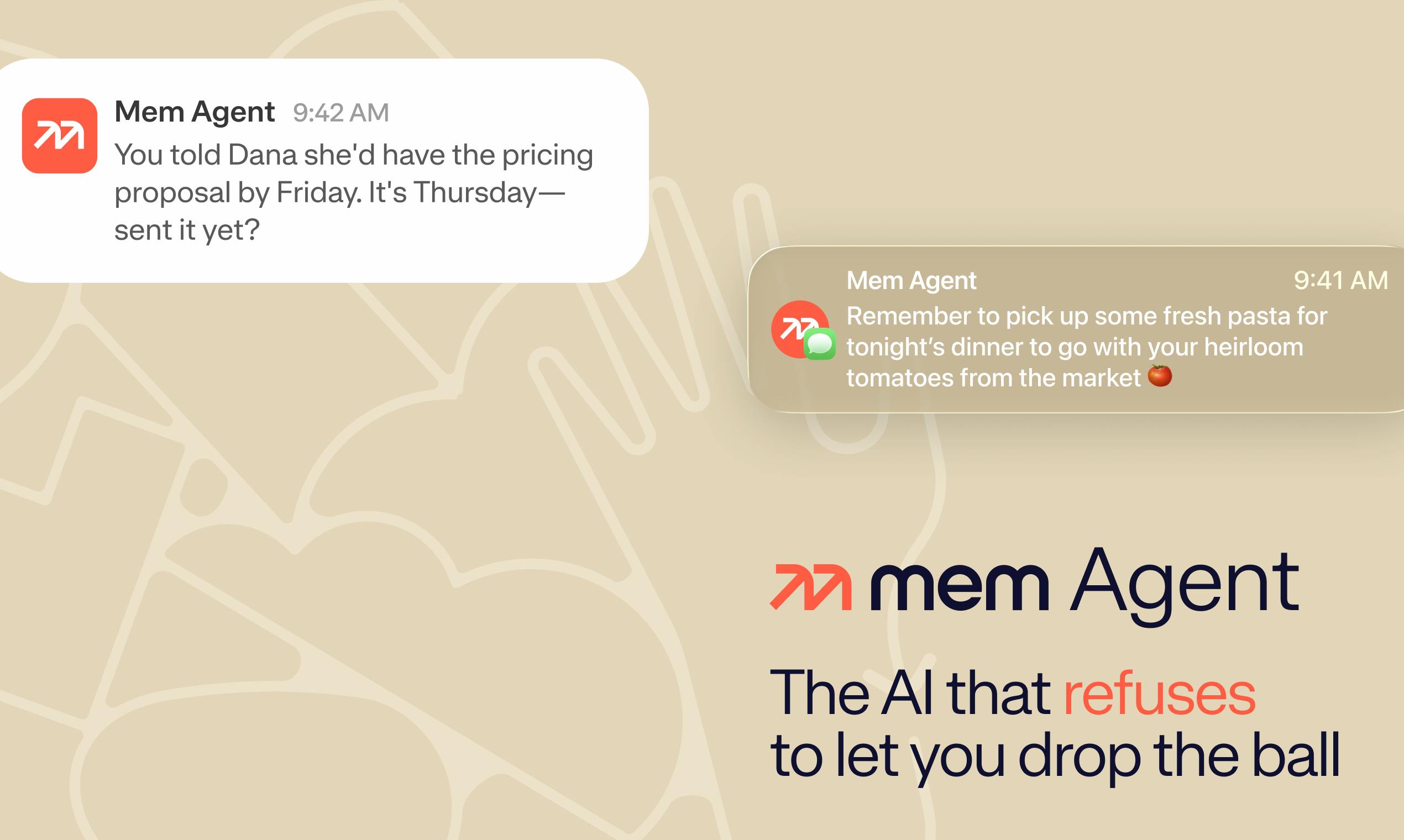
Mem Agent is a proactive AI assistant built on Mem’s personal knowledge workspace. It uses notes, meetings, messages, calendar information, and connected sources to identify unfinished commitments and provide context-aware follow-ups. Unlike a conventional chatbot, it can initiate reminders through channels including Slack, iMessage, and WhatsApp (official product page).
The product targets founders, executives, consultants, and other information-intensive professionals who currently combine notes, calendars, task managers, meeting transcription, and manual reminders. Its strongest product attribute is the combination of persistent, user-visible memory and proactive intervention rather than another standalone AI chat interface.
Company quality is credible but incompletely evidenced. CEO Kevin Moody has relevant engineering and product experience at Google and Google X, and Mem has operated since 2019 (Moody’s LinkedIn). The company raised a $5.6 million seed round led by Andreessen Horowitz and a $23.5 million Series A led by the OpenAI Startup Fund, reaching a reported $110 million post-money valuation in 2022 (founder announcement; TechCrunch).
The primary concern is the absence of current commercial evidence. Revenue, subscriber count, growth, retention, conversion, gross margin, burn, runway, and current valuation are not publicly disclosed. Public reviews are positive but limited: the U.S. App Store lists 119 ratings, while Product Hunt shows 14 reviews (App Store; Product Hunt). Neither demonstrates product-market fit.
The appropriate decision is DD. Mem has a credible product, qualified leadership, and a large potential market, but the $99 monthly proactive plan faces material willingness-to-pay and retention risk. Formal diligence should focus on whether Mem’s historical funding and valuation are supported by current recurring revenue and durable usage.
Product Overview
Mem addresses a recurring knowledge-work problem: people capture information across disconnected applications but fail to retrieve it or act on related commitments. Mem Workspace stores notes, meetings, web research, and other context; Mem Agent interprets that information and follows up when it believes an action is necessary (official website).
Core functions include voice capture, meeting recording without a visible meeting bot, semantic search, automatic organization, web clipping, PDF understanding, calendar context, and agentic creation or editing of notes. The company says Mem 2.0 was rebuilt as an offline-first product across desktop, web, and mobile (Mem 2.0 announcement).
Current web pricing is:
- Free: 25 notes and 25 Agent messages monthly.
- Pro: $12 per month for unlimited notes, 250 Agent messages, PDF understanding, email/API access, and meeting briefings.
- Proactive: $99 per month after a seven-day trial, including proactive reminders, commitment detection, external messaging channels, and unlimited usage (pricing).
Mem is available on Mac, Windows, web, and iOS. No current Android application was verified. Its iOS application has a 4.5/5 rating from 119 U.S. ratings and was actively updated at the report date (App Store).
The product replaces a fragmented workflow involving Apple Notes or Notion, a calendar, a task manager, meeting software, and manually configured reminders.
Product-quality assessment: Strong concept and broad implementation, but reminder accuracy, notification fatigue, and long-term reliability remain commercially unverified.
Founder and Team Assessment
Kevin Moody is Mem’s current CEO. His public profile reports prior roles as a Google Associate Product Manager and Product Manager, including Google Maps Platform and Android Automotive, plus earlier software-engineering work at Google X and Splunk (LinkedIn). His continuing leadership since 2019 demonstrates commitment and relevant product expertise.
Dennis Xu co-founded Mem after product-management experience at Yelp. His profile states that he left Mem in January 2024 and subsequently co-founded Adaptive (Xu’s LinkedIn). Diligence should examine the reason for the departure, retained equity and board rights, and whether Mem lost important technical or commercial leadership.
The official careers page names approximately ten people across engineering, design, customer support, and leadership, although it may not represent the complete team. No clearly active roles were displayed during review (careers). No prior founder exit was verified.
Founder Assessment: Strong product and technical credentials with sustained commitment, but commercial scaling ability and co-founder-departure implications require verification.
Market Opportunity
The initial addressable segment is information-intensive individual professionals who experience costly failures of recall or follow-through and are willing to pay for a persistent assistant.
Illustrative bottom-up scenarios are:
- One million Pro subscribers × $144 annually = $144 million annual revenue.
- 100,000 Proactive subscribers × $1,188 annually = $118.8 million annual revenue.
These are analyst scenarios, not forecasts or verified market estimates. Capturing either user base would require strong retention, international distribution, cross-platform availability, and substantially more public adoption evidence than currently exists.
The $12 plan competes with premium note-taking products. The $99 plan must provide value closer to administrative support or executive productivity software. Adjacent opportunities include team knowledge management, enterprise search, workflow automation, agent APIs, and profession-specific assistants. However, the current pricing page is primarily individual-focused; no current enterprise revenue or contracts were verified.
The market is large enough for venture-scale outcomes, but only if Mem becomes a high-frequency system of record rather than an occasional AI utility.
Traction and Growth Signals
Verified signals include:
- Approximately $29 million in funding from the OpenAI Startup Fund, a16z, Floodgate, Unusual Ventures, and other investors (OpenAI Startup Fund; Mem announcement).
- Sustained operation since 2019 and a ground-up product rebuild released in 2025.
- Active iOS development and a 4.5 rating from 119 U.S. ratings (App Store).
- A 4.7 Product Hunt rating from 14 reviews and roughly 590 followers (Product Hunt).
- Continued feature expansion into voice capture, calendar context, APIs, connected email, MCP, and proactive messaging.
Product Hunt reviewers generally praise low-friction capture, semantic retrieval, and AI organization. Reported weaknesses include price, performance, missing Android support, exact-keyword search, and language availability. The sample is too small and launch-selected to establish broad satisfaction.
Revenue, active users, paying subscribers, growth, retention, conversion, enterprise contracts, and website traffic are not publicly verified. Mem also declined to disclose revenue and major customers at its 2022 financing (TechCrunch).
Traction Assessment: Sustained product activity and credible financing, but commercial traction remains unverified.
Competitive Position
Direct competitors include Notion AI, Reflect, Granola, Evernote, Capacities, and Saner.AI. Indirect competitors include ChatGPT memory, Claude, Microsoft Copilot, Google Workspace, meeting assistants, and Todoist. Free alternatives include Apple Notes, Apple Reminders, Google Keep, Obsidian, and manually configured Notion systems.
Mem’s differentiation is the integration of visible personal memory, automatic organization, and proactive follow-up. Accumulated personal context could create behavioral switching costs, although Markdown export reduces hard lock-in. There is no evident network effect.
If Apple, Notion, Microsoft, or OpenAI launched the same feature within six months, customers would remain only if Mem delivered superior recall, lower setup friction, reliable cross-platform integrations, and more accurate interventions. Comparative evidence establishing those advantages is not public.
Defensibility Assessment: Medium-Low
Business Model and Economics
Mem’s freemium model supports product-led acquisition. The $12-to-$99 pricing ladder creates significant expansion potential: a retained Proactive subscriber represents $1,188 of annualized list-price revenue before discounts, refunds, payment fees, and App Store commissions.
The principal economic question is whether users retain the $99 plan after novelty declines. At that price, Mem must replace meaningful administrative effort rather than simply improve note-taking.
Variable costs include model inference, embeddings, transcription, storage, search infrastructure, messaging integrations, and customer support. Proactive background analysis may generate costs even when users are inactive. No gross-margin or cost-per-user data are disclosed.
Mem reports encryption in transit and at rest, SOC 2 Type II compliance, and no sale of customer data. The service is not end-to-end encrypted because its AI must process user content (security; privacy policy). Trust is both a product requirement and a potential sales constraint.
Unicorn Path
An 8× ARR multiple is appropriate for a scaled AI subscription company with strong growth, but consumer retention and inference-cost exposure. A higher multiple would require exceptional retention and growth.
Required ARR = $1 billion ÷ 8 = $125 million.
At list prices, that implies approximately:
- 868,000 Pro subscribers at $12 per month;
- 105,000 Proactive subscribers at $99 per month; or
- 250,000 subscribers at an illustrative blended annual revenue of $500.
These calculations exclude discounts, refunds, churn, payment fees, App Store commissions, and infrastructure costs. Required gross billings would therefore be higher.
A credible path requires strong annual retention, efficient organic distribution, Android and international expansion, more integrations, and likely team or enterprise offerings. Mem must also establish that its personal-context layer improves over time and remains difficult for larger platforms to replicate.
Unicorn Path: Conditional
Valuation Assessment
Mem’s most recent publicly reported valuation was $110 million post-money following its 2022 Series A, which brought total disclosed funding to approximately $29 million (TechCrunch). This historical figure should not be treated as the company’s current valuation.
No subsequent financing, secondary transaction, SAFE cap, current round, or acquisition offer was reliably identified. Current revenue and growth are also unavailable.
Valuation Attractiveness: Not Assessable
Assessment requires current ARR, growth, gross margin, retention, burn, runway, round size, proposed valuation, investor ownership, option-pool treatment, and liquidation preferences. The historical valuation could create financing-overhang risk if commercial growth has lagged.
Key Risks
- Commercial traction is undisclosed: Revenue, subscribers, growth, and retention are unknown.
- High willingness-to-pay hurdle: $99 monthly is expensive for individual productivity software.
- Competitive replication: Major AI and productivity platforms can bundle proactive memory.
- Consumer churn: Users may leave before accumulating enough context to experience compounding value.
- Historical valuation overhang: The 2022 valuation may complicate future financing.
- Privacy and security exposure: Mem handles sensitive notes, meetings, calendars, and messages.
- AI reliability: Incorrect commitments or poorly timed reminders may create notification fatigue.
- Founder concentration: Dennis Xu has departed, leaving Moody central to strategy and execution.
- Platform limitation: No verified Android application.
- Margin uncertainty: Continuous inference and transcription could pressure economics.
Final Assessment
Venture Potential: 67/100
| Category | Score |
|---|---|
| Market Size and Expansion Potential | 16/20 |
| Traction and Growth Evidence | 10/20 |
| Founder and Team | 12/15 |
| Product Strength | 8/10 |
| Distribution Potential | 9/15 |
| Business Model and Economics | 7/10 |
| Defensibility | 5/10 |
| Total | 67/100 |
Mem’s strongest attributes are founder-market fit, product maturity, credible investors, and high potential revenue per Proactive customer. Its weakest are absent commercial metrics, uncertain retention, platform bundling risk, and limited evidence of durable distribution.
Evidence Confidence: 61/100
Founder history, funding, historical valuation, pricing, product functionality, platform availability, security posture, and public review counts are verifiable. Product benefits are partly company-reported. Market calculations are analyst scenarios. Revenue, retention, unit economics, burn, runway, cap table, and current financing terms remain unavailable.
Final Decision: DD
Mem warrants a founder meeting and formal data request. The product and team are credible enough for potential venture backing, but an investment cannot be recommended without evidence that usage converts into durable subscription revenue at attractive margins and without knowing current financing terms.
Upgrade Conditions
- Verified ARR above $5 million with strong growth.
- Evidence of durable six- and twelve-month paid retention.
- Sustainable Proactive trial-to-paid conversion.
- Gross margin above 70% after inference and transcription costs.
- Repeatable customer acquisition outside launch communities.
- Referenceable team or enterprise customers.
- Comparative evidence of superior recall and intervention accuracy.
Downgrade Conditions
- Weak Proactive conversion or rapid post-trial churn.
- Low ongoing use after initial note import.
- Revenue materially below the level implied by the historical valuation.
- Successful bundling by Apple, Notion, Microsoft, Google, or OpenAI.
- Persistent false reminders or notification fatigue.
- Material privacy or security incident.
- Founder disengagement or slowing product development.
Questions for Further Diligence
- What are current ARR, MRR, and year-over-year growth?
- How many active and paying users are on Free, Pro, and Proactive?
- What are Proactive trial conversion, refund, and cancellation rates?
- What are 30-, 90-, 180-, and 365-day retention by plan?
- How frequently do retained users act on Agent-generated reminders?
- What are gross margin and inference, transcription, storage, and messaging costs per user?
- Which acquisition channels produce the highest-retention customers, and at what CAC?
- Why did Dennis Xu leave, and what equity or governance rights does he retain?
- What are the current team structure, monthly burn, and cash runway?
- What are the current financing valuation, round terms, and liquidation preferences?
- How does Mem measure false commitments, reminder accuracy, and notification fatigue?
- What is the roadmap for Android, teams, enterprise controls, and additional integrations?
Sources
- Product Hunt: Mem
- Official Mem website
- Mem Agent product page
- Official pricing
- Apple App Store listing
- Mem 2.0 announcement
- Mem careers and team page
- OpenAI Startup Fund investment announcement
- Mem seed-funding announcement
- TechCrunch Series A coverage
- Kevin Moody’s LinkedIn
- Dennis Xu’s LinkedIn
- Mem security page
- Mem privacy policy