
Table of Contents
Play with Putty Investment Report
Category: Collaborative AI app building (“vibe coding”) — Design Tools / AI
Company Stage: Internal research experiment at Google Labs (Alphabet Inc., NASDAQ: GOOGL) — not a standalone company
Founder or Founders: Not publicly disclosed. Built by an unnamed Google Labs team; Google Labs is led by VP Josh Woodward
Headquarters: Mountain View, California (Google/Alphabet HQ)
Funding: Not applicable — no external round; funded internally by Alphabet
Business Model: Free research experiment; no pricing or revenue model disclosed
Product Hunt Launch Date: Announced August 25, 2026; Product Hunt launch the same week (top-30 listing August 28, 2026)
Report Date: August 31, 2026
| Investment Metric | Assessment |
|---|---|
| Venture Potential | 40/100 |
| Unicorn Path | No Credible Path |
| Valuation Attractiveness | Not Assessable |
| Evidence Confidence | 58/100 |
| Final Decision | Pass |
Executive Summary
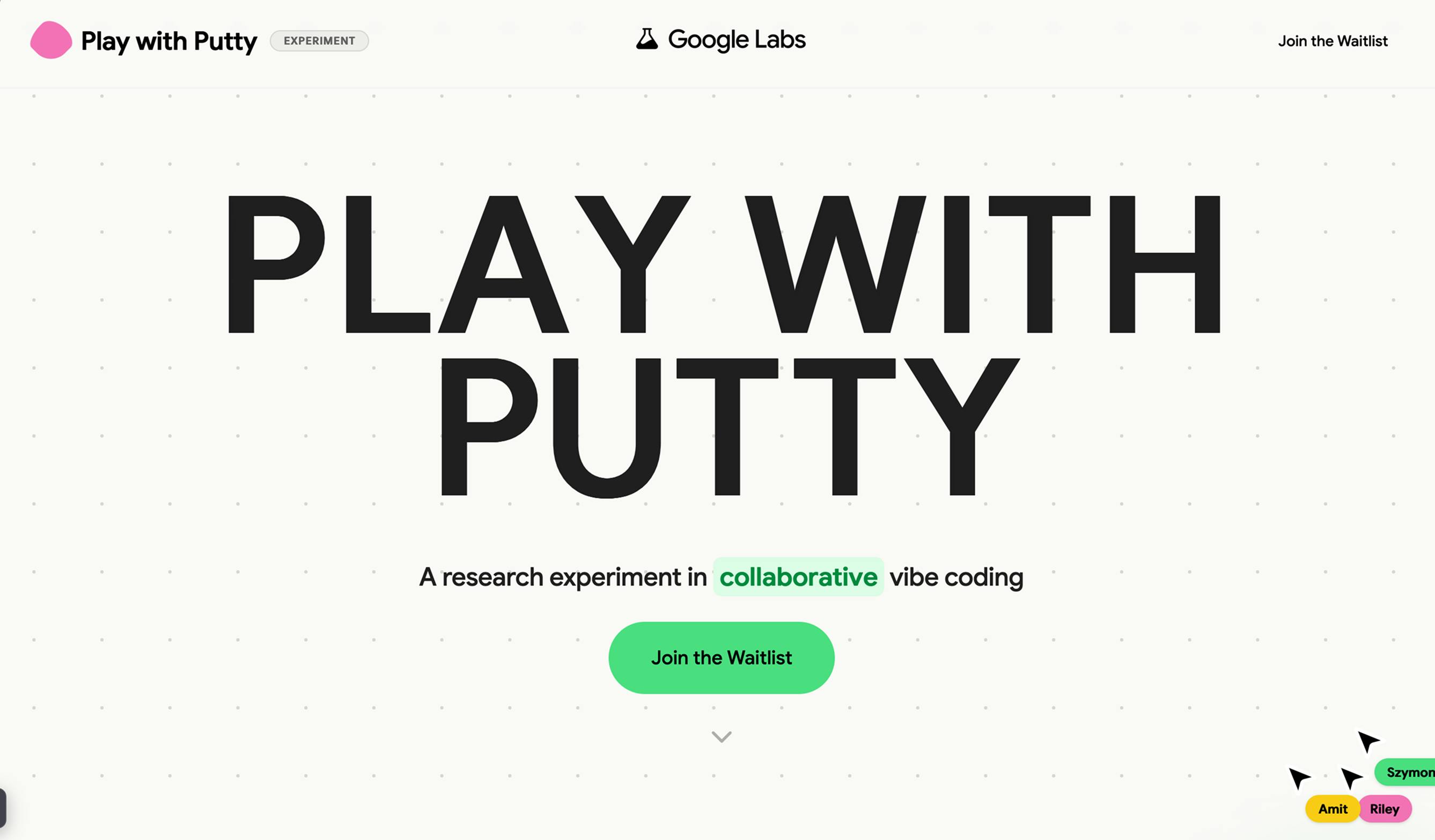
Play with Putty is a free, waitlist-gated research experiment from Google Labs that turns AI “vibe coding” into a multiplayer activity: multiple people share one workspace, describe what they want in natural language, and watch a live, usable app update in real time for everyone at once. It was announced on August 25, 2026 and listed on Product Hunt in the same week under Google Labs’ maker page. pasqualepillitteri
The product targets casual builders, educators, creator duos, and small groups for whom today’s alternative is taking turns in a single-player builder (Lovable, Bolt.new, v0) or pairing over screen share. Access currently requires a personal Google account (18+), excludes Workspace, school, and business accounts, and rolls out in waves starting in the United States. pasqualepillitteri
The concept is interesting because it lands in the hottest software category of 2026: Lovable just raised at a $13.3 billion valuation, Replit is valued at $9 billion, and Cursor was reportedly acquired for $60 billion. The multiplayer angle — direct manipulation of any UI element plus a shared change ledger — is a genuinely differentiated user experience, not just a prompt box. labs
The strongest positive signal is institutional: Google Labs has a verified record of graduating experiments into products people pay for, including NotebookLM, Flow, and AI Studio, under a leadership team with deep operating experience. sequoiacap
The most important concern is structural: Play with Putty is not a company. It has no legal independence, no revenue model, no disclosed team, and no spinout mechanism — Labs experiments historically either graduate into Google products or are shut down, as Whisk, ImageFX, and Firebase Studio were. There is nothing here for a venture investor to buy at any price. sequoiacap
Final decision: Pass. The product may be good; the investment case does not exist. The actionable takeaway for venture investors is the market signal — multiplayer, non-technical building is an emerging wedge where an independent startup with this experience and real monetization could be venture-scale.
Product Overview
The customer problem: AI app builders are single-player. A non-technical person builds alone, then shares a link or screen when they want input, breaking creative flow. Play with Putty makes the build itself shared, closer to a Google Doc for software. pasqualepillitteri
Core mechanics, per the official experiment page and launch coverage: one person opens a Putty space and invites others via link; anyone can prompt in natural language; the model updates the project live for everyone with no reload; users can select any UI component and instruct it directly (“talk to any element”); and a shared history ledger lets anyone scroll back through every change. pasqualepillitteri
Target users are prosumers and small groups — educators and students, creator collaborators, hobbyist friends, lightweight agency/client prototyping. Pricing: free during testing; Google has not said whether it will ever charge. Platform: web-based via labs.google, waitlist only, US-first rollout in waves. Because the product is pre-general-availability, hands-on quality, stability, and output fidelity are not independently verifiable as of this report. pasqualepillitteri
Founder and Team Assessment
There are no founders in the venture sense. The specific Putty team is not publicly disclosed; the experiment page credits only demo participants by first name. What is verified is the institutional home: Google Labs, run by VP Josh Woodward, a 16-year Google veteran who also took oversight of the Gemini app in April 2025 and shepherded NotebookLM from a 20%-time project to a breakout product. labs
Woodward has described the Labs model explicitly: experiments either graduate into existing Google products (AI Studio and the Gemini API moved to DeepMind) or become standalone products valuable enough that people pay for them, like NotebookLM, Flow, and AI Studio. Team size, staffing commitment, and hiring for Putty specifically: not publicly disclosed. sequoiacap
The key-person risk is inverted from a startup: the team can be reassigned or the project wound down at any time, with no cap table, vesting, or founder commitment to prevent it. Labs’ recent record includes shutting down Whisk and ImageFX on April 30, 2026 and sunsetting Firebase Studio by March 22, 2027. support.google
Founder Assessment: World-class institutional home and proven Labs leadership, but the specific team is undisclosed and commitment is structurally revocable at any time.
Market Opportunity
Defined narrowly, the initial segment is small groups who want to build simple tools and websites together without a developer: educators running build exercises, creator duos, friends, and solo builders who want feedback inside the tool rather than after it.
Willingness to pay is unproven for Putty, but category benchmarks exist: Replit Core from $20/month, Lovable from $25/month, v0 at $30 per user per month. Category revenue is already demonstrated at scale — Replit reportedly near $525 million ARR and Lovable in the $400–500 million ARR range (third-party estimates, not audited). One secondary estimate puts the 2026 vibe-coding market at $4.7 billion; this figure is unverified and should be treated cautiously. tech-insider
A bottom-up sketch (analyst assumption, not company data): if 2–3 million people worldwide actively experiment with AI builders and a multiplayer-native product converted 1–2% at roughly $240/year, the initial wedge is only $5–15 million ARR. Venture scale would require the team/Workspace motion — seats at $25–30 per user per month — which Putty currently cannot serve because Workspace accounts are excluded. pasqualepillitteri
The market can support venture-scale revenue; Putty’s monetized wedge within it is undefined.
Traction and Growth Signals
Launch-week evidence only. Product Hunt: approximately 107 upvotes and 2 comments, ranking #13 on August 28, 2026 per a third-party tracker; the Google Labs maker page shows 14 lifetime launches and about 2.5K followers. The announcement received pickup from the official Google Labs X account and tech blogs. pasqualepillitteri
There is no general availability, so none of the following exist publicly: user counts, active users, paying customers, revenue, retention, app store presence, GitHub activity, or traffic data. Product Hunt votes and press mentions are launch attention, not product-market fit.
The most important missing metrics are all of them: activation beyond the waitlist, returning-collaborator behavior, project completion rates, and any commercial signal whatsoever.
Traction Assessment: Launch-week attention only; commercially unverified and currently unverifiable.
Competitive Position
Direct competitors: Figma Make (multiplayer canvas plus code generation, with a design agent shipping since 2026); Replit Agent 4’s “Build Together” team coordination; Lovable, Bolt.new, v0 by Vercel, and Base44 in single-player AI building. Free alternatives: Google’s own Antigravity (free for individuals in public preview, now a full agentic platform with Antigravity 2.0), plus open-source tools like Cline and Aider. replit
Internal Google overlap is severe: Antigravity, AI Studio, Jules, and Gemini CLI all compete for the same strategic attention and users. codelabs.developers.google
Putty’s differentiation is real but thin: ground-up multiplayer, direct element manipulation, and a shared change ledger. There is no disclosed proprietary data, no network effects yet (shared projects could create mild lock-in), and total platform dependency on Google accounts and infrastructure. labs
The six-month question — “if the largest platform launched this feature tomorrow, why would users stay?” — has a weak answer, because Figma and Replit are already shipping multiplayer and team AI building. The honest response is UX craft, not a moat.
Defensibility Assessment: Low
Business Model and Economics
There is no revenue model. If monetized later, the likely form is a usage-based AI product with meaningful inference costs per active project, or a consumer/team subscription at category price points of $20–30 per month. The natural monetization unit for a collaboration product — team and Workspace seats — is blocked today by the personal-accounts-only restriction. pasqualepillitteri
Conversion, churn, renewal, gross margin, support load, and customer acquisition cost are all not assessable; the product has no billing surface. Alphabet’s scale absorbs the infrastructure (Q2 2026 CapEx of $44.9 billion, largely AI infrastructure ), which means unit economics are invisible rather than proven. abc
Unicorn Path
As currently constituted, none exists. The reasoning, with the hypothetical math made explicit: applying a conservative 10x revenue multiple to high-growth AI SaaS (versus roughly 17x for Replit and ~30x for Lovable on reported figures ), a $1 billion valuation would require roughly $100 million ARR — about 333,000 subscribers at $300/year, or about 55,000 teams at roughly $1,800/year. The category demonstrably supports this scale; competitors already report $400–500 million ARR. businessinsider
But reaching it would require Google to do things it has never done with a Labs experiment: spin out a separately capitalized entity, add monetization, open Workspace/team accounts, roll out internationally, and build a commercial team. Labs’ documented outcomes are graduation into Google products or shutdown. Under the current and foreseeable structure, there is no reasonable route to venture-scale revenue for an outside investor. sequoiacap
Unicorn Path: No Credible Path
Valuation Assessment
No funding round, SAFE, valuation, or investable entity exists for Play with Putty. The only exposure is Alphabet equity — approximately a $4.14 trillion market capitalization per a third-party analysis, with Q2 2026 revenue of $119.8 billion, up 24% — where Putty is immaterial. sec
Valuation Attractiveness: Not Assessable. Assessing it would require a spinout or standalone financing with disclosed ARR, growth, retention, gross margin, burn, round size, and post-money terms. None can exist under the current structure, so no valuation range is offered.
Key Risks
- No investable entity — the product cannot become a venture-scale company under any foreseeable Google structure
- Discontinuation risk — Labs recently killed Whisk and ImageFX and is sunsetting Firebase Studio support.google
- No monetization — free experiment with unbounded inference cost per active project
- Competitive replication — Figma Make and Replit already ship multiplayer/team AI building figma
- Internal cannibalization — Antigravity, AI Studio, and Jules compete for the same Google budget and users codelabs.developers.google
- Distribution mismatch — Workspace exclusion blocks exactly the team accounts a collaboration product needs; US-first waves limit reach pasqualepillitteri
- Priority risk — Labs leadership attention is split (Woodward also oversees the Gemini app), and internal teams can be reassigned silently cnbc
- Zero observable usage data — pre-GA waitlist means even directional product-market fit cannot be measured externally
Final Assessment
Venture Potential: 40/100
| Category | Score |
|---|---|
| Market Size and Expansion Potential | 15/20 |
| Traction and Growth Evidence | 2/20 |
| Founder and Team | 7/15 |
| Product Strength | 6/10 |
| Distribution Potential | 6/15 |
| Business Model and Economics | 1/10 |
| Defensibility | 3/10 |
| Total | 40/100 |
The strongest elements are the market (a proven multi-billion-dollar category with funded winners) and the product concept (a genuinely novel multiplayer UX). The weakest are the total absence of a business model, low standalone defensibility, and the structural reality that this is a feature experiment inside a public company, not a company. The 35–49 band normally signals a niche or bootstrapped business; here it reflects a strong concept with no commercial infrastructure attached.
Evidence Confidence: 58/100
Verified: product existence, features, and access mechanics (official Labs page); owner and launch date; Labs leadership and graduation model; Alphabet financials (SEC filing). Company-reported: Labs’ positioning and intent. Third-party estimates: Product Hunt vote counts, competitor ARR and valuations, market-size figures. Unavailable: Putty’s users, retention, costs, team size, roadmap, and any monetization plan. Confidence is capped by the impossibility of commercial verification pre-GA. pasqualepillitteri
Final Decision: Pass
The decision rests on structure, not quality. Venture Potential (40/100) reflects a promising concept with no commercial scaffolding; the Unicorn Path is nonexistent under current ownership; Valuation Attractiveness is Not Assessable because there is nothing to value; and traction is one week of launch attention. Even a flawless DD process could not produce investable terms, because Alphabet neither sells nor spins out Labs experiments. Pass does not mean the product is bad — it means no venture capital strategy can apply here.
Upgrade Conditions
- Google spins Putty (or a successor) into a separately capitalized, investable entity — not foreseeable based on Labs history
- For category exposure instead: an independent multiplayer vibe-coding startup demonstrating $1M+ ARR, above 70% six-month retention, Workspace/team support, and distribution beyond launch spikes would merit DD
Downgrade Conditions
- Putty is discontinued, as Whisk and Firebase Studio were support.google
- Figma or Replit ships a successful multiplayer building experience that absorbs the wedge figma
- Material privacy or data-governance issues emerge in shared project spaces
Questions for Further Diligence
- What is the intended end state for Putty — graduation into a Google product, a standalone paid product, or shutdown criteria?
- Which user segment showed the strongest engagement in the first wave of waitlist invites?
- Does Google intend to monetize, and if so, via consumer subscription, Workspace add-on, or usage-based pricing?
- Will Workspace, school, and business accounts ever be supported, and on what timeline?
- Which model(s) power generation, and what are the per-project inference costs?
- How are shared projects governed — data retention, participant privacy, export, and deletion?
- How does Putty relate strategically to Antigravity, Jules, and AI Studio without competing for the same users?
- What is the team size and composition, and is anyone assigned full-time?
- What usage or retention thresholds determine expansion versus wind-down?
- What is the international rollout schedule beyond the initial US waves?
- Are APIs, templates, or a publish/host ecosystem planned?
- If the experiment ends, what happens to user projects — export, migration, or deletion?
Sources
- Product Hunt — Google Labs maker page and Play with Putty launch
- Product Hunt — Play with Putty post
- Official experiment page — labs.google/playwithputty
- Alphabet Q2 2026 press release (SEC EDGAR)
- Sequoia “Training Data” — Josh Woodward on Google Labs
- CNBC — Josh Woodward profile
- Business Insider — Lovable $13.3B round and AI coding market
- Pasquale Pillitteri — Play with Putty launch coverage (secondary)
- NODUS — Product Hunt daily tracker, Aug 28, 2026 (secondary)
- Google Developers Blog — Antigravity launch
- Google support — Whisk and ImageFX shutdown notice
- Firebase Studio sunset and migration
- Replit — Agent 4 announcement
- Figma — 2026 AI Report