
Table of Contents
Youkti Investment Report
Category: AI-native B2B sales intelligence and revenue-action software
Company Stage: Early commercial / pre-seed-stage profile
Founder or Founders: Ramana Abhishek; other co-founder(s) not publicly identified
Headquarters: Hyderabad, India
Funding: Not publicly disclosed
Business Model: Freemium sales data with custom-priced revenue-action software; legacy pages also show low-cost subscriptions and usage pricing
Product Hunt Launch Date: September 13, 2026
Report Date: September 15, 2026
| Investment Metric | Assessment |
|---|---|
| Venture Potential | 54/100 |
| Unicorn Path | Conditional |
| Valuation Attractiveness | Not Assessable |
| Evidence Confidence | 39/100 |
| Final Decision | Watch |
Executive Summary
Youkti is an AI-enabled revenue-action platform for B2B sales teams. It combines prospecting, contact enrichment, buying signals, account research, outreach automation, CRM synchronization, competitive intelligence, and next-best-action recommendations. The intended users are account executives, outbound representatives, revenue-operations teams, and sales leaders (Product Hunt; official website).
The product addresses a real and economically meaningful problem: sales teams operate across fragmented data, CRM, engagement, intent, and enablement systems but still struggle to decide which accounts deserve attention. Youkti’s strongest product idea is its account-memory layer, which attempts to turn multiple signals and historical interactions into prioritized actions rather than another dashboard.
The strongest investment signal is breadth of execution by a small team. The official product covers account research, prospecting, competitive intelligence, campaign creation, CRM enrichment, and account monitoring, while the company’s LinkedIn profile indicates only 2–10 employees and eight associated profiles (LinkedIn). Three customer stories also provide preliminary evidence of real deployments, although their quantified outcomes are company-produced and unaudited.
The central concern is insufficient commercial validation. Revenue, ARR, paying-customer count, retention, gross margin, pipeline, customer acquisition cost, and financing terms are unavailable. Product Hunt attention—at least 297 launch-day votes and a company-reported #1 Product of the Day position—is encouraging launch interest, not proof of product-market fit (launch-day digest; LinkedIn).
Product quality appears promising; company quality remains only partially assessable. The market can support a large company, but Youkti has not publicly demonstrated repeatable distribution, defensibility, or enterprise economics. The appropriate decision is Watch, not DD, pending verified commercial metrics.
Product Overview
Youkti replaces the workflow of separately searching for prospects, purchasing contact data, monitoring intent signals, researching accounts, building sequences, and manually updating CRM records.
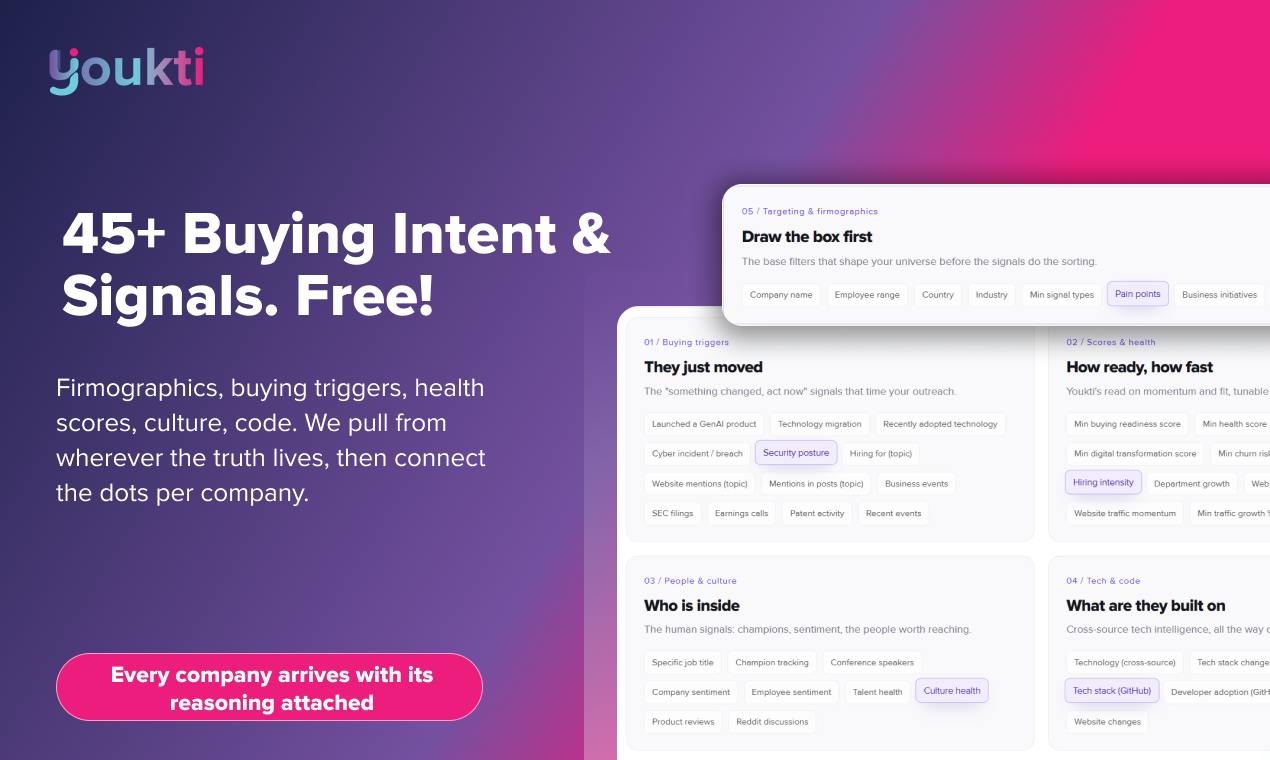
Core capabilities include natural-language company search, waterfall enrichment across more than 20 providers, research across 100+ account parameters, monitoring of 28+ signal categories, campaign generation through the ARYA agent, account journeys, and role-specific execution views (prospecting; account research; product explanation).
The product is web-based and integrates with major CRM, email, calendar, storage, and sales-engagement systems. The privacy policy identifies Salesforce, HubSpot, Pipedrive, Gmail, Outlook, Slack, and Microsoft Teams data as potential connected inputs (privacy policy).
Pricing is inconsistent across current public materials. Product Hunt says contact data, signals, and intent are free without a usage meter. An official prospecting page states $0.10 per enriched prospect, while an older competitive-intelligence page lists $500 and $2,000 annual packages. A company LinkedIn post says there is no standard pricing page because paid outcomes are custom-priced (prospecting; competitive-intelligence pricing; LinkedIn). Current effective pricing and packaging therefore require verification.
Product Quality Assessment: Broad, coherent workflow coverage and credible integration depth, but product reliability, data accuracy, onboarding time, and user satisfaction are not independently established.
Founder and Team Assessment
Ramana Abhishek identifies himself as co-founder and CEO. His public profile describes more than ten years in product marketing, GTM, demand generation, pre-sales, and solutioning, including roles at Kore.ai, Sprinklr, and Sutherland (LinkedIn). Kore.ai independently describes him as a former Senior Manager of Product Marketing with experience across AI, analytics, and customer experience (Kore.ai).
This creates reasonable founder-market fit on the commercial and product-marketing side. Public profiles also identify multiple founding engineers, including Adithya Challa, Jayadeep Vadlamani, Judith Kaushik, and Pratik Dahale. However, the identity and ownership role of any additional co-founder remain unclear.
LinkedIn reports a 2–10-person company founded in 2025, with eight associated profiles and locations in Hyderabad and Virginia. No material public hiring campaign was found. The small team implies execution efficiency but creates substantial founder and key-engineer dependency.
Founder Assessment: Strong GTM-domain experience and credible early execution, but co-founder structure, prior startup outcomes, technical leadership, ownership, and full-time commitments require verification.
Market Opportunity
The initial customer should be defined narrowly as a B2B company with an outbound sales team, an established CRM, hundreds or thousands of target accounts, and sufficient deal value to justify paid intent and workflow automation.
Willingness to pay is established at the category level. Apollo reported serving more than 500,000 companies and three million GTM professionals when it raised at a $1.6 billion valuation, while ZoomInfo reported $1.25 billion of 2025 revenue from more than 35,000 customers (Apollo; ZoomInfo). This verifies a large market but also demonstrates intense incumbent competition.
A bottom-up scenario—not a verified market estimate—is 50,000 addressable mid-market sales organizations at $10,000 annual revenue each, producing a $500 million serviceable market. Expansion into enterprise revenue intelligence, deal inspection, enablement, and customer expansion could increase annual contract value materially. Conversely, the published $500–$2,000 legacy packages would require an extremely large customer base.
The realistic market is venture-scale, but Youkti’s current obtainable share is unknown.
Traction and Growth Signals
Youkti received at least 297 votes on its September 13 Product Hunt launch, and the company reports finishing as the #1 Product of the Day (launch digest; LinkedIn). This indicates launch execution and community reach, not sustained usage.
The company publishes three customer stories: NeoSOFT allegedly scaled revenue to $8 million, Samvidh Technologies reported 20% quarter-over-quarter revenue growth, and Deeploop reported three times more selling time (NeoSOFT video; Samvidh video; Youkti channel). These are customer testimonials hosted by Youkti; attribution, baseline periods, contract values, and cohort representativeness are not independently verified.
Frequent product and LinkedIn updates throughout 2026 indicate active development. However, no reliable G2, Capterra, or substantial independent community-review footprint was found.
The most important missing metrics are ARR, paying accounts, active seats, weekly usage, conversion, logo retention, net revenue retention, customer concentration, and post-launch pipeline.
Traction Assessment: Active product development and preliminary customer evidence, but commercially unverified.
Competitive Position
Direct competitors include Apollo, Clay, ZoomInfo, 6sense, Gong, Outreach, Salesloft, and emerging AI-native sales agents. Indirect alternatives include CRM-native automation, spreadsheets, manual account research, generic LLMs, and internal RevOps workflows.
Youkti differentiates through free data, cross-signal reasoning, persistent account memory, and recommended actions. Its integration breadth may reduce setup friction, and a free-data wedge could support product-led acquisition.
Defensibility is currently weak. The privacy policy discloses dependence on third-party data from Apollo, ZoomInfo, Crunchbase, Full Enrich, and other providers, plus external models from OpenAI, Anthropic, and Google (privacy policy). This lowers initial development cost but limits proprietary-data advantage and exposes gross margin and supplier risk.
If a large platform launched the same capability within six months, customers would stay only if Youkti had materially better signal accuracy, workflow execution, accumulated account history, or faster measurable ROI. None is yet publicly demonstrated.
Defensibility Assessment: Low
Business Model and Economics
The intended model is free prospecting data paired with paid AI actions and revenue outcomes. This could generate qualified demand, but unlimited or heavily subsidized enrichment may be expensive because underlying data is licensed from multiple providers.
Variable costs include enrichment APIs, AI inference across multiple model providers, AWS/GCP infrastructure, monitoring, integration orchestration, and customer support. The privacy policy confirms reliance on these external services but does not disclose cost structure.
Software gross margins above 70% may be possible if paid workflow revenue grows faster than enrichment and inference usage. That remains unverified. Custom outcome-based pricing may produce higher contract values, but it can also create sales complexity, disputed attribution, and revenue-recognition issues.
Unicorn Path
An 8× ARR multiple is assumed for a scaled, healthy, growing B2B SaaS platform. This is an analytical assumption, not Youkti’s current multiple. Mature category evidence ranges from Apollo’s historical $1.6 billion valuation with substantial scale to Gong reporting more than $500 million ARR and ZoomInfo producing $1.25 billion annual revenue (Apollo; Gong; ZoomInfo).
Required ARR = $1 billion ÷ 8 = approximately $125 million.
That implies approximately:
- 62,500 customers at $2,000 annual revenue;
- 12,500 customers at $10,000 ACV; or
- 2,500 enterprise customers at $50,000 ACV.
The legacy public pricing is not compatible with a credible unicorn path without enormous customer volume. Youkti would need enterprise packaging, multi-product expansion, international distribution, strong retention, proprietary account intelligence, and materially higher ACV. It must also maintain high gross margins despite data and model-provider costs.
Unicorn Path: Conditional
Valuation Assessment
No reliable funding announcement, investor disclosure, SAFE cap, round terms, or valuation was found. Tracxn search results conflict: one profile describes Youkti as unfunded, while another apparently duplicated profile describes an undisclosed funding round. Neither establishes a verified transaction (Tracxn).
Valuation Attractiveness: Not Assessable
Assessment requires current ARR, growth, gross margin, retention, burn, runway, round size, SAFE cap or post-money valuation, investor rights, founder ownership, and liquidation preferences.
Key Risks
- Commercial traction and retention are undisclosed.
- Free data may produce structurally unfavorable unit economics.
- Incumbents can bundle similar AI actions into existing platforms.
- Dependence on third-party enrichment and model providers weakens defensibility.
- Pricing and packaging conflict across official pages.
- CRM, email, and calendar access creates material security and privacy obligations.
- Small-team and founder dependency may constrain enterprise support.
- Customer outcome claims lack independent measurement and attribution.
Final Assessment
Venture Potential: 54/100
| Category | Score |
|---|---|
| Market Size and Expansion Potential | 17/20 |
| Traction and Growth Evidence | 7/20 |
| Founder and Team | 9/15 |
| Product Strength | 8/10 |
| Distribution Potential | 7/15 |
| Business Model and Economics | 4/10 |
| Defensibility | 2/10 |
| Total | 54/100 |
The strongest elements are market size, founder-market fit, and product breadth. The weakest are defensibility, verified traction, pricing clarity, and unit-economics evidence.
Evidence Confidence: 39/100
Verified information includes the functioning website, product scope, legal entity name—Aryacognis Pvt Ltd—privacy architecture, founder’s prior Kore.ai role, Product Hunt launch, and several named team profiles. Customer outcomes, accuracy, and product benefits are company-reported. Market and unicorn calculations are analyst scenarios. Revenue, retention, funding, ownership, valuation, burn, and unit economics remain unavailable.
Final Decision: Watch
Youkti is too early and insufficiently validated for formal diligence. The product could become a meaningful B2B software company, but the current public evidence does not establish repeatable demand, durable differentiation, or venture-scale economics.
Upgrade Conditions
- Verify at least $1 million ARR with strong year-over-year growth.
- Demonstrate 90%+ gross retention and 110%+ net revenue retention.
- Sustain gross margin above 70% after data and AI costs.
- Show repeatable acquisition beyond founder outreach and Product Hunt.
- Establish enterprise contracts with $20,000+ ACV.
- Demonstrate a proprietary data, accuracy, or workflow advantage.
Downgrade Conditions
- Low paid conversion or high six-month customer churn.
- Data and inference costs preventing healthy gross margins.
- Major CRM or sales-platform replication.
- Declining product activity or founder disengagement.
- Misleading customer-impact or accuracy claims.
- Material privacy, deliverability, or anti-spam incidents.
Questions for Further Diligence
- What are current MRR, ARR, monthly growth, and recognized versus contracted revenue?
- How many paying companies and active weekly users does Youkti have?
- What are 30-, 90-, and 180-day logo and user retention?
- What are gross retention and net revenue retention?
- What percentage of free organizations convert, and how long does conversion take?
- What is realized ACV under the outcome-based model?
- What are data-provider, AI-inference, and infrastructure costs per active customer?
- What are gross margin, CAC, payback period, burn, and runway?
- How concentrated is revenue among NeoSOFT, Samvidh, Deeploop, and other customers?
- Who are all founders, what are their ownership percentages, and who leads engineering?
- What funding has been raised, and what are the current round valuation and terms?
- What proprietary data or workflow advantage cannot be reproduced by Gong, Apollo, Salesforce, or HubSpot?
Sources
- Product Hunt — Youkti
- Official website
- Official prospecting page
- Official competitive-intelligence pricing
- Youkti privacy policy
- Youkti LinkedIn company page
- Ramana Abhishek — Kore.ai profile
- September 13 Product Hunt launch digest
- Apollo financing announcement
- ZoomInfo 2025 results
- Gong 2026 ARR announcement