
Table of Contents
Plow Latch Investment Report
Category: AI Agent Security / Personal Computing
Company Stage: Pre-revenue or very early commercial launch; pricing is currently free
Founder or Founders: Sam Odio, Patrick Lucas, and Jonathan Deutsch
Headquarters: Menlo Park, California, United States
Funding: Not publicly disclosed
Business Model: Currently free; future monetization is not publicly disclosed
Product Hunt Launch Date: August 21, 2026
Report Date: August 26, 2026
| Investment Metric | Assessment |
|---|---|
| Venture Potential | 63/100 |
| Unicorn Path | Conditional |
| Valuation Attractiveness | Not Assessable |
| Evidence Confidence | 52/100 |
| Final Decision | Watch |
Executive Summary
Plow Latch is a macOS control layer that lets existing AI agents use a browser, command line, files, and logged-in accounts while attempting to restrict each agent to the permissions needed for its assigned task. The product addresses a real barrier to autonomous agents: users want completed actions, but granting broad access to a personal computer creates severe security and privacy risk.
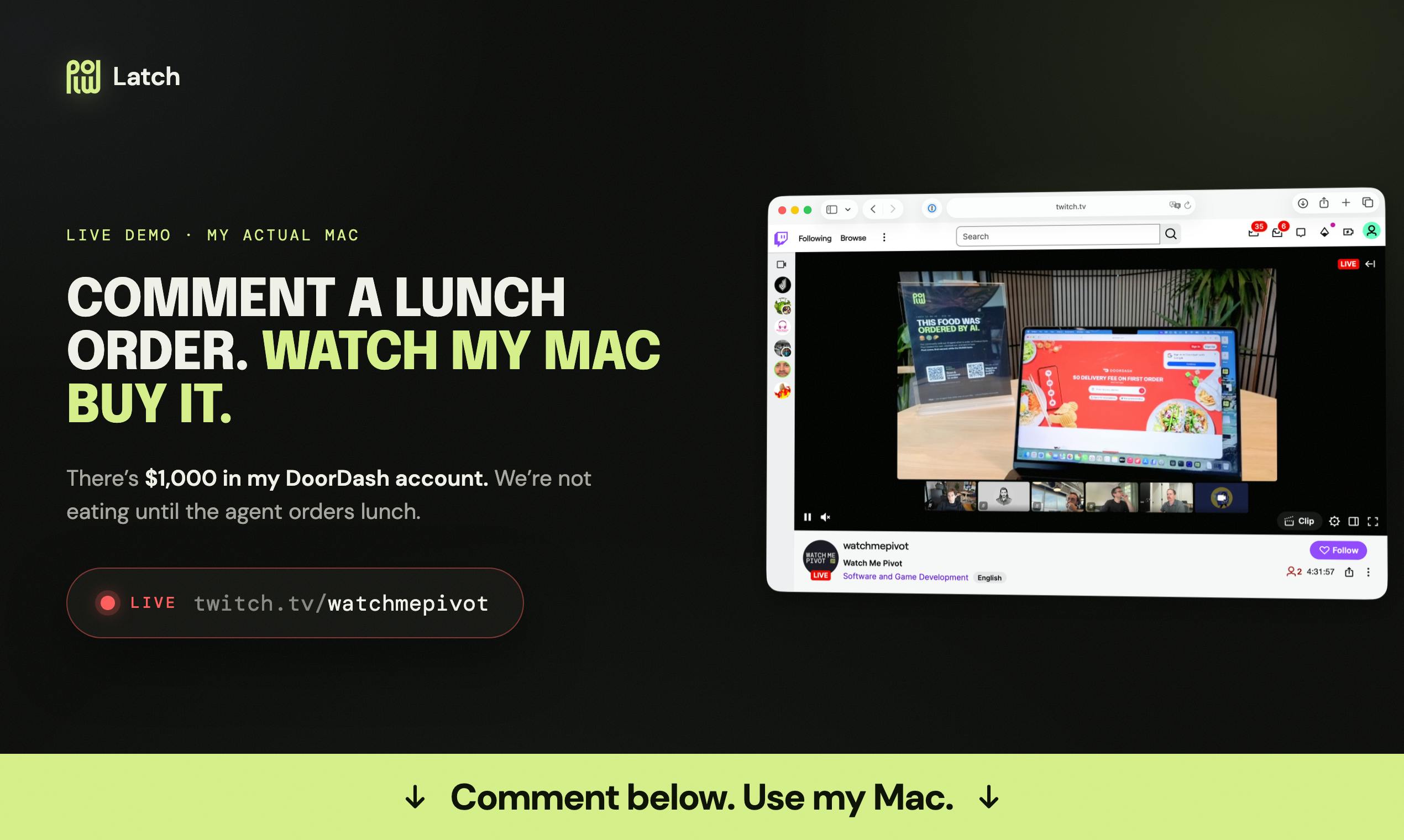
It combines local execution, credential shielding, scoped authorization, and an “AI Reviewer.” A launch demonstration let commenters operate Sam Odio’s Mac, place food orders, and fail to extract a password. This shows a working demo, not durable security or PMF.
The strongest signal is the team. Plow’s site names Sam Odio, Patrick Lucas, and Jonathan Deutsch and cites Dropbox, Zynga, and Apple experience. Odio has prior founder and product-leadership experience, including reported acquisitions by Facebook and Twitter.
The largest concern is its high-consequence trust boundary: one permission bypass, prompt-injection failure, credential leak, or mistaken financial action could cause serious harm. The product is free, usage is unknown, and platforms could bundle similar permissions.
Final decision: Watch. The problem is venture-relevant and the team is credible, but the company has not yet shown paid demand, independent security validation, repeat usage, or a defensible distribution advantage. DD should begin only after those signals emerge.
Product Overview
The initial user is a technical Mac owner who wants an MCP-compatible agent to complete multi-step tasks using local apps and accounts. Alternatives require manual work, bespoke automation, broad permissions, or supervision.
The Latch product page says installation produces an MCP link that connects an agent to the user’s browser, CLI, files, and logins. Plow says files remain on the Mac, passwords can be filled without being revealed to the agent, and no Plow cloud database holds the user’s content. New actions stop for either the user or an AI Reviewer, which treats agent output as untrusted data and denies actions when it cannot decide.
The macOS-only product is free; no paid plan, enterprise tier, App Store listing, or SLA is published. Plow’s privacy policy says relevant request data may reach Anthropic or OpenAI and anonymous usage metrics are collected. “Local” therefore does not mean all task data stays on-device.
The core value is controlled delegation: agents can execute real work while credentials and disallowed resources remain gated. ## Founder and Team Assessment
Plow’s site identifies Sam Odio, Patrick Lucas, and Jonathan Deutsch, describing backgrounds at Dropbox, Zynga, and Apple. Secondary profiles say Odio founded Divvyshot and Freshplum and held product roles at Fivestars and Dropbox. These support founder-market fit but require verification.
The site locates The Plow Collective PBC in Menlo Park. However, the privacy policy and terms identify the operator as “The Plow Collective, Inc,” while the product footer says “PBC.” The exact entity, incorporation, cap table, financing, team size, and founder ownership were not independently established; the discrepancy matters for investment and privacy diligence.
Founder Assessment: Experienced product and engineering founders with relevant platform backgrounds, but legal structure, financing, roles, and full-time commitment require verification.
Market Opportunity
The beachhead is Mac-based agent power users and small teams. Expansion could include Windows, enterprise endpoints, agent identity, audit trails, policy, and credentials.
An illustrative consumer scenario of 500,000 paying users at $240 annually produces $120 million ARR. A team product at $6,000 annual contract value would require 20,000 customers for the same revenue. Achieving them requires cross-platform support, high trust, frequent use, and low support burden.
Enterprise ACV could be larger, but requires certifications, fleet management, identity integration, auditability, and contractual liability.
Traction and Growth Signals
At review, Product Hunt showed 154 followers, 146 points, and a #8 daily rank. The live demonstration generated substantial comments and showed the product executing transactions and denying a credential request. This validates product functionality and marketing creativity.
No reliable public information was found for active users, downloads, paying customers, revenue, retention, daily tasks, incident rate, Discord size, enterprise pilots, or post-launch growth. Traction Assessment: Memorable launch and functioning demo, but no verified commercial or retention evidence.
Competitive Position
Competitors include OpenAI and Anthropic computer-use products, OpenClaw, Vy, TaskGPT, Credal, endpoint-security tools, and privileged-access systems. Manual approval, macOS permissions, password managers, VMs, and low-privilege accounts are alternatives.
Latch’s strongest differentiation is agent-agnostic, local Mac control with credential shielding and an adversarial review layer. However, initial switching costs are low, there is no evident network effect, and major agent or OS vendors control the interfaces Latch depends on.
If Apple, Anthropic, or OpenAI launched equivalent scoped permissions within six months, users would remain only if Latch worked better across agents, delivered independently validated protection, supported unique connectors, or became an enterprise policy system. That case is possible but not demonstrated.
Defensibility Assessment: Low to Medium.
Business Model and Economics
Latch is free and no future pricing is published. Likely models include a prosumer subscription, team seats, enterprise endpoint licensing, or premium policy and audit features; these are analyst possibilities only. Valuation cannot rely on an assumed model.
Local execution limits compute cost, but reviewer calls, support, security response, code signing, and connector maintenance remain. Enterprise sales add compliance, insurance, and incident-response costs.
The key economic questions are paid conversion, renewal, tasks per active user, reviewer inference cost, support tickets per endpoint, and losses or credits from failed actions.
Unicorn Path
Assume an 8x ARR multiple for a fast-growing security/software company with strong retention and gross margin. A $1 billion valuation would require about $125 million ARR. At an illustrative $240 annual consumer subscription, that is roughly 521,000 paying users. At $6,000 team ACV, it is about 20,800 customers; a $50,000 enterprise plan would require 2,500 customers.
A free Mac utility cannot support this outcome. Plow would need to become a cross-platform permission and identity layer, earn independent security trust, and build recurring subscriptions and distribution partnerships.
Unicorn Path: Conditional.
Valuation Assessment
No funding announcement, investors, round terms, revenue, or valuation were found for Plow Latch or The Plow Collective. Valuation Attractiveness: Not Assessable.
Required information includes ARR, paid conversion, retention, gross margin, burn, runway, cap table, incorporation documents, IP assignments, round size, SAFE cap or price, post-money valuation, option pool, and preferences. Product Hunt performance does not justify a valuation range.
Key Risks
- Security failure: prompt injection or permission bypass could expose credentials, money, communications, or files.
- Unproven demand: no paid usage, conversion, retention, or external production metrics.
- Platform bundling: Apple and agent vendors can integrate permissions at a privileged layer.
- Legal and liability exposure: autonomous transactions and sensitive-data access create disputes and regulatory obligations.
- False sense of safety: users may overtrust an AI reviewer whose failure bounds are not independently established.
- Mac-only scope: platform concentration limits reach and increases Apple dependency.
- Weak moat: MCP compatibility and policy prompts may be reproducible.
- Entity ambiguity: public pages use both “PBC” and “Inc.”
Final Assessment
Venture Potential: 63/100
| Category | Score |
|---|---|
| Market Size and Expansion Potential | 15/20 |
| Traction and Growth Evidence | 4/20 |
| Founder and Team | 14/15 |
| Product Strength | 8/10 |
| Distribution Potential | 10/15 |
| Business Model and Economics | 6/10 |
| Defensibility | 6/10 |
| Total | 63/100 |
The team, timing, and sharp trust problem are strengths. Commercial evidence, monetization, security proof, and defensibility are weak.
Evidence Confidence: 52/100
Product capabilities, free pricing, team names, launch activity, privacy policy, and stated headquarters are publicly visible. Security efficacy and local-data claims are company-reported, not independently validated. Revenue, users, retention, team size, financing, ownership, unit economics, and valuation are unavailable.
Final Decision: Watch
Plow Latch is an interesting product from a credible team, but its venture case depends on turning a free Mac utility into a trusted, cross-platform security layer. Public commercial evidence remains minimal.
Upgrade Conditions
- Independent red-team results and a documented security architecture.
- At least 10,000 monthly active users or 25 credible paid team deployments, with strong 90-day retention.
- Verified willingness to pay and a repeatable acquisition channel beyond launch events.
- Clear gross-margin evidence after reviewer inference, support, and security operations.
- Cross-platform or enterprise endpoint roadmap with design partners.
- Verified legal entity, founder ownership, IP assignment, and financing terms.
Downgrade Conditions
- Any material credential leak, unauthorized transaction, or misleading security claim.
- Low repeat task volume or weak paid conversion after launch.
- Apple or a major agent vendor bundles equivalent controls and Plow lacks differentiation.
- Reviewer costs or support burden prevent software-like margins.
- Founder attention shifts away or product updates slow materially.
Questions for Further Diligence
- How many installs, weekly active Macs, completed tasks, and external users does Latch have?
- What are 30-, 90-, and 180-day retention, task frequency, and free-to-paid conversion targets?
- What pricing and customer segment will be tested first, and what evidence supports willingness to pay?
- What permissions can the agent request, and which actions always require deterministic human approval?
- What red-team coverage exists for indirect prompt injection, credential extraction, privilege escalation, and malicious MCP servers?
- Which data remains on-device, which data reaches Plow or model providers, and for how long is each category retained?
- What are false-allow and false-deny rates for the AI Reviewer under adversarial evaluation?
- How are financial losses, unauthorized actions, disputes, insurance, and incident response handled?
- Why will users keep Latch if Apple, Anthropic, or OpenAI ships comparable controls?
- What are reviewer cost per task, current gross margin, support load, burn, and runway?
- What is the exact legal entity, cap table, founder commitment, IP ownership, and current financing proposal?
- Which enterprise design partners require fleet controls, audit logs, identity, or compliance features?