
Table of Contents
Cline Desktop App Investment Report
Category: Open-source AI coding agents and enterprise developer tools
Company Stage: Series A / early enterprise commercialization
Founder or Founders: Saoud Rizwan
Headquarters: San Francisco, California
Funding: $32 million total Seed and Series A funding
Business Model: Open-core SaaS, enterprise licensing, usage-based inference, and ClinePass subscription
Product Hunt Launch Date: September 11, 2026
Report Date: September 14, 2026
| Investment Metric | Assessment |
|---|---|
| Venture Potential | 81/100 |
| Unicorn Path | Plausible |
| Valuation Attractiveness | Not Assessable |
| Evidence Confidence | 70/100 |
| Final Decision | DD |
Executive Summary
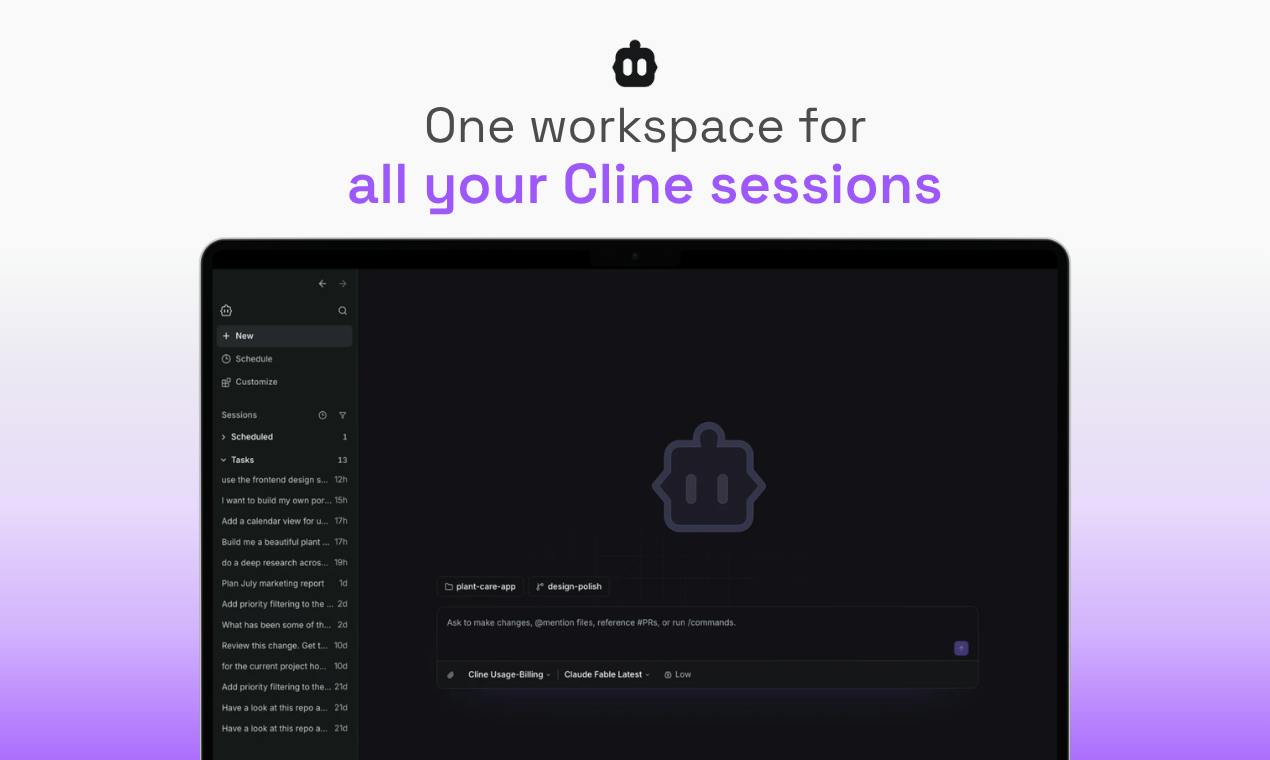
Cline is an open-source coding-agent platform available through a VS Code extension, command-line interface, JetBrains plugin, SDK, and now a standalone desktop application. Cline Desktop provides a workspace for running multiple agents, scheduling recurring tasks, importing sessions from other coding agents, and managing models, plugins, skills, and MCP servers (Product Hunt; GitHub).
The product serves individual developers and enterprises that want autonomous coding capabilities without committing to a single model provider or sending code through a proprietary vendor-controlled stack. Users can connect their own API keys, run local models, or use Cline-managed inference. Enterprise customers can deploy within a VPC, on-premises, or in air-gapped environments and add identity, governance, audit, and policy controls (enterprise page).
Cline has unusually strong public adoption evidence for its stage. The company reports more than 11 million developers, while its GitHub repository had approximately 67,960 stars and 7,342 forks as of September 14, 2026 (Product Hunt; GitHub API). The repository remains actively maintained, and the Desktop application has received frequent releases addressing functionality, reliability, and provider integrations (GitHub releases).
The strongest investment signal is the combination of bottom-up open-source distribution and emerging enterprise adoption. Samsung publicly announced a Cline beta and planned deployment within its Device eXperience division, while Cline says it co-developed its Spec Driven enterprise platform with LG CNS (Korea Times; Cline Spec Driven).
The main concern is monetization. Individual Cline software is free, users can bring their own inference, and the company explicitly avoids marking up standard inference. Revenue, enterprise ACV, paid-user conversion, retention, gross margin, and the economics of the $9.99 ClinePass subscription are not publicly disclosed. Nevertheless, the product, market, distribution, financing, and enterprise signals are strong enough to justify formal due diligence.
Product Overview
Cline addresses the limitations of autocomplete-oriented coding tools. It can inspect repositories, formulate a plan, edit multiple files, run commands, monitor compiler output, execute tests, use a browser, and revise its approach. File edits and terminal commands can require user approval, with checkpoints available for reviewing or reverting changes (VS Code Marketplace).
Cline Desktop expands this workflow beyond an editor sidebar. Its core functions include:
- Parallel agent sessions across multiple repositories
- Scheduled tasks such as pull-request reviews and dependency checks
- Session import from Claude Code, Codex, and OpenCode
- Support for more than 300 models, local models, and user-supplied API keys
- Plugins, skills, MCP servers, voice input, and web search
- Cross-session continuation between desktop, CLI, and IDE products
The Desktop launch is explicitly described as an early version. It launched for macOS, with Windows in beta, although the broader GitHub documentation now describes native support for both macOS and Windows (Product Hunt; GitHub).
Individual developers can use Cline without a software subscription and pay model providers directly. ClinePass costs $9.99 per month and provides quota-based access to selected open-weight models. Enterprise pricing is custom and includes SSO, role-based access, centralized billing, provider restrictions, audit logs, private deployment, and support (pricing; ClinePass documentation).
Product-quality assessment: Strong functionality, model choice, and deployment flexibility, although Desktop remains operationally immature and is still receiving frequent reliability fixes.
Founder and Team Assessment
Saoud Rizwan founded Cline in 2024 and remains founder and CEO in San Francisco (LinkedIn). Public evidence of earlier professional history is limited, but his execution since launch is strong: Cline has developed a large open-source community, raised institutional capital, recruited a technical team, and expanded from one extension into multiple interfaces and enterprise products.
Cline reports raising $32 million across Seed and Series A rounds. Emergence Capital and Pace Capital led the financing, with participation from 1984 Ventures, Essence VC, Cox Exponential, and several developer-focused angels (funding announcement). Emergence independently identifies Cline as a portfolio company founded by Rizwan (Emergence portfolio).
LinkedIn classifies Cline as an 11–50-person company and associates approximately 27 profiles with it; this is a platform-derived indicator, not a verified payroll count (LinkedIn). The careers page lists open senior engineering roles in San Francisco, demonstrating continued hiring (careers).
Key-person risk remains meaningful because Cline’s public identity and product philosophy are closely tied to Rizwan. However, the product cadence and expansion into infrastructure, enterprise, and model benchmarking indicate capabilities beyond a solo-maintained project.
Founder Assessment: Strong technical and community execution, with commercial scaling capability still requiring financial verification.
Market Opportunity
The initial customer is a professional software developer or engineering team using AI for repository-level coding, testing, modernization, or maintenance. Stack Overflow’s 2025 survey found that 84% of respondents were using or planning to use AI development tools, supporting broad category adoption (Stack Overflow survey).
A bottom-up analyst scenario assumes 10–25 million professional developers and technical users worldwide who could become regular agent users. At an annual software or enterprise revenue contribution of $300–$1,000 per paid seat, the potential annual market is approximately:
10–25 million seats × $300–$1,000 = $3–$25 billion.
This is an analyst range, not a verified market forecast. The addressable opportunity expands through API usage, the SDK, CI/CD agents, brownfield modernization, security remediation, agent orchestration, and enterprise knowledge systems.
Cline’s reported 11 million cumulative developers already represents substantial category reach, although cumulative installs or migrated accounts should not be equated with active or paying users. The realistic market is large enough for multiple venture-scale companies, but competition for paid enterprise seats is exceptionally intense.
Traction and Growth Signals
Cline Desktop ranked #5 Product of the Day on September 11, 2026 (Product Hunt). This result is secondary to stronger sustained signals:
- Approximately 67,960 GitHub stars and 7,342 forks, independently visible through GitHub’s API.
- An active repository updated on the report date.
- Frequent Desktop, CLI, SDK, and extension releases.
- Growth from 2.7 million installs in the 2025 funding announcement to a company-reported 11 million developers at the Desktop launch.
- A company-reported community of 20,000 Discord members at the time of financing.
- Samsung’s externally reported evaluation and rollout.
- Enterprise deployment, governance, and self-hosting products.
- Active senior-engineering recruitment.
The reported user figures have changed from 2.7 million installs in July 2025 to 5 million on some subsequent company pages and 11 million by September 2026. These figures are not necessarily contradictory because they were published at different times, but the company alternates between “installs,” “users,” and “developers.” Active-user and retention data are therefore still required.
No reliable public data was found for revenue, ARR growth, paid customers, conversion, daily active use, net revenue retention, or enterprise contract value.
Traction Assessment: Exceptional developer distribution and credible enterprise signals, but monetization remains commercially unverified.
Competitive Position
Direct competitors include Cursor, GitHub Copilot, Claude Code, OpenAI Codex, Windsurf/Cognition, and open-source alternatives such as Kilo Code and Roo Code. GitHub Copilot Business and Enterprise are priced at $19 and $39 per user per month, respectively (GitHub pricing). Claude and Codex also bundle coding functionality into broader paid AI subscriptions.
Cline differentiates through:
- Apache 2.0 open-source distribution
- Broad model and inference-provider choice
- BYOK, local-model, VPC, on-premises, and air-gapped deployment
- Transparent task-level inference costs
- A shared agent harness across IDE, CLI, SDK, and Desktop
- Human approval and checkpoint controls
- An established developer community and plugin ecosystem
There are no traditional network effects, and the open-source license permits competitors to reuse or fork components. Switching costs are moderate: users can migrate providers easily, which benefits adoption but limits lock-in. Enterprise policies, shared workflows, knowledge foundations, plugins, and audit systems could create higher organizational switching costs.
If the largest platform launched equivalent functionality within six months, customers might retain Cline because of its provider neutrality, inspectable code, deployment control, established integrations, and ability to run without a single vendor’s cloud. That is a credible answer, although Microsoft/GitHub, Anthropic, and OpenAI can bundle heavily and subsidize usage.
Defensibility Assessment: Medium to High
Business Model and Economics
Cline’s revenue model has three components:
- Enterprise licensing: Custom-priced governance, support, identity, deployment, and management.
- Cline-managed inference: Usage-based model access at cost or near cost.
- ClinePass: A $9.99 monthly subscription for discounted access to selected open-weight models.
The open-source individual tier reduces acquisition cost and supports bottom-up enterprise adoption. However, it also allows users to receive substantial value without paying Cline. Enterprise conversion and paid inference adoption are therefore central.
ClinePass’s economics are uncertain. Heavy users could consume meaningful inference while paying $9.99 monthly, although quota limits and negotiated provider pricing may protect margins. Cline measures usage across rolling five-hour, weekly, and monthly limits (ClinePass documentation).
The enterprise product should have higher gross-margin potential because customers often supply their own inference and infrastructure. Support, deployment, security reviews, and custom integrations could make early contracts service-intensive. Gross margin, inference subsidies, sales efficiency, and customer-support burden are not disclosed.
Unicorn Path
Assume a 10× ARR multiple, appropriate for a rapidly growing developer-infrastructure company with strong retention, enterprise expansion, and durable gross margins.
Required ARR = $1 billion ÷ 10 = approximately $100 million.
At ClinePass’s $119.88 annual subscription price, Cline would need approximately:
$100 million ÷ $119.88 ≈ 834,000 subscribers.
That would equal roughly 7.6% of the company-reported 11 million developer base, before accounting for inactive or duplicate installs. This is possible but would require strong renewal and disciplined inference costs.
Alternatively, at an analyst-assumed enterprise ACV of $100,000, Cline would need approximately 1,000 enterprise customers. A blended model—consumer subscriptions, enterprise seats, platform fees, and APIs—is more credible.
Cline must prove high enterprise retention, expand paid governance, monetize its SDK and agent infrastructure, and prevent inference subsidies from overwhelming subscription revenue.
Unicorn Path: Plausible
Valuation Assessment
Cline has disclosed $32 million in total funding. Forbes previously reported that the $27 million Series A valued the company at approximately $110 million, but current valuation and financing terms are not publicly confirmed (Forbes).
The historical valuation may no longer be relevant after reported user growth from 2.7 million to 11 million and subsequent enterprise expansion. Revenue is unavailable, so no responsible revenue multiple can be calculated.
Valuation Attractiveness: Not Assessable
Required information includes current ARR, growth, gross margin, retention, burn, runway, option pool, cap table, current round terms, post-money valuation, and liquidation preferences.
Key Risks
- Revenue and paid conversion remain undisclosed despite large reported adoption.
- Microsoft/GitHub, Anthropic, OpenAI, and Cursor can bundle or subsidize competing tools.
- The free, BYOK product may capture usage without sufficient monetization.
- ClinePass could face weak margins or restrictive quotas under heavy agent usage.
- Open-source licensing lowers proprietary code barriers.
- Autonomous code execution creates security and supply-chain risk.
- Enterprise sales may require costly support and deployment work.
- Reported developer counts may overstate active or retained users.
- Desktop is early and continues to exhibit authentication, scheduling, memory, and provider-integration defects.
- Rapid model and platform changes may reduce differentiation.
Final Assessment
Venture Potential: 81/100
| Category | Score |
|---|---|
| Market Size and Expansion Potential | 20/20 |
| Traction and Growth Evidence | 17/20 |
| Founder and Team | 12/15 |
| Product Strength | 9/10 |
| Distribution Potential | 14/15 |
| Business Model and Economics | 4/10 |
| Defensibility | 5/10 |
| Total | 81/100 |
Cline’s strongest assets are open-source distribution, product breadth, community adoption, enterprise deployment flexibility, and market timing. Monetization and unit economics are the weakest parts of the publicly visible case.
Evidence Confidence: 70/100
Funding, founder identity, headquarters, product activity, GitHub metrics, pricing, investors, hiring, and Samsung adoption are reasonably well supported. Developer counts, customer logos, and some enterprise claims are company-reported. Revenue, retention, active usage, gross margin, burn, runway, and current valuation remain unavailable.
Final Decision: DD
Cline merits formal due diligence because it combines venture-scale distribution, a credible founder, institutional financing, an active open-source ecosystem, and real enterprise demand. An investment decision cannot be made until monetization, retention, unit economics, and current financing terms are verified.
Upgrade Conditions
- Verified ARR and sustained triple-digit or similarly strong growth.
- Demonstrated enterprise net revenue retention above 120%.
- Evidence that paid conversion is increasing across the 11 million-user funnel.
- Enterprise software gross margins above 75%.
- ClinePass contribution margin remaining positive under heavy usage.
- Multiple referenceable enterprise deployments beyond pilots.
- Attractive current valuation and investor terms.
Downgrade Conditions
- Developer growth fails to translate into enterprise or subscription revenue.
- Enterprise deployments remain prolonged, service-heavy pilots.
- ClinePass inference costs materially exceed subscription revenue.
- Major competitors eliminate Cline’s model-neutrality or deployment advantage.
- Security incidents involving autonomous command execution.
- Declining repository activity or loss of key maintainers.
Questions for Further Diligence
- What are current ARR, MRR, and monthly revenue growth by product?
- How many of the reported 11 million developers are monthly active users?
- What are 30-, 90-, and 180-day retention for new users?
- How many ClinePass subscribers exist, and what is monthly churn?
- What are ClinePass revenue, inference cost, and contribution margin per subscriber?
- How many paying enterprise customers are in production versus pilot?
- What are enterprise ACV, sales cycle, gross retention, and net revenue retention?
- Which acquisition channels generate the highest retained and paid conversion?
- How much revenue comes from licensing, inference, subscriptions, and services?
- What are current burn, runway, headcount, and infrastructure commitments?
- What is the current cap table, valuation, round size, and proposed financing structure?
- What security controls prevent malicious prompts, plugins, or MCP servers from executing unsafe actions?
Sources
- Cline Desktop on Product Hunt
- Cline official website
- Cline pricing
- Cline Enterprise
- Cline GitHub repository
- GitHub repository API metrics
- Cline release history
- Cline funding announcement
- Emergence Capital portfolio profile
- Samsung adoption report—Korea Times
- ClinePass documentation
- VS Code Marketplace listing