
Table of Contents
Hello Inbox Investment Report
Category: Email deliverability monitoring and marketing software
Company Stage: Bootstrapped/early-stage; financing stage not publicly disclosed
Founder or Founders: Hans Desjarlais
Headquarters: Canada; official website lists Toronto, while LinkedIn lists Montreal
Funding: Not publicly disclosed
Business Model: Freemium B2B SaaS with monthly subscriptions and custom agency plans
Product Hunt Launch Date: September 14, 2026 for the current launch; Product Hunt indicates an earlier 2022 launch
Report Date: September 17, 2026
| Investment Metric | Assessment |
|---|---|
| Venture Potential | 49/100 |
| Unicorn Path | Conditional |
| Valuation Attractiveness | Not Assessable |
| Evidence Confidence | 45/100 |
| Final Decision | Watch |
Executive Summary
Hello Inbox is an email-deliverability platform for marketers, freelancers, agencies, and smaller marketing teams. It combines inbox-placement testing, DMARC monitoring, list verification, deliverability diagnostics, reputation alerts, content checks, and an AI assistant trained on the founder’s consulting experience (Hello Inbox).
The product addresses a persistent commercial problem: marketing emails that are blocked, rejected, or routed to spam generate less engagement and revenue. Increasing authentication requirements from major mailbox providers strengthen demand for monitoring and remediation. Google, for example, applies additional requirements to senders delivering more than 5,000 daily messages to Gmail accounts (Google sender guidelines).
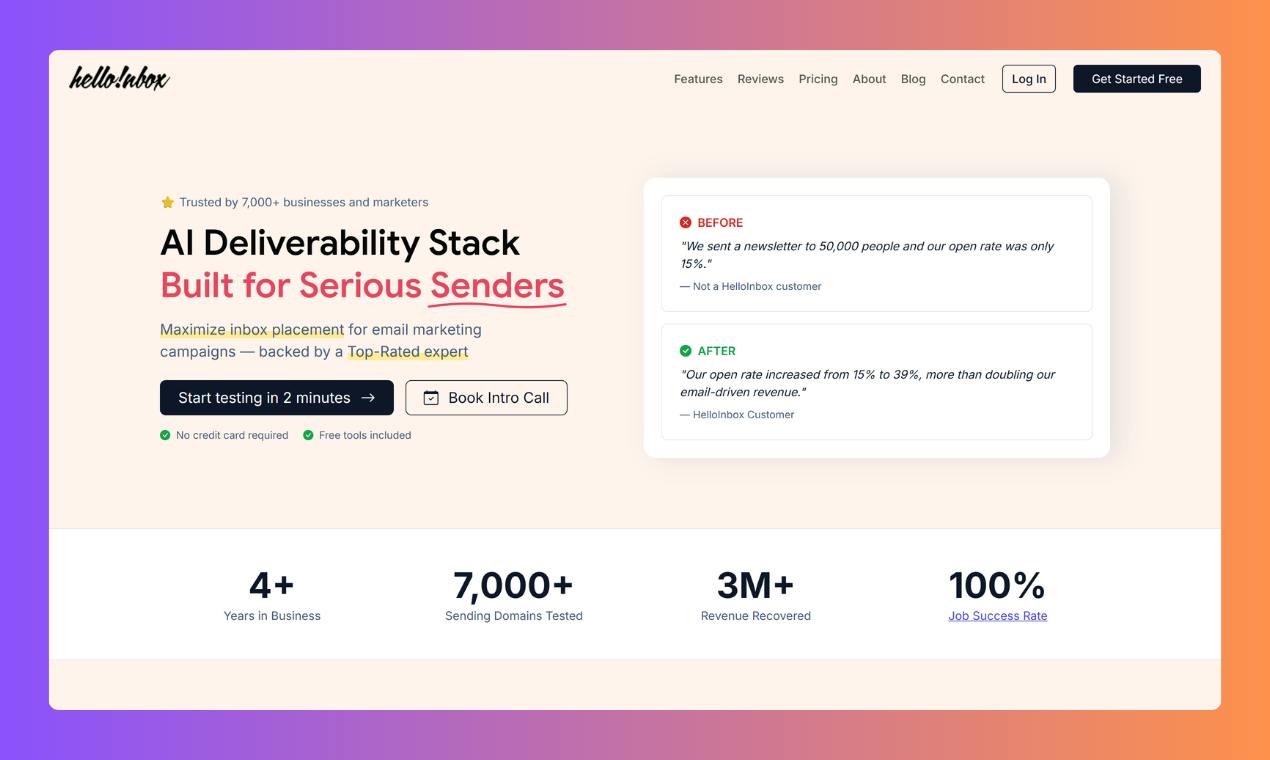
The strongest positive signal is founder-market fit. Founder Hans Desjarlais has provided deliverability consulting for several years and has converted recurring consulting problems into a self-service software product. The company also reports more than 7,000 businesses and marketers or sending domains tested, although the wording varies across the website and does not establish active or paying-customer counts.
The principal investment concern is the gap between product usefulness and venture-scale economics. Published plans cost $49 and $129 per month, the product has limited apparent switching costs, and well-funded competitors provide overlapping testing, authentication, monitoring, and remediation features. No reliable evidence was found for revenue, growth, retention, paid conversion, institutional funding, or enterprise contracts.
The decision is Watch. Hello Inbox may become a profitable bootstrapped SaaS business, but current public evidence does not yet justify formal venture diligence. An upgrade would require verified recurring revenue, sustained paid-customer growth, strong retention, and evidence that the product can expand into higher-value agency or enterprise contracts.
Product Overview
Hello Inbox helps organizations diagnose and improve marketing-email deliverability. Users connect a sending domain, run tests, inspect authentication and reputation problems, verify mailing lists, and receive recommended corrective actions.
The platform’s principal capabilities include:
- Email deliverability and inbox-placement testing.
- DMARC monitoring and authentication guidance.
- Email-address and mailing-list verification.
- Spam-word detection and AI-assisted rewriting.
- Domain and sender profiles.
- Blacklist, spam-rate, and reputation alerts.
- AI advice based on test results and sender context.
- Guidance and external tools for domain or mailbox warm-up.
The product works with campaigns sent through services such as Gmail, Outlook, Mailchimp, SendGrid, HubSpot, and Salesforce, according to the official website. It is delivered as a web application; no native App Store or Google Play application was identified.
Pricing is transparent:
- Starter: Free, including three monthly deliverability tests, one sending domain, five AI chats, and limited monitoring and verification.
- Pro: $49 per month, including 50 tests, unlimited AI chats, 20 inbox-placement tests, and 1,000 verifications.
- Business: $129 per month, including 250 tests, five domains, 100 placement tests, 5,000 verifications, and five users.
- Enterprise: Custom pricing, oriented toward agencies.
The product replaces separate deliverability-testing tools, DMARC dashboards, list-verification services, spreadsheets, manual DNS reviews, and specialist consulting. Consolidation and prescriptive guidance are the primary benefits.
Product Quality: Useful, understandable, and broad for its price point, but outcome claims and testing accuracy have not been independently validated.
Founder and Team Assessment
Hans Desjarlais is publicly identified as Hello Inbox’s founder. The company states that he is a top-rated email-deliverability specialist with four years of relevant consulting experience and a 100% Upwork job-success score (official website; Upwork profile).
LinkedIn lists Desjarlais as founder since May 2022 and also lists him as CTO of BAM Radio Network, a position reportedly held since 2014 (LinkedIn). This creates an unresolved commitment question: public profiles do not establish whether Hello Inbox receives his full working time.
The company’s LinkedIn profile lists 2–10 employees and a Montreal headquarters, while the official website lists Toronto. Neither employee count nor legal entity has been independently verified. No open careers page, institutional organizational chart, previous founder exit, or named senior engineering leadership was found.
Founder-market fit appears reasonable because the product packages the founder’s consulting knowledge. Technical capability is suggested by the working software and breadth of tools, while commercial scalability beyond founder-led expertise is unproven.
Founder Assessment: Strong subject-matter expertise, but team depth, full-time commitment, and scalable commercial execution remain unclear.
Market Opportunity
The initial customer segment is a small or midsized company, independent marketer, agency, or e-commerce operator sending recurring marketing campaigns but lacking an internal deliverability specialist.
These customers have a real willingness to pay when inbox-placement failures materially reduce campaign performance. However, many low-volume senders can rely on free diagnostics from their email platform or mailbox provider. Google Postmaster Tools, for example, provides Gmail-specific reputation, spam, and delivery information without a separate paid subscription (Google Postmaster Tools).
A scenario-based bottom-up market calculation illustrates the scale challenge:
- 100,000 Pro customers × $588 annual list price = $58.8 million ARR.
- 50,000 Business customers × $1,548 annual list price = $77.4 million ARR.
- A blended 100,000 customers at $1,000 annually = $100 million ARR.
These figures are analyst scenarios rather than estimates of Hello Inbox’s actual market. They also exclude annual-plan discounts and churn.
Potential expansion areas include larger agency accounts, automated remediation, managed DMARC, brand protection, sender-reputation insurance or guarantees, enterprise reporting, API access, and integrations with email-service providers. International distribution is feasible because the underlying email standards are global, but support and regulatory requirements vary.
The market can support a meaningful SaaS company. The current low-ACV positioning, however, makes venture-scale revenue dependent on very large customer volumes or a successful move upmarket.
Traction and Growth Signals
The current Hello Inbox launch ranked #3 Product of the Day on September 14, 2026 and showed approximately 480 followers and one review when indexed (Product Hunt; daily leaderboard). These are launch-attention signals, not evidence of recurring demand.
The official website claims:
- More than 7,000 businesses and marketers have trusted the product.
- More than 7,000 sending domains have been tested.
- More than $3 million of revenue has been recovered for users.
These are company-reported figures. The first two may refer to overlapping or differently defined populations, and the claimed recovered revenue is not supported by a disclosed methodology. None should be interpreted as paying-customer or recognized-revenue figures.
Testimonials are primarily associated with the founder’s consulting engagements, including Upwork clients. They support subject-matter competence but do not directly prove retention or satisfaction with the current SaaS platform.
Product activity is visible through a blog with posts dating from 2024 through 2026. In 2025, Hello Inbox acquired only the domain name TheEmailHelpline.com—not its company or services—to expand content and search distribution (announcement).
No reliable public information was found regarding ARR, MRR, active accounts, paying customers, conversion, churn, cohort retention, marketing efficiency, or website traffic.
Traction Assessment: Some product history and user-interest signals exist, but commercial traction remains unverified.
Competitive Position
Direct competitors include GlockApps for inbox-placement and spam testing, Validity for enterprise deliverability intelligence, Folderly for B2B deliverability remediation, and MailReach for testing and mailbox warm-up.
Indirect competitors include email-service providers with built-in deliverability dashboards, consultants, DMARC-specific vendors, mailing-list verification tools, and free services such as Google Postmaster Tools. Marketing platforms could bundle more prescriptive diagnostics into their existing products.
Hello Inbox differentiates through breadth, accessible pricing, plain-language recommendations, and an AI assistant based on the founder’s practical case history. The combination may be convenient for smaller teams that find enterprise products complex or expensive.
Defensibility is weak. Email authentication records and standard diagnostics are available to competing products, and generative advice is reproducible with general-purpose models. No proprietary delivery network, exclusive data source, network effect, or patented technology was identified. Persistent sender profiles and workflow history create modest switching costs but not a substantial moat.
“If the largest platform in this market launched the same feature within six months, why would customers continue using this product?” Customers might stay for vendor neutrality, consolidated diagnostics, lower pricing, or more practical advice. Those advantages are credible but insufficiently durable without proprietary outcome data or deeply embedded automation.
Defensibility Assessment: Low
Business Model and Economics
Hello Inbox operates a freemium subscription model. Annualized list prices are $588 for Pro and $1,548 for Business before annual discounts; Enterprise pricing is not disclosed.
The model could produce software-like margins, but variable costs include inbox-placement seed accounts, email-verification services or infrastructure, monitoring, storage, AI inference, customer support, and payment processing. The extent to which Hello Inbox owns versus resells underlying verification and testing infrastructure is unknown.
The free tier may generate organic adoption and search traffic, but its conversion rate is undisclosed. The product’s broad feature set could increase conversion while also raising support and infrastructure costs.
Expansion revenue is constrained by plan limits on domains, tests, verifications, and team members. Agencies offer the strongest potential for higher ACV because they can manage numerous sending domains and potentially use white-label lead-generation features.
Gross margin, customer-acquisition cost, payback period, support burden, and expansion revenue are not publicly disclosed. It is therefore unknown whether usage growth increases subscription revenue faster than verification, placement-testing, and AI costs.
Unicorn Path
An 8× forward-revenue multiple is assumed. This reflects a favorable outcome for a fast-growing SMB SaaS company while recognizing lower ACVs, competitive pressure, and uncertain defensibility.
Required ARR = $1 billion ÷ 8 = approximately $125 million.
At current list pricing:
- Pro at $588 annually: approximately 212,600 paying customers.
- Business at $1,548 annually: approximately 80,700 paying customers.
- An assumed $10,000 agency ACV: approximately 12,500 agency customers.
- An assumed $50,000 enterprise ACV: approximately 2,500 enterprise customers.
Annual discounts, churn, and payment fees would increase the gross customer-acquisition requirement. The current company-reported figure of 7,000 businesses or domains cannot be compared directly because active and paying status is unknown.
A unicorn outcome would require a major expansion from diagnostics into enterprise-grade deliverability infrastructure, automated remediation, API-based services, or agency operations. The company would also need substantially higher ACVs, low churn, strong gross margins, and distribution independent of the founder.
Unicorn Path: Conditional
Valuation Assessment
No reliable funding announcement, institutional investor, SAFE cap, post-money valuation, secondary transaction, or active financing process was identified. Revenue and growth are also undisclosed.
Valuation Attractiveness: Not Assessable
A responsible valuation assessment requires current ARR, year-over-year growth, gross margin, churn, customer concentration, burn, runway, founder ownership, financing amount, valuation cap or post-money valuation, and liquidation preferences.
No valuation range should be inferred from Product Hunt rank, reported domain tests, or consulting testimonials.
Key Risks
- Unverified commercial traction: Paying customers, revenue, growth, and retention are unknown.
- Low defensibility: Most diagnostics and AI recommendations are technically reproducible.
- Low ACV: Current pricing requires a very large customer base to reach venture-scale revenue.
- Incumbent bundling: Email platforms and established deliverability vendors can add overlapping features.
- Ambiguous usage claims: “Businesses trusted” and “domains tested” may include free or one-time users.
- Founder dependency: The product appears closely tied to one specialist’s knowledge and reputation.
- Commitment uncertainty: The founder publicly lists another continuing CTO position.
- Infrastructure economics: Verification, seed-account, monitoring, and AI costs could constrain margins.
- Security and privacy: The platform handles domain configurations, email lists, and sender-performance data.
- Retention risk: Customers may cancel after resolving a temporary deliverability problem.
Final Assessment
Venture Potential: 49/100
| Category | Score |
|---|---|
| Market Size and Expansion Potential | 13/20 |
| Traction and Growth Evidence | 7/20 |
| Founder and Team | 8/15 |
| Product Strength | 7/10 |
| Distribution Potential | 7/15 |
| Business Model and Economics | 4/10 |
| Defensibility | 3/10 |
| Total | 49/100 |
The strongest elements are a clear customer problem, relevant founder expertise, accessible pricing, and a broad product suite. The weakest are limited commercial evidence, low ACV, uncertain team capacity, and weak structural defensibility.
Evidence Confidence: 45/100
Product features, pricing, launch date, founder identity, and public product activity are verifiable. User, domain, and recovered-revenue figures are company-reported. Customer economics and the size of the organization are insufficiently verified.
Critical unavailable information includes revenue, paid accounts, active usage, retention, conversion, gross margin, customer acquisition costs, legal entity, funding, burn, runway, and valuation.
Final Decision: Watch
Hello Inbox could become a sustainable SMB SaaS or specialist-led software business. The present evidence does not yet show a venture-scale trajectory or a sufficiently defensible market position for formal diligence. A Watch decision allows evaluation of post-launch conversion and retention without mistaking Product Hunt interest for product-market fit.
Upgrade Conditions
- Reach and verify at least $1 million ARR.
- Demonstrate more than 1,000 paying customers or meaningful agency contracts.
- Show at least 70% six-month paid-customer retention.
- Establish gross margin above 70% after testing and verification costs.
- Demonstrate repeatable acquisition beyond founder referrals and Product Hunt.
- Increase average customer value through agency or enterprise plans.
- Validate measurable inbox-placement improvement using independent methodology.
- Build proprietary deliverability data or automated remediation capabilities.
Downgrade Conditions
- Weak free-to-paid conversion after the 2026 launch.
- High cancellation rates after customers complete one-time remediation.
- Material decline in product or content activity.
- Competitors bundle equivalent AI guidance at no additional charge.
- Verification and placement-testing costs materially compress gross margin.
- A security or privacy incident involving uploaded email lists or domain data.
- The founder reduces involvement without establishing a capable operating team.
- User or recovered-revenue claims prove materially misleading.
Questions for Further Diligence
- What are current MRR, ARR, and monthly revenue growth?
- How many of the reported 7,000 businesses or domains are active and paying?
- What are free-to-paid conversion rates for Pro and Business?
- What are 30-day, 90-day, 180-day, and twelve-month retention rates?
- What percentage of customers cancel after resolving an initial deliverability issue?
- What are gross margins after verification, inbox-testing, AI, and monitoring costs?
- Which product components are proprietary, and which depend on third-party providers?
- What are customer-acquisition cost and payback by organic, Product Hunt, consulting, and paid channels?
- How much revenue comes from software versus founder-led consulting?
- Who works full time on Hello Inbox, and what is the founder’s continuing role at BAM Radio Network?
- What are current burn, runway, cap table, and financing plans?
- What security controls apply to email lists, Google Postmaster data, DNS information, and sender profiles?
Sources
- Product Hunt — Hello Inbox
- Product Hunt daily leaderboard — September 14, 2026
- Hello Inbox official website and pricing
- Hello Inbox blog
- TheEmailHelpline.com domain acquisition announcement
- Hans Desjarlais — LinkedIn
- Hello Inbox — LinkedIn
- Hans Desjarlais — Upwork
- Google email-sender guidelines
- Google Postmaster Tools
- GlockApps
- MailReach pricing