
Table of Contents
CostLogic Investment Report
Category: Construction technology / AI-assisted estimating and job-costing SaaS
Company Stage: Pre-seed / newly launched
Founder or Founders: Dylan Sorensen and Micah Putman
Headquarters: Dallas, Texas
Funding: Not publicly disclosed
Business Model: Per-seat SaaS subscriptions with metered AI credits and custom enterprise plans
Product Hunt Launch Date: August 16, 2026
Report Date: August 19, 2026
| Investment Metric | Assessment |
|---|---|
| Venture Potential | 56/100 |
| Unicorn Path | Conditional |
| Valuation Attractiveness | Not Assessable |
| Evidence Confidence | 44/100 |
| Final Decision | Watch |
Executive Summary
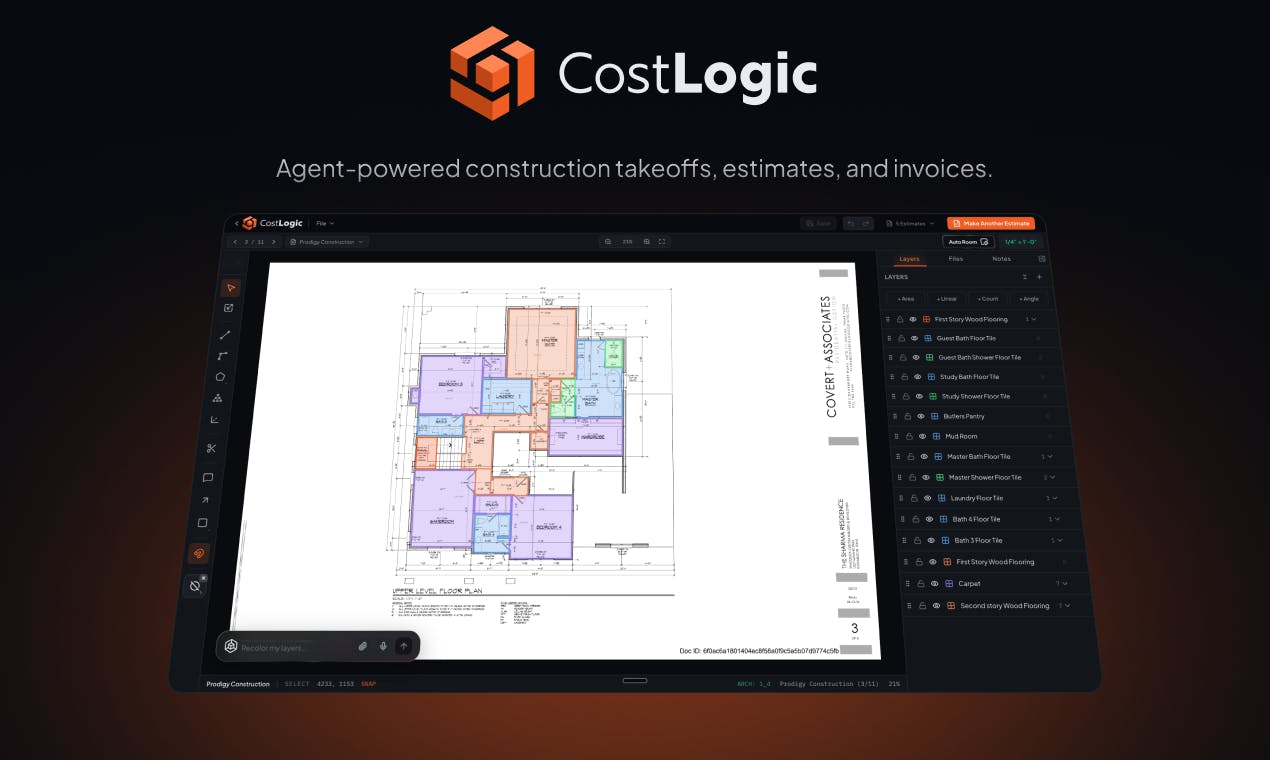
CostLogic is a browser-based construction workflow application combining blueprint takeoffs, cost estimates, and invoicing. Its Onyx AI assistant can answer project questions, help organize takeoff layers, price measured quantities, and draft estimates or invoices. A separate Auto Room feature detects rooms and areas from uploaded plans (official website).
The initial customer appears to be a solo estimator, specialty contractor, remodeler, or small construction company currently using separate tools—or spreadsheets, PDF viewers, and manual calculations—to move from construction plans to customer invoices. CostLogic’s strongest product attribute is workflow integration: measured quantities flow into estimates and invoices without re-entry. Published pricing is also below several established AI and takeoff competitors (CostLogic pricing; STACK pricing; Togal pricing).
The construction industry is large and fragmented, with more than 919,000 US construction establishments and approximately $2.1 trillion of annual output, according to the Associated General Contractors of America (AGC construction data). This provides a substantial potential customer base, but fragmentation also makes distribution, onboarding, and support difficult.
The most positive investment signal is that CostLogic is a functional, commercially priced product addressing an expensive and recurring workflow rather than a superficial AI wrapper. The most important concern is the absence of verified commercial traction. Revenue, paying customers, active projects, retention, conversion, customer references, and growth are not publicly disclosed. Product Hunt’s reported 107 points and #7 daily position show launch interest, not product-market fit (Product Hunt).
CostLogic could become a meaningful construction-software company, but the current low-to-mid-ticket seat model would require tens of thousands of customers or a successful move into larger contractor accounts to support a unicorn valuation. Final decision: Watch, pending evidence of paid adoption, retention, estimation accuracy, and repeatable industry distribution.
Product Overview
Construction estimating frequently requires several disconnected steps: viewing plans, calibrating drawing scale, measuring areas and quantities, entering those quantities into an estimate, applying labor and material rates, and creating an invoice. Manual transfer between tools creates delays and potential errors.
CostLogic consolidates that process. Users upload PDF drawings, calibrate scale, measure linear, area, count, and angle quantities, and organize measurements into takeoff layers. Measurements then flow into estimates with markup, waste, tax, and deposit controls. Accepted estimates can be converted into invoices and emailed to customers (official website).
Onyx is the product’s AI assistant. It can answer questions using project, takeoff, estimate, invoice, and optional notes data. Auto Room sends a selected plan image to Tectly for room detection, while page naming, scale detection, and Onyx use Fireworks AI infrastructure. CostLogic states that customer data is not sent to DeepSeek even though the hosted model uses DeepSeek-published open weights (security page).
Published plans are:
- Starter: $49.99 per seat monthly when billed annually, limited to three seats, 25 active projects, and 25 monthly AI credits.
- Pro: $139.99 per seat monthly when billed annually, with unlimited projects and seats and 100 monthly AI credits.
- Enterprise: Custom pricing with pooled credits, onboarding, additional storage, and security review.
- Trial: 14 days without a credit card and three Auto Room runs (pricing).
The application is web-based. No verified native mobile, App Store, or Google Play product was found. It replaces or complements spreadsheets, manual measurements, PDF markup software, standalone takeoff applications, accounting tools, and construction-management platforms.
Product Quality Assessment: Coherent and potentially valuable workflow design, but AI measurement accuracy and production reliability lack independent validation.
Founder and Team Assessment
CostLogic’s official site identifies Dylan Sorensen and Micah Putman as co-founders. The product is operated by Prodigy Labs LLC, which describes itself as a Dallas-based software company and CostLogic as its first product (CostLogic about; Prodigy Labs; privacy policy).
Putman’s public LinkedIn profile describes UX/UI design and full-stack development experience beginning in 2020, including mobile and web product work. This supports product-design and application-development capability, although no previous exit or scaled SaaS operating record was found (Micah Putman).
Reliable public information about Sorensen’s professional history is limited. Search results contain multiple people with the same name, and the official company pages provide no biography. Consequently, any apparent construction-operations or software experience could not be conclusively attributed to CostLogic’s co-founder.
Team size, employee roles, hiring activity, founder ownership, previous companies, prior exits, and full-time commitment are not publicly disclosed. The product’s breadth indicates meaningful execution capacity, but it is unclear whether development is performed solely by the two founders or with contractors and other employees.
Founder Assessment: Product-building capability is visible, but founder history, construction-domain expertise, commercial capability, and team depth remain insufficiently verified.
Market Opportunity
The narrow initial market is US specialty contractors, remodelers, homebuilders, and small general contractors that regularly estimate work from PDF plans but do not require a full enterprise construction-management suite.
AGC reports more than 919,000 US construction establishments. Many are unsuitable because they are too small, do not perform plan-based estimating, use incumbent systems, or lack willingness to adopt new software. Assuming 100,000–250,000 realistically addressable US firms is therefore an analyst estimate, not a verified CostLogic market figure.
At an estimated annual company value of $1,200–$5,000, representing approximately one to three Starter or Pro seats, the initial US recurring-revenue opportunity would be:
- Low case: 100,000 × $1,200 = $120 million
- High case: 250,000 × $5,000 = $1.25 billion
This is large enough to support a venture-backed business, but not automatically a unicorn. CostLogic must capture a material share of a fragmented market while competing against mature products.
Expansion opportunities include larger estimating teams, material and labor cost databases, bid management, supplier pricing, payments, accounting integrations, procurement, project management, subcontractor collaboration, and international markets. Transaction or payment revenue could materially increase revenue per customer.
Market timing is favorable because contractors face labor constraints and remain interested in reducing administrative work. Conversely, inaccurate AI measurements can create direct financial losses, making adoption dependent on trust and human verification.
Traction and Growth Signals
CostLogic launched on Product Hunt on August 16, 2026. Search results reported 107 points, 129 followers, and a #7 daily position (Product Hunt). These figures indicate early launch attention only.
The company has released a functional website, transparent pricing, a free trial, formal terms, a detailed privacy policy, and an unusually candid security page. This is stronger operational evidence than a waitlist or concept demonstration.
However, no reliable public evidence was found for:
- Revenue or ARR
- Paying-customer count
- Active users or projects
- Trial-to-paid conversion
- Customer retention
- Usage frequency
- Bid volume or invoice value
- Customer case studies
- Independent marketplace reviews
- Revenue growth
- Hiring or external funding
The available Capterra listing provides basic product information but did not provide a credible body of verified customer reviews. No sustained post-launch momentum can yet be measured because the product launched only days before this report.
Traction Assessment: Functional and commercially available, but commercially unverified.
Competitive Position
Direct competitors include STACK, Togal.AI, PlanSwift, Bluebeam Revu, On-Screen Takeoff, Buildxact, ProEst, and Estimating Edge. Indirect competitors include Autodesk Construction Cloud, Buildertrend, spreadsheets, manual PDF measurements, outsourced estimators, and trade-specific estimating tools.
CostLogic’s principal differentiation is combining takeoff, estimating, invoicing, and an action-oriented AI assistant in one comparatively focused interface. Pricing is attractive: CostLogic Pro costs $139.99 per seat monthly when billed annually, versus $249 per user monthly for STACK’s Takeoff & Estimate plan and $299 per user monthly for Togal’s Growth plan (CostLogic; STACK; Togal).
That advantage is not necessarily durable. Larger platforms already possess customer relationships, training resources, cost databases, accounting integrations, and extensive project histories. They can add generative interfaces and automated takeoff functions.
Switching costs could grow as customers accumulate projects, presets, pricing libraries, estimates, invoices, and workflow history. CostLogic currently offers CSV export for bookkeeping, but its public site does not demonstrate deep native accounting, ERP, supplier, or project-management integrations. Proprietary data and network effects are not established.
If the largest platform in this market launched the same feature within six months, why would customers continue using CostLogic? The best current answer is lower price, simpler workflow, and faster product iteration. That is useful but insufficient for strong long-term defensibility. CostLogic would need superior estimation accuracy, trade-specific data, deep workflow integration, and measurable customer ROI.
Defensibility Assessment: Low
Business Model and Economics
CostLogic uses recurring per-seat subscriptions, supplemented by purchasable AI credits and custom enterprise pricing. At published annual rates, a one-seat customer generates approximately $600 on Starter or $1,680 on Pro. A three-seat Pro account would generate approximately $5,040 annually.
Potential gross margins are attractive but likely lower than conventional lightweight SaaS because the product stores large blueprint files and pays external providers for AI processing. Variable costs include Supabase/AWS storage, Vercel hosting, Tectly image processing, Fireworks AI inference, email delivery, customer support, and Stripe payment processing (terms; privacy policy).
The credit system helps control AI costs: credits are consumed when a request reaches a provider, even if the user rejects the result. This protects economics but could create customer frustration when automated detection is inaccurate.
Customer acquisition is likely more difficult than for horizontal SaaS. Contractors may require demonstrations, onboarding, templates, training, and proof that measurements are reliable. CostLogic’s privacy policy confirms that it uses Meta, LinkedIn, and Google advertising measurement, suggesting paid marketing is already part of distribution (privacy policy). CAC and payback are unknown.
Enterprise expansion is constrained by security readiness. CostLogic explicitly states that it has no SOC 2 or ISO 27001 certification, independent penetration test, SAML SSO, full multifactor authentication, audit-log export, or contractual uptime commitment (security page).
Unicorn Path
An 8× ARR multiple is assumed for a high-growth vertical SaaS company with strong retention and approximately 70%–80% gross margin. A slower-growing or services-heavy business would receive a lower multiple.
Required ARR = $1 billion ÷ 8 = $125 million
Illustrative requirements are:
- At $1,200 average annual revenue per customer: approximately 104,000 customers
- At $5,000 per customer: approximately 25,000 customers
- At $20,000 enterprise ACV: approximately 6,250 customers
The first scenario is unrealistic without highly efficient self-service distribution. The second is possible but difficult in a fragmented, support-intensive market. The enterprise scenario is more credible, but requires security certifications, integrations, onboarding, account management, and functionality for larger estimating teams.
A unicorn outcome likely requires CostLogic to expand beyond takeoff and invoicing into a construction operating system with cost data, procurement, payments, collaboration, or transaction revenue. International expansion and trade-specific workflows would also be necessary.
Unicorn Path: Conditional
Valuation Assessment
No reliable funding announcement, investor disclosure, financing round, SAFE cap, or post-money valuation was found. The Crunchbase profile contains generic company information but no verifiable financing data; its visible placeholder “funding round” dated January 1, 1970 is not credible evidence of financing (Crunchbase).
Revenue, growth, gross margin, retention, burn, and current fundraising status are also unknown.
Valuation Attractiveness: Not Assessable
Assessment would require current ARR, paid-customer count, growth, cohort retention, gross margin after AI costs, CAC, burn, runway, round size, SAFE cap or valuation, option pool, investor ownership, and liquidation preferences.
Key Risks
- Unverified demand: No public evidence establishes paid adoption or retention.
- Accuracy liability: Incorrect takeoffs or estimates can cause underbidding, procurement errors, and direct losses.
- Established competitors: STACK, Togal, Autodesk, Bluebeam, and Buildertrend have stronger brands and distribution.
- Weak defensibility: Core AI and infrastructure depend on third-party providers.
- Distribution difficulty: Fragmented contractors can be expensive to acquire and support.
- Enterprise-readiness gap: Missing certifications, SSO, audit exports, penetration testing, and SLA.
- Low current ACV: Seat pricing requires large customer volume unless enterprise expansion succeeds.
- Founder and team uncertainty: Relevant histories, team depth, and full-time commitment are not fully verified.
- Third-party dependency: Auto Room relies on Tectly, while Onyx and other AI features rely on Fireworks AI.
- Security and privacy exposure: The platform stores plans, estimates, invoices, customer records, and commercially sensitive pricing.
Final Assessment
Venture Potential: 56/100
| Category | Score |
|---|---|
| Market Size and Expansion Potential | 16/20 |
| Traction and Growth Evidence | 6/20 |
| Founder and Team | 7/15 |
| Product Strength | 8/10 |
| Distribution Potential | 7/15 |
| Business Model and Economics | 7/10 |
| Defensibility | 5/10 |
| Total | 56/100 |
The strongest elements are the real customer problem, integrated product workflow, transparent pricing, and large construction base. The weakest are absent commercial metrics, limited founder evidence, difficult distribution, and low defensibility.
Evidence Confidence: 44/100
Product functionality, pricing, founders’ names, Dallas location, legal operator, infrastructure providers, and launch date are verified through primary sources. Product benefits and AI capabilities remain company-reported. Market calculations are analyst assumptions. Revenue, customers, retention, funding, team size, margins, burn, runway, valuation, and fundraising status remain unavailable.
Final Decision: Watch
CostLogic is promising but too newly launched and insufficiently validated for formal diligence. Product quality is above average for its stage, but company quality and venture-scale potential cannot yet be confirmed. Valuation attractiveness is not assessable.
Upgrade Conditions
- Reach at least $1 million ARR with verifiable billing records.
- Demonstrate more than 70% six-month customer retention.
- Produce referenceable contractor case studies with measured time savings and accuracy.
- Maintain gross margin above 70% after AI, storage, and support costs.
- Establish repeatable acquisition with a CAC payback below 12 months.
- Secure accounting, supplier, or project-management integrations.
- Win several multi-seat enterprise contracts.
- Complete an independent penetration test and SOC 2 readiness program.
Downgrade Conditions
- Low trial-to-paid conversion or high early churn.
- Material measurement or estimation errors causing customer losses.
- AI processing costs exceed available credit and subscription economics.
- Product development slows after launch.
- Established competitors match the integrated workflow at similar pricing.
- Customer acquisition remains dependent on paid campaigns with poor payback.
- A material security or privacy incident occurs.
- Founders do not remain fully committed.
Questions for Further Diligence
- What are current MRR, paying customers, and month-over-month growth?
- How many trials have started, and what percentage convert to paid subscriptions?
- What are 30-, 90-, and 180-day account and revenue retention?
- How many projects and takeoffs does the median customer complete monthly?
- How is Auto Room accuracy measured across different trades and plan qualities?
- What are gross margins after Tectly, Fireworks AI, storage, and support costs?
- What are CAC and payback by Google, Meta, LinkedIn, referral, and outbound channels?
- Which founders and employees are full-time, and what construction-domain experience does the team have?
- What integrations are planned for QuickBooks, suppliers, and construction-management platforms?
- What are burn, runway, prior funding, cap table, and current round terms?
- What proprietary data or workflow advantage will prevent incumbent replication?
- What insurance and contractual controls cover losses caused by inaccurate estimates?