
Table of Contents
OpenTrade Investment Report
Category: Agentic retail-trading software / developer fintech
Company Stage: Pre-seed / experimental product
Founder or Founders: Viraat Das and Pranav Nair, co-founders of Exla Corp.
Headquarters: San Francisco, California
Funding: Y Combinator W25 participation verified; total funding and OpenTrade-specific financing not publicly disclosed
Business Model: Currently free, source-available desktop software; future monetization not publicly disclosed
Product Hunt Launch Date: August 17, 2026
Report Date: August 20, 2026
| Investment Metric | Assessment |
|---|---|
| Venture Potential | 50/100 |
| Unicorn Path | Conditional |
| Valuation Attractiveness | Not Assessable |
| Evidence Confidence | 54/100 |
| Final Decision | Watch |
Executive Summary
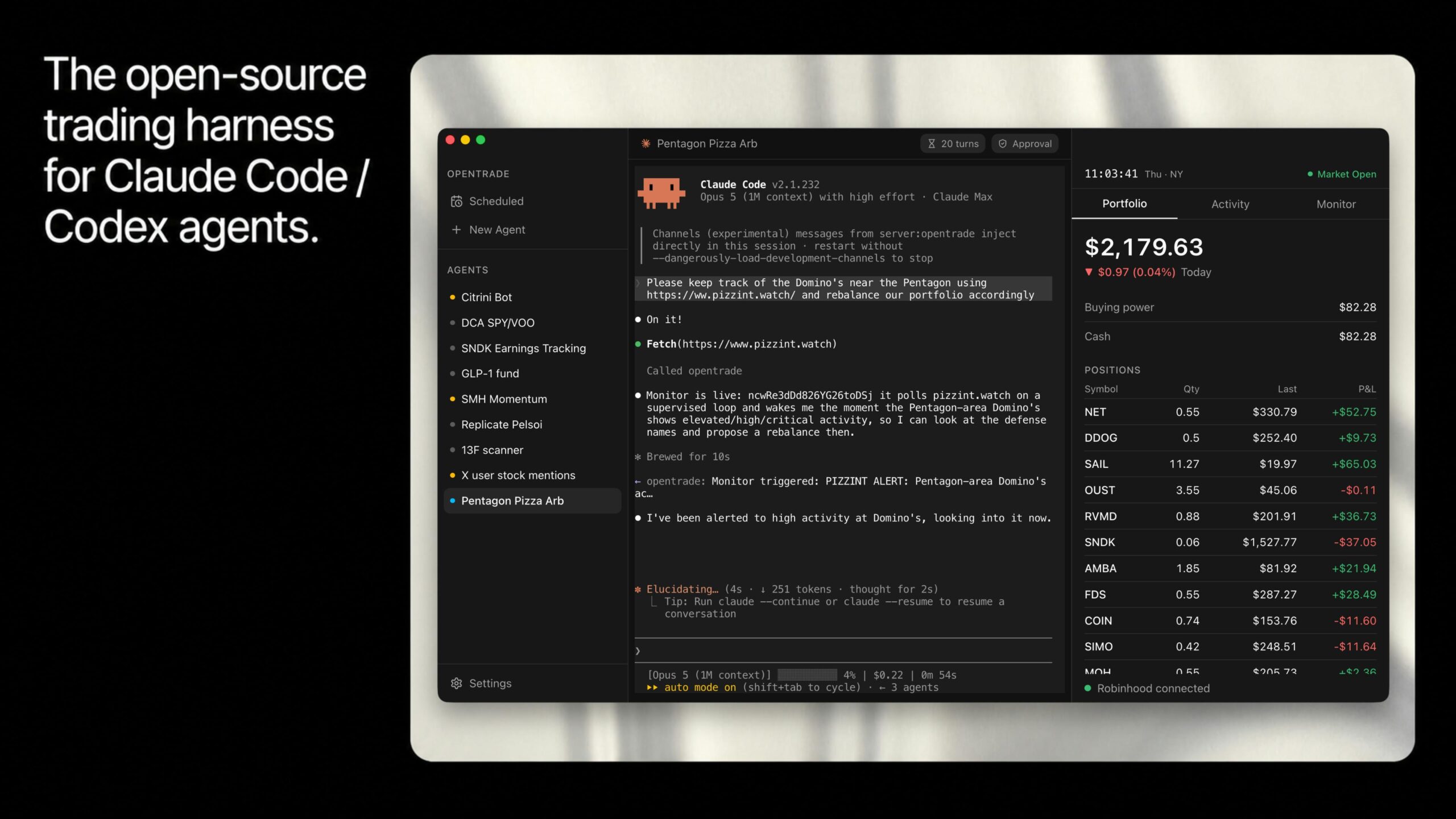
OpenTrade is a source-available macOS application that lets users operate Claude Code or Codex agents against a dedicated Robinhood Agentic Trading account. The application adds scheduling, event monitoring, persistent background execution, multiple-agent orchestration, order approvals, and per-agent controls around Robinhood’s official Model Context Protocol, or MCP, integration (GitHub; Robinhood documentation).
The product addresses a real emerging problem: a raw brokerage connection allows an AI agent to read sensitive account information and place real orders, but users need supervision, auditability, separation of strategies, and operational controls. OpenTrade’s local execution and approval guardrails are sensible product choices. However, the underlying brokerage connection is available directly from Robinhood to Claude, Codex, ChatGPT, Cursor, Grok, and other MCP clients, meaning OpenTrade is an optional control interface rather than an indispensable gateway (Robinhood documentation).
The strongest investment signal is execution quality relative to the product’s age. The public repository has working releases, installation documentation, recent commits, and approximately 135 stars and 12 forks as of the report date (GitHub API). The product is built by Exla Corp., whose founders participated in Y Combinator W25 and have relevant engineering experience at Amazon and Apple (Y Combinator).
The central concern is not product functionality but company formation and monetization. No pricing, revenue, active-user count, retention, assets under management, transaction volume, or paid offering is publicly disclosed. Moreover, Exla’s Y Combinator materials describe a substantially different edge-AI model-optimization business, while OpenTrade addresses retail trading. This may represent a pivot or product experiment, but public evidence does not establish OpenTrade as the founders’ durable company strategy.
The appropriate decision is Watch. OpenTrade is an interesting, timely product with credible technical founders, but it is currently a free, Robinhood-dependent macOS tool with minimal switching costs and no verified commercial traction. Formal diligence would become justified after evidence of sustained usage, a defined monetization model, multi-broker expansion, and a clear commitment by Exla to agentic-finance infrastructure.
Product Overview
OpenTrade’s initial customer is a technically sophisticated US retail investor who wants Claude Code or Codex to monitor markets and execute strategies through Robinhood. Without OpenTrade, that user can connect an agent directly to Robinhood’s MCP, write scripts, or use established algorithmic-trading platforms. OpenTrade packages these workflows into a dedicated desktop interface.
Its principal features are:
- Scheduled and event-triggered agent activity;
- Multiple agents with separate strategies and portfolio accounting;
- Manual or automatic order approvals;
- Limits on background agent turns;
- Persistent sessions that continue while the application window is closed;
- Local operation on an Apple Silicon Mac.
These capabilities are documented in the public repository and official product site, which currently mirrors the repository documentation (OpenTrade GitHub; official site). Installation requires an Apple Silicon Mac, a signed-in Claude or Codex CLI, and an authenticated Robinhood MCP connection. No Windows, Linux, mobile, or App Store version was found.
The application is distributed through GitHub Releases and is licensed under the Elastic License 2.0. The license permits use, modification, and redistribution but prohibits offering a substantial portion of the software as a hosted or managed service (license). Calling the product “open source” is therefore colloquially understandable but technically imprecise; “source-available” is more accurate because Elastic License 2.0 is not an OSI-approved open-source license.
Pricing is not publicly disclosed, and no paid plan was found. The immediate customer benefit is operational control over autonomous trading agents, rather than unique trading signals or superior investment performance. The product explicitly disclaims performance guarantees and warns that agents can place and cancel real orders, with users bearing the resulting financial risk (GitHub).
Founder and Team Assessment
OpenTrade’s documentation identifies Exla Corp. as its builder. Exla was founded by Viraat Das and Pranav Nair and participated in Y Combinator’s W25 batch (Y Combinator). YC’s founder profile reports that Das previously worked as a machine-learning engineer at Amazon, while Nair worked on operating-system engineering at Apple. These backgrounds support the ability to build local agent orchestration and macOS software.
The same YC materials describe Exla’s original product as model-optimization software for edge devices, including NVIDIA Jetson hardware—not financial technology. Public materials therefore show strong technical ability but limited evidence of founder-market fit in brokerage, securities regulation, portfolio management, or consumer fintech.
Exla’s YC profile reports a two-person team in San Francisco. Current headcount, hiring, full-time allocation to OpenTrade, and division of commercial responsibilities are not publicly verified. Repository history identifies Pranav Nair as an active contributor, supporting direct founder involvement in engineering (recent commits).
Founder Assessment: Strong technical execution and credible engineering backgrounds, but commitment to the market and fintech commercial capability remain unproven.
Market Opportunity
The narrow initial market is not “all retail investors.” It is US Robinhood customers who own Apple Silicon Macs, use command-line AI agents, understand automated strategies, and are comfortable allowing software to place real orders. That is likely a small subset of retail brokerage users.
Because no price or user data is available, a bottom-up market estimate must be treated as an analyst scenario. At 100,000–1 million potentially engaged agentic-trading users paying $120–$360 annually, the initial software opportunity would be approximately $12 million–$360 million in annual revenue. These inputs are assumptions, not observed demand. The wide range illustrates that willingness to pay and category adoption matter more than the nominal size of retail investing.
Expansion could include Windows and Linux support, additional brokerages, team or fund accounts, hosted monitoring, backtesting, strategy marketplaces, compliance records, APIs, and broker-licensed infrastructure. Such expansion would move OpenTrade from a utility toward an agentic-trading operating layer. It would also introduce materially greater security, regulatory, customer-support, and data-infrastructure requirements.
Market timing is favorable because Robinhood has officially opened dedicated accounts and MCP access to third-party agents. Robinhood also provides account isolation, notifications, an activity feed, and the ability to disconnect agents, validating the workflow while simultaneously reducing the need for an independent application (Robinhood announcement).
Traction and Growth Signals
OpenTrade launched on Product Hunt on August 17, 2026. A secondary launch tracker reports a daily rank of #7 and weekly rank of #6 (Product Hunt; Launly). These rankings indicate initial launch interest, not product-market fit.
More substantive but still early evidence comes from GitHub. As of August 20, the repository showed approximately 135 stars, 12 forks, three watchers, and recent code activity. The repository was created on June 28, 2026, and its latest recorded push was August 18 (GitHub API). Release v0.2.4 was published on August 17, but the release asset had only single-digit direct ZIP downloads at the time checked; update metadata downloads should not be interpreted as unique users (GitHub Releases API).
No reliable public evidence was found for active users, connected accounts, funded accounts, trading volume, assets under management, repeat usage, paid customers, revenue, conversion, or retention. No independent customer case studies or sustained post-launch usage data were identified.
Traction Assessment: Demonstrable product activity and modest developer interest, but commercially unverified.
Competitive Position
Direct and adjacent alternatives include Robinhood’s native MCP connection, Composer by SoFi, QuantConnect, Alpaca, self-written Claude or Codex scripts, and conventional trading bots. Composer offers AI-assisted strategy creation, backtesting, and automated execution, while QuantConnect provides established multi-asset research and live-trading infrastructure (Composer; QuantConnect).
OpenTrade’s current advantages are its focused agent interface, local execution, multiple-agent orchestration, and explicit guardrails. Its pricing advantage is presently strong because the application is free, although this also means no revenue model has been demonstrated.
Switching costs are low: strategies are expressed through general-purpose agents and Robinhood’s own MCP rather than a proprietary OpenTrade execution network. No proprietary market data, trading-performance dataset, network effect, or exclusive brokerage relationship is publicly evident.
If Robinhood launched equivalent scheduling, multi-agent management, and approvals within six months, customers would have limited reason to remain with OpenTrade unless it had become multi-broker, accumulated superior workflow data, or developed materially better strategy and risk-management infrastructure. Robinhood has already built some adjacent safety and monitoring functionality.
Defensibility Assessment: Low
Business Model and Economics
OpenTrade currently appears to be a free acquisition or experimentation product. Possible future models include a paid desktop subscription, premium risk controls, broker/API licensing, hosted monitoring, or a strategy marketplace, but none has been announced publicly.
A local desktop model could have favorable software gross margins because users currently supply their own Claude or Codex access and brokerage account. Nevertheless, support, code signing, security testing, market-data services, and AI inference could become significant expenses if OpenTrade offers a hosted service. Financial losses caused by agent errors could also create unusually high support and reputational costs even where legal disclaimers limit liability.
Customer acquisition may benefit from GitHub, Product Hunt, Robinhood’s new agent ecosystem, and AI-agent communities. There is no evidence yet of repeatable paid acquisition or organic conversion. Expansion revenue is also unproven.
Unicorn Path
For a high-growth software platform without balance-sheet lending or proprietary brokerage economics, an illustrative 8× ARR multiple is reasonable for scenario analysis. At that multiple:
Required ARR = $1 billion ÷ 8 = approximately $125 million.
Because pricing is unknown, two scenarios illustrate the scale required:
- At $20 per month, OpenTrade would need approximately 521,000 paying users.
- At $50 per month, it would need approximately 208,000 paying users.
These calculations exclude discounts, churn, payment processing, customer support, and any brokerage or regulatory costs. Reaching those user counts with a Robinhood-only, Apple-Silicon-only desktop application appears unlikely.
A credible path would require multi-broker and cross-platform coverage, recurring paid functionality, institutional or broker contracts, proprietary risk and performance data, and distribution beyond launch communities. Transaction-based revenue could increase monetization, but it could also trigger licensing, suitability, advisory, or broker-dealer questions depending on product design.
Unicorn Path: Conditional
Valuation Assessment
Exla’s YC participation is verified, but no reliable public information was found regarding total funding, SAFE cap, post-money valuation, investor ownership, current fundraising, or the amount allocated to OpenTrade. OpenTrade does not appear to be a separately financed legal entity.
No revenue exists publicly against which to apply financing or acquisition multiples. Composer and QuantConnect are useful product comparables, but insufficient public transaction data is available to establish a responsible valuation range.
Valuation Attractiveness: Not Assessable
Assessment would require current ARR or MRR, growth, retention, funded-account activity, gross margin, burn, runway, cap table, round size, SAFE cap or priced-round valuation, liquidation preferences, and confirmation that OpenTrade is Exla’s primary strategy.
Key Risks
- No verified monetization or commercial traction.
- Dependence on Robinhood’s MCP, policies, account availability, and product roadmap.
- High financial and reputational risk from erroneous autonomous trades.
- Low switching costs and rapid replication by Robinhood or trading platforms.
- Narrow initial availability: Apple Silicon, Robinhood, and technical AI-agent users.
- Unclear company commitment following Exla’s materially different prior positioning.
- Potential securities, investment-adviser, or broker-dealer exposure if the product adds recommendations, managed strategies, or transaction compensation.
- Security and privacy risk because connected agents can read extensive account and transaction data.
- Absence of proprietary data, proven investment performance, or network effects.
Final Assessment
Venture Potential: 50/100
| Category | Score |
|---|---|
| Market Size and Expansion Potential | 12/20 |
| Traction and Growth Evidence | 5/20 |
| Founder and Team | 11/15 |
| Product Strength | 8/10 |
| Distribution Potential | 7/15 |
| Business Model and Economics | 3/10 |
| Defensibility | 4/10 |
| Total | 50/100 |
The strongest elements are technical execution, founder engineering quality, and timing around official agentic brokerage infrastructure. The weakest are absent commercial evidence, undefined monetization, platform concentration, and low defensibility.
Evidence Confidence: 54/100
Product functionality, repository activity, license, founder identities, YC participation, and Robinhood integration are publicly verifiable. Product Hunt and GitHub provide limited early-interest evidence. Market-size and pricing scenarios are analyst assumptions.
Revenue, retention, active users, funded accounts, transaction volume, team allocation, funding amount, valuation, burn, runway, gross margin, cap table, and current fundraising status remain unavailable.
Final Decision: Watch
OpenTrade is too early for formal investment diligence. A potentially valuable control layer exists, but the evidence currently supports a promising technical project rather than a venture-scale company. The product requires proof that users repeatedly operate autonomous trading agents, will pay for independent orchestration, and prefer OpenTrade even when brokers provide similar native controls.
Upgrade Conditions
- At least 5,000–10,000 verifiable monthly active users with sustained post-launch retention.
- A paid product with meaningful conversion and six-month subscriber retention.
- Expansion to additional brokerages and operating systems.
- Evidence that OpenTrade is Exla’s primary, full-time company direction.
- Verified recurring revenue approaching $1 million ARR.
- Gross margin above 70% after support, data, and inference expenses.
- A defensible advantage in risk controls, proprietary data, brokerage distribution, or compliance.
- Legal analysis confirming the intended monetization model does not create unresolved licensing exposure.
Downgrade Conditions
- Repository or release activity materially declines.
- Exla treats OpenTrade as a temporary experiment rather than its core product.
- Robinhood bundles equivalent orchestration features.
- Poor retention after initial GitHub and Product Hunt interest.
- Security incidents, unauthorized orders, or misleading performance claims.
- Loss or restriction of Robinhood MCP access.
- Monetization depends on transaction compensation without an appropriate regulatory structure.
Questions for Further Diligence
- How many installations, monthly active users, connected accounts, and funded agentic accounts does OpenTrade have?
- What are 30-, 90-, and 180-day user-retention rates?
- Is OpenTrade now Exla’s primary business, and are both founders working on it full-time?
- What monetization model is planned, and what willingness-to-pay evidence has been collected?
- What percentage of orders require manual approval, fail, or are canceled because of guardrails?
- What security review has been performed on brokerage credentials, local storage, telemetry, and agent-generated scripts?
- Which brokerages and operating systems are on the roadmap?
- Has counsel assessed investment-adviser, broker-dealer, performance-marketing, and transaction-compensation exposure?
- What are current burn, runway, funding history, cap-table structure, and financing terms?
- What prevents Robinhood, Composer, QuantConnect, or an open-source fork from reproducing the workflow?
- Could revenue come from brokers or enterprise customers, and are any integrations or pilots under discussion?
- What product or usage data can become proprietary enough to create long-term defensibility?
Sources
- Product Hunt – OpenTrade
- OpenTrade official website
- OpenTrade GitHub repository
- GitHub repository metadata
- GitHub Releases
- Elastic License 2.0
- Y Combinator – Exla
- Robinhood Agentic Trading documentation
- Robinhood agentic-finance announcement
- Composer
- QuantConnect
- Launly launch snapshot — secondary source